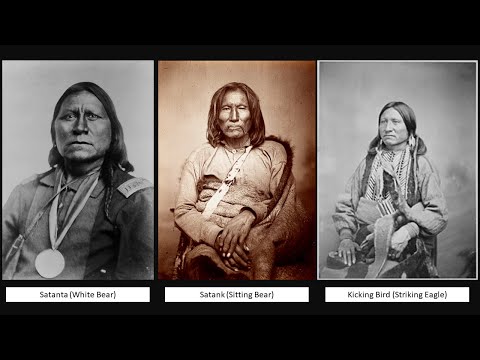
The spring of 1871 promised prosperity for Captain Julian Fields. His mule train—thirty-six of the finest animals in Texas—was loaded with flour and grain, bound for Fort Griffin. The wagons were new, the harnesses gleaming, and the drivers well-armed. No one could have predicted that within days, this symbol of progress would become a smoldering ruin, and its men would be butchered by a force of 150 Kiowa warriors led by the notorious chiefs Satanta, Satank, and Big Tree.
On a flat hill near Salt Creek Prairie, just nine miles from present-day Graham, Texas, the attack came without warning. The drivers circled their wagons, but against such overwhelming numbers, resistance was brief. Only two men escaped to carry the news. One wounded man was lashed to a wagon wheel and burned alive as the train was consumed by flames.
Unknown to the raiders, General William Tecumseh Sherman had passed along that very road just hours earlier. The near miss would prove decisive. When survivors reached Fort Richardson, Sherman dispatched Colonel Ranald Mackenzie to investigate. Mackenzie confirmed every gruesome detail. Sherman then met with a committee of citizens, including W.W. Duke and Judge J.R. Robinson, who painted a grim picture of frontier suffering.
Sherman traveled to Fort Sill, where the Kiowa chiefs came to collect their government rations. Satanta, arrogant and boastful, admitted to leading the attack. “I led the battle,” he declared. “I killed many drivers and captured forty-one fine mules. Anyone who claims credit is a liar.” He implicated Satank and Big Tree as participants under his command.
When Sherman ordered their arrest, old Satanta began to backpedal. He claimed he had only gone along to show the young men how to fight. “The white men killed and wounded many of my people,” he said, “but this will make things right now. I will stop causing harm. I want to forget the past and start anew.” Sherman responded with contempt: “It is cowardly for 150 warriors to kill 12 drivers who know nothing of fighting. If you want a battle, my soldiers are always ready.”
As the chiefs were seized, the tension at Fort Sill exploded. Twenty armed soldiers stood guard, while nearly every Indian carried a rifle and Colt revolver. Lone Wolf handed his bow and arrows to an unarmed warrior and his pistol to another. Soldiers prepared to fire, but Satanta raised his shackled hands and shouted, “Do not shoot! Do not shoot!” The order was given to hold fire.
Then a gunshot rang out outside the fort. An Indian had tried to pass a guard and shot an arrow; the guard fired back, killing him instantly. When order was restored, Sherman demanded the stolen mules be returned. But the women had fled in panic, taking all but eight of the animals. The prisoners were shackled and sent under heavy guard to Jacksboro. On the way, Satank tore at his own flesh, trying to break free, and was shot dead when he attempted to kill a guard.
The remaining chiefs, Satanta and Big Tree, were tried in Jacksboro that July. The jury—twelve of the finest men in the county—heard testimony from survivors like Thomas Brazel and Indian Agent Tatum. The defense fought hard, but the evidence was overwhelming. Old Satanta, shackled, delivered his own plea: “I cannot talk with these irons on my wrists like women. I have always been a friend to the white man. I have never made war on you. If you let me go back to my people, I will withdraw my warriors. I will take them across the Red River and make that the line between us. But if you kill me, it will be a spark in the prairie that starts a great fire.”
The jury convicted both men of first-degree murder and sentenced them to death. The courtroom erupted in loud approval. But Agent Tatum and Judge Seward urged clemency, warning that executions would trigger revenge attacks. Governor Davis commuted the sentences to life imprisonment. Yet the story was far from over—the frontier would soon learn whether justice or vengeance would prevail.
Satanta and Big Tree were transferred to the state penitentiary in Huntsville, their shackles never loosening their grip on the public imagination. For the first time, a new idea took root along the frontier: Indian raiders could be held accountable under the white man’s law. Yet the peace was brittle, and everyone knew it.
In the months that followed, the Kiowa and Comanche grew restless. The release of the chiefs became a rallying cry, and young warriors—those who had not ridden with Satanta—now sought to prove themselves by striking where the old leaders had struck. Settlers who had breathed easy after the trial began to bolt their doors again at dusk.
Colonel Mackenzie, however, was not a man to wait for the next massacre. With Sherman’s blessing, he launched a relentless campaign across the Staked Plains, driving the Comanche and Kiowa toward the reservation with a fury they had never seen from the bluecoats. He did not come to negotiate. He came to end the raids, once and for all.
By the autumn of 1871, the mule trains were running again through Salt Creek Prairie. New drivers, new wagons, but the same uneasy silence as they crossed the flat hill where the burned wheel had once stood as a grim marker. Some men swore they could still smell charred wood on the wind.
Back in Jacksboro, the men who had survived the massacre tried to rebuild their lives. Thomas Brazel, whose testimony had helped convict the chiefs, returned to freighting. He never spoke of that day unless pressed, and when he did, his voice dropped low. “They came out of the grass like demons,” he would say. “We never had a chance.”
Agent Tatum, meanwhile, watched the reservation with growing unease. The eight mules the soldiers had recovered were a bitter symbol—a fraction of the forty-one stolen, and proof that the government’s authority reached only as far as its rifles. He wrote to Washington again, warning that the peace depended on keeping the chiefs locked away.
But in the summer of 1873, the government—eager to reduce its costs and quiet the growing chorus of Eastern humanitarians—announced a new policy. Satanta and Big Tree would be released on parole, provided they never again took up arms against the United States. Tatum read the order with a heavy heart. He had seen the old chief’s eyes when the verdict was read. He knew what parole would mean.
The parole board’s decision reached the reservation before the chiefs themselves did. Runners carried the news from agency to agency, and by the time Satanta and Big Tree stepped off the wagon road and onto Kiowa land, a crowd of warriors had gathered to greet them. Some wept. Others fired rifles into the air in celebration. The old chief walked through the crowd with his head high, as though the prison years had never happened.
But something had changed in Satanta. The fire that once burned in his speeches had banked into something colder. He spoke little at the councils, and when he did, his words carried a strange edge—not the boastful pride of the Salt Creek raid, but a quiet, simmering resentment. Big Tree, by contrast, seemed genuinely chastened. He kept to his lodge, avoided the war councils, and told anyone who would listen that he had seen enough of the white man’s iron cells to last a lifetime.
Tatum watched them both with a wary eye. He had argued against parole, and now his warnings seemed prophetic. “Satanta did not come back to make peace,” he wrote in his official journal. “He came back to wait.”
The waiting did not last long. By the spring of 1874, reports began filtering into Fort Sill of Kiowa and Comanche warriors gathering in the Staked Plains—not to hunt, but to fight. The old leaders of the resistance were gone or broken, but a new generation had taken up the cause. Among them were men like Quanah Parker of the Comanche, whose mother had been a white captive, and who now led raids with a cunning that rivaled Satanta’s own.
Then came the news that shattered the fragile peace. A band of Kiowa warriors, emboldened by the chiefs’ release, had attacked a wagon train near the very same Salt Creek Prairie where Fields’s mules had been slaughtered three years earlier. This time, however, the drivers were not caught off guard. They had heard the stories, and they had drilled. When the warriors came screaming out of the grass, they found a circle of wagons bristling with rifles and men who knew exactly what to do.
The attack was repulsed, but the damage was done. Sherman, now commanding general of the entire army, received the report with cold fury. He had given the chiefs a chance. He had trusted the parole system. And now the same ground was soaked with blood again.
Mackenzie was dispatched once more, this time with orders that left no room for interpretation. He was to find Satanta, Big Tree, and any other parole violators, and he was to bring them back—dead or alive. The colonel, who had spent years chasing Comanche raiders across the Llano Estacado, needed no further encouragement. He assembled a column of cavalry and infantry and set out into the heart of the Staked Plains.
What followed became known as the Red River War—a brutal, grinding campaign that pitted Mackenzie’s bluecoats against warriors who knew every arroyo and buffalo wallow. The Indians fought with desperate skill, but they were outnumbered, outgunned, and slowly starved as the army destroyed their villages and their food stores. One by one, the bands surrendered or scattered.
Satanta, however, did not surrender. He was found hiding in a Comanche camp, and when the soldiers dragged him out, he did not resist. He looked at Mackenzie with those same cold eyes and said nothing at all.
The old chief was returned to Huntsville, this time with no parole board to save him. The walls of the penitentiary closed around him again, and the world outside went on without him. The frontier was changing—railroads were pushing west, buffalo hunters were wiping out the herds, and the old ways were dying faster than anyone could have imagined.
On a cold October morning in 1878, a guard making his rounds found Satanta’s cell empty. The window was open, and far below, on the prison yard stones, lay the body of the great Kiowa chief. The official report called it suicide. But among his people, the story was told differently—that he had been pushed, or that he had simply willed himself to fly.
Whatever the truth, the death of Satanta marked the end of an era. The Kiowa and Comanche would never again ride to war against the white man. The reservations swallowed them, and the children who came after would know their grandfathers only as old men who spoke of buffalo and battles and a world that had vanished.
Thomas Brazel, the driver who had survived Salt Creek, lived to see the railroads reach Jacksboro. He died in 1890, an old man surrounded by grandchildren, and on his mantelpiece stood a single mule shoe—the only relic he had kept from that day. He never spoke of the massacre in his final years, but his daughter once found him staring out the window at dusk, his lips moving silently, as though he were counting wagons.
And on the flat hill near Salt Creek, where the burned wheel had once stood, a small stone marker was eventually placed. It bore no names, only a date and a simple inscription: “In memory of the drivers who fell here, 1871.” The wind still blows across that prairie, and some say that on certain evenings, when the light is low and the grass is dry, you can hear the creak of wagon wheels and the distant crack of rifles—echoes of a time when the frontier was young, and the price of progress was written in blood.
The years passed, and the frontier changed beyond recognition. The railroads brought settlers by the thousands, and the old hunting grounds were fenced and plowed. Yet the name Satanta still carried weight in the councils of his people. Some said he had been a martyr, others a fool—but none could deny he had been a leader.
Big Tree lived quietly on the reservation, a man who had seen too much. He died in 1927, an old man who had outlived his world by half a century. Before his death, he told a young ethnographer: “We fought because we had to. The white man would not stop. Now the buffalo are gone, and so are we.”
Agent Tatum’s warnings proved right in the end. The parole that released Satanta had only delayed the inevitable, and the Red River War that followed cost more lives than the Salt Creek raid ever had. The government learned nothing, and the frontier paid the price.
Today, a historical marker stands near Graham, Texas, noting the site of the Salt Creek massacre. Few stop to read it. The prairie is quiet, the wagons long gone.
But what of Satanta’s final words—“If you kill me, it will be a spark in the prairie that starts a great fire”? Did his death ignite a war, or did it merely mark the end of one? And when we look back at the frontier, do we see justice—or simply the victor’s version of history?
Report this article
Select a reason for reporting:






