The jungle canopy exploded in a deafening roar as the first shells screamed overhead. For the young New Zealand artillerymen of 161 Battery, this was no training exercise—this was the reality of war in South Vietnam, where every fire mission could mean the difference between life and death for their Australian and American comrades. But how did a small nation from the South Pacific find itself embroiled in one of the 20th century’s most controversial conflicts? The story of New Zealand’s involvement in Vietnam is far more complex than most history books reveal.
From the steamy jungles of Phuoc Tuy Province to the bustling streets of Saigon, Kiwi soldiers, medics, and engineers would leave an indelible mark on a war that divided their homeland. Yet their contributions—both on and off the battlefield—remain largely unknown to the wider world. This is the story of a nation’s quiet determination, of humanitarian aid delivered under fire, and of courage that would earn the respect of allies and adversaries alike.
The first New Zealanders arrived not with guns blazing, but with scalpels and stethoscopes. In April 1963, a civilian surgical team began treating South Vietnamese civilians, planting the seeds of a medical mission that would grow into something extraordinary. By 1967, the first New Zealand Services Medical Team—19 strong—would deploy to Bong Son, relieving an American medical unit and taking on the overwhelming task of caring for a population caught in the crossfire.
These medics, drawn from the Royal New Zealand Air Force, Navy, and Army, would treat not only South Vietnamese civilians and military personnel but also Viet Cong prisoners. The Bong Son dispensary, and later the 100-bed hospital, operated at near capacity, with an average of 92 beds occupied at any given time. Approximately 46,000 outpatients—mostly civilians—were treated annually before the team’s withdrawal in December 1971. In those four and a half years, 98 Kiwi personnel served, leaving a legacy of compassion that would endure long after the guns fell silent.
But the Kiwi contribution wasn’t limited to medicine. From 1966 onwards, New Zealand poured nearly 350 million US dollars (equivalent to 3.3 billion today) into economic assistance for South Vietnam. This funding supported mobile health teams, refugee camps, vocational training, and even the construction of a science building at the University of Saigon. It was a commitment that went beyond military might—a genuine effort to build, not just destroy.
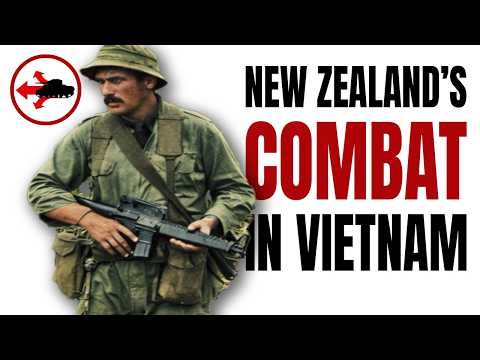
Of course, New Zealand also sent its warriors. Beginning in June 1964, 25 Army Engineers arrived to establish headquarters in Bien Hoa, just north of Saigon. They built roads and bridges, reconstructed facilities, and laid the groundwork for what would become a full military commitment. Over 3,000 New Zealand military personnel would serve in Vietnam, with 37 killed and 187 wounded. Among them were the legendary Special Air Service troopers, who arrived in November 1968 and mounted 155 long-range reconnaissance patrols, ambushing enemy supply routes with deadly efficiency.
And then there was 161 Battery. On May 27, 1965, New Zealand’s Prime Minister announced the deployment of this artillery unit to South Vietnam in a combat role. Equipped first with four 105mm L5 pack howitzers, later increased to six, and eventually upgraded to M2A2 howitzers, the battery would prove pivotal in battles such as Long Tan and Binh Ba. Initially under the command of the U.S. 173rd Airborne Brigade, the Kiwis later joined the 1st Australian Task Force at Nui Dat, their forward observers patrolling with infantry companies to direct deadly accurate fire support.
Their courage did not go unnoticed. In 2019, the United States awarded 161 Battery the Meritorious Unit Commendation, and the Australian Army, for the first time, honored a New Zealand unit with the Unit Citation for Gallantry. It was a recognition of the quiet professionalism and unwavering bravery that defined the Kiwi soldier.
Yet for all their achievements, the New Zealanders in Vietnam faced the same questions that haunted their allies. As the war dragged on and public opinion at home turned, these men and women continued to serve with distinction, their stories often overshadowed by larger narratives. But their legacy—of medical mercy, engineering ingenuity, and artillery excellence—remains a testament to a small nation’s outsized impact.
As the last New Zealand troops withdrew in 1972, they left behind a country forever changed, and a history that deserves to be remembered. This is their story—a story of courage, compassion, and the unexpected ways a distant nation answered the call of duty.
But the story of New Zealand’s involvement in Vietnam began long before the guns of 161 Battery roared to life—and it started with a decision that would echo through the corridors of power in Wellington for years to come. When Prime Minister Keith Holyoake announced the deployment of combat troops in May 1965, he did so knowing full well the controversy it would ignite at home. New Zealand was a nation of just over two and a half million people, and sending its sons to fight in a conflict thousands of miles away was not a decision made lightly.
The political calculus was delicate. New Zealand had long relied on its ANZUS alliance with the United States and Australia for its security, and in the Cold War climate of the 1960s, demonstrating loyalty to its powerful allies was seen as essential insurance against future threats. Yet Holyoake was careful to frame the commitment as a measured, proportionate response—never the massive deployment that some hawks in Washington might have preferred.
This caution extended to the way New Zealand fought. The Kiwis were never going to overwhelm the battlefield with numbers, so they compensated with skill, precision, and a reputation for professionalism that punched far above the nation’s weight. Every soldier, every gunner, every medic was expected to be worth several of their counterparts. It was a philosophy born of necessity—and it earned the New Zealanders a respect that larger contingents often struggled to command.
For the men of 161 Battery, that reputation was forged in fire. The forward observers who patrolled with Australian and New Zealand infantry companies were the eyes of the battery—and their work was among the most dangerous in the war. Crawling through dense jungle, often within meters of enemy positions, these men carried the weight of every fire mission on their shoulders. One miscalculation, one wrong coordinate, and friendly fire could devastate the very troops they were sworn to protect.
Veterans of the battery would later speak of the bone-deep exhaustion of fire missions that stretched through the night, the smell of cordite hanging in the humid air, and the grim satisfaction of hearing over the radio that their shells had landed true. At Long Tan in August 1966, New Zealand artillery fire would prove decisive in saving an Australian company from being overrun by a vastly superior Viet Cong force. The gunners never saw the faces of the men they saved that day—but those men never forgot.
Yet the war was not only fought with shells and bullets. Behind the lines, a quieter battle raged for the hearts and minds of the Vietnamese people—and here too, the Kiwis made their mark. The economic assistance programs that began in 1966 were not mere window dressing; they were a genuine attempt to build a viable future for South Vietnam. Mobile health teams fanned out across the countryside, reaching villages that had never seen a doctor. Refugee camps received crucial support. Schools and universities gained equipment they could never have afforded on their own.
It was a two-pronged approach: the sword and the scalpel, the howitzer and the hospital bed. And for a time, it seemed to work. The Kiwis were welcomed in many villages where American troops were viewed with suspicion—their small numbers and quiet demeanor setting them apart from the massive, sometimes overwhelming American presence.
But as the 1960s gave way to the 1970s, the tide of the war—and of public opinion—began to turn inexorably. The Tet Offensive of 1968 shattered the illusion of imminent victory. Protests against the war grew louder in Wellington, Auckland, and Christchurch. Young New Zealanders, many of them the same age as the soldiers fighting in Vietnam, took to the streets carrying placards and demanding answers from their government.
The men serving in Vietnam felt the change in the letters they received from home, in the newspapers that arrived weeks late, in the subtle shift of tone when they returned on leave. Some were spat upon. Others were ignored. The country they had sworn to serve was becoming a country that no longer wanted to know them.
And yet they served on—because that was what they had been trained to do, because their mates depended on them, because the alternative was unthinkable. The Special Air Service troopers continued their long-range patrols, slipping through the jungle like ghosts, gathering intelligence and ambushing enemy supply lines. Between November 1968 and February 1971, the New Zealand SAS mounted 155 patrols—a record of quiet, deadly efficiency that earned them a fearsome reputation among the Viet Cong.
The medics too kept working, their hospital at Bong Son a small island of healing in a sea of chaos. They treated Viet Cong prisoners with the same care as allied soldiers—a quiet statement of humanity that spoke louder than any propaganda. When the last of them withdrew in December 1971, they left behind a rebuilt hospital and thousands of Vietnamese who owed their lives to a country they could barely find on a map.
The end, when it came, was swift and unceremonious. On April 21, 1975, the final No. 41 Squadron flight lifted off from Tan Son Nhut, carrying 38 embassy staff and refugees to safety. Saigon fell just days later. The war New Zealand had entered with such careful calculation was over—and the reckoning at home was only beginning.
Veterans returned to a country that had moved on, many of them struggling in silence with wounds both visible and invisible. It would take decades—and the tireless advocacy of the veterans themselves—for New Zealand to formally acknowledge their service. The 2019 honors, the Meritorious Unit Commendation, the Australian Unit Citation for Gallantry: these came late, but they came.
Today, the story of the Kiwis in Vietnam is finally being told—not as a tale of controversy, but as one of professionalism, compassion, and quiet courage. From the gunners of 161 Battery to the medics of Bong Son, from the engineers who built roads to the SAS troopers who slipped through the jungle, they did their duty and did it well.
And perhaps that is the truest legacy of New Zealand’s involvement in Vietnam: not the politics, not the protests, but the simple fact that when their allies called, a small nation answered—and answered with honor.
What do you think—should New Zealand’s Vietnam veterans have received recognition sooner, or did the controversy of the war make that impossible? Share your thoughts in the comments below.
Report this article
Select a reason for reporting:






