The auction house in Savannah smelled of old paper and polished wood. Dr. Michael Torres moved slowly between the tables, his trained eyes scanning decades of accumulated history. Daguerreotypes in cracked leather cases, tintypes of stern-faced families, cabinet cards faded to sepia ghosts. He had spent fifteen years studying Victorian-era photography, and he could spot something significant from across the room. Today, however, nothing particularly interesting had caught his attention. He was about to leave when a small velvet-lined case near the back wall made him pause.
The auctioneer, an elderly woman with reading glasses hanging from a chain, noticed his interest. “That one just came in yesterday,” she said. “Estate sale from a house on Forsyth Park. Family had it stored in the attic for generations.” Michael carefully opened the case. Inside was a daguerreotype, remarkably well preserved, showing a wedding scene from 1857. The couple stood formally in an elegant parlor—the bride in a full-skirted white gown with lace sleeves, the groom in a dark frock coat. Behind them hung an ornate mirror with a gilded frame reflecting the room’s velvet curtains and candlelit chandelier. He had seen hundreds of wedding photographs from this period, but something about this one felt different. The composition was unusually deliberate, the lighting precisely calculated. The photographer had been skilled, perhaps even exceptional for the time.
“How much?” Michael asked, still studying the image. “Starting bid is 200. Not many people interested in these old things anymore.” Michael bid 400 without hesitation. No one else competed. Twenty minutes later, he walked out of the auction house with the daguerreotype carefully wrapped in acid-free tissue paper.
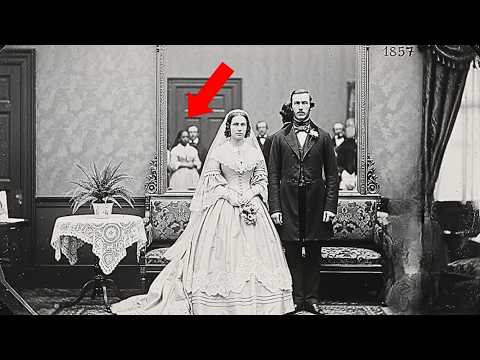
Back in his office at the Savannah College of Art and Design, Michael placed the photograph under his illuminated magnifying lens. The detail was extraordinary. Every fold of fabric, every flower in the bride’s bouquet clearly visible despite being over 160 years old. He could even make out the pattern on the wallpaper. Then, he noticed something in the mirror’s reflection. Just visible between the curtains, partially obscured by shadow, was a figure—a woman. Her dark skin contrasting with a simple light-colored dress. She stood very still, her posture erect, her face turned slightly toward the camera. Michael’s breath caught.
In 1857, in Savannah, Georgia, the presence of an enslaved person at a wealthy white wedding would have been expected. But her positioning in this photograph was unusual. She wasn’t simply passing through the background. She appeared to be watching, witnessing. He leaned closer, his pulse quickening. The photographer had deliberately framed the shot to include her reflection. This wasn’t accidental. This was intentional. Michael sat back, his mind already racing through questions. Who was she? Why had the photographer included her? And why had this image remained hidden in an attic for over a century and a half? He knew he had to find out.
Michael spent the next morning setting up his digital scanner, a high-resolution device capable of capturing details invisible to the naked eye. He had used it before to reveal hidden inscriptions, faded signatures, and deteriorated text on 19th-century photographs. If there were any clues embedded in this daguerreotype, the scanner would find them. The process took nearly two hours. The machine hummed softly as it captured the image in sections, building a complete digital file with extraordinary detail. When it finished, Michael transferred the file to his computer and began the painstaking work of examination.
He zoomed in on the couple first. The bride appeared to be in her early twenties, her face composed but unsmiling, typical for the era when long exposure times made natural expressions difficult. The groom stood slightly behind her, one hand resting formally on her shoulder. His face showed the same careful stillness. Then, Michael shifted his focus to the mirror. At maximum magnification, the woman’s face became clearer. She appeared to be in her thirties, her features strong and dignified. Her dress, while simple, was clean and well-maintained. But what struck Michael most was her eyes. They looked directly toward the camera with an intensity that seemed to transcend time.
He saved the enhanced image and began his research. The velvet case had included a small brass plate with an inscription, partially worn but still legible: Marriage of S. Whitmore, April 18th, 1857. Michael opened his laptop and accessed the Georgia Historical Society’s online archives. He typed “Whitmore marriage 1857 Savannah” into the search field. Within seconds, results appeared. The marriage record was formal and brief. Sarah Elizabeth Whitmore, age 22, to Mr. James Robert Kincaid, age 28, united in holy matrimony at the Whitmore residence, April 18th, 1857. Witnesses: Mr. Charles Whitmore, father of the bride; Mrs. Dorothy Whitmore, mother of the bride.
Michael jotted down the names. He cross-referenced Whitmore with property records from the same period. What he found made his stomach tighten. Charles Whitmore had been a cotton merchant, moderately wealthy by Savannah standards. According to the 1850 census, the most recent before the wedding, the Whitmore household included Charles, his wife Dorothy, their daughter Sarah, and six enslaved individuals. Their names were not recorded, only their ages and genders listed in a cold, bureaucratic column. One entry stood out: Female, negro, age 28. Michael did the math. In 1857, she would have been approximately 35 years old—the same approximate age as the woman in the mirror.
He leaned back in his chair, his mind working through the implications. This woman had likely been enslaved by the Whitmore family. She had been present at Sarah’s wedding, probably serving guests, attending to details invisible to the celebration around her except as labor. But the photographer had seen her, and more than that, he had chosen to include her. Michael knew he needed more information about the photographer. In the mid-19th century, daguerreotypists often signed their work or stamped their cases with studio names. He examined the velvet case again under magnification, searching for any mark or inscription he might have missed. There, embossed in faint gold lettering along the inner spine, he found it: A. Morrison, photographer, Savannah.
Michael immediately began searching historical business directories. Savannah had been home to several photography studios in the 1850s, but A. Morrison didn’t appear in the most common references. He expanded his search, digging through newspaper archives, advertisements, and city records. Finally, in the April 10th, 1857 edition of the Savannah Daily Morning News, he found a small advertisement: A. Morrison, daguerrean artist, recently arrived from Boston, specializing in family portraits and wedding ceremonies. Studio temporarily located at 42 Broughton Street. Rates competitive.
Boston. That detail caught Michael’s attention immediately. In the 1850s, Boston had been a center of abolitionist activity. Photographers from the North sometimes brought with them not just technical skill, but different social perspectives—perspectives that could be dangerous to express openly in a city like Savannah, where the economy depended entirely on slavery. Michael searched further, looking for any other mentions of A. Morrison. He found only two more advertisements, both from the spring of 1857, and then nothing. By June, the studio listing had disappeared. Morrison seemed to have left Savannah as quickly as he had arrived.
That afternoon, Michael drove to the Georgia Historical Society’s main research library. He requested access to their collection of personal papers from prominent Savannah families. If the Whitmores had been wealthy enough to commission a professional wedding photograph, there might be letters, diaries, or household records that survived. The archivist brought him three boxes of Whitmore family documents, mostly business correspondence belonging to Charles Whitmore. Michael worked methodically through bills of lading, cotton sale receipts, and letters regarding trade negotiations. Nothing personal, nothing revealing.
Then, near the bottom of the second box, he found a small bundle of letters tied with faded ribbon. The handwriting was feminine, delicate. He carefully untied the ribbon and began reading. The letters were from Sarah Whitmore to her cousin in Charleston, written in the months leading up to her wedding. Most discussed wedding preparations—dress fittings, guest lists, flower arrangements—but one letter, dated March 1857, made Michael’s hands tremble.
“Dearest Caroline,” Sarah had written, “I have made a request of Father that troubles him greatly, but which I cannot abandon. When I marry James, I wish for Clara to be present. Not simply as she has always been, but as witness to my happiness. Father says this is impossible, that it would cause scandal. But Clara has been my companion since childhood. How can I celebrate the most important day of my life as if she does not exist?”
Michael read the passage three times. Clara. Finally, a name. He photographed the letter with his phone, then continued reading through Sarah’s correspondence. He found two more references to Clara, both frustratingly vague. In one, Sarah mentioned, “The situation with Clara remains unresolved.” In another, written just days before the wedding, she wrote only, “I have reached an understanding, though not the one I hoped for.”
He returned to the 1850 census record, staring at the anonymous entry: Female, Negro, age 28. Was this Clara? The timeline matched, but without names he couldn’t be certain. Michael needed genealogical records—birth records, death certificates, anything that might confirm Clara’s existence and trace what happened to her. But he knew that enslaved people were rarely documented in official records unless they were sold, freed, or involved in legal proceedings.
He began searching manumission records—legal documents recording the freeing of enslaved individuals. Georgia had strict laws governing manumission in the 1850s, requiring legislative approval for each case. The records were incomplete, but the Georgia archives had digitized some of them. Michael spent hours scrolling through scanned documents, his eyes aching from the old handwriting and faded ink. Most manumissions were brief, transactional: Be it known that I, [name], do hereby manumit and set free [enslaved person], having received compensation or in consideration of faithful service.
Then, dated May 2nd, 1857—two weeks after Sarah’s wedding—he found it. Be it known that I, Charles Whitmore of Chatham County, do hereby manumit Clara, a woman of color approximately 35 years of age, in consideration of long and faithful service to my family, and at the request of my daughter, Mrs. Sarah Kincaid.
Michael sat back, absorbing the implications. Clara had been freed after the wedding, not before. She had been enslaved when the photograph was taken. Yet somehow she had been included in that image, her presence captured in the mirror’s reflection, deliberate and unmistakable. He thought about Sarah’s letters, her desire for Clara to witness her happiness. Had this photograph been Sarah’s compromise—a way to include Clara without causing the scandal her father feared? But that didn’t fully explain it. Sarah hadn’t taken the photograph. Morrison, the photographer from Boston, had. He was the one who positioned the camera, who framed the shot to include Clara’s reflection. He made the choice.
Michael needed to know more about Morrison. He returned to the newspaper archives, searching not just for advertisements but for any mention of the name. Boston newspapers from the 1850s were partially digitized, and he began searching there as well. In the Boston Daily Atlas from 1856, he found an article about a photography exhibition. Among the exhibitors listed was Mr. Arthur Morrison, whose remarkable portraits captured not merely faces, but the dignity of the human spirit.
Arthur Morrison. The full name gave Michael more to work with. He searched Boston city directories, tax records, church registries. Morrison had operated a studio on Tremont Street from 1854 to 1856, then the listing ended. Why had he come to Savannah? And why had he left so quickly? Michael had a theory forming, but he needed more evidence.
The next morning, Michael called Dr. Ellen Shaw at the Massachusetts Historical Society. She confirmed the connection: Morrison had ties to the Boston Vigilance Committee, and after a safe-house raid in 1856, he vanished from the city. “He was documenting something,” Ellen said. “Some abolitionists traveled south deliberately, gathering evidence to share with northern audiences.”
Michael returned to the photograph with new eyes. Morrison had been hired to record a wedding built on enslaved labor—and instead he subverted it, framing Clara’s reflection so she could not be erased. “He made a record,” Michael murmured. “A visual testimony.”
But the story wasn’t finished. A query on genealogy forums led him to Patricia Johnson of Atlanta, who believed Clara was her great-great-great-grandmother. “We’ve never had a photograph of her,” Patricia said, her voice breaking. “Only stories.”
When Patricia arrived in Savannah with her mother Dorothy and daughter Jasmine, Michael placed the enlarged image before them. Dorothy touched Clara’s face and whispered, “That’s her. She stood like she was made of iron.”
Patricia produced a faded 1872 letter. In it, Clara wrote that she still kept the photograph, remembering how Sarah had wanted her to be part of that day. “She was kind in a time when kindness was rare,” Clara had written.
Michael flew to Boston, then to the Vermont Historical Society, where a forgotten collection of 23 glass-plate negatives and Morrison’s journal had waited for decades. The entry for April 18th, 1857, read: “I positioned my camera to include Clara’s reflection… She understood what I was doing… I made this negative so that she might have evidence of her presence, her witness, her existence.”
Three months later, the Georgia Historical Society opened Witnesses: The Morrison Archive and the Hidden Faces of Slavery. Clara’s descendants stood before the wedding photograph, and Patricia told a reporter, “She wasn’t invisible. Someone saw her humanity and thought it mattered enough to preserve.”
Alone in the gallery that night, Michael studied Clara’s straight back and direct gaze. The image had waited in darkness for over a century—and now it was seen. How many other reflections are still waiting for someone to notice?
Report this article
Select a reason for reporting:






