Dr. Rebecca Thornton had spent fifteen years studying Civil War-era photography, and she had learned not to expect surprises. But on a cold February morning in 2019, while digitizing a faded portrait from 1873, she paused at an image that seemed entirely unremarkable: two men standing side by side in a Boston studio. The taller man on the left was white, dressed in a dark wool suit. Beside him stood a black man in simpler but well-kept clothing. His posture was upright, dignified—there was no subservience in his stance. He stood as an equal.
Rebecca tilted her head, studying the image more carefully. Photographs of black and white men standing together as apparent equals in the 1870s were not common, especially not in formal studio settings. This image was different. These two men were positioned identically, their shoulders nearly touching, their gazes forward. It suggested something unusual—familiarity, perhaps even friendship. She made a note in her catalog and moved on. But the image stayed with her.
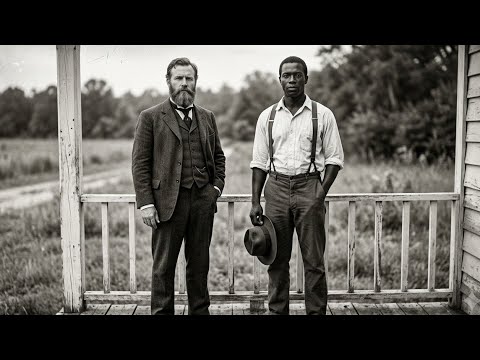
Over the following weeks, she found herself returning to it, pulling it up on her screen late at night, zooming in on the men’s faces, searching for clues. Who were they? What brought them to this studio on what must have been an ordinary afternoon in 1873? And why did this photograph feel so deliberately composed, as if it were documenting something far more significant than a casual sitting?
It was during one of these late-night sessions, nearly a month after first encountering the photograph, that Rebecca noticed something she had overlooked before. Behind the two men, barely visible in the soft focus of the studio backdrop, was a section of wallpaper. Most studio photographers of the era used painted canvas backdrops or plain walls. But this one had wallpaper—an ornate floral pattern that covered most of the visible background, except in one small section just behind the white man’s left shoulder. The wallpaper appeared different. The pattern was mismatched, as if a piece had been replaced or pasted over another layer.
Rebecca leaned closer to her monitor, squinting at the pixelated image. She increased the resolution, sharpening the contrast, and zoomed in as far as the scan would allow. The mismatched wallpaper became clearer now, and within its folds and creases, she could make out faint lines—too deliberate to be accidental, too structured to be mere decoration. They looked almost like markings, symbols, directions. Her breath caught in her throat.
She sat back, staring at the screen, her mind racing. Could it be? She reached for her phone and called her colleague, Dr. Marcus Whitfield, a specialist in abolitionist history and the Underground Railroad. When he answered, she didn’t bother with pleasantries. “Marcus,” she said, her voice tight with excitement, “I need you to look at something. I think I just found a map.”
Marcus Whitfield arrived at Rebecca’s office the next morning carrying two large coffee cups and a leather satchel filled with reference books. He had been intrigued by her late-night call, but skeptical. Maps hidden in wallpaper? It sounded like the plot of a sensational documentary, not serious historical research. But Rebecca wasn’t prone to wild speculation, and the urgency in her voice had convinced him to drive three hours to see the photograph himself.
She pulled up the image on her computer and walked him through what she had found. Marcus sat down his coffee and leaned in, his eyes narrowing as he studied the mismatched section of wallpaper. Rebecca had already enhanced the image using digital restoration software, isolating the background and increasing the sharpness of the faint markings. What emerged was unmistakable. A series of lines, dots, and small symbols that formed a crude but deliberate pattern.
“These look like route markers,” Marcus said quietly, tracing the lines with his finger on the screen. “See here? This could be a river. And these dots—they might represent safe houses or stations along the Underground Railroad.”
Rebecca nodded. “That’s what I thought, but I wanted to be sure before I said anything. Can you confirm it?” Marcus pulled out one of his books, flipping to a section on coded maps used by abolitionists in the 1850s and 1860s. He compared the symbols on the screen to documented examples of Underground Railroad maps, quilts, songs, and occasionally hidden drawings. The similarities were striking. The pattern on the wallpaper matched known conventions: wavy lines for waterways, circles for safe locations, stars for guides or conductors.
“This is real,” Marcus said, his voice filled with quiet astonishment. “This isn’t just decoration. Someone put this here deliberately. But why would a photography studio have a map like this embedded in its wallpaper?”
Rebecca had already begun researching the studio itself. The photograph bore a faint stamp on the reverse side: J.M. Hartford Studio, Boston, Mass. Est. 1868. She had found a few scattered references to the studio in old business directories and city records, but little else. Most studios from that era had left minimal documentation, and many had closed or burned down decades ago. But she kept digging, scouring newspaper archives, city tax records, and even old advertising circulars. Finally, she found it. A small notice in an 1875 edition of the Boston Daily Advertiser: “J.M. Hartford, photographer and proprietor, offers discreet portraiture services for all clients, regardless of station or circumstance. Appointments available at all hours.”
The wording was peculiar. “Regardless of station or circumstance”—in the racially divided society of 1870s America, that phrase was loaded. It suggested that Hartford’s studio welcomed clients who might not be accepted elsewhere. And “appointments available at all hours” hinted at something even more unusual: flexibility, secrecy, perhaps even clandestine meetings.
Marcus looked up from the newspaper clipping. “You think Hartford was running a station?”
“I think it’s possible,” Rebecca said. “The Underground Railroad didn’t end with the Emancipation Proclamation or even the end of the Civil War. There were still people escaping violent situations in the South, seeking safety, trying to reunite with families. And there were people in the North willing to help them—even after the war. If Hartford was one of them, hiding a map in his studio wallpaper would have been brilliant. It’s right there in the open, but unless you know what you’re looking for, it just looks like a bad wallpaper job.”
Marcus sat back, exhaling slowly. “So, who are these two men?”
That, Rebecca admitted, was the question she couldn’t yet answer. There were no names on the photograph, no inscriptions, no accompanying documents—just two men standing together in a studio that may have doubled as a refuge, in front of a wall that concealed a secret map. To find out who they were, she would have to go deeper into family records, census data, and the fragmented, often deliberately obscured history of those who risked everything to help others escape bondage.
Rebecca and Marcus spent the next several weeks working in tandem, each pursuing different threads of research that might reveal the identities of the two men in the photograph. Rebecca focused on the studio itself, while Marcus dug into abolitionist networks and post-war assistance organizations in Massachusetts. They met twice a week to compare notes, their shared determination growing stronger with each new discovery.
Rebecca’s breakthrough came from an unexpected source: a probate record. In 1889, a man named Jonathan Michael Hartford had died in Boston, leaving behind a modest estate that included the building where his photography studio had once operated. The probate documents listed his assets, debts, and a few personal effects. Among them was a handwritten journal donated to the Massachusetts Historical Society after his death, but never fully cataloged or transcribed.
Rebecca requested access to the journal, and when it arrived, carefully preserved in an archival box, she spent an entire afternoon reading Hartford’s cramped, fading handwriting. The journal was a revelation. Hartford had not been a mere businessman. He had been a committed abolitionist, deeply connected to the network of activists who had operated the Underground Railroad before and during the Civil War. And even after the war’s end, he had continued to assist formerly enslaved people who arrived in Boston seeking work, education, and safety from the violent retaliation they faced in the South.
His studio, as Rebecca had suspected, had served as more than a place for portraits. It had been a meeting point, a place where information was exchanged, where maps were shared, and where those fleeing danger could find temporary refuge. One entry, dated April 1873, caught her attention. Hartford wrote: “Today I made a portrait of two friends whose bond defies every cruelty this nation has inflicted. One was born free, the other was born into chains. Yet they have remained brothers in all but blood.”
They asked that I include a particular section of wall in the frame—the one we use for those who need guidance. I understood their meaning. This photograph is not merely a keepsake. It is a testament. Rebecca’s hands trembled as she read the passage aloud to Marcus over the phone. “He’s talking about them,” she said. “The two men in the photograph. Hartford knew them. He knew what they were doing.”
Marcus, meanwhile, had been combing through records of abolitionist families in the Boston area, cross-referencing names with property records, church membership rolls, and even old letters preserved in university archives. He found a reference to a man named Thomas Whitaker, a white landowner from Virginia who had moved to Boston in 1869. According to a letter written by a Quaker abolitionist, Whitaker had brought with him a companion—a man of remarkable courage who had once been held in bondage on his family’s estate, but who now stands as his equal and most trusted friend.
The letter didn’t name the companion, but it described him as someone who had escaped slavery with Whitaker’s assistance years before the war, and who had returned to Virginia during the conflict to help others flee. After the war, the two men had settled in Boston together, where they worked quietly to continue the mission they had started. Marcus and Rebecca now had a name—Thomas Whitaker—and a story that was beginning to take shape. But they still needed confirmation, something that would definitively link Whitaker to the photograph.
Rebecca found the confirmation she was looking for in a collection of letters held by a small historical society in Richmond, Virginia. The letters had been written by members of the Whitaker family between 1848 and 1875, and among them was a series of correspondence between Thomas Whitaker and his younger sister, Catherine. The letters painted a vivid picture of a family divided by conscience and circumstance.
Thomas Whitaker had been born in 1840 into a wealthy Virginia family that owned a tobacco plantation worked by enslaved people. From childhood, he had been deeply uncomfortable with the institution of slavery, influenced in part by his mother, who had been a devout Quaker before marrying into the Whitaker family. She had taught Thomas to see enslaved people not as property but as human beings deserving of dignity and freedom. This belief had put him at odds with his father, who viewed abolition as a threat to their livelihood and social standing.
Among the people enslaved on the Whitaker plantation was a boy named Samuel, born the same year as Thomas. The two had grown up together, playing in the fields and woods surrounding the estate. Despite the vast gulf in their legal and social status, they had formed a genuine friendship—one that became increasingly painful and complicated as they grew older and the realities of slavery became impossible to ignore.
In one letter dated 1859, Thomas wrote to his sister: “I can no longer pretend that this arrangement is just or tolerable. Samuel is my friend, my brother in every way that matters. Yet the law and our father’s will bind him to a life of servitude. I have decided that I must act, even if it costs me everything.”
The following year, Thomas helped Samuel escape. According to the letters, Thomas had used his knowledge of the family’s land and connections to arrange Samuel’s passage north, providing him with false papers, money, and contacts in abolitionist networks. The escape was successful, but it came at a tremendous cost. Thomas’s father disowned him, and Thomas left Virginia shortly afterward, moving to Pennsylvania and eventually to Boston. He maintained contact with his sister, who sympathized with his actions but remained bound to the family estate.
The letters also revealed that Samuel had not simply disappeared into the North. During the Civil War, he had returned to Virginia, working as a scout and guide for Union forces, helping to free others still enslaved on plantations throughout the region. After the war, he reunited with Thomas in Boston, where they worked together to assist newly freed people in finding homes, jobs, and education. Their friendship, forged in childhood and tested by the brutality of slavery, had endured.
Rebecca shared the letters with Marcus, and together they pieced together the timeline. By 1873, both men would have been in their early thirties. The photograph taken that year was a deliberate commemoration of their bond—a visual record of a friendship that had survived separation, war, and a social order designed to keep them apart.
But there was still the question of the map. Why had they chosen to have the photograph taken in Hartford’s studio, in front of that specific section of wallpaper? Marcus reached out to Dr. Evelyn Carter at the Smithsonian’s National Museum of African American History and Culture, an expert on the Underground Railroad. He sent her high-resolution scans of the photograph and the enhanced image of the wallpaper map.
“This map is consistent with route markers used by conductors on the Underground Railroad,” Dr. Carter wrote back. “But some markers appear to be postwar additions. This suggests the network didn’t simply dissolve after emancipation. It adapted.” To the untrained eye, the wallpaper looked like a decorative flaw. To those who knew what to look for, it was a discreet reference guide—something that could be consulted during a portrait sitting without drawing suspicion.
Rebecca contacted a wallpaper conservator, who confirmed that the mismatched section was a printed pattern layered over the original, applied by hand using techniques matched to abolitionist pamphlets of the 1860s. Hartford had likely commissioned the map himself, or it had been provided by associates in the network.
Armed with this information, Rebecca and Marcus searched for records of others who might have visited Hartford’s studio. They found references to Frederick Douglass, who had visited Boston in 1873, and Harriet Tubman, who maintained correspondence with activists in Massachusetts. While there was no direct evidence either had visited the studio, the connection suggested Hartford’s work was well known within the network.
Marcus also discovered something else: a brief mention in an 1874 letter written by a formerly enslaved woman named Hannah, who had arrived in Boston from South Carolina with her two children. “A kind man named Samuel helped me find work and a place to stay,” she wrote. “He took me to a photographer’s studio where I could see a map on the wall hidden in the flowers. It showed me where others like me had traveled, and it gave me hope.”
Rebecca felt a chill run down her spine. This wasn’t just a story about a photograph or a hidden map. It was a story about two men who had refused to let injustice define their lives—who had turned a childhood friendship into a lifelong mission, and who had used every tool at their disposal, including a photographer’s studio and a piece of wallpaper, to help others find freedom.
With the identities of Thomas Whitaker and Samuel now confirmed, Rebecca and Marcus turned to understanding why the photograph had been taken. In the 19th century, portrait photography was an expensive and deliberate act. A sitting at a studio like Hartford’s would have required planning, money, and intent. This was not a casual snapshot. It was a statement.
Rebecca returned to Hartford’s journal, searching for more entries from 1873. One entry, written in late April, provided crucial insight: “T. and S. came to me today with a request both humble and profound. They wish to have their portrait made together as equals—to commemorate the bond they have shared since boyhood. But more than that, they wish for the portrait to serve as a record, proof that friendship, loyalty, and justice can endure even in a world built to destroy them. They asked that the wall behind them show the path, so that anyone who looks upon this image in years to come will understand that their work did not end with their own freedom, but extended to all who sought refuge.”
Rebecca read the passage aloud to Marcus during one of their regular calls. “They wanted it to be a record,” she said, her voice filled with emotion. “Not just for themselves, but for everyone who came after.”
Marcus was silent for a moment. “So the photograph wasn’t just about their friendship. It was about the mission. They were documenting the network, preserving it in a way that couldn’t be easily destroyed or forgotten.”
“Exactly,” Rebecca said. “And by including the map in the background, they were embedding that mission directly into the image. Anyone who knew what to look for would see it. And even those who didn’t would see two men standing together as equals—which in 1873 was a radical act in itself.”
Marcus began searching for other photographs from Hartford’s studio, wondering if the map had appeared in other portraits. He found a handful of images in various archives. In two of them, the same section of wallpaper was visible in the background—slightly out of focus, but unmistakable. One showed a young black woman holding a baby, her expression serious but hopeful. The other showed an elderly white man seated in a chair, his hands folded in his lap, his eyes gazing directly at the camera with quiet determination.
Marcus reached out to descendants of families connected to abolitionist networks in Boston. Within weeks, he received a reply from a woman named Clara, who recognized the elderly man as her great-great-grandfather—a Unitarian minister who had sheltered fugitives in his church basement during the 1850s and continued to support newly freed people after the war. She had no idea that a photograph of him existed, much less one that might contain a hidden map.
The young woman with the baby proved harder to identify, but eventually Marcus found a reference in a church registry: a woman named Ruth, listed as having been baptized in 1873 along with her infant daughter. The registry noted that she had arrived in Boston from Georgia earlier that year, seeking sanctuary and a new beginning. The timeline matched, and Marcus suspected that Ruth had been one of the many people Samuel had helped settle in the city.
Each photograph, it seemed, was part of a larger tapestry—a deliberate effort by Hartford, Thomas, Samuel, and others to document a movement that had been largely invisible, to preserve the names and faces of people who had fought for freedom in ways both large and small. And the map wasn’t just a practical tool. It was a symbol—a reminder that the work of liberation was never finished, that each generation had to carry it forward.
Rebecca wanted to understand more about the personal relationship between Thomas and Samuel—not just their abolitionist work, but the friendship itself. She returned to the letters Thomas had written to his sister, searching for passages that revealed the emotional depth of their bond. What she found was both heartbreaking and inspiring.
In a letter from 1862, written while Thomas was living in Pennsylvania and Samuel was somewhere in the South, Thomas wrote: “I think of him every day—wondering if he is safe, if he remembers our childhood promises, if he knows that I would give anything to see him again. People ask me why I risked so much to help him escape, as if friendship and loyalty were not reason enough. They cannot understand that Samuel is not merely someone I helped. He is the person who taught me what it means to live with courage and integrity. I owe him everything.”
Another letter, from 1868, after the two had reunited in Boston, revealed the quiet joy of their restored friendship: “Samuel and I have found a rhythm here. We work together. We share meals. We argue about politics and philosophy late into the night. There are those who look at us with suspicion, who cannot fathom why a white man and a black man would choose to live as equals and companions. But we have never needed their approval. We have only needed each other.”
Rebecca shared these passages with Marcus, who had been conducting his own research into Samuel’s life. While Thomas’s letters provided one perspective, Marcus wanted to find Samuel’s voice—to understand how he had experienced the friendship and the work they did together. This proved more difficult. Formerly enslaved people in the 19th century rarely had the resources or opportunity to leave written records, and Samuel appeared to be no exception.
But Marcus didn’t give up. He contacted archives specializing in African American history, oral history collections, and genealogical societies. Finally, he found a reference in the archives of a black church in Boston: a brief oral history collected in the 1930s from an elderly woman named Esther, who had been a member of the congregation in the 1870s. Esther recalled a man named Samuel who had been active in the church, helping newly arrived families find housing and work. She described him as “a quiet man, but one who carried himself with great dignity. He never spoke much about his past, but we all knew he had suffered and survived. He and his friend Thomas—a white man, which was unusual—worked together to help people like us. They were like brothers.”
Marcus arranged to have the oral history transcribed and analyzed. In it, Esther also mentioned that Samuel had once told her: “Thomas gave me my freedom, but I gave him his purpose. We saved each other in different ways. And now we save others together. That is what friendship should be—not just affection, but action.”
Those words—not just affection, but action—resonated deeply with both Rebecca and Marcus. The photograph wasn’t just a static image of two men standing together. It was a visual representation of a philosophy—a way of understanding friendship as something active, as something that required sacrifice, risk, and a commitment to justice. Thomas and Samuel hadn’t simply preserved their bond despite the forces that sought to tear them apart. They had transformed that bond into a force for change, using it to build networks, shelter the vulnerable, and challenge the very systems that had once held Samuel in bondage.
As Rebecca and Marcus continued their research, they began to uncover the broader network that Thomas, Samuel, and Hartford had been part of. It wasn’t just a handful of individuals working in isolation. It was a sprawling, interconnected web of activists, church groups, business owners, and everyday people who had committed themselves to helping those escaping violence and oppression in the post-war South.
Marcus found records of a group called the Boston Vigilance Committee, which had been active during the 1850s in protecting fugitive slaves from capture under the Fugitive Slave Act. After the Civil War, the group had reorganized under a new name—the Committee for Southern Refugees—and shifted its focus to assisting newly freed people who faced violence, exploitation, and discrimination as they tried to build new lives. Thomas and Samuel had both been members.
The committee’s records, preserved in a university archive, included meeting notes, financial ledgers, and correspondence with similar groups in other cities. One letter, written in 1874 by Thomas to a colleague in Philadelphia, outlined the scope of their work: “We have assisted over two hundred individuals and families in the past year alone, providing temporary housing, employment referrals, legal assistance, and safe passage to other locations when necessary. The map that J.M. Hartford so cleverly embedded in his studio has proven invaluable. It allows us to discreetly share route information with those who need it, and it serves as a reminder to all who see it that the struggle for true freedom is far from over.”
Rebecca cross-referenced the committee’s records with Hartford’s journal and found numerous overlaps. Hartford had photographed dozens of people connected to the committee, and many of those portraits had been taken in front of the same section of wallpaper. It was clear now that the map wasn’t just a decorative choice. It was a deliberate tool, integrated into the committee’s operations and used to communicate vital information in a way that appeared innocent to outsiders.
Dr. Carter, the Smithsonian expert, helped Rebecca and Marcus trace the routes indicated on the map. Using geographic analysis and historical records of safe houses, they determined that the map covered a network stretching from Richmond, Virginia, through Baltimore and Wilmington, and into Philadelphia and Boston. Some of the stops on the map corresponded to known Underground Railroad stations from before the war, while others appeared to be new locations established after 1865 to help people fleeing the rising violence of white supremacist groups in the South.
One of the stops marked on the map was a farm outside Baltimore owned by a Quaker family named Patterson. Rebecca found references to the farm in several abolitionist memoirs, describing it as a place of refuge where fugitives had been sheltered during the war. She contacted the current owners of the property—descendants of the Patterson family—and was astonished to learn that the original farmhouse still stood. The family invited her to visit, and she made the trip with Marcus the following week.
Walking through the old farmhouse, they found evidence of its history everywhere: hidden compartments in the walls, a concealed cellar accessible only through a trap door in the kitchen, and even faint markings on the floorboards that matched symbols used in Underground Railroad codes. The family showed them a diary kept by the farm’s original owner, which included entries describing the people who had stayed there, their journeys, and their destinations. One entry from 1873 mentioned “a man sent by T. and S. from Boston, seeking passage to Canada to reunite with his brother.” The timeline and details matched the work Thomas and Samuel had been doing.
Rebecca felt a profound sense of connection to the past as she stood in that farmhouse. The map on Hartford’s wallpaper wasn’t just an abstract set of symbols. It represented real places, real people, real acts of courage and compassion. And the photograph of Thomas and Samuel, taken in front of that map, was a testament to all of it.
By the summer of 2020, Rebecca and Marcus had compiled enough evidence to publish their findings. They co-authored a paper for the Journal of American History detailing the discovery of the map, the identities of Thomas Whitaker and Samuel, and the broader network they had been part of. The paper included high-resolution images of the photograph, the enhanced map, and excerpts from Hartford’s journal and the letters Thomas had written to his sister.
The response was immediate and overwhelming. Historians, journalists, and genealogists from across the country reached out, eager to learn more. Several descendants of families connected to the Boston Vigilance Committee and the Committee for Southern Refugees came forward with their own family stories, adding new layers to the narrative. One woman, a descendant of Ruth—the young mother photographed in Hartford’s studio—shared letters and documents that confirmed her ancestor’s journey from Georgia to Boston and her connection to Samuel, who had helped her find work as a seamstress.
The photograph itself became the subject of exhibitions and educational programs. The Massachusetts Historical Society organized a special display featuring the original image alongside Hartford’s journal, the letters, and artifacts from the Patterson farm. Visitors stood in silence before the photograph, struck by the quiet dignity of the two men and the hidden story the image contained.
Rebecca and Marcus were invited to give talks at universities, museums, and historical societies. At one lecture in Richmond, Virginia, they were approached by an elderly man who introduced himself as a distant cousin of Thomas Whitaker. He had grown up hearing vague family stories about an ancestor who had caused a scandal by helping enslaved people, but the details had been lost over generations. Seeing the photograph and learning the full story, he said, had given him a sense of pride he hadn’t known he was missing. “For so long,” he told Rebecca, “this part of our family history was buried, treated as shameful. But now I see it differently. Thomas didn’t just defy his family. He chose a higher loyalty. He chose justice. And he did it alongside someone he loved as a brother.”
Marcus, meanwhile, had been working with genealogists to trace Samuel’s descendants. It was a painstaking process, as many records of black families from the 19th century had been lost, destroyed, or never created in the first place. But eventually, he found a lead: a woman named Angela living in Atlanta, whose great-great-grandfather had been named Samuel and had lived in Boston in the 1870s. Angela agreed to take a DNA test, and the results confirmed the connection. She was Samuel’s direct descendant.
When Marcus called to tell her about the photograph, Angela wept. “I never knew,” she said. “I never knew he had done all of this. I knew he had been enslaved, that he had escaped. But I didn’t know about Thomas, or the map, or the people he helped. This changes everything. It means my family’s story isn’t just about survival. It’s about resistance—about building something better.”
Rebecca and Marcus arranged for Angela to visit Boston and see the photograph in person. She stood before it for a long time, her fingers lightly tracing the glass that protected the image. “He looks strong,” she said softly. “He looks free.”
The photograph of Thomas Whitaker and Samuel, taken in Jonathan Michael Hartford’s studio in 1873, is more than a historical artifact. It is a window into a moment when friendship, courage, and justice converged in the most deliberate and profound way. For over a century, the image had been overlooked, filed away in archives, its significance hidden beneath layers of faded wallpaper and forgotten names. But when historians finally looked closely—when they zoomed into the background and saw the map embedded in the wall—they uncovered a story that had been waiting to be told.
Thomas and Samuel had grown up in a world designed to keep them apart—a world where one was born free and the other was born into bondage. But they had refused to accept that division. Thomas had risked everything to help Samuel escape. And Samuel had dedicated his life to extending that same gift of freedom to others. Together, they had built a network of resistance that continued long after the Civil War ended, helping hundreds of people find safety, work, and dignity in the North.
The map on the wall—hidden in plain sight, disguised as decorative wallpaper—was a stroke of brilliance. It served as both a practical guide and a symbol of hope, a reminder that the struggle for liberation was ongoing and that ordinary people working together could change the course of history. And the photograph itself, with Thomas and Samuel standing side by side as equals, was a deliberate act of defiance and commemoration. It was their way of saying: We were here. We mattered. And this bond—this friendship—was stronger than any law or prejudice.
Rebecca Thornton and Marcus Whitfield’s discovery brought that story back to light. It reminded the world that history is not just written in grand declarations and famous battles, but in quiet acts of courage, in friendships that refuse to bend, and in the determination of people who see injustice and choose to act.
The photograph now hangs in the Smithsonian’s National Museum of African American History and Culture, where thousands of visitors see it every year. They stand before it, just as Angela did, and they see two men—one white, one black—standing together in a moment of perfect equality. Their friendship immortalized, their mission preserved. And behind them, barely visible but undeniably present, is the map: a testament to the network they built, the people they saved, and the legacy they left behind.
It is a reminder that even in the darkest times, even when systems of oppression seem insurmountable, ordinary people can create extraordinary change. All it takes is courage, loyalty, and the willingness to see each other—not as the world defines us, but as we truly are: equals, companions, brothers.
The photograph will remain long after we are gone—a frozen moment in time that speaks across generations. It asks us to look closer, to see beyond the surface, and to recognize that within every image, every life, every friendship, there are stories of resistance and hope waiting to be discovered. Thomas and Samuel gave us that gift. And now, 150 years later, their story continues to inspire, to challenge, and to remind us that the work of justice is never finished. It is simply passed from one generation to the next—like a map hidden in wallpaper, waiting for those brave enough to find it.
So the next time you look at an old photograph, ask yourself: what might be hiding in plain sight—and who will be brave enough to look closer?
Report this article
Select a reason for reporting:






