When the first banks began to fail in the 1920s, most Americans had no idea that their life savings could vanish overnight. There was no federal insurance, no safety net—just a promise that if your bank went under, you might get something back. Eventually. Maybe. The numbers are staggering: from 1929 to 1933, about 9,000 banks suspended operations, and depositors lost roughly $1.3 billion. But here’s the paradox: in 1933, the worst year of all, those losses amounted to only about 2% of all deposits in American commercial banks. Two dollars out of every hundred. Nationally, that sounds survivable. So why did it break the country?
The answer lies not in the total sum, but in who had to wait, who couldn’t afford to wait, and who got out early. The real damage was a system that quietly sent the bill to the people least able to pay it.
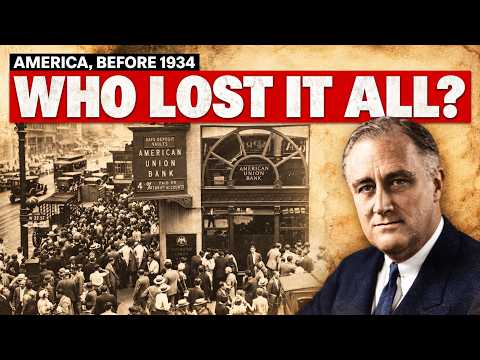
To understand why America had no safety net, you have to picture banking before the crash. In 1921, there were over 30,000 banks in the United States—more than in the rest of the world combined. Most were unit banks: one office, one town, no branches. Your banker knew your family, your farm, your debts. But that intimacy came with a fatal weakness. All loans sat in the same place. If wheat prices collapsed or cotton failed, every borrower struggled at once, and the bank had nowhere to turn.
That’s exactly what happened in the 1920s. While the cities boomed, farm country suffered a slow-motion bust. Agricultural prices fell hard after World War I, and rural banks began dying. The FDIC counts an average of 588 bank failures a year during the ’20s, compared with just 82 a year between 1900 and 1919. Those failures were confined primarily to agricultural areas. So the first people to lose their money weren’t Wall Street speculators—they were farm families in Kansas, Nebraska, and the Dakotas.
And here’s the strange part: some of those families thought they were insured. The idea of deposit insurance wasn’t new. In 1829, New York created a bank obligation insurance program, and between 1908 and 1917, eight states tried again—Oklahoma, Kansas, Nebraska, Texas, Mississippi, South Dakota, North Dakota, and Washington. Each had a guarantee fund built from assessments on the banks themselves. But the state didn’t stand behind the money; the other banks did. When the farm depression hit, claims piled up faster than the funds could pay. Washington’s fund stopped in 1921, and by early 1930, every one of these state funds had ceased operation. In seven of the eight states, the share of insured deposits never paid from any source ran as high as 70%.
Think about what that meant at a kitchen table. You put your money in a state bank covered by the guarantee, and when it failed, you found out the guarantee was only as strong as the banks paying into it—and those banks were failing, too.
In Congress, the idea kept coming back. Between 1886 and 1933, lawmakers introduced 150 separate proposals for national deposit insurance. None became law until 1933. One of the men pushing hardest was Congressman Henry Steagall of Alabama, who represented a rural district and wanted to end the runs that had devastated small banks and small towns. For years, he couldn’t get his federal guarantee. But the farm failures of the ’20s were only a warning.
In the autumn of 1930, the trouble left the countryside and came for the cities. By the fall of 1930, there was reason to think the worst was over. The downturn that began in 1929 had lasted about 15 months, roughly the length of an ordinary recession. The economy looked poised to recover. Then a company in Nashville, Tennessee, cracked. Caldwell and Company was the largest financial holding company in the South, offering banking, brokerage, and insurance. Its leaders lost heavily in the securities markets, and to cover those losses, they drained cash from the banks they controlled. On November 7, 1930, the Bank of Tennessee in Nashville closed. Within 10 days, Caldwell affiliates in Knoxville and Louisville, Kentucky, failed too.
This is where the structure of American banking turned a local failure into a regional panic. Small country banks didn’t keep all their reserves in their own vaults—they kept a lot on deposit at bigger correspondent banks in the city. So when a city bank went down, the small banks that relied on it lost access to their own cash. Within weeks, hundreds of banks suspended operations. About a third reopened within months. Most were liquidated.
There was also a quieter problem. When the crisis began, just over 8,000 commercial banks belonged to the Federal Reserve System. Nearly 16,000 did not. Those non-member banks lived in a world much like the one before the Fed existed. If they got into trouble, the central bank had no obligation to help them.
What happened next works almost like a natural experiment. The crisis hit two neighboring Federal Reserve districts. The Atlanta Fed took a broad view: it sped up lending to member banks, encouraged them to lend on to non-member banks, and sent cash to towns facing panics. The St. Louis Fed took a narrow view: it limited lending and refused to help non-member banks. The results were stark. In the Atlanta district, the contraction slowed and recovery began. In the St. Louis district, hundreds of banks failed, lending fell, and unemployment rose. Same crisis, two different policies. One way to read it: who lost their money depended partly on which side of a line on a central bank’s map you lived.
But Nashville was only the opening act. Five weeks later, the biggest failure yet would hit New York City.
It’s December 10th, 1930, in the Bronx. Outside a branch of the Bank of United States on Southern Boulevard, a crowd starts to form. By midday, somewhere between 20,000 and 25,000 people had gathered, and police had to control the street. By the end of the day, roughly 2,500 to 3,000 depositors had pulled out about $2 million. The New York Times blamed a false rumor started by a small local merchant who was also a stockholder. The next morning, December 11th, the bank didn’t open.
To understand why this one mattered so much, start with the name. The Bank of United States had nothing to do with the government. It was a private bank founded in 1913 by Joseph Marcus, a Jewish immigrant. When the name was approved, directors of a rival bank objected that, in their words, “ignorant foreigners would believe that the United States government was interested in this bank.” The name was approved anyway.
The bank catered especially to New York’s Jewish merchants. It grew fast through a wave of mergers in the late 1920s, reaching 62 branches by 1930. In 1929, it held about $238 million and had more than 400,000 depositors. Some of them assumed from the name that the bank was run by the government. It wasn’t. And when the end came, there was no rescue.
That autumn, the bank had been in talks to merge with three other New York banks. On December 8th, the merger was dropped. Problems included guaranteeing the bank’s deposits and the mortgages and loans held by its subsidiaries. Then came the run. And then the state banking superintendent, Joseph Broderick, took over. By the day it shut, deposits were down to about $160 million from $238 million the year before. Anyone who’d pulled out before the doors closed got their money. Everyone still inside was locked in.
It was the largest bank failure in American history up to that point. Members of the New York Clearing House offered depositors loans worth 50% of their frozen deposits. In other words, you could borrow against your own money. On December 23rd, when those loans began, depositors arrived hours early, and many were turned away.
Then the courtroom part of the story began. In 1931, the bank’s president, Bernard Marcus, and its vice president, Saul Singer, were each sentenced to three to six years in Sing Sing. The judge, George Donnellan, blamed their personal greed for the bank’s downfall and for the hardship it brought upon its 400,000 depositors.
So did those depositors lose everything? No. And this is the twist that the usual story leaves out. According to the economic historian Paul Trescott, depositors eventually recovered about three quarters of their money through loan collections, asset sales, and lawsuits against stockholders and directors. But the bank’s affairs weren’t fully settled until 1944. Fourteen years. A shopkeeper who was 40 in 1930 would have been 54 when it ended.
That’s what losing your money usually meant before 1934. Not always a total wipeout. More often, a long freeze during what the Federal Reserve called the longest and deepest downturn in American history, when you needed that money most.
And the Bank of United States wasn’t the end. It was the start of a far bigger collapse. The numbers for 1931 are brutal. According to the FDIC, 2,293 banks suspended operations that year, holding about $1.69 billion in deposits. Depositor losses came to about $390 million. Losses borne by depositors in 1931 alone exceeded the losses for the entire period from 1921 to 1929.
Then the crisis went international. On September 21st, 1931, Britain left the gold standard. Foreigners started converting dollar assets into gold. In early October, the Federal Reserve Bank of New York raised its discount rate to stop the gold from leaving. That defended the dollar, but it made borrowing more expensive at exactly the moment American banks were desperate for cash.
Inside the Fed, there was a real argument about what to do. And one side of it was chilling. Some officials held what’s called the liquidationist view: let weak institutions fail during a panic and the economy will come out healthier. The Federal Reserve’s own history names Andrew Mellon, Herbert Hoover’s Treasury Secretary, as an advocate of that approach. Others disagreed. Eugene Meyer, the governor of the Federal Reserve Board, advocated widespread direct assistance and was instrumental in creating the Reconstruction Finance Corporation, which Congress set up in January 1932 to lend to banks, railroads, and other institutions. But banks were reluctant to borrow from it, partly because their names would be published, and a bank seen borrowing looked weak.
The result of all this hesitation shows up in one figure. From the fall of 1930 through the winter of 1933, the money supply fell by nearly 30%. Prices fell by a similar amount. Debts became heavier, and more borrowers went bankrupt, which pushed more banks under. Decades later, the Federal Reserve admitted its part. In November 2002, Ben Bernanke, then a Fed governor, said of the Great Depression, “We did it. We’re very sorry.” And he promised it wouldn’t happen again.
So where did frightened savers go? Some went to the post office. Since 1911, the United States Postal Savings System had let people deposit money at their local post office. The law said the faith of the United States was solemnly pledged to repay those deposits. In other words, it was government-backed savings years before the FDIC. It paid just 2% interest, deliberately kept low to keep bankers from objecting, and it was capped, at first at $500 per person, raised in stages to $2,500 by 1918.
After the crash, everyone discovered it. Between 1930 and 1934, postal savings deposits jumped from $103 million to $887 million, measured in 1913 dollars. That’s an increase of almost 760%. So here’s another answer to who lost. A saver who never trusted banks and kept money at the post office could come through untouched, at least up to the cap. The one who trusted the local bank was exposed.
And the worst was still ahead, because in the winter of 1933, the panic reached Detroit. But first, a question underneath all of this. When a bank failed before 1934, what actually happened to the money left inside it? The answer is receivership. A receiver took over the bank, collected what loans it could, sold what assets it could, and paid depositors out over time. And for national banks, there was one more source of money: the shareholders themselves.
Since 1864, shareholders in national banks had been subject to double liability. If the bank failed, you didn’t just lose what you paid for your shares—the receiver could bill you for up to the par value again to help pay depositors. The Office of the Comptroller of the Currency found that across 2,973 national bank receiverships from 1865 through 1939, creditors proved claims of about $942.9 million and received about $593.3 million. That’s roughly 63 cents on the dollar, paid in pieces, over years. In 80% of receiverships, uninsured depositors took losses. Double liability helped, but only about half of the $181 million assessed on shareholders was ever collected.
Put those numbers together and you get something more precise than “everyone lost everything.” Creditors got back about 63 cents on the dollar—some far more, some far less, and none knew in advance which they’d be. That uncertainty is what made people run. If the person ahead of you in line gets 100 cents today while you might get 60 eventually, the rational move is to get in line. Every individual decision made sense. Together, they were catastrophic.
And in early 1933, the public found out how differently the people at the top had been playing. A New York lawyer named Ferdinand Pecora became chief counsel to the Senate Banking Committee. His first big target was Charles Mitchell, chairman of National City Bank, who disclosed over $1.2 million in 1929 salary and bonuses—and admitted he’d sold stock to a family member at a loss to avoid income tax. He hadn’t broken any law, but many judged his dealings unethical. Shortly afterward, Mitchell resigned.
Then came Edgar Brown, an investor who testified that brokers had talked him into converting $225,000 in government bonds into a managed stock portfolio. When prices fell and he wanted out, he was pressured to hold on. He said he’d been placed in the category of “the man who seeks to put his own mother out of his house.” His portfolio collapsed. And when he asked the bank for a personal loan, it turned him down—even as it kept offering loans without collateral to its own brokers.
Edgar Brown wasn’t a depositor in a failed bank. He was an investor. But his story landed just as millions of ordinary depositors were wondering whether the system had ever been on their side. And while the Senate dug into Wall Street, the banking system began to fall apart in real time.
On October 31st, 1932, Nevada became the first state to declare a banking holiday. Then, on February 14th, 1933, Michigan declared one after troubled Detroit banks couldn’t secure loans from the Reconstruction Finance Corporation. After Michigan’s holiday, the pressure spread. By March 4th, 1933, the day Franklin Roosevelt was inaugurated, every state in the country had declared some kind of bank holiday. The panic reached its peak in the first three days of March.
At 1:00 a.m. on Monday, March 6th, Roosevelt issued Proclamation 2039, suspending all banking transactions nationwide. He’d been sworn in about 36 hours earlier. Three days later, Congress passed the Emergency Banking Act. In the House, it passed after about 40 minutes of debate with no amendments allowed. Then, on March 12th, Roosevelt went on the radio in the first of his fireside chats. He explained that when you deposit money in a bank, the bank doesn’t put it into a safe deposit vault—it lends it out. He told listeners it was safer to keep their money in a reopened bank than under the mattress. But he was careful, too. “I do not promise you that every bank will be reopened or that individual losses will not be suffered,” he said. And he ended with the line, “Let us unite in banishing fear.”
On March 13th, member banks in Federal Reserve cities began to reopen. By March 15th, banks holding about 90% of the country’s banking resources were back in business, and deposits were coming in faster than withdrawals. For most banks, the crisis was over. But not for all of them. Some 4,000 banks would remain closed forever. The FDIC’s figures for 1933 show about $3.6 billion in deposits sitting in suspended banks and losses to depositors of about $540 million—the worst single year of the entire crisis.
Detroit shows what that meant up close. The city’s two major banks, the First National Bank of Detroit and the Guardian National Bank of Commerce, never reopened. They went into liquidation and new banks replaced them. And here’s the remarkable part. According to Judge Averill Cone, writing in the Detroit Legal News, the closed banks eventually paid their depositors 100 cents on the dollar during their receiverships. Every penny. But eventually is the key word. A family with savings locked inside one of those banks in February 1933 didn’t need the money years later—they needed it that winter.
So the honest answer to who lost isn’t just a dollar figure. It’s time, and the cost of waiting. Whatever a family had to give up while its savings were frozen never shows up in the FDIC’s tables, because technically the bank paid them back. Which raises the obvious question: if everyone could see the damage, why was a federal guarantee still so controversial in 1933?
The answer is that some of the most powerful people in the country, including the new president, didn’t want it. Roosevelt opposed deposit insurance and reportedly said it would never work. The Federal Reserve’s history goes further and says he threatened a veto. His objection, as the historian John Steele Gordon describes it, was moral hazard: insuring deposits put a premium on sloppy banking and penalized good banking. Senator Carter Glass of Virginia, the primary force behind separating commercial from investment banking, strongly opposed it at first. The bankers opposed it, too. The president of the American Bankers Association called deposit insurance “unsound, unscientific, and dangerous.” Large banks opposed it; small rural banks were its main supporters.
But the public had made up its mind. One business journal reported that Congress and the public would reject any banking bill without deposit insurance, and that Glass had simply yielded to public opinion. The breakthrough came from a Republican, Senator Arthur Vandenberg of Michigan, whose state had just watched its banks freeze. He proposed starting with a temporary insurance fund rather than waiting for a permanent one. His argument was simple: “The need is greater in the next year than for the next 100 years.” His amendment passed overwhelmingly.
On June 16th, 1933, Roosevelt signed the Banking Act of 1933, often called Glass-Steagall. It split commercial banking from investment banking, and it created the Federal Deposit Insurance Corporation. The Treasury put in $150 million, and the Federal Reserve Banks subscribed, too. Glass got his separation. Steagall finally got his guarantee.
But a law on paper doesn’t protect anyone. The real test would come on the first day of 1934. On January 1st, the temporary deposit insurance fund opened for business. Coverage was capped at $2,500 per depositor. More than 13,000 banks were insured or approved on that first day—about 90% of all commercial banks. Each insured bank paid an assessment of half of 1% of its insurable deposits. On July 1st, 1934, coverage doubled to $5,000, and the Banking Act of 1935 made the system permanent.
That same year, the FDIC made its first payout. The Fondulac State Bank in East Peoria, Illinois, failed, and the first depositor to be paid was a woman named Lydia Lobsiger. She received $1,250, which restored her life savings. Before 1934, her story could easily have gone the way of millions of others: a locked door, a receiver, years of waiting for payments that might cover only part of what she’d saved. Instead, the money came from a fund, rather than from the wreckage of her bank.
The effect on bank failures was dramatic. Failures averaged 588 a year in the ’20s and about 2,277 a year from 1930 to 1933. From 1934 through 1942, they averaged 43 a year. And the old system of double liability faded away. The Banking Act of 1933 allowed new bank shares without it, and the Banking Act of 1935 let banks drop it from existing shares as of July 1st, 1937. Shareholders no longer stood behind depositors. The FDIC did.
But that shift—from shareholders carrying the risk to an insurance fund carrying it—is exactly what the critics had warned about. The strongest argument against deposit insurance isn’t that it doesn’t stop runs; Steagall was right, and there hadn’t been a serious one since. The argument is about what happens to banks when nobody has a reason to watch them. Economists call it moral hazard. If your deposit is guaranteed no matter what, you’ve got no reason to care whether your bank is careful or reckless. You’ll pick the one paying the highest interest rate. And the bank’s owners know it. That, in Gordon’s account, is what Roosevelt feared.
The critics also have historical evidence on their side, and it comes from the same state experiments we started with. The economists Charles Calomiris and Matthew Jaremski studied those early 20th century state insurance systems, comparing insured state banks with uninsured national banks operating in the same states. Their conclusion was that insurance increased risk by removing market discipline. Insured banks competed aggressively for deposits and rode the wartime rise in farm prices, which led an asset price bubble to form. When prices reversed in the early 1920s, the insured systems collapsed and left depositors with losses. In their reading, the guarantee didn’t just fail to prevent the farm belt failures—it may actually have made them worse.
There’s a structural critique, too. Gordon argues that Glass-Steagall greatly weakened the country’s strongest banks while protecting the weakest ones from market forces. In that view, the 1933 law kept a fragile system of small banks alive instead of fixing it. And they point to what came later: a much enlarged and extended deposit insurance became a leading cause of the savings and loan debacle of the late 1980s.
Supporters answer that the alternative had already been tested for decades, and the results were the lines outside the Bank of United States, the frozen savings of Detroit, and 4,000 banks that never reopened. They argue that a well-supervised insurance fund, paid for by the banks, is a small price for ending the panics that turned recessions into depressions. And they point out that both things can be true at once. Deposit insurance can stop runs and encourage risk. The question has always been how to get the first without too much of the second.
That argument never really ended. The $2,500 limit of 1934 didn’t last. It rose step by step over the decades: $10,000 in 1950, $40,000 in 1970, $100,000 in 1980. In 2008, during the financial crisis, it was raised temporarily to $250,000, and the Dodd-Frank Act made that permanent in 2010.
And then came 2023. On March 10th, California regulators closed Silicon Valley Bank. Two days later, New York regulators closed Signature Bank. On May 1st, California regulators closed First Republic Bank, and JPMorgan Chase agreed to take over its deposits and buy nearly all of its assets. According to the FDIC, those were the second, third, and fourth largest bank failures in its history. Here’s the detail that connects 2023 straight back to 1933: the federal government declared that the failures of Silicon Valley Bank and Signature posed a systemic risk and protected all of their depositors, including the uninsured ones above the limit. In the old world, those depositors would have been waiting in the receivership line.
So the question from 1933 came back in a new form. If the limit is $250,000, but the government protects everyone above it whenever a failure looks dangerous enough, then is there really a limit? And if there isn’t, who’s watching the banks? The critics warning about moral hazard and Steagall’s warning about runs are both still sitting on the table 90 years later.
So who lost their money before 1934? The farm families of the 1920s lost first, often in banks that promised a guarantee their state funds couldn’t keep. The depositors of the Bank of United States lost time, waiting 14 years for about three quarters of their savings. Creditors of failed national banks got back about 63 cents on the dollar overall, slowly, while shareholders paid only about half of what they were billed. And the people who lost the most in ways that never appear in any official table were the ones who needed their money that year and couldn’t wait for the receivers. The people who lost the least were the ones who moved first or who’d never trusted the banks to begin with, like the savers at the post office. And, in a sense, bankers like Charles Mitchell, who’d already been paid.
That doesn’t mean every banker was a villain. Bank shareholders were billed for losses under double liability, and about two thirds of American banks weren’t even members of the Federal Reserve. The system that failed them wasn’t one man’s design. It was the product of thousands of small banks, a divided central bank, a gold standard, and a political culture that had turned down a national guarantee for nearly half a century. Deposit insurance fixed the panic. Whether it planted new risks is still an open question.
So here’s what I want to ask you: if the government will protect deposits above the limit whenever a failure looks dangerous, should the limit be raised for everyone—or should it be enforced, even if that means some depositors lose real money? Let me know in the comments.
Report this article
Select a reason for reporting:






