Foggia Airfield, Italy, February 1st, 1944. Captain Alessandro Tornielli, a cocky 24-year-old Italian ace with kills to his name, is laughing so hard at reconnaissance photos that he’s almost spilling his morning espresso. “Marco, come look at this joke,” he calls to his wingman, waving the photos in the air. “The Americans have finally lost their minds. They call this thing the Corsair.”
The photo shows what looks like a flying disaster. Wings bent like a broken seagull, and a nose so massive it seems like someone strapped an engine to a bathtub and called it a fighter plane. “Madonna mia,” Lieutenant Santini chuckles, shaking his head. “How can something this ugly even fly? Our beautiful Folgore will dance circles around this flying brick.”
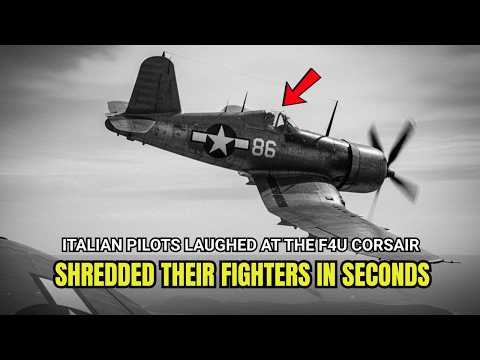
But here’s what these confident Italian pilots didn’t know. In just a few hours, their laughter would turn to absolute terror. That ugly flying bathtub they were mocking, it was about to become their worst nightmare and change aerial warfare forever. What happened next would shatter everything these experienced pilots thought they knew about air combat.
The desperate need for speed, let me take you back. Vought F4U Corsair. The US Navy had just given Chance Vought an impossible mission. Build us a fighter that’s faster than anything flying, can destroy enemy bombers with devastating firepower, and can land on aircraft carriers.
Most engineers would have laughed, but Rex Beisel, Vought’s chief designer, saw an opportunity where others saw impossibility. The problem. To get the speed they wanted, he needed the most powerful engine available, the massive 2,000 horsepower Pratt & Whitney R-2800 Double Wasp. But this beast of an engine required a propeller over 3 ft in diameter. Imagine trying to land that on an aircraft carrier without the propeller kissing the deck.
Beisel’s solution was pure genius. Those ugly inverted gull wings that the Italian pilots were laughing at, they weren’t a design flaw. They were revolutionary engineering. By bending the wings down and then back up, he could mount the landing gear at the lowest point, giving that massive propeller the clearance it needed. The result? An aircraft that looked like nothing anyone had ever seen before.
When the first F4U Corsair rolled off the production line in 1942, it immediately started breaking records like they were made of paper. First American fighter to exceed 400 mph, check. 47 mph to be exact. Most powerful fighter engine in the world, double check. Most devastating armament ever mounted on a fighter, triple check. But speed was just the beginning of this monster’s capabilities.
The Corsair’s armament was absolutely devastating. Six Browning 50 caliber machine guns mounted in the wings. When all six fire together, they unleashed 4,500 rounds per minute of pure destruction. Each bullet weighed nearly 2 oz and traveled at over 2,800 ft per second. This wasn’t just firepower. This was aircraft shredding annihilation.
And here’s the kicker. The Corsair was built like a tank. While other fighters would crumble under battle damage, the F4U could absorb punishment that would destroy any other aircraft and keep flying. But there was one problem. The troubled child.
Every revolutionary weapon has teething problems, and the Corsair had plenty. The US Navy initially rejected the Corsair for carrier operations. Why? It was a handful to fly. Torque effects that could catch pilots off guard. Visibility problems during landing. And a terrifying tendency to stall without warning. Several test pilots died learning the Corsair’s secrets.
So where did it go? The Marines. Land-based operations where the Corsair’s challenging characteristics were more manageable. This decision would prove to be destiny. Marine pilots in the Pacific became the first to unlock the Corsair’s deadly potential. They learned that this wasn’t just another fighter. It was an entirely new kind of weapon that required entirely new tactics. And by early 1944, these battle-hardened Marine pilots were bringing their revolutionary aircraft and tactics to the Mediterranean.
Meanwhile, back in Italy, pilots like Captain Torriani were still dominating the skies with their elegant Macchi C.202 Folgore fighters. The Folgore was truly beautiful, fast, maneuverable, and flown by skilled pilots who had honed their craft during the Spanish Civil War. In traditional dog fighting, these Italian aces were masters. But by 1944, everything was falling apart for Italian aviation.
The country had surrendered, but German forces occupied northern Italy. Many of the best pilots had defected or stopped flying. Aircraft production had virtually ceased, and remaining pilots were flying patched-together fighters running on questionable fuel. Still, they maintained their confidence. After all, their reconnaissance photos of the new American fighter seemed to confirm their assumptions.
“Look at this thing,” Torriani told his squadron mates, pointing at the Corsair photos. “This looks like something a child would draw if you asked them to design an airplane. How are we supposed to take this seriously?” They had no idea that death was approaching at 400 plus mph.
What the Italian pilots didn’t understand was that the Corsair had spawned an entirely new form of aerial warfare. Marine pilots had learned brutal lessons in the Pacific. Traditional dog fighting was suicide against this aircraft. Instead, they developed tactics that played to the Corsair’s incredible strengths.
Major Pappy Boyington explained it perfectly to his pilots. “The F4U isn’t just another fighter. It’s a completely new kind of weapon. Forget everything you know about dog fighting. This aircraft is designed to kill, not to dance. Use its speed, use its firepower, and never give the enemy a fair fight.”
New tactics were simple, but deadly. Dive on enemy formations from high altitude, make high speed firing passes with devastating effect, climb away before the enemy could respond. Control the terms of engagement. Completely dot energy management over maneuverability. Firepower over finesse. And in January 1944, these tactics were about to be exported to the Mediterranean.
February 4th. 4:30 before, 5,000 ft above the Italian countryside, Captain Toriani spots them first. B-25 Mitchell bombers with their fighter escort approaching from the southeast. “Contact. 2:00 high,” he radios. “I count 12 escort fighters.” Wait. As the range closes, those distinctive inverted gull wings become unmistakable.
“Those must be the new Corsairs. They’re even uglier in person,” Lieutenant Santini laughs over the radio. “Look at those ridiculous wings.” What happened next changed everything.
Major Robert “Cowboy” Cowen, leading the Corsair formation, had spotted the Italian fighters immediately. Unlike the confident Italians, Cowen felt no amusement. He’d seen too many good pilots die from underestimating opponents, but he knew exactly what his F4Us were capable of.
“Bandits 11:00 high,” Cowen announced calmly. “Four contacts, looks like Macchis. Remember your briefing, gentlemen. We have the speed and the firepower. Use them.”
Then Cowen did something that violated every traditional rule of fighter combat. Instead of turning to engage the attacking Italian fighters, he ignored them completely and continued straight toward the bombers. The Italian pilots were baffled. In their experience, escort fighters always turn to engage attackers. This suggested either cowardice or incompetence.
Torriani felt his confidence surge as he rolled into his attack dive. The lead Corsair was perfectly positioned in his gunsight, flying straight and level like a training target. At 400 yards, he pressed the trigger.
What happened next was seared into his memory forever.
Instead of continuing straight or trying to evade, the Corsair suddenly pulled up into a climb so steep and so fast that it seemed to defy physics itself. That massive Pratt & Whitney engine, unleashing over 2,000 horsepower, hauled the fighter skyward like a rocket. In seconds, the Corsair had gained 2,000 feet and was positioning for a counterattack.
“Madonna!” Torriani gasped, watching the American fighter climb away from him like it was powered by magic. His beautiful Macchi simply couldn’t match the raw power of that enormous engine.
Then Major Cowen dove back down for his counterattack. The six .50 caliber machine guns opened fire at 300 yards, their muzzle flashes creating a deadly constellation of light. 4,500 rounds per minute of devastating firepower screamed toward the Italian fighter.
The impact was catastrophic. Torriani felt his Macchi shudder as massive bullets, each weighing nearly two ounces, began tearing his aircraft apart. These weren’t the small-caliber rounds he was used to facing. These were aircraft-destroying hammers.
The first burst lasted only two seconds, but it was enough to doom the Italian fighter. Bullets smashed through the engine cowling, severing oil lines and punching holes in cylinder heads. The windscreen exploded in a shower of glass. Control cables were cut. But it was the psychological impact that was most devastating.
The sound of those .50 caliber bullets striking his aircraft was like being inside a giant drum during a thunderstorm. The vibration was so intense his vision blurred and his hands were shaken from the controls. “My God,” he gasped into his radio. “What kind of guns are those?”
Lieutenant Santini, watching his squadron leader’s aircraft disintegrate under the Americans’ guns, felt his confidence evaporate like morning mist. The Corsairs’ attack had been so fast, so devastating, that there had been no time to react. One moment, Torriani had been diving on what appeared to be an easy target. The next, his aircraft was trailing smoke and debris as it spiraled toward Earth.
But the nightmare wasn’t over. As Santini attempted to avenge his squadron leader, another Corsair dove on him from above, its six machine guns already chattering death. The .50 caliber bullets struck his Macchi with the force of sledgehammers.
First burst through the engine, destroying the supercharger. Second burst up the fuselage, shattering the canopy and wounding Santini. Third burst struck the wing root and severed the main spar. Santini’s fighter broke apart in midair. The wing folded upward as structural failure propagated through the airframe. The young Italian pilot barely managed to bail out before his aircraft exploded in a ball of orange flame.
In less than two minutes, the Italian formation was shattered. Two aircraft down, one pilot dead, one drifting toward Earth under a parachute. The two remaining pilots made the only rational decision available: they ran. But even retreat wasn’t safe from the Corsairs’ devastating capabilities.
The speed and decisiveness of those attacks reverberated through Italian fighter squadrons for months. Pilots who had been confident in their abilities suddenly found themselves facing an enemy with seemingly supernatural capabilities. The Corsair’s combination of speed, firepower, and ruggedness made it nearly invincible.
Most demoralizing was the realization that this wasn’t just about superior equipment. It was about a completely different approach to warfare. The American pilots weren’t trying to outfly their opponents in traditional dogfights. They were using their aircraft’s advantages to avoid fair fights entirely, creating situations where the outcome was predetermined by superior performance.
Word spread quickly. Il diavolo blu, the blue devil, Italian pilots began reporting Corsair sightings even when no F4Us were in the area. The distinctive sound of the aircraft’s engine, a deep throaty roar unlike any other fighter, became a source of terror.
Flight Sergeant Mario Bellagamba wrote in his diary: “Today we scrambled to intercept bombers over Florence. Someone reported Corsairs in the area. Immediately the formation began to spread out, pilots looking nervously over their shoulders. We never saw a single Corsair, but the mission was ruined. How can we fight an enemy that defeats us just by existing?”
By summer 1944, the psychological dominance of the F4U was breaking Italian will to fight. Captain Torriani, recovering from his crash, reflected in his diary: “We have been fighting the last war while the Americans have been preparing for the next one. Our beautiful Macchis were designed for aerial warfare of 1940, but the Corsair represents 1950. We are not just outmatched, we are obsolete.”
The statistics were brutal. Six Italian fighters lost for every Corsair claimed. Pilots requesting transfers to avoid Corsair encounters. Italian air resistance virtually ceased by September ’44. The Regia Aeronautica, which had begun the war as a proud and capable force, had been systematically destroyed by an enemy representing a new generation of aerial warfare.
The aircraft that Italian pilots had dismissed as an ugly flying bathtub had revolutionized air combat, introducing concepts that would influence fighter design for decades. The tactical principles developed by Marine pilots—energy management, superior firepower, technological advantage—became the foundation of jet age fighter tactics.
For Captain Torriani and the Italian pilots who survived their encounters with the Blue Devil, the lesson was learned too late and at too high a cost. The laughter that had echoed through Italian ready rooms in early 1944 was replaced by silence. The silence of pilots who had learned to fear the distinctive whistle of the Corsair’s approach.
Here is the eternal silence of those who learned too late that some jokes can kill. The F4U Corsair had announced the arrival of a new era in aerial warfare, one where technological superiority and tactical innovation would triumph over tradition and experience. In the deadly serious business of aerial combat, it’s not how you look that matters—it’s how effectively you can destroy your enemies when the shooting starts.
So tell me: have you ever judged a book by its cover, only to discover the cover hid something truly formidable? Share your story in the comments below.
Report this article
Select a reason for reporting:






