On April 7, 2003, a US Army colonel stood on a street corner in Basra, Iraq, and watched something that would haunt him for years. British soldiers—the same men who had just fought through the city in 36 hours—were walking around without helmets, wearing soft red and green berets, drinking from plastic water bottles, and chatting with locals. He turned to a British officer next to him and asked six words that would end up in the most important American military doctrine document of the 21st century: “How the hell did they do that?”
The colonel wasn’t the only one stunned. General Tommy Franks, General James Mattis, and the entire US command structure were watching Basra closely, and what they saw defied everything they knew about urban combat.
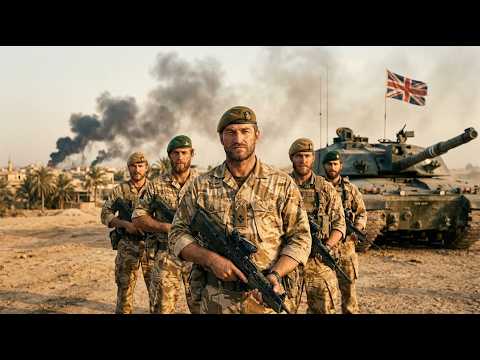
Just weeks earlier, the British had been handed a mission that seemed impossible: 26,000 soldiers to secure a city of 1.3 million people, defended by 14,000 regular Iraqi troops, up to 3,000 Fedayeen, and unknown numbers of Ba’ath militia. One Pentagon briefer privately called it “the easy job”—but the math never worked on paper. The British accepted it anyway.
They had been preparing for this kind of fight for 50 years, in places like Malaya, Borneo, Aden, and Northern Ireland. The doctrine had a name: the soft cap. It said that if you assault a city of a million civilians the way you assault an enemy army, you win the battle and lose the population for a generation. So you don’t assault it. You isolate it. You let the interior collapse. Then you go in fast, hard, and symbolic—and you leave the rest standing.
Major General Robin Brims, commanding the 1st UK Armoured Division, surrounded Basra on March 24 and then did nothing for 14 days. The American media called it caution. Tommy Franks wanted the city taken. But Brims was following a playbook the Americans didn’t have.
On April 6, the assault began. AS90 guns and RAF Tornados hit Ba’ath Party headquarters and Fedayeen command posts. Challenger 2 tanks from the Royal Scots Dragoon Guards and Queen’s Royal Lancers led the charge, with infantry from the Black Watch, Royal Regiment of Fusiliers, and Irish Guards behind them. Brigadier Graham Binns made a call no American urban warfare manual would have endorsed: instead of clearing block by block, he drove his armored column straight into the symbolic heart of the city—the Ba’ath Party headquarters, the Sheraton Hotel, the bridges over the Shatt al-Arab. He bypassed entire pockets of resistance.
Inside the Warriors, temperatures exceeded 95 degrees. Soldiers fought room by room with grenades and rifle butts. By the afternoon of April 6, the Iraqi resistance broke—not degraded, broke. By the evening of April 7, the city was in British hands. 36 hours of direct assault after 14 days of preparation. The largest city captured by British forces since World War II.
And then came the moment that colonel on the street corner couldn’t understand. Within 30 minutes of clearing a building of armed Fedayeen, the same Royal Marines were talking with families on the same street. The soft caps weren’t a lapse in discipline—they were a deliberate, calculated signal: “We are not occupying you. We are here as soldiers, not as conquerors.”
General Mattis later told his officers the British had demonstrated the patience to win without destroying what you’re trying to save. That line would end up in the American counterinsurgency doctrine three years later. But the story doesn’t end there. The same doctrine that won Basra in 36 hours would be tested in the years that followed—and the British would pay a price no one saw coming.
The first price came in body bags, and it came almost immediately. Sergeant Steven Roberts of the 2nd Royal Tank Regiment was shot on March 24, 2003, near Az Zubayr, just days into the invasion. He had given up his enhanced body armor because there was a shortage and another soldier needed it more. The bullet that killed him would have been stopped by that armor. His widow, Samantha, would spend years forcing a public inquiry that changed how the British Army equipped its front-line troops.
Four days later, Corporal of Horse Matty Hull of the Blues and Royals was killed in a friendly-fire incident. An American A-10 attack aircraft mistook his patrol for Iraqi vehicles and engaged. The cockpit audio was later leaked. The pilot’s voice when he realizes what he has just done is one of the most painful artifacts of the war.
But the soft cap doctrine had another side—one that produced heroes the British Army had not seen in a generation. On May 1, 2004, in Al Amarah, a Warrior driver named Johnson Beharry, originally from Grenada, drove his vehicle out of a rocket-propelled grenade ambush after his commander was incapacitated. He saved every man inside. Five weeks later, another RPG detonated six inches from his head. It fractured his skull. He reversed his Warrior out of the kill zone before losing consciousness. He spent months in a coma. On March 18, 2005, he was awarded the Victoria Cross—the first living recipient since 1969.
By 2006, the same patient doctrine the American generals had praised was being exploited as weakness. The Mahdi Army, loyal to the Shia cleric Muqtada al-Sadr, controlled significant parts of Basra. They had figured out the British would not shoot back the way the Americans would. The soft cap that had won April 2003 could not, on its own, hold the city three years later.
In 2007, British forces withdrew from Basra Palace, the last major British base inside the city, under a deal with local militias widely seen as a retreat. In 2008, Iraqi army units backed by American forces ran Operation Charge of the Knights to retake the city. The same American officers who had praised the British in 2003 were now telling reporters off the record the British had lost what they had won.
The Chilcot Inquiry began in 2009. Seven years, 2.6 million words, the longest public inquiry in British history. It concluded the UK had gone to war before peaceful options were exhausted, the intelligence on weapons of mass destruction was wrong, and post-invasion planning was wholly inadequate. But the same report explicitly acknowledged British military personnel had served with courage and distinction. The politicians failed. The soldiers did not.
The British soldier on that Basra street corner—the one with the soft beret and the water bottle and the woman with the baby—was real. There were thousands of him. He represented the cleanest image the war ever produced, a doctrine 50 years in the making working exactly as it was supposed to. But that image was taken in April 2003. By 2006, the same corner was a place where British patrols could not stop. By 2007, it was a place where British patrols could no longer go. The soldier in the beret had to put his helmet back on. The water bottle had to become a rifle. The conversation had to become a checkpoint.
The doctrine that had worked so brilliantly for 36 hours could not hold a city for 36 months. Not because the doctrine was wrong, but because the war being fought around it changed faster than the men holding the corners could change with it. That is the lesson the American generals took from Basra—not just the patience, not just the soft caps, but the harder lesson. You can win the battle, win it brilliantly, and still lose what came after.
The colonel watched from the other side of the street for a full minute. Then he turned and asked his six-word question. He never got a real answer. He probably never will. But the men who wrote the counterinsurgency manual three years later had stood on the same corners. They had seen the same thing. And they understood, even if they could not fully explain it, that the British had shown them something the American military would spend the next decade trying to learn.
The name the locals quietly started calling the British soldiers on the corners—the men with no helmets—was “the soft caps.” It was not a term of derision. It was a term of recognition. They had seen something different. Something that worked, for a while. Something that could not last.
But here is the part that gets left out of almost every retelling. The Americans did not simply admire the British from across the street and go home. They copied them, badly, and then they copied them again, better, and the second copy is the one that shaped the next twenty years of American war.
The first copy was the Marine Corps. In the summer of 2003, barely three months after the colonel asked his six-word question, a Marine colonel named John Kiszely—no, that was the British general—the Marine colonel who actually did the copying was a man named Frank Hoffman, working out of Quantico, and he started circulating memos asking a question nobody in the Pentagon wanted to answer out loud: what if the British were not being soft in Basra, but were in fact running the only war in Iraq that was working?
Hoffman’s memos became a working group. The working group became a series of visits. British officers from the Royal Marines and the Parachute Regiment were flown to Quantico and asked, in effect, to teach a seminar on how they had done it. One of them, a major who had cleared Umm Qasr house by house, stood in front of a room of American officers and said the phrase that would follow him for the rest of his career: “We did not go in to kill everybody in the building. We went in to kill the two men who needed killing and then we sat down and had tea with the rest.”
The room went quiet. Not because it was shocking. Because it was obvious, and none of them had been trained to do it.
That is the moment the doctrine actually started to move. Not in Basra in April 2003, when the colonel asked his question. In Quantico, in the autumn of 2003, when a British major said the obvious thing out loud and a room full of American officers realized their entire professional education had been pointed in the wrong direction.
Within a year, the Marine Corps had a draft document. Within two, the Army was involved. By 2006, Petraeus and Amos had co-authored FM 3-24, and the men who wrote it were, almost to a person, officers who had either served alongside the British in southern Iraq or had sat in one of those Quantico seminars and heard the major say the thing about the tea.
And here is the cruel irony that nobody in that room could have predicted. The doctrine the Americans learned from the British in 2003 was the doctrine the Americans used to surge into Baghdad in 2007—and the same doctrine the British, by then, could no longer practice in Basra. The student had surpassed the teacher at the exact moment the teacher was losing the city.
By 2007, when the surge was at its height and American commanders were walking unhelmeted through Anbar markets, shaking hands and drinking tea, the British were pulling back to the airport outside Basra and handing the city to the Iraqi army. The Americans were doing Basra 2003 in Baghdad 2007. The British were doing Baghdad 2004 in Basra 2007. The two armies had, for a few strange months, swapped places.
General Mattis, by then commanding Marine Forces Central Command, was asked about this in a briefing that summer. He did not answer directly. What he said instead was this: “The British taught us how to do it. Then they ran out of the resources to keep doing it. That is not a failure of doctrine. That is a failure of national will, and it can happen to any of us.”
That line never made it into FM 3-24. It was too political, too raw, too close to a criticism of the British government that the American military was not prepared to make in writing. But every officer who heard it remembered it. Because it was the real lesson. The soft cap was not a trick. It was a commitment. And commitments cost money, and money comes from parliaments, and parliaments lose patience.
The British Parliament had voted for the war in March 2003 with a majority of 263. By 2007, that majority had evaporated, the prime minister who had taken the country to war was gone, and the public had turned. The soldiers on the corners could not be reinforced because the country that had sent them had stopped believing in the corners.
And that is where the story really ends—not with a doctrine, but with a budget line and a ballot box. The soft caps were never defeated in Basra. They were defunded in London. You can train a soldier to walk a street without a helmet. You cannot train a parliament to keep paying for the street.
So when the Americans finally learned the lesson, they learned it from an army already being asked to leave. Mattis saw it. Petraeus saw it. The colonel on the corner saw it first, and never got his answer because there wasn’t a clean one to give.
The British did everything right, and it still wasn’t enough. That is the part of Basra that never makes the documentaries—the part where the doctrine was sound, the soldiers were superb, and the war simply outlasted the will that carried them there.
So here is the question worth asking, and the one the colonel never could: if the best army in the world can win the battle and lose the peace, was it ever really a military problem at all?
Report this article
Select a reason for reporting:






