Dr. Elizabeth Morrison had seen thousands of civil rights photographs, but this one stopped her cold. Two young women—one white, one black—stood on a sun-drenched Florida beach in 1956, smiling as if the world weren’t watching. But Elizabeth’s trained eye caught what others missed: the men in the background, arms crossed, eyes fixed on the women like predators sizing up prey. “What were you two doing?” she whispered. “And who was watching you?”
It was February 2024, and Elizabeth had spent a decade studying the visual history of desegregation. The photo seemed innocuous at first—just two friends in stylish swimsuits, posing for a vacation snapshot. But the date on the back told a different story: 1956, Miami. Beaches were strictly segregated. Two women of different races together in swimsuits wasn’t just unusual—it was dangerous.
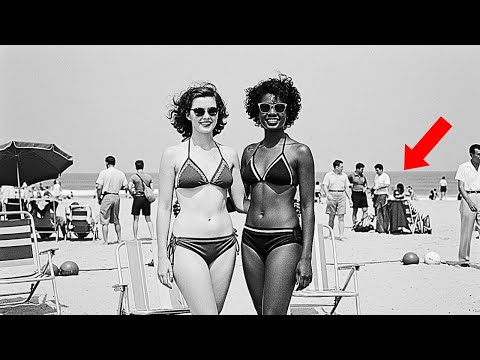
Elizabeth zoomed in on the background, and her breath caught. At least seven men in white shirts and dark trousers stood scattered across the sand, their postures unmistakable. They were watching. Waiting. One wore a police uniform, his arms crossed, his expression stern. Another pointed directly at the women, his finger extended like a loaded weapon. A third held a camera with a large flash, documenting the scene from a different angle. This wasn’t a casual snapshot. This was deliberate documentation.
She cross-referenced the image with her database of civil rights protests. Nothing came up. No newspaper coverage, no arrest records—as if the moment had been erased from history. Elizabeth called her research assistant, Marcus, then hesitated. Something told her this photograph was different. The women’s expressions—fearless yet aware, joyful yet purposeful—suggested they knew exactly what they were doing and what it might cost them.
For four hours, Elizabeth dissected every detail. The white sand and distant palm trees suggested Miami or Fort Lauderdale. The long shadows indicated late afternoon, around 4 or 5 p.m. The photographer had positioned the women to take advantage of the golden light—a deliberate choice. But it was the figures in the background that consumed her. She isolated each one, enlarging and enhancing them individually. The man closest to the women, about 20 feet behind them, wore a police uniform. His badge was visible, his belt equipped with gear. His stance radiated hostility. Further back, three men in civilian clothes stood in a tight group, all facing the women. One pointed; another appeared to shout; the third had his hands on his hips in confrontation.
Elizabeth contacted the historical society in Boston that had received Catherine Reeves’s estate donation. Three days later, a massive file arrived: letters, diary entries, newspaper clippings, and more photographs. She opened the first document—a diary entry dated May 15, 1956, written in elegant cursive.
“I met the most remarkable woman today at the Fellowship Church gathering. Her name is Dorothy and she teaches elementary school in Overtown. We talked for three hours about everything—literature, music, politics, faith. She has a perspective on this country that I, in my privileged whiteness, have never fully understood.”
Elizabeth’s pulse quickened. This was Catherine, the white woman in the photograph. Dorothy was her companion. She read on, watching their friendship develop. Catherine wrote about meeting Dorothy for coffee at integrated churches—the only places they could socialize without violating segregation laws. She wrote about her father’s uncomfortable disapproval. Then, an entry dated July 20, 1956:
“Dorothy and I have decided to do something about the beach situation. It is unconscionable that in this year of 1956, with the Supreme Court having ruled segregation unconstitutional two years ago, Florida still maintains separate beaches based on race. Dorothy proposed that we simply go together to Lumis Beach and refuse to leave. I agreed immediately.”
Elizabeth sat back, her hands trembling. This was it. The photograph was part of a planned civil disobedience action—a deliberate challenge to Florida’s segregation laws. And there was a journalist involved.
She searched Miami archives for black teachers in the Overtown neighborhood during the 1950s. After hours of cross-referencing, she found a lead: Dorothy Williams, an elementary school teacher at Booker T. Washington Elementary from 1953 to 1959. A phone call confirmed that Dorothy had been dismissed for “conduct unbecoming a teacher” in 1959—a vague charge that, in the segregation era, often meant civil rights activism.
Further research led Elizabeth to the archives of the Miami Times, the city’s historic black newspaper. There, buried in the August 10, 1956 edition, she found a small article: “Two women defy beach segregation.” The piece confirmed everything: Dorothy Williams, 24, and Katherine Reeves, 22, were removed from Lumis Beach by Miami police after refusing to leave the whites-only section. They were detained for several hours but released without charges after intervention by NAACP attorneys.
Elizabeth printed the article and pinned it to her research board. She then found Dorothy’s photograph in a 1955 school yearbook—the same warm smile, the same intelligent eyes. But what happened to her after 1959? The trail went cold. No marriage record, no death certificate in Florida. Finally, a reference in the Detroit Urban League archives: Dorothy Williams had moved to Michigan in 1960 and worked as a community organizer throughout the 1960s. She had been present at the March on Washington in 1963. She had lived until 2015, passing away at 83.
Elizabeth felt a surge of emotion. Dorothy had lived a long life of activism and service. And somewhere in Detroit, there might be family members who could fill in more of the story. But before she could pursue that lead, she found more diary entries from Catherine detailing the planning of the beach protest. The entry dated August 3, 1956, revealed the careful deliberation behind what seemed like a simple act.
“Dorothy and I met with Reverend Patterson and three others from the Fellowship Church tonight. We discussed every detail of next week’s beach action. Reverend Patterson warned us that the police might be violent, that we could be seriously hurt. Dorothy was calm, steady. She said she had already experienced violence just for existing as a black woman in the South. At least this violence would have a purpose. Her courage shames me.”
The entry continued: “We have decided on Saturday, August 11th, at 4:00 in the afternoon. Harry Benson, the photographer from the Miami Herald’s Negro Edition, will be there. He’ll position himself where he can photograph us and any police response. We will wear our swimsuits and carry towels and beach bags just like anyone else enjoying a summer day. We will walk onto the sand together, choose a spot, lay out our towels, and simply exist in that space. If approached by police, we will politely explain that we are breaking no legitimate law. We will not leave unless physically removed.”
Elizabeth cross-referenced the date and found that August 11, 1956 was indeed a Saturday. The Miami Herald’s coverage the following day mentioned a “minor incident” at Lumis Beach involving two females who were “escorted from the premises”—no details, no names. The deliberate vagueness told its own story.
But Catherine’s diary entries from after the event provided vivid details that no newspaper captured. “We arrived at the beach at 3:45. My hands were shaking as we walked from the parking area toward the water. Dorothy took my hand and squeezed it. ‘Whatever happens,’ she said, ‘we’ve already won just by being here together.’ We found a spot about 30 yards from the water. The moment we spread out our towels, I felt the change in atmosphere. Conversations around us stopped. People stared. A woman grabbed her children and moved them away as if we carried some disease. A man shouted something crude that I will not repeat here. But we sat down. We smiled. And Harry appeared with his camera.”
Elizabeth read on, her heart pounding. The entry continued: “Harry called out to us, asking if we would stand for a photograph. We stood together and I remember feeling a strange mixture of fear and exhilaration. The sun was warm on my skin. The ocean breeze was gentle. And beside me stood my dear friend Dorothy, brave and beautiful. For just a moment, I forgot about the hostile stares and the danger. I forgot about segregation and injustice. I simply stood on a beach with my friend, and it felt like the most natural thing in the world. But the moment did not last. As Harry snapped the photograph, I saw movement in my peripheral vision. A police officer was walking toward us, and behind him came several men in civilian clothes. Their faces were hard, angry.”
Elizabeth found a second photograph in Catherine’s collection—this one taken moments after the first. It showed the police officer confronting the two women, his hand raised in command. Dorothy stood with her chin lifted, defiant. Catherine stood beside her, one hand reaching toward her friend as if to offer support or protection. The tension was palpable.
Catherine’s diary continued: “The officer grabbed Dorothy’s arm. I stepped forward and said, ‘If you arrest her, you’ll have to arrest me, too.’ He looked at me with contempt and said, ‘Oh, I intend to, sweetheart.’ Within minutes, two more officers arrived. They escorted us roughly but not violently off the beach. The crowd watched in silence. Some seemed satisfied. Others looked uncomfortable, perhaps even ashamed. We were taken to a police station, fingerprinted, and held in separate cells for four hours before Reverend Patterson arrived with an NAACP attorney who secured our release.”
Elizabeth discovered that the beach protest was only the beginning. In the weeks following their arrest, both women became more deeply involved in Miami’s civil rights movement. Catherine’s diary entries from late August revealed the personal cost. “Father called from Boston yesterday. He is furious. Someone sent him a newspaper clipping about my arrest. He demanded that I return home immediately and cease this embarrassing behavior. He said I am bringing shame on the family. I told him that I would not stop, that this is the most important work I have ever done. He hung up on me.”
Dorothy’s perspective came through in a letter to her sister in Atlanta: “Dear Ruth, I know you worry about me, but I must tell you that I have never felt more alive or more purposeful than I do now. Yes, I lost my teaching position. Yes, I have been threatened and harassed. Yes, I wake up some mornings afraid of what might happen. But I also wake up knowing that I am fighting for something larger than myself. Catherine and I have formed a bond that transcends the artificial boundaries this society tries to impose.”
Elizabeth found evidence of more beach protests throughout the fall of 1956. Catherine and Dorothy returned to Lumis Beach three more times, each time with a few more supporters. The group grew from two to five to ten. Local newspapers continued to ignore or minimize the protests, but the Miami Times documented each one. By December, the beach protests had inspired similar actions at segregated swimming pools, parks, and public facilities across Miami.
But the resistance was growing more violent. Catherine’s diary entry from November 18th described an incident that left both women shaken: “We were attacked today. A group of men surrounded us as we tried to enter the beach. They shouted obscenities, threw sand, and one man spit directly in Dorothy’s face. She did not flinch. She stood there, dignified and calm, while this hateful man degraded himself with his action.”
Elizabeth discovered a gap in Catherine’s diary—no entries between December 1956 and March 1957. Worried, she searched other documents and found letters between Catherine and her mother that explained the silence. Catherine had been hospitalized in January 1957 after collapsing during a protest. The diagnosis was exhaustion and malnutrition. She had been working multiple jobs to support herself after her family cut off her allowance while devoting every spare moment to activism. Her mother had traveled to Miami and insisted Catherine return to Boston to recover.
But the letters revealed something Elizabeth had not expected: Catherine’s mother’s transformation. In a letter dated February 14th, 1957, she wrote: “My dear daughter, I came to Miami prepared to bring you home and convince you to abandon this dangerous path you have chosen. But after spending time with you, meeting Dorothy and the others in your group, and seeing firsthand the injustices you are fighting against, I find myself changed. I attended the Fellowship Church with you last Sunday and heard Reverend Patterson speak about the moral imperative to stand against evil. I watched Dorothy teach children in her makeshift classroom after losing her official position, and I saw the love and dedication she brings to that work. I am ashamed that I asked you to stop. I am ashamed that I prioritized comfort and reputation over justice. When you return to Miami—and I now understand that you must return—know that you have my support and my love.”
The reconciliation with her mother seemed to energize Catherine. When she returned to Miami in March, the diary entries resumed with renewed vigor. “Mother has done something extraordinary. She has used her connections in Boston to arrange speaking engagements for Dorothy and me at churches and universities throughout New England. We will spend April traveling, sharing our story, raising awareness and funds for the Miami movement. I never imagined my mother, who spent her life in comfortable society, would become an ally in this fight. It gives me hope that hearts can change.”
Elizabeth traced Catherine and Dorothy’s friendship through the following decades, piecing together the story from letters, photographs, and public records. After the speaking tour, both women continued their activism, though their paths diverged geographically. Catherine completed her degree at Radcliffe and became a civil rights attorney, working for the NAACP Legal Defense Fund. Dorothy moved to Detroit and became a community organizer, working on housing discrimination, education equity, and voter registration. But they remained in constant contact—weekly letters at first, then monthly as their lives became busier, but never ceasing.
A letter from Dorothy in 1963 showed the continued bond: “Dearest Catherine, I am writing this from a church in Birmingham, waiting to join the march tomorrow. I think of that first day on the beach in Miami seven years ago when we decided to simply exist together in a space that told us we could not. That small act of defiance led me here, to this movement that is finally forcing America to confront its sins. I carry you with me in every march, every sit-in, every moment of fear and courage.”
Catherine’s response, written two weeks later, revealed her anguish over the violence in Birmingham: “Dorothy, I watched the news footage of the dogs and fire hoses turned on peaceful protesters and I was physically sick. I searched every face in every photograph, terrified I would see yours among the injured. Thank God you are safe. I am coming to Birmingham. I cannot sit in my comfortable office in New York while you and others face such brutality.”
Elizabeth found photographs from the Birmingham campaign showing Catherine and Dorothy working side by side—registering voters, organizing legal support for arrested protesters, documenting the violence inflicted by authorities. The images showed them older now, no longer the carefree young women on the beach, but seasoned activists with determination etched into their faces.
Elizabeth compiled all her research into a comprehensive report and prepared an exhibition for the Smithsonian titled Friendship as Resistance: The Story of Catherine and Dorothy. The centerpiece was the original 1956 beach photograph, displayed alongside Catherine’s diary entries, Dorothy’s letters, newspaper clippings, and photographs documenting their decades of activism and friendship.
At the exhibition opening, Elizabeth stood before a crowd of historians, civil rights veterans, and members of both women’s families. She had located Catherine’s niece and Dorothy’s grandson, both of whom had provided additional materials and stories. “This photograph,” Elizabeth began, gesturing to the large print behind her, “appears to show a simple moment—two friends enjoying a day at the beach. But when we examine it closely, when we study the hostile figures in the background and understand the context in which it was taken, we see something far more profound. We see an act of resistance. We see two women who refused to accept the artificial boundaries of segregation, who risked their safety and futures to demonstrate that friendship and equality could exist despite laws and customs designed to prevent them.”
Dorothy’s grandson, Michael, spoke next. He held a framed letter his grandmother had written shortly before her death in 2015. “Grandmother wrote this to Catherine, who had died six months earlier. She never sent it, but she asked me to read it at her funeral.” He unfolded the paper and read: “My dearest Catherine, I am writing to you though you are gone because I cannot stop talking to you. For nearly 60 years, you were my sister, my ally, my conscience, and my joy. What we began on that Miami beach in 1956 changed both our lives, set us on paths we never could have imagined. But more than that, it proved something I have held on to through every difficult moment since: Love is stronger than hate. Friendship is stronger than prejudice. And ordinary people doing brave things can change the world. Thank you for seeing me, truly seeing me, in an era when most white people looked through black people as if we were invisible. Thank you for standing with me. Thank you for a lifetime of friendship that defied every rule designed to keep us apart.”
The room was silent for a moment after Michael finished reading. Then Catherine’s niece, Jennifer, stood and walked to the photograph. She touched it gently, her fingers tracing the outline of her aunt’s face. “Aunt Catherine kept a copy of this photograph on her desk for her entire life,” Jennifer said softly. “When I was a child, I asked her about it. She told me it was a picture of the moment she learned what courage really meant. Not the absence of fear, but the choice to act despite fear. She said Dorothy taught her that—and that it was the most valuable lesson of her life.”
Elizabeth concluded the evening by revealing the final piece of her research: the identities of some of the hostile figures in the background. Through extensive archival work and facial recognition comparison with other historical photographs, she had identified three of the watching men as known members of white supremacist groups active in Miami during the 1950s. One was later arrested for violence against civil rights protesters. Another had written letters to newspapers defending segregation with increasingly extreme rhetoric. “By identifying these figures,” Elizabeth explained, “we complete the story this photograph tells. We see not just the courage of Catherine and Dorothy, but the act of resistance they faced from those invested in maintaining white supremacy. This photograph captures a moment of confrontation between two visions of America—one based on racial hierarchy and segregation, the other based on equality and integration. We know which vision ultimately prevailed, though the struggle continues. And we know that it prevailed in part because of ordinary people like Catherine and Dorothy who refused to accept injustice and who demonstrated through their friendship that a different world was possible.”
The exhibition ran for six months and became one of the most visited in the Smithsonian’s history. The photograph was reproduced in textbooks, featured in documentaries, and shared widely on social media. Catherine and Dorothy’s story reached millions of people who had never heard of their beach protests or their decades of activism.
But perhaps the most meaningful impact was personal. After the exhibition opened, Elizabeth received dozens of letters from people who had been inspired by the story. Young people wrote about finding the courage to stand up against injustice in their own communities. Elderly people wrote about their own memories of the civil rights era, sharing stories that had never been documented. Most movingly, several people wrote about interracial friendships in their own lives—friendships that had been tested by family disapproval, social pressure, or outright hostility, but had endured.
One letter from a woman in her 70s read: “I saw your exhibition yesterday and wept. In 1959, I was best friends with a black girl in my high school in Alabama. My parents forbade me from seeing her outside of school. I was 17 and a coward. I chose my parents’ approval over my friend’s dignity. I have regretted that choice every day for 60 years. Seeing what Catherine and Dorothy were willing to risk—seeing the beautiful friendship they built and maintained across a lifetime—has given me the courage to finally try to find my old friend and apologize. Thank you for bringing this story to light. It is never too late to choose courage over comfort.”
Elizabeth kept that letter pinned to her office wall, a reminder of why the work of recovering and preserving these hidden histories mattered. The photograph of two young women standing together on a beach in 1956, smiling despite the dangers surrounding them, had become more than a historical artifact. It had become a symbol of resistance, friendship, and the enduring power of ordinary people to create extraordinary change.
As Elizabeth looked at the photograph one more time, she thought about Catherine’s words from one of her final diary entries, written in 2014, a year before her death. “People sometimes ask me if I have regrets about the path my life took—the family conflicts, the arrests, the threats, the years of struggle with so little recognition or reward. I tell them I have only one regret: that Dorothy and I did not meet sooner. That we did not have even more years of friendship than the 60 we were blessed to share. Everything else—every sacrifice, every difficult moment—was worth it. We changed things in small ways and sometimes in larger ones. But more importantly, we proved that love and friendship could transcend the barriers society erected. We lived as if the world we wanted already existed. And in doing so, we helped bring that world a little bit closer to reality.”
Elizabeth saved her research and closed her laptop. The rain had stopped, and a pale winter sun was breaking through the clouds. She thought about the two women on the beach, their courage, their friendship, their refusal to accept the world as it was. And she knew that their story was far from over—it would continue to inspire, to challenge, and to remind us that even the smallest acts of defiance can change the world.
Michael smiled through his tears and added one final detail. “Grandmother never knew who those men in the background were. She said it didn’t matter—they were just fear wearing faces.” The crowd laughed softly, the tension breaking like a wave.
Later that night, Elizabeth stood alone before the photograph, the museum empty and quiet. She traced the women’s smiles with her eyes. Two friends. One beach. A world that said no. They had said yes anyway.
The rain had stopped outside her window. Somewhere in the archive, a new file waited—another hidden story, another ordinary act of courage. Elizabeth turned off the lights, but the photograph seemed to glow in the dark.
What small act of courage will you choose today?
Report this article
Select a reason for reporting:






