The basement archives of the Atlanta History Museum smelled of old paper and preservation chemicals. David Richardson moved carefully between rows of filing cabinets, his practiced hands sorting through boxes of donated photographs that had arrived last week from an estate sale. At 42, he’d spent 15 years as the museum’s chief archivist, cataloging thousands of images that documented the city’s complex history. He opened a box labeled “Auburn Avenue Collection, Early 1900s” and found it filled with photographs wrapped in tissue paper. Auburn Avenue had been the heart of Atlanta’s prosperous black community in the early 20th century—home to businesses, churches, and families who’d built wealth and influence despite rigid segregation.
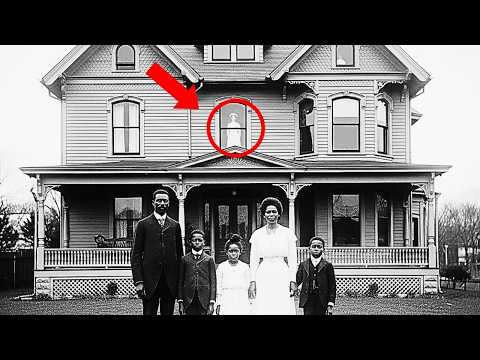
David unwrapped the photographs one by one, making preliminary notes. Most showed typical scenes: church gatherings, business establishments, family portraits. Then his hands touched a larger photograph, roughly 10 x 12 inches, mounted on thick cardboard backing. The image showed a handsome black family posed in front of a substantial two-story house. The father stood tall in a dark suit, his posture dignified and proud. The mother wore an elegant white shirtwaist and dark skirt, her hair styled fashionably. Three children stood with them—two boys in matching sailor suits and a young girl in a white dress with ribbons, perhaps six years old.
What struck David immediately was the quality of everything in the photograph. The house behind them was well-maintained with ornate trim and a wraparound porch. The family’s clothing was expensive, tailored—not the simple garments often associated with black families in historical photographs. This was clearly a family of means, of education, of status within their community. David turned the photograph over. On the back, written in careful script: “The Family, Auburn Avenue, June 1908.” No names, no other details. He made a note to cross-reference the address with city directories from that period, but something about the image nagged at him.
He carried it to his examination table and positioned his magnifying lamp over it, studying the details more carefully. The father’s hand rested protectively on his wife’s shoulder. The mother’s hand held the young daughter’s. The boys stood straight and serious, as was common in formal photographs of the era. Then David’s attention was drawn to the house behind them—specifically to a second-floor window visible over the mother’s left shoulder. He adjusted his lamp and leaned closer. There was something in that window, a pale shape partially obscured by the curtain. At first, he thought it might be a reflection or a flaw in the photograph. But as he increased the magnification, the shape resolved into something unmistakable.
A face. A woman’s face pressed against the glass, her hands visible on either side of her face, as if she were looking out—or trying to be seen.
David sat back, his heart racing. The woman in the window was white. He could see that clearly now—pale skin, light-colored hair, and her expression, even in the grainy resolution of a century-old photograph, was one of distress, fear perhaps, or desperation. He checked the photograph again, examining every detail of the family posed outside. They showed no awareness of the figure in the window. Their expressions were calm, dignified, focused on the camera. But that face in the window changed everything about this image.
David pulled out his reference materials on Atlanta in 1908. The city was rigidly segregated with strict social codes governing interaction between races. The idea of a white woman living in—or being hidden in—a black family’s home was virtually unthinkable. It would have been dangerous for everyone involved, potentially deadly. Yet there she was, captured accidentally by the camera, a figure that shouldn’t exist according to everything David knew about that time and place.
He made careful notes and took several photographs of the image with his professional camera, particularly enlarging the window section. Tomorrow he would begin the process of trying to identify this family and understand what this photograph was really documenting. But already David sensed he’d found something significant. Not just a family portrait, but evidence of a story that had remained hidden for over fifty years—waiting for someone to look closely enough to see what the camera had accidentally preserved.
David arrived at the museum early the next morning, the mysterious photograph occupying his thoughts through a restless night. He’d made high-resolution scans of the entire image with special attention to the window where the woman’s face appeared. Under digital enhancement, her features became even clearer: young, perhaps early twenties, with an expression of unmistakable fear. His first task was identifying the house. Auburn Avenue in 1908 had been home to Atlanta’s most successful black professionals—doctors, lawyers, business owners who had built substantial homes in one of the few areas where they could live without constant white interference.
David pulled city directories from 1908 and 1910, cross-referencing addresses with property ownership records. The architecture visible in the photograph was distinctive: Queen Anne style with ornate trim, a wraparound porch, and distinctive gable windows. Only a few houses on Auburn Avenue matched that description. David made a list of addresses and their owners according to the 1908 directory. One entry caught his attention: 412 Auburn Avenue, owned by Dr. Marcus Hayes, physician. The directory listed his household as including his wife Elizabeth, a teacher, and three children. No mention of any white woman. No domestic servants listed, which itself was notable, as wealthy families typically had help documented in census records.
David pulled newspaper archives from 1908, searching for any mentions of Dr. Hayes or his family. He found several references. Dr. Hayes had been prominent in the black community, one of only a handful of black physicians in Atlanta. He’d treated patients others refused to see, testified in court cases involving black victims, and written articles about public health for black newspapers. That kind of prominence would have made him a target. David found evidence of this, too: newspaper articles about threats against “uppity” black professionals, reports of violence, editorials warning black citizens to “know their place.” Dr. Hayes’s name appeared in several articles about black professionals who challenged segregation’s boundaries.
David sat back, thinking. A prominent black doctor living in a fine house in a black neighborhood—with a white woman hidden in his home. What possible circumstances could explain that? His mind ran through possibilities, all of them dangerous, all of them potentially deadly for everyone involved. He needed to find out more about Dr. Hayes and his family. The photograph was dated June 1908. David began searching newspapers from May through August of that year, looking for any unusual incidents, any stories that might connect to what the photograph revealed.
On his third day of searching, he found something. A small article in the Atlanta Constitution from July 12, 1908: “Fire at Auburn Avenue Residence. Authorities investigating suspicious blaze at home of colored physician. Family escaped unharmed. Cause under investigation.” The article gave the address: 412 Auburn Avenue. Dr. Hayes’s home had burned less than six weeks after this photograph was taken. David’s hands trembled as he searched for follow-up articles. There were two more brief mentions: one stating the fire was ruled accidental, another noting that the Hayes family had relocated temporarily while repairs were made. But David’s historian’s instinct told him there was more to the story. A suspicious blaze that was quickly ruled accidental at the home of a prominent black civil rights advocate—shortly after a photograph was taken that showed a white woman hidden in the house.
He needed to find descendants of the Hayes family, or anyone who might remember the story this photograph had accidentally documented. David spent the following week tracking the Hayes family through historical records. Census data from 1910 showed them still at the Auburn Avenue address with the same three children. By 1920, Dr. Hayes had passed away; the death certificate listed heart failure at age fifty-two. Elizabeth Hayes continued teaching until 1935, according to school employment records. The three children—Marcus Jr., James, and Sarah—had all attended college, unusual for any children in that era, but particularly remarkable for black children in the segregated South.
Marcus Jr. became a lawyer, James a minister, and Sarah a social worker. All three had stayed in Atlanta, building on their father’s legacy of community service. David found an obituary for Sarah Hayes from 1987. She’d been the last surviving child, passing away at age eighty-five. The obituary mentioned surviving family: three children, eight grandchildren, and numerous great-grandchildren. One granddaughter, Dr. Patricia Hayes, was listed as a professor at Spelman College.
David’s heart leaped. She might still be alive, still teaching. He called Spelman’s history department and learned that Dr. Patricia Hayes had retired five years ago but still lived in Atlanta. The department secretary, after David explained his work at the history museum, agreed to pass along his contact information.
Dr. Hayes called him that evening. Her voice was warm but cautious. “The secretary said you found a photograph of my great-grandparents?”
“I believe so,” David said carefully. “Dr. Marcus Hayes and his family, taken in front of their Auburn Avenue home in June 1908. But there’s something unusual in the photograph that I’d like to discuss with you in person, if you’re willing.”
There was a pause. “Unusual how?”
“I’d rather show you,” David said. “It’s something that raises questions about what was happening in your great-grandfather’s household that summer. Historical questions that I think you might be able to help me understand.”
They agreed to meet the next day at the museum. David spent the evening preparing—making prints of the full photograph and detailed enlargements of the window where the woman’s face appeared. He gathered all the research he’d compiled about Dr. Hayes, the fire, and the family’s history.
Dr. Patricia Hayes arrived promptly at ten. She was a woman in her sixties with the same dignified bearing David had noticed in the original family photograph. He led her to a private viewing room where he’d laid out the materials.
“This is your great-grandfather’s family,” he said, showing her the photograph.
Patricia leaned over it, her expression softening. “I’ve never seen this picture. My grandmother Sarah spoke about her childhood, but photographs were rare. They lost many possessions in a fire.” She looked up sharply. “You mentioned something unusual.”
David showed her the enlargement of the window. Patricia stared at it for a long moment, her face going pale. “Is that a white woman?”
David confirmed. “In the second-floor window of your great-grandfather’s house, visible in the background of this family portrait. I’ve researched extensively, and there’s no record of any white person living in or working for your great-grandfather’s household. Yet she’s clearly there, and her expression suggests distress.”
Patricia sat down heavily. She was quiet for so long that David began to worry he’d upset her. Then she spoke, her voice barely above a whisper. “My grandmother told me a story once, when I was in college studying history. She made me promise never to repeat it while certain people were still alive. But everyone from that generation is gone now.” She looked up at David. “She said her father saved a white girl’s life in 1908, and it nearly destroyed their family.”
Patricia Hayes pulled a small notebook from her purse—the kind academics carry everywhere. She flipped through pages of handwritten notes, clearly gathered over years of family history research. “My grandmother Sarah was six years old in the summer of 1908,” Patricia began. “She was the youngest child, and by her own admission, she remembered events from that time with a child’s clarity—the feelings more than the facts. But certain incidents stayed with her vividly.”
David pulled out his own notebook, ready to document everything Patricia shared.
“In May of 1908, a white man named Harold Garrett came to my great-grandfather’s medical office late at night. This was highly unusual. White people didn’t typically seek treatment from black doctors, and they certainly didn’t come after hours. But Garrett was desperate. His daughter, Anne, had attempted suicide by swallowing poison. He couldn’t take her to a white hospital or doctor because the circumstances were suspicious, and he feared legal consequences.”
Patricia’s voice hardened. “The circumstances were that Harold Garrett had been beating his daughter for months, trying to force her into a marriage with a business associate. Anne had refused, and he’d become increasingly violent. The suicide attempt was her way out.”
David felt sick. “Your great-grandfather treated her. He saved her life.”
“But in doing so, he saw the evidence of long-term abuse—broken bones that had healed incorrectly, scars, malnutrition—and she was terrified of returning home. She begged my great-grandfather to help her escape. So he hid her,” Patricia said.
David nodded slowly, understanding dawning. “In the South in 1908, with strict segregation and social codes, who would think to look for a white girl in a black family’s home? It was brilliant precisely because it was unthinkable. But it was also incredibly dangerous.”
“If discovered, my great-grandfather could have been lynched. His entire family could have been killed. The black community’s relative safety in that neighborhood could have been destroyed by white mob violence.” She pointed to the photograph. “This picture was taken in early June, about three weeks after Anne arrived. My grandmother said Anne stayed in the upstairs guest room, kept away from windows, never seen by visitors. The family told curious neighbors they had a sick relative visiting. In a close community, people accepted that explanation and didn’t pry.”
“But she appeared in this photograph,” David said, “accidentally.”
“My grandmother remembered the day clearly. A photographer had come to take a family portrait. My great-grandfather wanted to document their home and family before the boys went to boarding school that fall. Anne had been instructed to stay away from windows during the session, but apparently she watched anyway. The photographer never noticed, focused on positioning the family in the foreground.” Patricia touched the image gently. “My grandmother said Anne was lonely, curious about the world outside her room. For those few minutes while the family posed, she probably felt connected to them—watching a family that treated each other with love and respect, everything her own family had denied her.”
David studied the woman’s face in the window again, seeing it now with new understanding. Not just fear, but longing. The hands pressed against the glass weren’t just seeking help. They were reaching toward the kind of family life she’d never known.
“What happened to her?” David asked. “The fire in July. Was that connected?”
Patricia’s expression grew grim. “Harold Garrett discovered where his daughter was hiding. My grandmother never knew how—whether he’d bribed someone, followed a lead, or simply became suspicious of the black doctor who’d treated Anne. But he came with others, white men who believed they had the right to destroy a black family that dared harbor a white girl.”
Patricia continued, her voice steady but filled with old pain. “The attack came on the night of July 10th, 1908. My grandmother Sarah remembered being woken by her mother, who was moving quickly through the house, gathering the children. She could hear men shouting outside, could smell smoke.”
David listened intently, imagining the terror that must have filled that house. Harold Garrett and approximately a dozen other men had surrounded the house. They were throwing rocks, breaking windows, and had started a fire on the front porch. They demanded that Anne be turned over to them immediately. But my great-grandfather knew that if he simply handed her over, she’d be returned to her abusive father—or worse, punished for disgracing her family by staying with black people.
Patricia pulled out another document from her folder, a photocopied page from what appeared to be a personal diary. “This is from my great-grandmother Elizabeth’s journal. She rarely wrote about that night, but this entry is from a week afterward, when the family had temporarily relocated. She wrote: ‘Marcus stood at the door and told those men that Anne Garrett was under his medical protection and would not be returned to an abusive household.’ They laughed at him—a black man speaking of rights and protection to white men—but he didn’t move.”
David felt chills run through him. The courage that must have required, facing down a violent mob while protecting a white girl in his own family.
“The fire was spreading quickly,” Patricia continued. “But something unexpected happened. The black community responded. My grandmother said she remembered looking out the back window and seeing neighbors arriving—dozens of them, maybe over a hundred men and women from Auburn Avenue and the surrounding blocks, coming with buckets of water, with determination, with the understanding that if this family was destroyed, none of them were safe.”
“They fought the fire and confronted the mob?” David asked.
“More than that. Several of the men were veterans, had served in the Spanish-American War. They came armed and made it clear that burning this house would not be unopposed. The white mob hadn’t expected organized resistance. They’d thought they could terrorize one black family without consequence.” Patricia’s voice filled with pride. “My great-grandfather had earned immense respect in that community. He’d treated people regardless of their ability to pay, had stood up for civil rights, had helped families in crisis. When his home was attacked, the community defended him as he defended them.”
“What about the police?” David asked.
Patricia laughed bitterly. “They arrived eventually—after the community had already put out the fire and the white mob had dispersed. The official report called it an accidental fire, cause unknown. No mention of the attack, the mob, or the true circumstances. That was typical. Authorities rarely acknowledged white violence against black citizens.”
David looked at the photograph again—at the Hayes family standing proudly in front of their home, unaware that in just weeks they’d face this crisis. And at Anne’s face in the window, the white girl whose desperate situation had sparked such violence.
“Where was Anne during the attack?” he asked.
“That’s where the story gets more complicated,” Patricia said. “And where my grandmother’s memory becomes less clear. She remembers her father taking Anne down to the basement, to a hidden root cellar that connected to old tunnels—remnants of the Underground Railroad that had once helped enslaved people escape. Anne was kept there during the worst of the attack.”
David’s historian mind raced. Underground Railroad tunnels beneath Auburn Avenue homes. It made sense. Atlanta had been a crucial junction point for people fleeing slavery, and the infrastructure that had saved lives before the Civil War apparently still served that purpose decades later.
“After the mob dispersed, my great-grandfather knew Anne couldn’t stay. Her presence had nearly gotten his family killed, but he also couldn’t simply return her to her father.” Patricia carefully unfolded another document—a letter yellowed with age, written in elegant script. “This is from Anne Garrett herself, written in 1952 to my grandmother Sarah. They’d maintained contact secretly over the years. Anne wanted Sarah to know what had happened after that terrible night.”
She handed the letter to David, who read it carefully.
Dear Sarah, you were so young that summer, I doubt you remember me clearly. But I remember you—a bright-eyed child who would sometimes peek into my room and smile at me, making me feel less alone. Your father saved my life twice, once from poison and once from a fate worse than death. I want you to know what became of me after I left your home, so you can tell your children someday that courage and compassion can triumph over hate.
After the fire, your father contacted a network of people—some black, some white abolitionists who’d once helped escaped slaves. They arranged for me to be smuggled out of Atlanta, hidden in a freight wagon heading north. I traveled to Philadelphia with false papers, my hair cut short, dressed as a boy to avoid detection. In Philadelphia, Quaker families took me in, helped me finish my education, and eventually supported me in becoming a teacher. I married a good man, a bookshop owner, who treated me with a kindness I’d never known. We had three children, and I made sure they understood that people of all races deserve dignity and respect—a lesson I learned from your family.
I never saw my father again. He died in 1920, and I felt no sorrow. But I think often of your father, your mother, your brothers, and you. Your family risked everything for a stranger simply because it was right. That kind of courage shaped who I became and how I raised my own children.
David read the letter twice, moved by Anne’s words. “Did your grandmother maintain contact with her?”
“Christmas cards, occasional letters—always carefully worded in case they were intercepted. Anne sent photographs of her children, and my grandmother sent pictures of hers. Two families separated by hundreds of miles and racial boundaries, connected by one summer when courage mattered more than fear.”
Patricia pulled out more photographs—images of Anne in her later years, surrounded by children and grandchildren, her expression peaceful and content. She looked nothing like the frightened young woman in the window of the 1908 photograph.
“Anne passed away in 1976,” Patricia said. “Her obituary mentioned she’d been a lifelong activist for civil rights and women’s rights—that she’d marched in suffrage parades, had donated to the NAACP, had taught generations of children to question injustice. But it didn’t mention why. Didn’t tell the story of a black family that saved her life when her own white family tried to destroy it.”
David looked at all the material spread across the table—the original photograph with Anne’s face barely visible in the window, the diary entries, the letters, the later photographs. Together they told a story that challenged simple narratives about race relations in the early twentieth century.
“Why didn’t your family share this story publicly?” David asked.
Patricia’s expression grew complicated. “Several reasons. First, while Anne was alive, revealing the story could have endangered her. Her father had connections, and even decades later, there could have been repercussions. Second, the black community in Atlanta had to be careful. Reminding white people of times when black families had protected white people—had acted with more humanity than white families showed—that could spark backlash.” She paused, gathering her thoughts. “But the main reason was that my great-grandfather didn’t do what he did for recognition or credit. He did it because a young woman needed help, and he had the skills and courage to provide it. The photograph accidentally documented Anne’s presence, but my great-grandfather never wanted proof or praise. He wanted Anne to be safe.”
David understood, but he also felt strongly that the story needed to be told. “Now times have changed. Anne’s gone. Your great-grandparents are gone. The people who might have caused trouble are gone. This story—of moral courage, of cross-racial compassion, of community solidarity—it needs to be known.”
Over the following months, David worked closely with Patricia Hayes to create a comprehensive historical exhibition. They titled it Hidden in Plain Sight: Stories of Courage in Jim Crow Atlanta. The 1908 family photograph served as the centerpiece, with detailed explanations of what the image accidentally revealed. Patricia provided family documents, photographs, and oral histories that filled in the full story. David researched the broader context—Atlanta’s racial dynamics in 1908, the violence that black communities faced, and the networks that helped people escape dangerous situations despite rigid segregation.
They also tracked down Anne Garrett’s descendants. Anne’s granddaughter, Carol, now in her sixties and living in Boston, was shocked to learn the full story of how her grandmother had escaped Atlanta.
“Grandmother told us she’d run away from an abusive home,” Carol said during a phone call with David and Patricia. “She said kind people had helped her reach Philadelphia, but she never specified who those people were or the details of her escape. I always assumed she’d been helped by white abolitionists or Quakers.”
“She was,” Patricia said gently. “Eventually. But the people who saved her life initially—who hid her when it was most dangerous—were my great-grandparents. A black family who risked everything.”
Carol was silent for a long moment. Then her voice came through thick with emotion. “I need to meet you. I need to see this photograph and hear the full story. And I need to thank your family, even though it’s generations too late.”
Carol flew to Atlanta for the exhibition’s opening. The moment she and Patricia met was emotional—two women, one white and one black, descendants of families whose fates had intertwined during one desperate summer over fifty years ago. They embraced, both crying, both understanding that they carried forward a legacy of courage and compassion that transcended the racial hatred of their ancestors’ time.
The exhibition opened on a Saturday in March 1960. The timing was significant. The sit-in movement had begun in Greensboro just two months earlier, and Atlanta’s own student activists were organizing protests against segregated lunch counters. The story of Dr. Hayes and Anne Garrett resonated powerfully with the young activists who saw parallels to their own struggle.
David had worried that white visitors might stay away, uncomfortable with a story that showed black moral superiority and white violence. But the opposite happened. Hundreds of people came—both black and white—drawn by the mystery advertised in the exhibition’s promotional materials: a family photograph with an unexplained figure in the window.
The photograph itself was displayed with careful lighting that emphasized both the dignified family in the foreground and Anne’s barely visible face in the window. Beside it, enlarged details made her presence unmistakable, along with explanatory text that told the full story without minimizing the danger or the courage required. Additional displays showed Anne’s letter to Sarah, photographs of her later life, and documents about the Hayes family’s continued civil rights work—Dr. Marcus Hayes Jr.’s legal career fighting segregation, James Hayes’s ministry that preached equality, and Sarah Hayes’s social work helping abuse victims, all showing how that summer of 1908 had shaped their life’s work.
But the most powerful display was a simple one: the 1908 photograph next to a 1955 photograph of Anne and Sarah finally meeting in person after forty-seven years of correspondence. Both were elderly women by then, but their embrace showed the bond that had persisted across decades and racial boundaries.
Carol stood before this display during the opening, with Patricia beside her. “Our grandmothers stayed connected all those years,” Carol said softly. “They understood something that most people in their time didn’t. That humanity matters more than race. That courage can bridge any divide.”
A young black woman, perhaps twenty years old, approached them. “Excuse me—are you the descendants mentioned in the exhibition?” Patricia and Carol both nodded. The young woman’s eyes filled with tears. “I’m a student at Spelman. We’re organizing sit-ins at downtown lunch counters, and we’re facing violence, threats, arrests. But this story—knowing that people have been fighting this fight for generations, knowing that courage and compassion existed even in the darkest times—it gives me strength to keep going.”
Patricia took the young woman’s hand. “My great-grandfather would want you to know that the fight is worth it. That standing up for what’s right, even when it’s dangerous, is the only way change happens.”
The exhibition’s success brought unexpected visitors. An elderly white woman approached David during the second week, her hands trembling as she held out a faded photograph. “My grandmother knew Anne Garrett,” she said quietly. “She always said Anne was sweet, but terribly afraid of her father.” David documented the image and her testimony, adding another piece to the growing mosaic of evidence.
A black man in his eighties came forward too. “My grandfather was one of the men who fought that fire,” he said. “He told me it was the night the community learned they could stand together against white violence.” David realized the Hayes family’s crisis had been a turning point—a precedent of collective defense that protected the whole neighborhood.
Anne’s other granddaughter sent copies of journals found in an attic. One entry, from June 1908, read: “I’m ashamed that people of color must risk everything to show basic human decency that white people withhold.” David incorporated every new fragment into the exhibition, watching a hidden history finally breathe.
On the fiftieth anniversary of the opening, an elderly woman donated a small leather journal—Dr. Hayes’s private reflections. The final entry, from the night of the fire, read: “My children will remember that their father chose what was right over what was easy. That is the only legacy that matters.”
The photograph remained what it had always been—a family portrait taken on an ordinary summer day. But it was also a document of resistance, preserved only by chance, waiting for someone to look closely enough to see.
And once seen, that story changed everything. So tell me—what hidden truths might be waiting in the old photographs you’ve never truly examined?
Report this article
Select a reason for reporting:






