Marcus Johnson’s hands trembled as he peeled back the acid-free tissue paper. The photograph inside was supposed to be a testament to racial equality in 1870—a white boy and a black boy standing shoulder to shoulder, equals in a time of deep division. But as the sepia image emerged under the museum’s bright lights, something about the black boy’s collar caught his eye. A tiny mark, barely visible, that would shatter everything the donor believed.
Patricia Hamilton, the donor, watched him with pride. “My great-great-grandfather is the boy on the left,” she said, her voice thick with emotion. “Our family always believed this photograph represented something extraordinary.” Marcus nodded, but his pulse quickened. He had seen that mark before—in his doctoral research on post-emancipation labor systems.
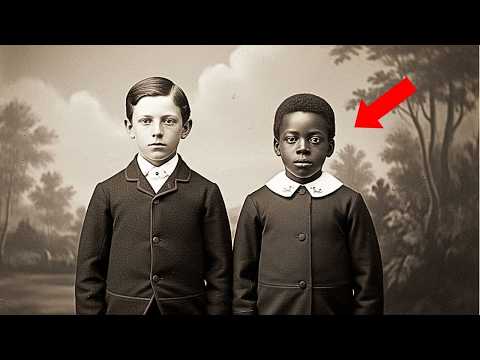
He leaned closer, adjusting the light. The white boy’s collar was plain, starched. But the black boy’s collar bore a small cross within a circle, embroidered into the fabric. It was a symbol used in Pennsylvania during Reconstruction to mark apprenticed black children—a brand of control disguised as benevolence.
“Do you know anything about Samuel?” Marcus asked, keeping his voice steady. Patricia’s smile faltered. “Only that he was Thomas’s friend. They were equals.” Marcus didn’t respond. He knew the truth would be far more painful.
Later that night, alone in his office, Marcus stared at the high-resolution scan. The two boys looked back at him, their expressions unreadable. What had they been thinking? Had Samuel chosen to stand there, or had he been ordered? The mark on his collar told a different story—one of legal bondage, not friendship.
He pulled up the 1870 census. Thomas Hamilton, age 10, lived on Spruce Street with his wealthy merchant father. And there, listed as a laborer, was Samuel—age 10, black, born in Virginia. No last name. No school attendance recorded. The single detail contradicted Patricia’s story immediately.
Marcus’s stomach tightened. He searched Pennsylvania’s apprenticeship laws and found the Act of March 1866, which allowed judges to bind out black children as unpaid laborers. The next morning, he drove to the city archives and pulled the indenture records. In March 1867, he found it: “Samuel, a colored male child of approximately 7 years of age, orphaned, is hereby bound as an apprentice to Jonathan Hamilton… until he shall reach the age of 21.”
There was no signature from Samuel. No consent from any parent. He was simply declared an orphan and bound. The phrase “formerly property of Robert Fletcher, deceased” struck Marcus like a blow. Samuel had been enslaved, separated from his family, and then processed into a new form of bondage.
Marcus thought of the photograph. It had been taken three years after Samuel’s indenture. Had Thomas and Samuel truly been friends? Or had Samuel simply been required to be Thomas’s companion—to play with him, to lose at games, to smile on command? The positioning that seemed so progressive might have been Jonathan Hamilton’s way of demonstrating his own enlightened attitudes. But “almost” was the operative word.
He needed to find out more. The photographer’s records might hold the key. At the Historical Society of Pennsylvania, Marcus found James Morrison’s business ledger. In June 1870: “Hamilton, J. Portrait, two subjects, carte de visite format, six copies, $3.50.” Two subjects—not “family portrait,” not “two sons.” Just two subjects.
Then he found a letter from Jonathan Hamilton to Morrison, dated two weeks before the sitting. “I wish to commission a portrait photograph of two boys, my son Thomas and his companion Samuel. It is my desire that they be positioned as equals in the frame… I wish this portrait to serve as documentation of my household’s Christian values.”
Marcus read it three times. Hamilton had specifically requested that the boys be photographed as equals. This wasn’t a spontaneous portrait of friendship—it was a carefully planned statement. The word “companion” was loaded, often meaning an assigned playmate, not a genuine friend. And “children under my care”—not “my children”—was a telling distinction.
The church records confirmed it. Samuel was listed only as “colored boy, household of J. Hamilton,” never as a member. He was present, but not truly part of the congregation. A letter from the minister advised that Samuel be taught “obedience and contentment” rather than complex theology. “A negro child bound as an apprentice needs to understand his duties before God and man, and to accept his place in the divine order with grace and humility.”
Marcus felt sick. Then came an email that changed everything. Dr. Claudia Warren, a retired professor, claimed to be Samuel’s great-great-granddaughter. “My family oral history includes details that match your research,” she wrote. “Would you be willing to meet?”
They met at a coffee shop. Claudia pulled out a faded photograph of an elderly black man. “This is Samuel Freeman,” she said. “He took the surname Freeman after his apprenticeship ended.” Samuel had rarely spoken of his childhood, but near the end of his life, he told stories. “The Hamilton family was not cruel,” Claudia said. “But he was never free. He worked from dawn until late at night, and his job was partly to be Thomas’s playmate—to keep him entertained, to lose at games when necessary.”
Then she revealed the most chilling detail. “When Samuel first arrived, Mrs. Hamilton sewed a mark into all his shirt collars—a cross inside a circle. She said it was to identify his clothing, but Samuel understood. It marked him as property.” He burned every marked shirt the day his indenture ended.
Marcus knew he had to tell Patricia. The next afternoon, he sat her down and walked her through everything—the indenture, the census, the church records, the collar mark. Patricia’s face grew pale. “So they weren’t really friends,” she whispered. “Samuel wasn’t there by choice.”
“That’s what the evidence suggests,” Marcus said gently. “The Hamilton family may have believed they were being benevolent, but the fundamental reality was one of coercion and control.”
Patricia wiped her eyes. “My whole life, we’ve told the story of how progressive our ancestors were. I’ve shown this photograph to my grandchildren and told them to be proud.” She looked at the image on the screen. “Now I see something else. Samuel looks trapped.”
Marcus nodded. “I met with Samuel’s great-great-granddaughter. Her name is Dr. Claudia Warren. Would you be willing to meet her?” Patricia agreed.
Two weeks later, the museum hosted a gathering. Patricia and Claudia stood together in front of the photograph. “I’m here to correct a family story that has been told for five generations,” Patricia began. “My ancestors did not treat Samuel Freeman as an equal. He was an apprenticed child, bound by a legal system designed to maintain control over black children after slavery ended.”
Claudia stepped forward. “Samuel survived, built a life of freedom, and raised children who knew their worth. But he carried the trauma always. He understood that good intentions don’t erase oppression.” The two women embraced, and the audience applauded.
The photograph remained on display, now with Samuel’s true story told beside it. The mark on his collar—once invisible—now stood as a symbol of historical injustice and the importance of looking closely, questioning comfortable narratives, and insisting that every person’s story deserves to be told with honesty.
But for Marcus, one question lingered. What had Thomas known? Had he ever understood what his childhood had been built on? The answer, like so much of history, remained buried in the silence of the past—waiting for someone to look closely enough to find it.
Three weeks after the exhibit opened, a letter arrived at Marcus’s office in a cream-colored envelope with a Richmond postmark. The handwriting was spidery and old, the kind that belonged to someone who had learned penmanship in another century. Marcus turned it over twice before opening it.
The sender introduced herself as Eleanor Brandt, age eighty-one, of Richmond, Virginia. “I believe I am descended from the Fletcher family,” she wrote. “Robert Fletcher was my great-grandfather’s brother. I read about your exhibit in a newsletter and I have something that may be of interest—a ledger kept by Robert during the war years.”
Marcus read the letter twice. Robert Fletcher was the man named in Samuel’s indenture as his former enslaver. A ledger from that household could be the missing piece—documentation of Samuel’s earliest years, perhaps even the names of his parents.
He called Eleanor that afternoon. Her voice was thin but clear, and she spoke with the unhurried precision of someone who had spent decades considering difficult things. “I inherited the ledger from my mother,” she said. “It’s been in a trunk for years. I never looked closely at it until I read about your exhibit. There are names in it, Mr. Johnson. Names of people my family owned.”
She paused. “I want it in a museum. I don’t want it in my house anymore.”
The ledger arrived four days later, packed in a cardboard box with more care than the book itself deserved. It was a merchant’s daybook, bound in cracked brown leather, its pages foxed and water-stained. Robert Fletcher had recorded everything—cotton sales, shipments of tobacco, the purchase of a new wagon—and, in the margins and between the business entries, the names of the people he held.
Marcus put on his cotton gloves and began to read. The entries were terse, transactional. “Boy child born to Eliza, March 1860. Named Samuel by Eliza.” Marcus’s breath caught. There it was—Samuel’s birth, recorded not as a birth but as an increase in property, yet the words named Samuel by Eliza glowed on the page like a small act of defiance.
Eliza. Samuel’s mother had a name. She had chosen her son’s name. Marcus turned the pages with shaking hands.
Later entries charted the war’s approach. In 1862, Fletcher noted the sale of several enslaved people to a trader bound for the Deep South—“Eliza and two others, sold, $1,800.” Samuel, then two years old, was not listed among those sold. Marcus stared at the entry, his jaw tight. Samuel had been separated from his mother when he was barely old enough to remember her face.
Fletcher died in 1864, and the ledger’s final entries were made by another hand. Marcus closed the book and sat in silence for a long moment. Samuel had not been an orphan, not truly. He had been made one—by sale, by death, by a legal system that preferred him nameless and alone.
He called Claudia that evening. When he told her about Eliza, she was quiet for a long time. “We always wondered,” she finally said. “My grandfather said Samuel used to hum a song he couldn’t remember learning. Maybe it was hers.”
Marcus looked at the photograph on his desk, at the two boys frozen in their careful stillness. Samuel’s story was no longer a single mark on a collar. It was a mother’s voice, a name chosen in bondage, a song half-remembered across a lifetime. The past, he thought, was never truly silent—it was only waiting for someone to listen.
Marcus arranged for the ledger to be digitized and shared with Claudia and Patricia. When Patricia saw the entry—named Samuel by Eliza—she wept again, but this time for a mother she had never known to look for. “His name came from love,” she said. “Not from a judge or a merchant. From his mother.”
The museum added Eliza’s story to the exhibit, a single line of ink transformed into a memorial. Claudia brought her grandchildren to see it, pointing to the words on the panel. “That’s your ancestor,” she told them. “She named him, and she loved him, and that love outlasted everything they did to him.”
Marcus stood by the photograph one last time as the museum closed for the evening. The two boys looked back at him, still solemn, still holding their secrets. But now the silence around them was filled—with a mother’s song, a daughter’s courage, and a truth finally told.
What names in your own family history are waiting to be spoken aloud?
Report this article
Select a reason for reporting:






