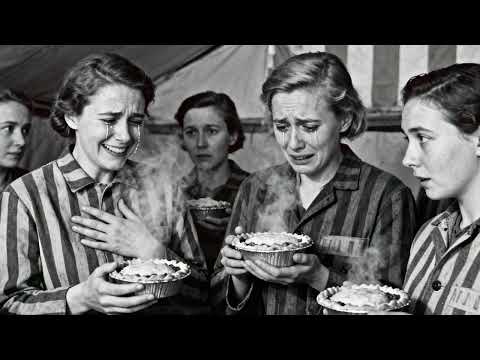
November 1944. Fort Lawton, Washington State. The mess hall doors swung open, and twenty-three-year-old Adelhyde Krueger stopped breathing. Three weeks a prisoner, she had spent seventy-two hours bracing for the brutality she had been promised from American hands. Instead, she stared at something that made no sense—something that violated every understanding she had of how the world worked in the fifth year of Total War.
Golden pastry crusts. Dozens of them, rising from white ceramic dishes, releasing clouds of steam into the cold November air. The scent hit her before her mind could process what her eyes were seeing. Rich, fatty, impossibly abundant beef. Real beef. Not the memory of beef, not the rumor of beef, not the thin gray substitute German rations had optimistically labeled as beef since 1942. Actual meat swimming in thick gravy, wrapped in butter-soaked pastry that looked like something from her grandmother’s kitchen in Essen before the war consumed everything normal about living.
Beside her, Edeltraud Hoffmann made a small sound in her throat. The twenty-two-year-old nurse from Karlsruhe had steady hands that never shook during the worst field surgeries, had held dying soldiers without flinching. Now she was trembling, staring at the serving line where American soldiers in crisp uniforms placed these impossible creations onto metal trays with the casual indifference of men who had never known hunger.
“It cannot be real,” Edeltraud whispered in German, her voice carrying the hollow quality of someone whose reality had just fractured. “It is a trick, a test. They want to see if we are animals who will fight over food.”
But Ingaborg Richter, twenty-six and practical to her core, was already moving forward. The records keeper from Mannheim had spent two years documenting supply shortages with mathematical precision. She knew exactly how many grams of fat, how many calories, how much protein the Reich allocated to its auxiliary corps. She had calculated her own slow starvation with the same care she gave to filing systems.
Her hands, ink-stained and too thin, reached for the tray offered by an American private who could not have been older than nineteen. He was smiling at her—actually smiling—as if serving food to enemy prisoners was a pleasant task rather than a grim duty. The pot pie landed on her tray with a weight that felt obscene.
Ingaborg looked down at it and felt something crack inside her chest. The crust was perfect, golden brown, flaking at the edges, steam escaping from a decorative vent cut into the center. Through that small opening, she could see chunks of beef, carrots, peas, potatoes, all suspended in gravy so thick it barely moved. This single serving contained more meat than her entire family had seen in a month, more butter than her ration card had allowed in a year, more food than she had eaten in any single meal since 1942.
Adelhyde’s mind traveled backward as she stood frozen in the serving line. The scent of beef pot pie pulled memories from places she had tried to seal shut. Essen, 1942. Her mother’s kitchen—once filled with the smell of sour braten and fresh bread—had become a laboratory of substitution and scarcity. They had learned to make coffee from roasted acorns, to stretch a single egg across four people, to convince themselves that turnip soup was nourishing when served in her grandmother’s good china.
By 1943, even the turnips became precious. Adelhyde remembered her younger sister, Greta, thirteen years old, crying not from sadness but from the constant gnawing emptiness that no amount of watered-down soup could fill. Their ration cards allowed two hundred grams of meat per week—when meat was available, which it rarely was. Bread became darker, denser, stretched with sawdust and potato starch until it sat in the stomach like a stone, providing bulk without nutrition.
Her mother had developed the hollowed look that all German women wore by the war’s fourth year: skin stretched tight over bones, eyes too large in thinning faces, hands that trembled from lack of fat.
Adelhyde had joined the Women’s Auxiliary Corps in 1943, partly out of patriotic duty, but also because military service meant better rations. As a communication specialist, she received an extra hundred grams of bread daily, sometimes real butter instead of the chalky margarine civilians choked down. She had felt guilty about this small abundance, sneaking food home to Greta whenever possible, watching her sister devour a piece of military-issue bread with the intensity of someone dying of thirst finding water.
The propaganda had assured them that everyone was sacrificing equally, that the British were starving, that the Americans were suffering under their own rationing. The newsreels showed German soldiers well-fed and strong. Never mentioned the desperate telegrams from the Eastern Front describing men eating leather boots and tree bark. Never acknowledged that by 1944 the average German woman was consuming fewer calories than a medieval peasant during famine.
Adelhyde had been captured outside Strasbourg, too exhausted to run when American tanks rolled through their position. She had expected immediate execution or at minimum the same brutal starvation her government claimed was being inflicted on German prisoners. Instead, within six hours of capture, she had been given white bread—actual white bread, soft and fresh, with real butter. She had eaten it slowly, alone in a transport truck, and wept into her hands because something so simple should not have felt like a miracle.
That bread should have prepared her for what was coming. Should have warned her that everything she understood about the war, about the enemy, about who was winning and who was suffering might be built on lies as substantial as sawdust stretched into bread. But nothing—not even that impossible white bread—could have prepared her for the sight of beef pot pie being served as ordinary prison food on an ordinary Tuesday evening in November.
The journey from Europe to America had taken three weeks, and every day of it had challenged what Ingaborg Richter thought she knew about how enemies treated their captives. She had boarded the transport ship at Le Havre expecting a floating hell—cramped holds where prisoners were stacked like cargo, minimal food, perhaps beatings from guards who saw them as representatives of the regime that had killed their brothers and friends.
Instead, she found quarters that, while not luxurious, were cleaner and more spacious than the barracks she had occupied while serving the Wehrmacht. The ship’s hold had been converted into sleeping areas with actual bunks, thin mattresses that were nonetheless more comfortable than the straw pallet she had grown accustomed to. There were bathrooms with running water—a luxury that had become increasingly rare in Germany as infrastructure crumbled under Allied bombing.
The other women—fifty-eight of them, ranging from eighteen to thirty-four—had moved through those first days in a state of anxious confusion. They whispered to each other in German, trying to understand why their captors were not matching the image of brutal American soldiers that propaganda had burned into their minds.
Mechtild Schneider, the twenty-five-year-old medical orderly from Dortmund, had been the first to voice what they were all thinking. “They feed us three times daily,” she said on the fourth day at sea, her voice low and uncertain. “Not scraps—actual meals. Bread, soup with vegetables, sometimes tinned meat. More food than I received while serving in field hospitals.”
The observation hung in the air like an accusation—not against the Americans, but against something larger that none of them wanted to examine too closely. Lisa Bauer, twenty years old and still carrying the idealistic fervor that had led her to volunteer for the auxiliary corps, tried to maintain the narratives they had all been taught.
“It is strategy,” she insisted, her young face set with determination. “They fatten us for propaganda purposes, to show the world how humane they are while they bomb our cities and kill our families.” But even as she spoke, doubt flickered in her eyes.
Rosewitha Wagner had said nothing during these debates. The twenty-three-year-old administrative specialist from Augsburg had spent the entire war processing paperwork, watching numbers that represented rations shrink month by month. While official reports claimed Germany was thriving, she had learned to recognize the gap between what officials said and what reality showed. Now, eating her third meal of the day aboard an American transport ship, she understood that the gap was not a crack but a chasm—and that everything on the other side of it would require her to rebuild her understanding of the world from the foundation up.
Fort Lawton materialized through the gray November rain like something from a fever dream. Edeltraud Hoffmann pressed her face against the transport truck’s canvas opening, watching American soil approach with a mixture of dread and exhausted curiosity. She had spent twenty-five months as a field nurse, had seen bombed cities and dying soldiers, had developed the hardened exterior necessary to function in a world of constant trauma. Nothing in that experience had prepared her for what she saw as they passed through the camp gates.
American soldiers were everywhere—and they looked healthy. Not the wan, stretched healthiness of people surviving on rations, but genuine vitality. Their uniforms fit properly, not hanging loose on frames depleted by inadequate nutrition. They moved with energy that spoke of bodies receiving enough fuel to function optimally. Some were laughing—actually laughing—as if joy was something still permitted during wartime.
One group sat outside a building eating sandwiches during their break, and Edeltraud watched in disbelief as one soldier took two bites of his sandwich, decided he did not want it, and casually tossed the remainder into a waste bin. She turned to Adelhyde, gripping her arm with fingers that had forgotten how to be gentle.
“Did you see that?” she hissed. “He threw away food. He threw it away.”
Adelhyde had seen it. They had all seen it. The casual waste spoke louder than any propaganda ever could about the fundamental difference between their world and this one. In Germany, throwing away food was not merely wasteful—it was obscene. It was a crime that could result in arrest. It was something so unthinkable that children were beaten for leaving crumbs on their plates. Yet here was an American soldier discarding half a sandwich as if food was so abundant that waste carried no moral weight.
The women were processed through intake with an efficiency that felt almost gentle. American female officers, members of the WAC, conducted the paperwork and basic medical examinations. They were professional but not cruel—bored rather than hostile. One of them, a lieutenant with tired eyes and a Boston accent, actually apologized when the medical examination took longer than expected.
“Sorry for the wait,” she said in English that Ingaborg partially understood. “We weren’t expecting you all until tomorrow.”
The barracks they were assigned to were simple but clean, with real beds and blankets that smelled of soap rather than mildew and unwashed bodies. There were windows with glass that was not broken, floors that had been swept recently, a stove for heat that actually worked. Rosewitha sat on her assigned bunk and felt the mattress beneath her—thin but present—and realized she was going to cry. Not from fear or relief or any single emotion, but from the overwhelming cognitive dissonance of discovering that prison in America was more comfortable than service to the Fatherland had been.
She did not cry. Not then. The pot pie was still warm in her hands, and crying would have meant putting it down.
The first bite was a cathedral. The second was an accusation. By the third, Adelhyde understood that she was not tasting food but evidence—proof that a government which could not feed its daughters had still demanded their obedience, their brothers, their everything.
Across the table, Ingaborg set down her fork with the finality of a stamp on a document. “We were not defeated by armies,” she said quietly. “We were defeated by arithmetic.”
Years later, in her Portland kitchen, Adelhyde would slide the pot pie into the oven and tell her granddaughter the truth she had carried across an ocean: that a single Tuesday dinner had taught her more about honesty than a decade of speeches ever had.
Emma frowned at the golden crust. “So the pie was the lie-breaker?”
Adelhyde smiled. “The pie was the truth.”
What would you have done—eaten, or wept?
Report this article
Select a reason for reporting:






