The photograph was unremarkable at first glance—just two young men, filthy and exhausted, sitting on rubble in war-torn France. But Dr. Robert Hayes froze when he saw it at a Virginia estate sale in September 2023. One was white. The other was black. And they were laughing together.
In 1918, America’s military was rigidly segregated. Black soldiers served in separate units, forbidden from fraternizing with white troops. Yet here was a scene that officially shouldn’t exist. Robert turned the photo over. Faded pencil read: “William and James, France, October 1918, last laugh before the push.”
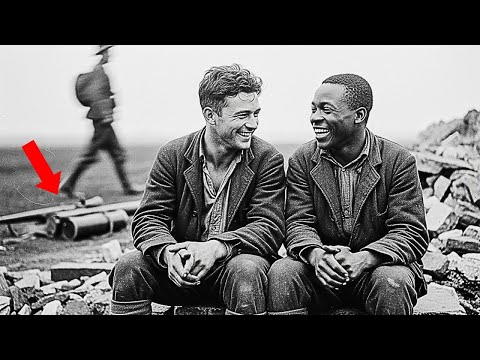
October 1918 meant the Meuse-Argonne Offensive—the bloodiest American battle of the war. “The push” was soldier slang for an attack. These men had been photographed just before facing almost certain death.
Robert purchased the entire box for $50 and returned to Georgetown. He sent the image to three colleagues: a photographic authentication expert in London, a WWI specialist at Yale, and Professor Marcus Thompson at Howard University. Within hours, all responded with shock.
“Where did you find this?” they asked. The London expert confirmed authenticity—paper stock, chemical composition, and aging matched 1918 originals. Marcus called directly. “Robert, do you understand what you have? This photograph shows something that officially never happened. A genuine friendship between a black and white soldier in the segregated American army. This is historically impossible.”
Yet there it was. Robert spread the photo on his desk. Both men showed exhaustion and fear, but their laughter was real. In that moment, they had found something precious—human connection across a divide their society insisted must never be crossed.
“I need to find out who they were,” Robert said. “William and James. I need to know their story.”
Marcus warned him: “Prepare yourself. Uncovering this story means confronting everything ugly about American racial history—and everything beautiful about human nature that survives despite that ugliness.”
That night, Robert began his investigation, unaware he was about to uncover one of the most remarkable hidden stories of the Great War.
The next morning, Marcus arrived at Georgetown carrying three thick folders. He spread documents across the conference table—military regulations, unit rosters, newspaper clippings from 1918. “Let me show you why this photograph shouldn’t exist,” he began.
When America entered the war in 1917, the military implemented absolute segregation. General Order Number 40 explicitly prohibited social interaction between races. Black soldiers were assigned to separate units, housed in separate camps, and given the worst assignments.
Marcus continued: “The 92nd and 93rd Infantry Divisions were black units, but commanded almost entirely by white officers, many openly racist. Black soldiers received inferior equipment and inadequate training. Most were assigned to labor battalions—digging trenches, burying bodies, loading supplies.”
“But some fought in combat,” Robert interjected. “The Harlem Hellfighters.”
“Yes, but they fought under French command because American commanders refused to put black soldiers in combat roles. Under American command, black soldiers were laborers, nothing more.”
Robert studied the photograph again. “So how did William and James become friends?”
“That’s the mystery. They would have had to actively defy regulations, social pressure, and enormous risk. Interracial friendship wasn’t just discouraged—it was dangerous.”
Marcus pulled out a newspaper clipping from the Chicago Defender, a black newspaper from 1919. “I listened to this account from a returning black soldier: ‘We were treated worse by our own army than by German enemies. White soldiers would rather see us dead than acknowledge us as equals.’ Any black soldier caught talking informally with whites faced immediate punishment.”
Robert felt the weight of what the photograph represented. Yet William and James were clearly friends. Their body language was completely relaxed with each other.
“Exactly,” Marcus said. “Which means their friendship formed under extraordinary circumstances. Probably in combat, where survival mattered more than racial codes.”
Over the next week, Robert and Marcus worked to authenticate every detail. Military equipment specialists identified the gas mask as Model 1917, the canteen as standard American issue. The rifle was French—a Lebel—suggesting proximity to French forces. Dr. Jennifer Hartman from the Library of Congress examined the physical photograph. “Paper stock consistent with 1918 manufacturer. Chemical composition matches military darkroom standards. This is definitely an original photograph from October 1918, not a reproduction.”
The photograph was real. The friendship it depicted had actually existed. Despite being officially impossible.
Robert returned to the inscription: Last laugh before the push. These men knew they were about to face death. They had found friendship in the worst place imaginable and were photographed moments before that friendship might end forever.
“We need to find out who they were,” Robert said. “Their names, their units, what happened to them.”
Marcus nodded grimly. “Most WWI personnel records were destroyed in a fire in 1973. Finding two soldiers with only first names will be nearly impossible.”
“Then we start with what we have,” Robert replied. “The location, the date, the circumstances. Someone took this photograph. Someone preserved it. Someone wanted this moment remembered.”
The investigation was just beginning.
Robert decided to pursue two parallel investigations—tracking William, the white soldier, and James separately. He started with William, hoping white soldiers’ records might be more complete.
He returned to the Virginia estate where he’d found the photograph. The auction house provided details: the estate belonged to Patricia Thornton, who died at 96 with no living relatives. Her house in Richmond was being liquidated.
Robert drove to Richmond and contacted the estate attorney, who gave him access to remaining items. In a closet, Robert found a small trunk containing letters tied with ribbon. The return address read: “William Thornton, AEF, France.”
Robert’s hands shook as he opened the first letter, dated August 1918. William wrote to his parents about arriving in France, describing training and expressing optimism. Subsequent letters grew darker—mentions of mud, cold, constant artillery fire, mounting casualties.
Then Robert found a letter dated October 10th, 1918.
Dear Mother, I write knowing this may be my last letter. We attack tomorrow against heavy German positions. Many of my company have fallen. I have witnessed horrors I cannot describe. But I must tell you something that has given me hope in this darkness. I have found a friend here, though he and I should not be friends according to the rules of men. But facing death together, those rules seem absurd. He is the finest friend I have known. If I do not return, know I was not alone. I face the end with a true brother beside me. Your loving son, William.
Robert photographed the letter carefully. William had written about James without naming him—careful, even in private correspondence, not to explicitly acknowledge a forbidden friendship.
He contacted military historians specializing in unit identifications. Dr. Harold Kemp at the Army Heritage Center provided crucial information: “William Thornton served with the 79th Division, 313th Infantry Regiment. They saw intense combat in the Meuse-Argonne Offensive. The regiment suffered nearly 40% casualties—over a thousand men killed or wounded.”
Robert requested William’s service record. When it arrived, the details were devastating. Private William Thornton, killed in action October 14th, 1918. Buried in Meuse-Argonne American Cemetery, France.
The casualty report included a notation: Found severely wounded in no man’s land during recovery of position near Bale. Died during evacuation. Personal effects recovered and sent to family.
The photograph had been among William’s personal effects. He had carried it into battle—an image of himself and his forbidden friend, taken just days before the assault that killed him.
Robert sat back, overcome with emotion. William had been 23 years old, killed just weeks before the war ended. He had grown up in segregated Virginia, but had somehow seen past racial barriers. He had recognized James’ humanity and offered his own in return.
Now Robert needed to find James. He needed to know if the other man in the photograph survived, if he carried memories of their friendship, if he ever knew what William had written about him. The investigation had become deeply personal. Robert was no longer just documenting history—he was honoring two men who had dared to be friends when friendship was forbidden.
Finding James proved far more difficult. The 1973 fire that destroyed military records had disproportionately affected black soldiers’ files—as if history conspired to erase them. Robert had only a first name and a date.
He reached out to Marcus again. “I need to find a black soldier named James who served near Bale in October 1918.”
Marcus sighed. “Robert, over 200,000 black soldiers served in WWI. Without a last name or unit, this is nearly impossible.”
“There has to be something. Records, letters, anything.”
Marcus suggested alternative sources: black newspapers, church records, veterans organizations. “Black communities kept their own records because they knew the government wouldn’t.”
Robert spent weeks in archives. He traveled to the Schomburg Center in New York, the Moorland-Spingarn Research Center at Howard, and the Southern Historical Collection at UNC. He read thousands of pages of black newspapers from 1918-1919, searching for any mention of a soldier named James.
In the November 23rd, 1918 edition of the Chicago Defender, Robert found a brief notice:
Private James Washington, 92nd Division, previously reported missing in action near Bale, France, has been confirmed alive and recovering in a French hospital. Private Washington of Richmond, Virginia, suffered severe injuries but is expected to survive. His mother, Mrs. Ruth Washington, has been notified.
Robert’s heart raced. James Washington—from Richmond, the same city where William’s family lived. This couldn’t be coincidence.
Census records from 1920 showed Ruth Washington, widow, living on Clay Street in Jackson Ward, Richmond’s black neighborhood. James Washington, age 24, was listed at the same address, occupation: laborer.
James had survived. He had come home.
Robert’s next call was to the Richmond Public Library. A local history specialist, Mr. Franklin, knew the name immediately. “James Washington? He was well known in Jackson Ward. Carpenter, veterans’ organizer, spoke at churches and schools. He died in 1983 at 89—one of Richmond’s last surviving black combat veterans of the Great War.”
Did he leave any papers? Franklin paused. “His family donated materials to our collection in the 1990s.”
Two days later, Robert sat in the archive room with boxes of James’s belongings. Photographs, certificates, newspaper clippings—and letters. One, dated October 5th, 1918, made his hands tremble.
Dear Mama, the fighting here is worse than I can tell you. But I must tell you something that has given me hope. I have found a friend here, though he is white, and we should not be friends according to the rules of men. His name is William, and he is from Richmond, same as us. If I survive, I will remember him always.
Robert’s vision blurred. Both men had written about their friendship—careful, coded, aware that what they shared was forbidden and precious.
Then he found a transcript of a talk James gave in 1968 at Virginia Union University. In it, James said: “I met a white soldier in France, and he became my brother. We were in a village waiting to attack, and we laughed about something stupid. Someone took our picture. I carried that picture through the war. When I look at it, I remember that racism isn’t natural. It’s taught. That white boy saw me as his equal. That gives me hope.”
James had kept a copy of the photograph for fifty years, showing it to students as proof that change was possible.
Robert closed the folder, overwhelmed. Now he understood the deepest layer of the photograph’s secret. Not just that the friendship existed—but that when William died, James had to grieve in isolation. William’s family mourned publicly. James mourned alone, in silence, for a friend whose family might not have known he existed.
He contacted Dr. Mitchell Yockelson, a military historian specializing in WWI American operations. “The fighting around Bale in early October 1918 was brutal,” Mitchell explained, spreading tactical maps across the table. “The 313th Infantry approached from the west. The 92nd Division operated in the same sector, primarily as labor troops. But as casualties mounted, commanders threw everyone into the line regardless of assignment. Segregation broke down in combat.”
“So they met in the chaos,” Robert said.
“Exactly. After days under fire, soldiers stopped caring about race. They only cared about who they could trust.”
Robert pieced together the timeline. The photograph was taken October 3rd or 4th, just before the initial assault. William survived the first week but was killed October 14th during a German counterattack. James was wounded around the same time and reported missing.
Then Robert found one more piece—a translated French medical report dated October 18th, 1918: American soldier James Washington admitted with severe wounds. Patient unconscious two days. Upon regaining consciousness, repeatedly called for someone named William. Became agitated when informed no other Americans were admitted with him. Required sedation.
James had called for William even in delirium. He survived, but his friend did not.
Robert’s investigation turned to what happened after the war. James returned to Richmond in February 1919. The Richmond Planet noted: “Private James Washington, wounded hero of the Argonne campaign, has returned home. He was welcomed at Ebenezer Baptist Church Sunday.”
Church records showed James teaching Sunday school, serving as deacon, helping organize a Negro Veterans Association chapter. But there was no indication he ever spoke publicly about William—until the 1968 college talk.
Through the Richmond Black History Museum, Robert found Reverend Marcus Bradley, 94 years old but still sharp. He had known James in the 1970s and early 1980s.
“Oh yes, I remember Mr. James,” Bradley said. “He was a quiet man, but dignified. You could tell he had seen things, done things.”
Did he talk about the war?
“Not often. But there was something he kept private. I asked him once if the war changed him. He said, ‘The war showed me the world could be different than what we’re told it must be. I saw goodness where I was told there was none.’ That’s all he’d say.”
Robert showed the photograph. Reverend Bradley studied it carefully, then nodded. “Mr. James showed me that picture once. He pulled it out and said, ‘I’ve been waiting sixty years for America to catch up to what I knew in 1918.’ He pointed to the white soldier and said, ‘That was my friend. In France, we were equals. Then we came home and I had to sit in the back of the bus. But for a few weeks in 1918, we were just two men.’”
Did he say what happened to his friend?
“He said his friend didn’t make it home. Died in the battle where Mr. James was wounded. He said he tried to reach him but couldn’t. He was found days later still trying to crawl toward where he’d last seen his friend.” Bradley’s eyes were damp. “He carried guilt about that his whole life.”
Robert sat in his car afterward, thinking. James had survived, built a good life, contributed to his community. But he carried the memory of William for sixty-five years. The photograph wasn’t just a memento—it was evidence of a friendship that couldn’t be acknowledged, a loss that couldn’t be publicly mourned.
Robert still had one question: How did the photograph end up with Patricia Thornton, William’s niece? William died with it among his effects. His belongings would have been sent to his parents. But Patricia was born in 1927, nine years after William’s death. How did she come to possess and treasure it?
Robert requested access to Thornton family papers at the Virginia Historical Society. The collection included letters, diaries, and documents spanning generations. William’s mother, Martha Thornton, kept a diary throughout her life. Her entries from 1918-1920 were painful reading—joy when William enlisted transformed to worry, then the devastating telegram in October 1918.
But a March 1919 entry caught Robert’s attention:
William’s belongings arrived today. His uniform terribly damaged, his Bible, some photographs. Among them was a picture I do not understand. William is laughing with a colored boy, both looking like they’ve been through hell. Who was this boy? Why did William keep this? I’m confused and troubled. Harold says I should destroy it, that people might get the wrong idea, but I cannot. William chose to carry this into battle. It meant something to him. So I will keep it, though I will not display it.
Robert found more entries over following years. Martha quietly investigated, trying to understand the photograph. She made discreet inquiries with veterans’ families, the War Department, anyone who might have known William in France.
A December 1920 entry read: I have found him—the boy in the photograph. His name is James Washington, and he lives in Jackson Ward, only two miles from our home. He survived the war, came home wounded but alive. I do not know what to do. Harold forbids me from contacting him. He says it would be scandalous. But James Washington fought alongside my son. He shared William’s final days. I have so many questions only he could answer.
The entries stopped there, but Robert found an envelope marked Private. Inside was a letter in different handwriting, dated January 1921:
Mrs. Thornton, I hope you will forgive this letter. My name is James Washington. I served with your son, William, in France. I was with him during the battle where he fell. I wanted to write for many months but did not know if you would welcome such a letter from someone like me. I want you to know that William was the finest man I ever knew. He treated me with dignity when few others would. We became friends, though I know that may be difficult for you to understand. He spoke of you often—of his home, of his hopes to return. The day before the battle, we sat in a village’s ruins, and despite the horror around us, we laughed. Someone took our picture. It was the last time I saw William alive. The next day, the attack began. William was hit by shellfire. I tried to reach him but was wounded myself. I’m haunted by the thought that he died alone. I wanted you to know your son was brave, kind, and good. If you wish to respond, I would be honored. If not, I understand. With deepest respect, James Washington.
Robert’s hands shook photographing the letter. Martha had received this from James—but there was no copy of any response. Robert found the answer in Martha’s final diary entry about the photograph.
February 1921. I wrote to James Washington and told him I could not meet or correspond further. It is not proper, and Harold is right that it would cause talk. But I also told him I was grateful to know William had a friend at the end, and that I did not blame him. I enclosed $5—a small gesture, but what more can I do? I keep the photograph hidden, but I look at it sometimes and wonder about that moment of laughter. William looks happy. That brings me comfort, even if I cannot understand the full story.
Robert felt overwhelming sadness. Martha wanted to honor her son’s friendship, but racial barriers made it impossible. She did the only thing she could—keep the photograph safe, eventually passing it to her granddaughter, Patricia.
Robert found Patricia’s papers. She inherited the photograph in 1952. A note in her handwriting dated 1953 read: Grandmother left me Uncle William’s war photograph with a note saying it was precious and must be kept safe always, though she didn’t explain why. I researched and learned the other man was James Washington, who still lives in Richmond. I wanted to contact him to learn about my uncle, but mother forbade it absolutely. So I keep the photograph hidden as grandmother did, and honor Uncle William’s memory by supporting veterans of all races. Perhaps someday someone will find this picture and tell the story properly.
Three generations of Thornton women had kept this photograph safe, recognizing its importance even when they couldn’t acknowledge it publicly. Patricia lived her entire life honoring her uncle by working for veterans’ rights, never able to explain why.
Now finally, their story could be told.
Robert had one element remaining: Who took the photograph? The image was too well composed to be casual. Someone with skill had captured that moment. He examined the original with high magnification. In the bottom right corner, barely visible, were faint markings. Using digital enhancement, he made out initials: E.H., 1918.
Dr. Hartman from the Library of Congress searched databases of military photographers. “I found something,” she called two days later. “Edward Harrison. He was a photographer with the Army Signal Corps assigned to document the Meuse-Argonne campaign. His photographs are in the National Archives.”
Robert traveled to the archives and requested Harrison’s complete photographic record. Most images were formal—troops marching, officers planning, equipment moving. But in a box labeled Personal Collection—Not Official Record, Robert found something different. Soldiers writing letters, medics tending wounded, quiet moments between battles. Among them were several images of black soldiers working alongside white soldiers, contradicting official segregation narratives.
A note in Harrison’s handwriting accompanied these: What I witnessed but was not supposed to document. The army wanted pictures of heroic American boys, separate and distinct. They did not want evidence that rules broke down, that black and white soldiers worked together, helped each other, became friends. But I photographed the truth, not the myth.
Harrison’s service record showed he’d been reprimanded twice for inappropriate photographic subjects and had film confiscated several times. After the war, he returned to Philadelphia and worked as a commercial photographer. He died in 1962.
But Harrison’s grandson, Robert Harrison, was alive—a retired photography professor in Maryland. Robert contacted him and arranged a visit.
Robert Harrison welcomed him into a home filled with his grandfather’s work. “Grandpa Ed never talked much about the war,” he explained. “But late in life, he told me the photographs he was most proud of were the ones the army tried to suppress. He said he photographed the war as it actually was, not as generals wanted it remembered.”
Robert showed him the photograph of William and James. Did your grandfather mention this image?
Robert Harrison studied it. “He didn’t mention specific images, but he told me a story once about two soldiers in October 1918. He’d been documenting fighting around Bale when he came across two young men in the rubble—one white, one black—and they were laughing together. Genuinely laughing, not forced smiles for official photographs. Grandpa Ed said he knew immediately he was seeing something rare and important. He took several pictures, though he knew he wasn’t supposed to photograph Negro soldiers interacting informally with white soldiers.”
What happened to the other photographs?
“His commanding officer confiscated most. Grandpa Ed only saved a few by hiding them in his gear. He made prints after the war but never displayed them publicly. He said the country wasn’t ready to see evidence contradicting the racial order.”
Robert Harrison went to a filing cabinet and pulled out a folder. “After Grandpa Ed died, I inherited his negative collection.” He searched through folders before pulling out a negative sleeve. “Here—October 1918, Bale sector.”
He placed negatives on a light box. Robert gasped. Three images of William and James. The first showed them serious, war’s weight clear on their faces. The second captured them in conversation. The third—the surviving image—showed them laughing.
“Can I have these digitized?” Robert asked, voice shaking.
“I’ll print them for you. Grandpa Ed would have wanted their story told. He believed photographs should witness truth, not propaganda.”
Robert now had the complete narrative: the photograph, letters from both men, diary entries, military records, casualty reports, and additional photographs showing that day’s progression. The story was no longer hidden. William and James’s friendship—their shared humanity in inhumane circumstances, their challenge to racial barriers—was now part of the historical record.
But Robert wanted one more thing: to bring the story back to Richmond and honor them properly.
He spent three months assembling the complete story. He wrote a detailed article for the Journal of Military History, laying out evidence methodically. But he also prepared something for general audiences—a feature for American Heritage magazine with all photographs and documents reproduced.
The article traced the entire narrative: Two young men from Richmond, separated by race in a deeply segregated society, who found themselves thrown together in the hell of the Meuse-Argonne Offensive. There, facing death daily, they recognized each other’s humanity. They became friends—not despite racial differences, but in defiance of a society that insisted such friendship was impossible.
William carried their photograph into battle and died with it on October 14th, 1918. James survived, wounded and traumatized, calling for William even in his delirium. He came home to Richmond, built a life, but carried memories of their friendship for sixty-five years.
Three generations of Thornton women—Martha, her daughter, and Patricia—kept the photograph safe, recognizing its importance even when they couldn’t publicly acknowledge it. James kept his own copy, showing it to students decades later as proof that racism was taught, not natural.
The photograph had been hidden because it was dangerous—not because it showed evil, but because it showed possibility. It proved that racial barriers were artificial, enforced through violence and law, not inevitable human nature. When those enforcement mechanisms broke down in combat chaos, William and James naturally became friends.
Robert’s article concluded: “This photograph is one of the most important historical documents from World War I—not despite being hidden for over a century, but because it was hidden. Its concealment reveals how threatening genuine interracial friendship was to American racial order. Its survival, protected by women who understood its significance, shows that even in the darkest times, some people recognized truth and preserved it for future generations.”
The article was accepted for publication. Documentary filmmakers contacted Robert about adapting the story. Museums requested to exhibit the photograph and related materials. But Robert wanted something more immediate. He contacted the Richmond Times-Dispatch and proposed a feature article.
The editor was immediately interested. “This is exactly the hidden history we need to tell. Can you have it ready for November 11th—Veterans Day?”
Robert could. He would make sure that this time, both William and James were remembered together, as they should have been all along.
He also contacted both families. Finding William’s relatives was straightforward. Michael Thornton, a Richmond lawyer, was William’s great-great-nephew. He knew nothing about his ancestor’s friendship with James until Robert’s research revealed it.
Finding James’s descendants took longer. Through church records and genealogical research, Robert located Dorothy Washington Clark, James’s granddaughter—a retired schoolteacher living in Richmond.
Both families were shocked to learn their ancestors’ story. Both agreed to participate in a Veterans Day commemoration. Robert arranged for a historical marker to be placed in Jackson Ward, telling the story of James Washington’s service and his friendship with William Thornton. The marker would include the photograph and honor both men’s courage—the courage to fight for their country, and the courage to see each other as equals when their entire society said it was impossible.
November 11th, 2024, approached. Robert had spent a year investigating a single photograph. Now he would share what he’d learned with the world—and bring two families together for the first time in over a century.
The hidden story was about to become public history.
On November 11th, 2024—exactly 106 years after the armistice ending World War I—Robert stood in Jackson Ward at the dedication of a historical marker. Over 200 people gathered, descendants of both families meeting for the first time despite living in the same city for over a century.
The marker, placed where James Washington’s carpentry shop once stood, told both men’s story. It included the photograph and read:
Private James Washington, 1894–1983, served with the 92nd Division in France during World War I. Wounded in the Meuse-Argonne Offensive in October 1918. He returned home to become a respected community leader and craftsman. During the war, he formed a friendship with Private William Thornton, 1895–1918, of the 313th Infantry Regiment, crossing racial barriers that defined their era. Their friendship, documented in this photograph taken October 1918, demonstrates that shared humanity can transcend imposed divisions. Both men fought for democracy abroad while being denied full equality at home. We honor their service, courage, and vision of a world where such friendships need no explanation.
Dorothy Washington Clark, James’s granddaughter, spoke first. She was 68, a retired schoolteacher who’d listened to her grandfather’s stories as a child.
“My grandfather rarely spoke about the war,” she said. “But he kept that photograph on his dresser until the day he died. When I asked about it, he said, ‘That’s my friend William. We were soldiers together.’ I asked why William wasn’t in other pictures, and Grandpa James got quiet. Then he said, ‘Some friendships exist in a moment of truth, and that moment has to be enough.’ I didn’t understand then, but now I do. William and my grandfather saw each other as equals when the whole world said that was impossible. That photograph proves the world was wrong.”
Michael Thornton, William’s great-great-nephew, spoke next. “I grew up hearing about my great-great-uncle William as a war hero. But the story was incomplete. We honored his service but didn’t understand what it meant to him. Finding out about his friendship with James Washington doesn’t diminish William’s memory—it elevates it. It shows he was a man ahead of his time. Someone who saw past divisions his society enforced. I’m proud of that legacy, and I’m honored to stand here with the Washington family, recognizing a friendship our families should have acknowledged a century ago.”
Robert spoke last, explaining the research process and what the photograph revealed about American history.
“This image seems simple,” he said. “Two young men laughing in war’s ruins. But it’s one of the most powerful historical documents I’ve encountered. It’s evidence that racial barriers defining American society in 1918—and for decades afterward—were not natural or inevitable. They were enforced through violence, law, and social pressure. When enforcement mechanisms temporarily broke down in combat chaos, William and James naturally became friends. They didn’t need to be taught to see each other as equals. They simply needed freedom to do so.”
He paused, looking at the crowd. “The dark secret this photograph holds is not about evil. It’s about possibility. It’s about the world we could have if we chose to see each other as William and James did. That’s why it was hidden so long—not because it showed something shameful, but because it showed something dangerous to power structures of its time. It showed that division is a choice, not destiny.”
After the ceremony, families gathered—Washingtons and Thorntons meeting for the first time. They exchanged stories, examined old photographs, marveled at the friendship connecting their families without their knowledge.
Dorothy and Michael stood before the marker, looking at their ancestors’ image.
“They would have liked this,” Dorothy said quietly. “Being remembered together.”
“They deserved this long ago,” Michael replied.
Robert watched them, feeling the weight of the past year settle into peace. He’d started with a single photograph purchased at an estate auction. Now he’d uncovered a story challenging assumptions about American history, about race, about individual friendships’ power against systemic injustice.
The photograph would be exhibited at the Virginia Museum of History and Culture. Robert’s book manuscript would be published. Documentary filmmakers would tell the story. But more important was this moment—two families reconciled across a century of separation, honoring two men who dared to be friends when friendship was forbidden.
As the crowd dispersed, Robert took one final photograph: Dorothy and Michael shaking hands beneath the marker, with the 1918 image of their ancestors visible behind them. Past and present connected at last.
The photograph history tried to erase was now permanently part of the historical record. William and James’s friendship would be remembered, studied, celebrated. Their laughter in Bale’s ruins had echoed across a century, proving that even in darkest times, human connection and equality were possible.
That was the real secret—not something dark, but something luminous. A moment of hope and humanity refusing to be forgotten, no matter how long hidden. Robert had helped ensure it would never be forgotten.
But the story isn’t finished. How many other moments like this—friendships across forbidden lines, quiet acts of humanity in inhumane times—still wait in attics, archives, and forgotten boxes for someone to notice? What will you do the next time you hold an old photograph and wonder what secret it might be keeping?
Report this article
Select a reason for reporting:






