You’ve heard the story: Patton slams a revolver on the desk and threatens to shoot an SS general where he stands. It’s dramatic, it’s viral, and it’s everywhere. There’s just one problem—it never happened.
The real encounter was colder, quieter, and far more unsettling. No gun, no growling dog, no Hollywood theatrics. Just a defeated man, an interpreter, and a piece of paperwork that stripped away his rights.
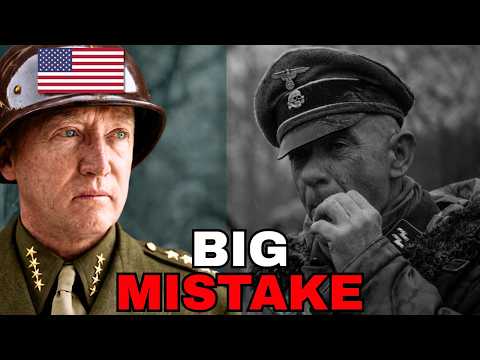
November 19th, 1944. Third Army troops are clearing Metz, a fortress city the Germans have held for weeks. Inside a brewery, they find him: SS Brigadenführer Anton Dunckern, Gestapo and SS Police Chief for the entire Metz sector, a personal friend of Himmler, a man who had marched with Hitler in 1923. He is the highest-ranking SS officer Third Army has captured so far.
Word reaches Patton, and he decides he wants this one himself. Not for a grand interrogation, but for something more personal.
Dunckern is marched into the headquarters tent. He expects the courtesy of rank—a salute, a translator, the basic dignity officers extend to each other even in war. Instead, Patton doesn’t stand up. He won’t even speak German to him, though he could. Through an interpreter, he says he can’t be bothered to question the man personally because out of every German general he’s captured, this is the first one wholly untrue to everything.
“He is a liar,” Patton says. Four words, flat.
Dunckern tries to explain. He says he couldn’t reach his weapon in time to fight back. That’s the only reason he’s alive. Patton doesn’t blink.
Then comes the part every viral version gets wrong. There’s no gun on the table. Patton doesn’t need one. He tells Dunckern exactly what happens if he doesn’t start talking: “I will turn him over to the French. They know how to make people talk.”
But the real threat isn’t shouted across a desk. It’s what happens after the room clears. Patton doesn’t send Dunckern to a standard POW camp and let the rules take over. He has him reclassified—not as a prisoner of war, but as a political detainee. Stripped, on the spot, of protections every other captured German officer in Third Army’s custody still had.
That’s not a threat. That’s a man quietly rewriting the rules in real time because he decided this particular prisoner hadn’t earned the ones already written.
So where did the gun on the desk come from? Almost certainly Hollywood. The 1970 film Patton leans hard into pistol theatrics that the real transcript, preserved in Patton’s own papers, simply doesn’t contain. No Willie in the room. No “I will personally shoot you where you stand.” Just contempt, an interpreter, and a piece of paperwork that quietly ended a man’s rights.
It’s a better story precisely because it’s smaller and colder than the fake one. And Metz isn’t the only place Patton’s real story got quietly rewritten into something louder.
Some of those rewrites, it turns out, started a lot closer to home than a movie script.
Consider the necktie. Of all the things Patton could have done to rebuild Second Corps after Kasserine, he chose a strip of cloth. Officers in combat zones, some of them within artillery range of the enemy, were ordered to knot a tie every morning. Soldiers grumbled. Bradley rolled his eyes. But three weeks later at El Guettar, the 10th Panzer Division broke against American lines for the first time in the war.
The tie wasn’t about discipline. It was about reminding every man that the sloppy days were over, and that someone was watching.
That’s the man the myth is built on. But underneath him was someone almost nobody puts in the reels.
Patton didn’t learn to read until he was eleven years old. By his own account, he assumed as a child that he was simply stupid. Classmates mocked him. So he memorized long passages by ear and recited them aloud, because reading off a page was nearly impossible. At West Point, he failed mathematics and was held back an entire year, watching classmates graduate ahead of him while he started over from scratch.
Today we’d probably call it dyslexia. Nobody had that word for what was happening to him in 1904.
And the high-pitched fury the fake interrogation scene loves? That detail is actually true. It’s just aimed at the wrong scene. Surviving recordings confirm Patton had a notably high, thin voice, nothing like the gravel George C. Scott gave him on screen. Patton himself reportedly admitted the swearing was there to cover for it—that a general with a voice like his needed something else to make men listen.
His wife, Beatrice, was cut from the same cloth. At a formal dinner in Washington not long after the First War, a desk-bound officer sneered within earshot about little boys getting promoted to colonel. The next thing anyone remembers, Beatrice was sitting astride the man’s shoulders, banging his head against the marble floor until Patton and another officer pulled her off him.
Then there’s his son. During the entire Second World War, by most accounts, Patton saw him exactly twice. Their relationship survived almost entirely on paper—weekly letters to a cadet at West Point. When George Jr. was accepted into the Academy, his father’s letter of congratulations read: “We are really proud of you for the first time in your life. See to it that we stay that way.”
Their daughter had her own line about him, muttered once after he’d yelled at her mid-riding lesson: “Dear God, please let that son of a break his neck.”
Nobody thought twice about it at the time.
April 25th, 1944. Six weeks before D-Day. Patton is asked to say a few off-the-record words at the opening of a servicemen’s club in a small English town called Knutsford. Nothing prepared, nothing official. He tells the crowd it’s the evident destiny of the British and Americans—and of course the Russians—to rule the world.
Off-the-record doesn’t mean off the page. The quote runs in papers worldwide within a day, and early versions leave the Russians out entirely, turning a throwaway line into an international incident six weeks before the most important invasion of the war.
Eisenhower doesn’t relieve him, but he puts it in writing. One more incident like this, and Patton is finished—instantly, no discussion.
So Patton sits in England on June 6th, 1944, while the invasion he’d spent his whole career preparing for happens without him. That night he writes to Beatrice: “It is hell to be on the sidelines and see all the glory eluding me.”
He got another chance. But he never fully learned the lesson.
September 22nd, 1945. The war in Europe is over, and Patton is military governor of Bavaria, responsible for denazification—removing former Nazi officials from power. At a press conference, he says he doesn’t see the need for this denazification thing, and compares it to a Democratic and Republican election fight back home.
Walking out afterward, he tells an aide the truth quietly: “Stupid goddamn mistake. I knew better, but I wouldn’t give the son of a bitch the satisfaction of knowing it.”
Knowing better doesn’t save him. Eisenhower summons him to Frankfurt and tells him flatly, “George, you have broken the back of our policy.”
Ten days later, Patton is relieved of Third Army—the army he built, the army that broke the siege at Bastogne—and handed a desk job writing history instead of making it. His own summary of the day: “I’ve just been fired by the best friend I ever had.”
Remember the reincarnation? The soldier certain he’d already died a dozen times before, certain he knew exactly how a warrior’s story was supposed to end?
He’s quoted endlessly saying there’s only one proper way for a professional soldier to die: the last bullet of the last battle of the last war.
He never said it. It’s a line from the 1970 film, put in his mouth by a screenwriter twenty-five years after he was gone. No letter, no document, no witness places those words in the real Patton’s mouth.
Here’s what actually happened.
December 9th, 1945. Eight months after the war in Europe ended. A pheasant hunting trip outside Mannheim. Passing the wrecked, burned-out vehicles still littering the road, Patton says, almost to himself: “How awful war is. Think of the waste.”
Minutes later, an army truck turns into his car’s path at a crawling speed. He’s thrown forward and breaks his neck. Paralyzed but still talking, he tells the man beside him: “This is a hell of a way to die.”
Twelve days later, he’s gone. Sixty years old. Killed not by the enemy, not by the last bullet of the last battle, but by a truck on a wet road and a broken neck—exactly the way his own daughter once wished on him, without meaning a single word of it.
And that’s where the legend usually stops. A great general, a tragic accident, a neat closing shot of a flag-draped coffin. But the story kept going after the coffin, and that’s the part almost nobody tells.
Because within weeks of Patton’s death, an extraordinary thing started happening in the letters, the memoirs, and the interviews of the men who had served under him. Small details began to drift. Anecdotes got sharper, funnier, more cinematic. The necktie story grew a punchline. The Metz interrogation grew a revolver. The high, thin voice disappeared entirely, replaced by something that sounded like it belonged on a war memorial.
The man who couldn’t read until he was eleven was being rewritten by people who loved him into something he had never quite been.
Some of that was grief. Some of it was the simple human urge to make a good story better. But a surprising amount of it, historians have since discovered, came from a source much closer to Patton than any Hollywood screenwriter.
His own family had been polishing the Patton legend for years—quietly, deliberately, and with the same fierce loyalty Beatrice had shown when she climbed onto that officer’s shoulders in a Washington dining room.
And one document in particular, tucked away in the Patton papers for decades, would eventually force historians to ask a question nobody wanted to ask: how much of the general we remember was actually written by the general himself?
The answer, it turns out, is more than anyone expected. Patton had been writing his own legend since before the war—carefully, deliberately, in letters and journals he knew would be read. He wasn’t just fighting battles. He was building a character for history to find.
And history found it. The swagger, the ivory grips, the profanity—all of it was real, but none of it was accidental. Patton understood something most generals never did: that memory is a battlefield too, and the man who writes the first draft usually wins.
So the revolver on the desk isn’t really a lie about Patton. It’s a lie Patton would have understood perfectly—maybe even admired. It’s louder than the truth, and louder always travels further.
But here’s the thing about the real man, the one who couldn’t read until he was eleven, who failed math at West Point, who sat in England on D-Day listening to the invasion on the radio. He didn’t need a gun on a desk. He didn’t need the last bullet of the last battle.
He was complicated, petty, brilliant, and human—and the truth of him is stranger and sadder and far more interesting than any myth Hollywood ever built.
So the next time someone tells you the story of the revolver and the growling dog, you’ll know exactly what to say.
But here’s the question worth asking: if Patton himself spent a lifetime polishing his own legend, are we really sure we know which parts of him were ever true—and does it even matter if the myth is what made men fight?
Report this article
Select a reason for reporting:






