At 5:30 AM on November 9, 1914, the Indian Ocean lay dead flat under a rising sun. Aboard the German light cruiser SMS Emden, Captain Karl von Müller stood on the bridge, a man who had become a legend. In just three months, he had sunk or captured 23 Allied ships, shelled Madras, and torpedoed a Russian cruiser in Penang Harbor—all without killing a single civilian. The British press called him the “gentleman pirate,” and 78 Royal Navy warships were hunting him. None had found him. Yet this morning, his luck was about to run out.
Müller’s plan was simple: land 50 sailors and marines on Direction Island to destroy the British cable and wireless station. With that station offline, the first convoy carrying Australian and New Zealand troops to Egypt would lose its communications relay across the Indian Ocean. He calculated the convoy was still days away. He was wrong. Just 212 miles to the north, the convoy was already passing, and one of its escorts—the Australian cruiser HMAS Sydney—had just received the station’s distress signal. She was closing at 25 knots.
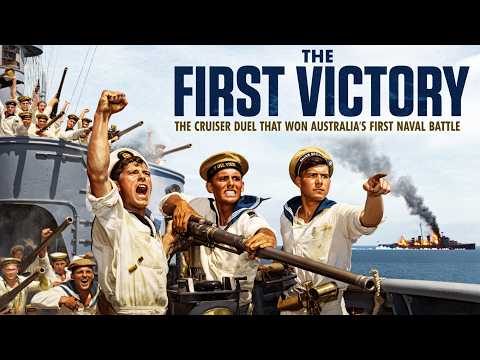
Müller had not been hunted in three months. He was about to be. What followed would become the most consequential naval engagement of the war’s first year—a duel between two ships, two commanders, and two navies that would echo through history.
To understand the drama about to unfold, you must know the man on the bridge. Karl Friedrich Max von Müller was born in Hanover in 1873, the son of a Prussian army colonel. He entered the Imperial German Navy at 18 and, by 1914, had served on three continents. He spoke functional English, did not drink or gamble, and read history in his cabin during the late watches. His captain’s table was famously quiet. He was a precise, deliberate officer who never raised his voice—a trait that would serve him well in the hours to come.
His ship, the Emden, was a Dresden-class light cruiser: 3,650 tons, ten 4.1-inch guns, and a top speed of 24 knots. She was graceful, with three tall funnels and a long, low silhouette. Her crew of 316 loved her for the way she handled at speed. When war broke out, Emden was at Tsingtao, a German colonial port in China. Her squadron commander, Vice Admiral Maximilian von Spee, took the rest of the East Asia Squadron east into the Pacific, but Müller asked for and received permission to detach and raid the Indian Ocean. Spee gave him a single collier for fuel and no further orders. Müller sailed west with perhaps three weeks of coal and no friendly port for 10,000 miles. He had one light cruiser against the combined navies of Britain, France, Russia, and Japan. The mathematics did not work.
Yet by November, Müller had made those mathematics irrelevant. On September 10, he took his first prize, a Greek collier carrying Indian coal. Three days later, he sank his first British merchant ship, the Indus, off the coast of India. He took the crew aboard, fed them, returned their belongings, and transferred them to a neutral ship. He repeated this policy on every prize that followed. By September 20, he had taken seven ships in the Bay of Bengal—without killing a single civilian. He bought coal where he could and seized it where he could not. He treated every captured master with the precise courtesy of an officer who understood that the laws of war were the only thing protecting him from being treated as a pirate when he was eventually caught. He intended to be treated as a naval officer, and he behaved like one.
On the night of September 22, he did something audacious. He brought Emden to within 3,000 yards of the breakwater at Madras and opened fire on the storage tanks of the Burmah Oil Company. 125 rounds of high explosive went into the tank farm. Five tanks burned, and half a million gallons of kerosene lit the sky for two nights. The British civil administration in India, which had been telling the press that the war would be invisible in the subcontinent, suddenly had to explain why a German warship had just shelled their second-largest commercial port. Müller vanished into the Bay of Bengal again.
The Royal Navy mobilized. The cruisers Hampshire and Yarmouth, the French armored cruiser Dupleix, the Japanese battlecruiser Ibuki, and a screen of armed merchant cruisers were diverted to hunt him. The Indian Ocean became briefly the most heavily patrolled body of water in the world. They could not find him. He took more prizes through October, including the Clan Grant, the King Lud, and the Limerick. He kept a British collier’s 6,000 tons of Welsh coal and used it. He continued to capture crews unharmed and transfer them to neutral ships at the earliest opportunity. He sent dignified telegrams to the British Admiralty when he had British personnel to repatriate. The British found his courtesy infuriating and effective. The Indian press began calling him the “Swan of the East,” and the English-language papers in Calcutta and Singapore picked up the phrase. By mid-October, Karl von Müller had become a celebrity in the enemy’s own newspapers.
Then, on October 28, he did the most reckless thing he ever did: he attacked Penang Harbor. Penang was a major British naval anchorage with shore batteries, minefields, and a known concentration of Allied warships. Müller approached at first light, flying a dummy fourth funnel made of canvas and wood to disguise Emden as a four-funneled British cruiser. He passed under the guns of the harbor fort and a French gunboat without being challenged. When he came abreast of the Russian protected cruiser Zhemchug, with her crew asleep and her ammunition lockers padlocked, he ran up the German ensign and fired a torpedo at point-blank range. The torpedo struck below the aft magazine. The magazine went up, and the Russian ship broke in half. 88 Russian sailors died in the next 40 seconds. Emden’s gunners then opened fire with all five portside 4.1-inch guns at a range of less than 400 yards, firing into the wreck for another minute until the bow disappeared.
Müller turned and raced for the harbor entrance. On his way out, he encountered the French destroyer Mousquet, returning to harbor. He sank her too. Then he stopped, lowered boats, and recovered every French survivor from the water before the wreck went down. He had killed nearly 200 Allied sailors in 20 minutes, yet he had paused in the middle of a flight from an enemy harbor to save the lives of men he had just been killing. The French survivors later described being treated with the same courtesy Müller had shown the British merchant captains. The Mousquet’s wounded were given Emden’s own medical officer and morphine from Emden’s stores. They were transferred to a neutral British steamer the next morning with their personal effects.
This was the man on the bridge at 5:30 AM on November 9. Three months of war. 23 ships destroyed or captured. Two enemy warships sunk. The shore facilities of two Allied ports damaged. 78 enemy warships diverted to hunt him. And by the count that mattered most to him, not a single non-combatant killed. He was tired. His crew was tired. His ship’s bottom was foul with growth, and his boilers needed cleaning. He had decided after Penang that he needed one more strike before turning Emden south to find a remote anchorage for refit. The cable and wireless station at Direction Island was that strike.
Once it was offline, British communications in the eastern Indian Ocean would be blind for at least a week. He could disappear into the southern latitudes, clean his boilers, scrape his hull, and return to the war refreshed. His last intelligence summary, from a captured British steamer’s papers, indicated that the next Anzac convoy was forming at Albany and was not due to sail before the first week of November. He calculated that, given the convoy’s escort speed and routing, it would not be near the Cocos Keeling Group before the middle of the month at the earliest. His calculation was correct as of the date of the British document he had read. It was wrong by six days. The convoy had sailed early. The convoy was here.
The convoy had left Albany on November 1: 38 transport ships carrying the first contingent of the Australian Imperial Force and the New Zealand Expeditionary Force—20,000 men of the original Anzacs bound for Suez and ultimately for the beaches at Gallipoli. The convoy was escorted by HMAS Melbourne, HMAS Sydney, HMS Minotaur, and the Japanese battlecruiser Ibuki. The senior officer of the escort was Captain Mortimer Silver in Melbourne. The escort had been ordered to keep silent radio discipline and had been routed past the Cocos Keeling Group at a distance of about 50 miles to the north, on the assumption that the cable station there was a useful navigational reference and a friendly point of contact in an otherwise empty ocean.
At 6:00 AM German time, Emden’s first cutter pulled away from her side. The landing party was under the command of Kapitänleutnant Hellmuth von Mücke, Müller’s first officer: three officers, six warrant officers, and 41 sailors and marines armed with rifles, four Maxim machine guns, and demolition charges. Their orders were simple: land on Direction Island, take control of the cable and wireless station, cut the underwater cables, destroy the wireless masts, and be back aboard within 90 minutes. Müller would wait for them at anchor.
The boat reached the beach at 6:20 AM. The senior cable operator at the station, a man named Darcy Farran, watched it come in through binoculars from the operations room. The station was a low set of bungalows with a tall wireless mast on a coral atoll 70 yards above sea level. Farran had three minutes’ warning. He used them. He sent the cable signal that the station was being attacked. He sent the wireless signal too, on every frequency available. In plain English, he gave the position. He gave the description of the attacking ship. He named her correctly as Emden, because the canvas fourth funnel that had fooled the Russians at Penang did not fool a trained signals operator who had been watching her closely for ten minutes through good optics.
The signal went out at 6:28 AM. It was picked up immediately by HMS Minotaur, the senior escort vessel, 250 miles to the north. Minotaur was the closest heavy ship, but the convoy commander knew she was needed where she was. He needed to detach a fast cruiser. HMAS Melbourne, the flagship, started to detach, then thought better of it. The commodore could not leave the convoy. He signaled HMAS Sydney instead. Sydney was on the starboard wing of the escort, at 38°20’ south of the cable station’s reported position. She was the fastest ship in the screen.
At 6:45 AM, Captain John Glossop received the order: Detach, investigate, engage and destroy. He turned Sydney south. He rang for full speed. The engineers below pushed her up through 20, 22, 24, 25 knots. The boiler pressure climbed to 220 psi. The wake lengthened behind her. She had a clean bottom and clean boilers, and she was the newest cruiser in the Royal Australian Navy, commissioned only 16 months earlier. She was ready for this. She had been built for this.
Sydney was a Chatham-class light cruiser: 5,400 tons, eight 6-inch breech-loading guns, top speed 25½ knots—though her engineers thought she could do 26 with clean boilers and a good head of steam. She was longer and heavier than Emden. Her guns outranged Emden’s by 4,000 yards. She had been built specifically to outclass the German light cruiser type. She was, in the precise calculation of naval architecture, a hunter designed to kill exactly the kind of ship she was now chasing.
Glossop was 43, born in England, and had transferred to the Royal Australian Navy at its founding in 1911—one of the British professional officers who had volunteered to take Australian commissions to seed the new force with experience. He was a deliberate, careful officer in the same mold as Müller. He did not raise his voice. He did not improvise. He read his orders and carried them out. He had 295 men under his command, mostly young, who had been in commission for 16 months and had not yet fired their main armament at an enemy ship. By 11:00 that morning, they would have.
The course south was 212 nautical miles. At 25 knots, that was 8½ hours. Glossop pushed her harder. He held the bridge for the next 2½ hours without leaving it. He did not eat breakfast. He read and reread the signal from Direction Island. He looked at the chart. He calculated and recalculated his approach. He decided, based on Emden’s known top speed and the known position of the cable station, that the German cruiser would still be in the vicinity of the islands when he arrived. She would not have gotten her landing party back aboard before he was sighted. He intended to engage her before she could recover her men. He would arrive at his calculated intercept point at 9:15 AM.
At 9:15 AM, Emden’s lookout on the foremast called down to the bridge: smoke on the northern horizon, bearing 010° true. Müller went to the bridge wing and raised his Zeiss binoculars. He saw at first only a column of dirty coal smoke—thick, not the trailing wisp of a merchant ship at economical speed. It was the dense black plume of a warship at full power, he thought. In the first 30 seconds, he thought it must be the Buresk, his own collier, returning early from the auxiliary anchorage where he had ordered her to wait. That was wrong. The smoke was too thick. Then he thought it must be HMS Newcastle, a Royal Navy light cruiser he knew to be operating in the Indian Ocean. Newcastle would be a manageable opponent: similar in displacement to Emden, similar in armament, perhaps slightly faster. He had a competent crew and a clean ship and three months of combat experience. He could fight Newcastle and win, or fight and run. Either outcome was acceptable.
He gave the order to weigh anchor. He gave the order to recall the landing party by siren and signal flag. He could not wait for Mücke’s men; the approaching ship was closing too quickly. He turned Emden’s bow northward toward the approaching smoke. He intended to engage on his terms, while he still had room to maneuver and the wind on his quarter.
At 9:32, the approaching ship’s hull lifted above the horizon. Müller raised his glasses again. The hull was longer than Newcastle’s. There were three funnels, spaced wider apart than Newcastle’s. The bridge structure was higher. He counted the guns visible on her port side: four. Then he saw the mounting forward of the bridge that he had missed. Five guns on one side, which meant ten guns total, which meant she carried eight broadside guns and two on the center line, which meant 6-inch guns, which meant she was a Chatham-class cruiser. Which meant he could not fight her and win, and he could not, with his foul boilers and his slow ship, run from her and escape.
He had perhaps three minutes to think. He had three options: surrender, fight, or run for the protection of neutral waters. The nearest neutral waters were the Dutch East Indies, 640 miles to the north. He could not reach them. Surrender was not an option a German naval officer of his generation considered. Fight was, in arithmetic terms, suicide. Fight was the option he chose.
He turned Emden hard to port to bring his full broadside to bear. He ordered all engines ahead full. He ordered the gunnery officer to open fire at maximum range. At 9:40 AM, the first salvo of 4.1-inch shells left Emden’s port battery. The range was 9,500 yards. The shells fell short.
Sydney’s gunnery officer, Lieutenant Commander John Garcia, had been waiting for that opening salvo. He had watched it come up short. He now knew, by direct observation, what he had known by calculation since 7:00 that morning: Emden’s guns could not reach him at this distance. His could reach her. He opened the firing key. The first salvo of four 6-inch shells left Sydney’s port battery at 9:41 AM. The shells did not fall short.
The first hit struck Emden’s forecastle and detonated against the deckhouse forward of A turret, killing seven men instantly. The second hit took down the wireless mast. The third hit detonated against the upper bridge structure on the port side, killing the gunnery rangefinder operator and the executive officer’s runner. Emden’s fire control was now reliant on local control by individual gun captains—a procedure she had drilled, but which had a maximum effective range of about 6,000 yards in clear conditions. She was being shot at from 9,500. She could not reply.
Müller saw immediately what was happening. He ordered the helm hard to starboard to close the range. He was trying to bring his torpedo tubes into action. Emden carried two submerged torpedo tubes on her broadsides. Their range was 4,500 yards. If he could get inside that range, he could win this fight with a single hit on Sydney’s hull below the waterline. The torpedo had been the great equalizer of pre-war naval calculation. The hare with teeth.
Glossop saw what Müller was doing. He turned away. He held his range. He continued to fire. He was an experienced officer in a position of overwhelming advantage, and he was not going to give it up by closing to knife-fight range when his opponent had a knife. He used Sydney’s superior speed and superior range to control the geometry of the engagement.
The range steadied at 8,000 yards. Emden’s gun captains, firing in local control, began to find the range. They put two shells into Sydney in the first ten minutes. One hit forward and burst against the deck near the after control position, killing three Australian sailors and wounding twelve. The other hit a 6-inch gun mounting on the upper deck and disabled it for the remainder of the engagement. Sydney was now firing seven guns to Emden’s reduced broadside. Sydney was also taking water from a near miss that had sprung a plate in her after engine room. She was still combat effective. She was still firing accurately and fast.
The range came down to 7,500 yards. Emden was hit again. A 6-inch shell from Sydney’s forward gun took out Emden’s forward funnel. The funnel toppled across the deck. The reduced draft on the boilers below caused an immediate loss of three knots of speed. Emden could no longer keep station with Sydney. She could no longer close the range. The geometry of the engagement was now fixed. The next 6-inch hit took out Emden’s after funnel. The second loss of draft brought her down to 15 knots. Sydney could now choose her range with perfect freedom.
For the next 20 minutes, the gunnery of HMAS Sydney was the gunnery of a ship in target practice. Garcia walked his fire along Emden’s length. He hit her bridge. He hit her after superstructure. He hit her hull at the waterline. He started fires in three separate compartments. He killed her portside torpedo officer, Lieutenant Robert Withoeft, with a shell through the bridge. He killed her gunnery officer with a separate hit moments later. He killed 30 more men in the next ten minutes.
Müller stayed on the bridge. He had been knocked off his feet twice by the concussion of close hits. He had a fragment wound on his forearm. He was, by every available account from the officers who survived the next hour, completely calm. He gave orders in his normal speaking voice. He did not raise his head when the man next to him was killed by a shell fragment through the throat. He continued to direct the ship’s maneuver. He continued to fire his guns. He fought a battle that was already lost with the same disciplined precision that he had brought to every action since the beginning of the war.
At 10:15 AM, the bow torpedo tube was destroyed by a direct hit. The compartment flooded. Two torpedo crew were killed instantly. The fire control circuits to the rear torpedo tubes were severed by the same explosion. He could no longer use his torpedoes. His last theoretical chance of inflicting a fatal blow on Sydney was gone.
At 10:30, the steering engine was destroyed. Emden’s helm jammed. She could no longer be steered. The helmsman tried to control her with the engines alone, but with one boiler room flooding and her remaining funnels venting smoke into the bridge, the engineering team below could not maintain a steady pressure on either shaft. She slewed slowly to port. She began to circle. She was no longer maneuvering. She was drifting under her own dying momentum.
The casualties on board had become catastrophic. Of 316 officers and men, 64 were already dead in the first 40 minutes of the engagement. Another 30 would die before the ship was beached. The deck below the waterline was six inches deep in salt water and blood. The medical officer was working in his sick bay with three feet of water around his ankles. The wounded were being laid on the after well deck because the sick bay could no longer hold them. Two German officers later wrote that the cries of the wounded were so loud above the gunfire that the bridge could hear them.
Müller made his decision at 10:45. He could not surrender at sea. The act of hauling down his colors under fire from a Royal Navy cruiser was a humiliation that the laws and customs of his service did not permit a commander to accept while his ship could still be fought. But he could not fight. He could not steer. He could not maneuver. He had a hundred wounded men below decks who would drown if she sank. He decided to beach her.
He saw, three miles to the south, the long white line of surf on the coral reef of North Keeling Island. If he could bring her bow onto the reef before she lost the last of her steam, he could save the wounded. He gave the order. The helm was useless. He used the screws. He went ahead full on the starboard screw and reverse full on the port. Emden’s bow swung slowly to starboard. The wind caught her and helped. She lined up on the reef. She struck it bow-on at ten minutes past 11:00 AM. The coral tore open her bow for 30 feet of her length. She rode up onto the reef and stuck there. Her stern remained in deep water. Her superstructure remained above the waterline. The wounded could be evacuated.
Müller, on the bridge, ordered the colors struck down. He gave the order in the same flat voice in which he had given every order that morning. The ensign came down. Emden ceased fire, her surviving guns trained fore and aft. Sydney closed the range. She had not seen the ensign come down. She fired one final salvo at the wrecked ship on the reef. The salvo hit the after deck and killed nine more German sailors who had been waiting to evacuate the wounded. Glossop saw, through his binoculars, that the ensign was down. He ceased fire. The time was 11:30 AM.
He sent a wireless signal to the convoy and to the Admiralty in London. The signal read, in the precise and unadorned style of a Royal Navy combat report: “Emden burning and beached.” It was the most consequential single sentence the Royal Australian Navy had sent in its short history.
What happened next did not appear in recruiting posters. Glossop chased down the German collier Buresk, then returned to North Keeling at 4:00 PM to find Emden still ablaze, her crew in chaos, no boats serviceable. The Australians had two. They began the evacuation. Müller was among the last to leave, his uniform torn and stained with smoke and blood.
He came aboard Sydney at 6:00 PM, saluted the quarterdeck, and surrendered his sword to Glossop. Glossop accepted it—then handed it back. “Your conduct of your ship and your treatment of our merchant crews has earned you the right to wear your sword on board this ship.” Müller took it below and never wore it again.
The final count: 134 Germans dead, 65 wounded, 117 captured. Sydney lost four killed, eight wounded. The landing party under Mücke, stranded on Direction Island, seized the schooner Aisha and sailed 1,700 miles to Padang, then crossed Arabia by camel and rail to reach Constantinople six months later—the war’s most extraordinary escape.
Churchill read Glossop’s signal that evening and sent it to the press. “Emden burning and beached” became a national catchphrase in Australia—the new Commonwealth’s first naval victory. Müller died of pneumonia in 1923, aged 49. Glossop outlived him by eleven years.
What does it say about war that the victor returned the vanquished’s sword—and that both men behaved with such precision and courtesy while killing each other? Share your thoughts below.
Report this article
Select a reason for reporting:






