Dr. Rebecca Foster had restored hundreds of Victorian portraits, but the moment she zoomed in on the youngest child’s hand, her coffee cup slipped from her fingers and shattered against the studio floor. The girl was holding a lit candle. Not a doll, not a flower—a flame captured in a frozen moment from 1907. That was strange enough. Then Rebecca looked at the child’s face.
Her eyes were closed. Not blinking. Not resting. Closed with the terrible finality of death.
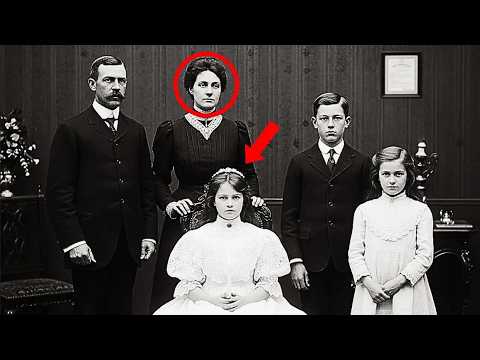
Rebecca had worked in the Portland Historical Society’s restoration studio for fifteen years. She knew the smell of chemical solutions and old paper better than her own home. She’d cleaned grime from countless glass plate negatives, coaxed faded faces back from oblivion, and treated every image with reverence. But this photograph—donated in a leather case from a Brunswick farmhouse estate—felt different from the moment it arrived. The family of five sat posed in their parlor: a stern father, a mother with an unreadable stare, and three children arranged with unnatural stiffness. Even for an era of long exposures, something was off.
Now, two hours into digital restoration, the truth was emerging pixel by pixel. The father’s hand rested on the middle daughter’s shoulder—protective, or holding her in place? The mother’s gaze was too fixed, too distant, as if staring into an abyss. And the youngest child, no more than four years old, sat in a small chair at the front, dressed in pristine white lace, her small body positioned with perfect precision.
Rebecca’s hands trembled as she enhanced the background. There, on the parlor wall behind the family, hung a framed document. She adjusted the contrast until letters emerged. A death certificate. The date was barely legible—February 1907—but the age read clearly: 4 years. Cause of death dissolved into blur.
She pushed back from the monitor, her heart pounding. Post-mortem photography was common in the early 1900s, when child mortality was devastating and families grasped at any way to preserve a memory. But those photographs were usually obvious—the deceased posed alone, or held by grieving parents, often in coffins. This family had posed their dead child as if she were alive, seated among them, a candle burning in her hand.
Rebecca canceled her afternoon meetings and sent her assistant home early. She needed to be alone with the image. She zoomed in on the candle, enhancing until the tiny flame appeared with perfect clarity. White wax. Dark wick. A bright blur against the darker parlor. In Victorian symbolism, candles represented the light of life, the soul’s journey, the passage from darkness to light. But why make the child appear so lifelike? Why pose the entire family as if this were a normal portrait rather than a memorial?
As evening shadows filled the studio, Rebecca noticed something else—the father’s expression wasn’t just stern. It was broken. The older brother’s rigid posture wasn’t formality. It was fear. And the mother’s distant stare wasn’t grief. It was denial.
Rebecca made a decision. Tomorrow, she would drive to Brunswick and find out exactly what happened to the Harrison family in February 1907. She had no idea that the answer would involve nine days of a mother’s desperate refusal to let go, a town physician’s disturbing journal, and a secret that had been packed away for over a century—waiting for someone to finally zoom in.
The Brunswick Historical Society occupied a converted church on a quiet side street, its stained glass windows throwing colored light across tables piled with documents. An elderly volunteer named Mr. Carson greeted Rebecca at the door, and when she showed him the restored photograph, his eyes widened. “Good Lord,” he murmured, pulling reading glasses from his shirt pocket. “I haven’t seen a memorial photograph like this in years.”
He carried the image to a window, studying it in natural light. His weathered hands trembled slightly as he traced the outline of the youngest child. “This is the Harrison family from the old Cooper Road farm,” he said finally. “My grandmother used to talk about them. Tragic story.”
Rebecca leaned forward. “What happened?”
Mr. Carson set the photograph down carefully. “The youngest daughter died in the winter of 1907. Pneumonia, if I remember correctly. But there was talk in the town. People said strange things about that family after she passed.”
“What kind of things?”
“That they kept her in the house for days before the burial. That the mother wouldn’t let anyone take the child away.” He shook his head. “It was a different time. People grieved in ways we might find disturbing now.”
Rebecca thought of the death certificate on the wall, the candle in the child’s hand. “Do you know what happened to the rest of the family?”
“The father died not long after. The mother and the other children moved away. I don’t know where.” He paused, his expression troubled. “Why the interest in this particular photograph?”
She explained about the restoration work, the details emerging from beneath decades of grime. She didn’t mention the growing unease she felt every time she looked at those frozen faces—the sense that something beyond normal grief had been captured in that moment.
Three days later, Patricia from the county clerk’s office called with news. She’d found the death certificate for Eleanor Harrison, age 4, who died on February 14th, 1907. Cause of death: pneumonia. Buried in Riverside Cemetery in Brunswick.
“There’s something else,” Patricia added, her voice uncertain. “I found a newspaper clipping from the Brunswick Gazette dated February 1907. It mentions the Harrison family. Would you like me to send you a copy?”
“Please,” Rebecca said, gripping the phone tightly.
The scan arrived within the hour. The article was brief, printed in the obituary section, but the language was oddly formal. The community extends its sympathies to Mr. and Mrs. Joseph Harrison on the passing of their youngest daughter, Eleanor, who departed this life on the 14th of February. Services were delayed pending the arrival of family members from Boston.
Delayed services. Rebecca read the phrase again. Mr. Carson had said the family kept the child’s body in the house for days. In February in Maine, that would have been cold enough to preserve the body. But still—how many days had passed between Eleanor’s death and her burial?
She searched the cemetery’s online database and found Eleanor Harrison’s grave easily. Section C, plot 47. The listing showed she was buried on February 23rd, 1907—nine days after her recorded death.
Nine days. Rebecca’s skin prickled. What had happened in those nine days? What had the Harrison family done with their daughter’s body while they waited?
She looked again at the photograph—the elaborate white dress, the carefully arranged hair, the candle burning in that small hand. This wasn’t just a memorial portrait taken shortly after death. This was something else. Something that spoke to a level of denial or ritual that went beyond normal grief.
The studio felt suddenly cold despite the radiator’s steady hiss. Rebecca pulled her cardigan tighter and made a decision. Tomorrow she would visit Riverside Cemetery. Perhaps Eleanor’s grave would provide answers that the photograph couldn’t.
As she prepared to leave for the day, her phone rang—an unknown number with a Maine area code. “Dr. Foster? This is Margaret Brennan. I’m calling from the Brunswick Historical Society. Mr. Carson mentioned you were researching the Harrison family. I think I might have something you need to see.”
Margaret Brennan’s apartment was in a converted Victorian house near the center of Brunswick. She greeted Rebecca at the door—a thin woman in her seventies with sharp eyes and quick movements. Her living room was an organized chaos of books, photographs, and archival boxes.
“I’ve been collecting Brunswick family histories for forty years,” Margaret explained, leading Rebecca to a cluttered desk. “When Mr. Carson called and described your photograph, I remembered something I’d acquired at an estate sale in 1995. I hadn’t thought about it in years.”
She produced a small leather-bound journal, its pages yellowed and fragile. “This belonged to Dr. Samuel Whitmore, the town physician in the early 1900s. He kept detailed notes on his cases—including some observations about the families he treated.”
Rebecca took the journal carefully, her hands trembling with anticipation. Margaret pointed to a page marked with a strip of paper. “February 1907,” she said quietly. “Read this entry.”
The handwriting was cramped and faded, but legible. February 15th, 1907. Called to the Harrison residence on Cooper Road. The child Eleanor passed in the night, pneumonia having claimed her despite all my efforts. I expected to make arrangements for the undertaker, but Mrs. Harrison refused to allow me to take the child. She became hysterical, insisting that Eleanor would wake, that she could see her breathing. Mr. Harrison, broken by grief, could not bring himself to intervene.
Rebecca looked up, her throat tight. “Did he go back?”
Margaret nodded, turning several pages forward. “Read this.”
February 20th, 1907. My fifth visit to the Harrison home. The situation has not improved. The mother continues to maintain Eleanor in the parlor, changing the candle daily, speaking to the child as if she were merely sleeping. The other children are terrified, forbidden to mention their sister’s death. Mr. Harrison has withdrawn completely. I have consulted with the county authorities, but they are reluctant to intervene in what they consider a family matter. Tomorrow, a photographer is coming at Mrs. Harrison’s request. She wishes to have a family portrait made while Eleanor is still with us. God help this family.
Rebecca set the journal down, her hands shaking. The photograph now made terrible sense. It wasn’t just a post-mortem portrait—it was the culmination of a mother’s desperate denial, a final attempt to preserve the illusion that her daughter still lived.
“There’s one more entry,” Margaret said softly. “The final one about the Harrisons.”
Rebecca picked up the journal again, her stomach churning with dread. February 23rd, 1907. The photographer came yesterday. I was not present, but I heard the account from him this morning. Mrs. Harrison directed the arrangement with precise instructions—the dead child positioned as if alive, seated in her favorite chair. The candle was lit fresh for the photograph. The mother insisted upon it, saying it was Eleanor’s light. The other children wept during the posing. The older boy tried to refuse, but the father forced him to stand in place. It took nearly an hour to complete the exposure. After the photographer left, Mr. Harrison finally summoned the strength to contact the undertaker. Mrs. Harrison collapsed when they came to take the child. The burial was conducted today, nine days after the child’s passing.
Rebecca closed the journal, her eyes burning with unshed tears. She thought of the photograph waiting in her studio—that frozen moment of grief and denial preserved forever in glass and silver.
“What happened to the family after that?” she asked.
Margaret sighed, settling into a worn armchair. “Joseph Harrison died in 1909. Heart failure, officially, but I suspect it was grief. Catherine, the mother, lived until 1934, but she never recovered her mental health. She spent the last fifteen years of her life in an institution in Augusta. The boy Thomas moved to Boston and changed his name—never married, never had children. The middle daughter Sarah married young and moved to New York. She had children, but she apparently never spoke about her family. Her descendants wouldn’t even know about the Harrisons if not for genealogical research.”
Rebecca thought about the photograph, about the terror the other children must have felt during that long exposure—standing frozen while their dead sister sat among them with a candle in her cold hand, knowing their mother’s grief had twisted into something unrecognizable.
“The photograph was in Sarah’s descendant’s estate?” Rebecca asked.
Margaret nodded. “Her great-granddaughter passed away last year. She was ninety-three and had no children. The estate was liquidated. The photograph must have been packed away for decades. Perhaps Sarah couldn’t bear to look at it, but couldn’t bring herself to destroy it either.”
“The death certificate in the background,” Rebecca said suddenly. “Why would they hang it on the wall for the photograph?”
“I noticed that too,” Margaret said. “I think Mrs. Harrison wanted proof—proof that Eleanor had died, proof of the date. So that when they looked at the photograph, they would remember what they had done, how they had honored their daughter in those final days before letting her go.”
It was a chilling thought—that the mother, even in the depths of her denial, had understood on some level what she was doing.
Rebecca returned to the studio and called Robert Whitmore, the doctor’s grandson. He listened in silence, then said, “My grandfather blamed himself until the day he died. He had the authority to take that child, but he hesitated out of respect for their grief.” The words hung in the air like the candle’s smoke.
Weeks later, the exhibition opened. Jennifer Marshall, Sarah’s great-great-granddaughter, stood before the photograph with her teenage daughter. “She was four,” the girl whispered, staring at Eleanor. “The same age as my cousin.” Rebecca explained the candle then—a mother’s desperate belief that her daughter’s light still shone.
The exhibition drew crowds, but what surprised Rebecca most were the visitors who lingered, tears streaming, sharing their own stories of loss. An elderly woman approached her one afternoon. “I lost my daughter fifty years ago,” she said. “I kept her room exactly as she left it. Seeing this—it helps me forgive myself.”
Rebecca often stood before the photograph, studying those frozen faces. Eleanor, pale and still. Catherine, staring into emptiness. Thomas and Sarah, terror barely concealed. But she also saw love—desperate, distorted, ultimately destructive love. The photograph had been hidden for over a century, packed away by descendants who couldn’t bear to look at it. Now it served as evidence of how little has changed. We still struggle to accept death. We still light metaphorical candles, hoping they might guide our lost ones back.
Eleanor Harrison died on Valentine’s Day, 1907. Nine days later, she was finally laid to rest. But in a way, Catherine’s wish had come true. Her daughter’s light was still shining more than a century later—illuminating the darkest corners of human loss. What would you have done, standing in that parlor, holding a candle for someone you couldn’t let go?
Report this article
Select a reason for reporting:






