You are a German soldier who has spent years laughing at America. You have heard the stories—how Americans are soft, spoiled, living on chocolate and chewing gum, how their soldiers would crumble at the first sign of real hardship. You have mocked their abundance, called it weakness, and convinced yourself that German discipline would always triumph over American indulgence. Then you are captured. You are shipped across the Atlantic, expecting starvation, cruelty, maybe even execution. You have heard the rumors about American prison camps—worked to death, fed scraps, treated worse than animals. But then you sit down for your first meal in an American POW camp. What is placed in front of you is not punishment. It is not cruelty. It is something so shocking that it will haunt you for the rest of your life.
Fresh bread with butter. Hot coffee—real coffee. Meat and vegetables. More food than you have seen in months. In that moment, everything you believed about America crumbles, because what you are tasting is not weakness. It is a strength so overwhelming that this nation can afford to feed even its enemies better than your own country feeds its heroes.
The propaganda machine had a favorite lie. In Nazi Germany, food was not just sustenance—it was a weapon. The story German soldiers heard over and over was simple: Americans are soft and spoiled. Their soldiers survive on chewing gum and chocolate, without canned fruit and coffee. They would collapse in the face of German discipline versus American indulgence. Around smoky campfires and in freezing bunkers, these stories became running jokes. “We endure black bread and cabbage soup,” German soldiers would laugh. “The Americans need steak and candy bars just to function.”
But this was not just about mocking enemy rations. It was about protecting German pride. Because deep down there was a terrifying thought they could not admit: what if an army that was both well-fed and well-armed was actually impossible to defeat? It was easier to laugh at abundance than face that frightening truth.
When tens of thousands of German troops were captured across North Africa, Italy, and France, the bravado continued during the long voyage to America. But now the jokes had an edge of desperation. In the cramped ship holds, prisoners filled the silence with bitter laughter. “Let’s see how these spoiled Americans feed us,” they sneered. “Their food will probably be inedible anyway. We’ll show them what real soldiers look like.” Behind the sneers was growing unease. Every clang of pots from the ship’s galley, every faint smell of cooking that drifted down, reminded them of what awaited. They braced for cruelty. They braced for hunger. They braced for humiliation. None of them believed they would find kindness.
But the moment their ship pulled into an American harbor, everything they thought they knew began to collapse. What the German prisoners saw as they disembarked was not the poor, chaotic land Nazi propaganda had promised. Instead, they saw harbors lined with towering cranes, endless rows of trucks, and trains sprawling from factories that never seemed to end. Workers moved cargo with precision and speed. The docks buzzed with unstoppable energy. As they were marched onto waiting trains, the German prisoners fell into stunned silence. Through barred windows, America flew past—fertile farmland stretching to the horizon, neat towns with clean streets, highways packed with automobiles, factory smokestacks billowing productivity. Some whispered in disbelief. Others buried their thoughts, unwilling to admit what their eyes were telling them. This was not weakness. This was something else entirely. And they were about to discover just how powerful abundance could be.
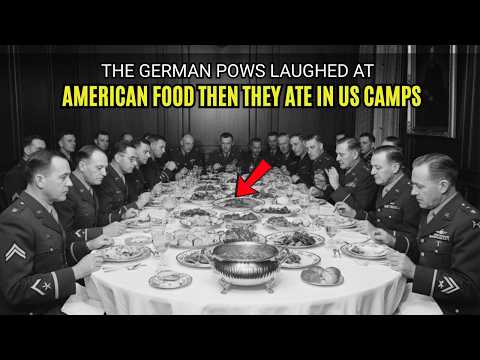
Marched into POW camps surrounded by barbed wire and watchtowers, the German prisoners braced themselves for thin soup and stale bread. Instead, they were led into an orderly mess hall filled with the smell of cooking food. What they saw defied everything they had been told. Wooden tables set in perfect rows, plates piled higher than they had imagined possible. Fresh soft bread, actual meat and vegetables, sometimes even potatoes with gravy. And then came the real shock—steaming mugs of real coffee. For men who had not tasted genuine coffee in years, who had grown used to bitter substitutes made from barley and acorns, this was nothing short of miraculous. The first meal silenced them completely. Forks clinked. Spoons scraped. But few words were spoken. The food was not just plentiful. It was good. Some prisoners muttered that they were eating better as captives than their families back home. In that first meal, many realized something they could never say out loud: America had strength enough to feed even its enemies.
The first meal was shocking. But what truly shattered their expectations was what came next. Day after day, the food kept coming. This was not one generous gesture—this was a system. Breakfast brought fresh bread with butter or jam, sometimes eggs, oatmeal, even bacon. Lunch was stews filled with beans, peas, and lentils, often with chunks of meat. Dinner meant roast beef, pork chops, or chicken with potatoes and vegetables. On Sundays, there was even dessert—pies, puddings, canned fruit. And every single day, steaming mugs of genuine coffee were handed out like it was nothing. For many prisoners, that rich aroma in the mess hall was more shocking than the sight of armed guards.
The change in their bodies was undeniable. Soldiers who had marched into captivity thin and hollow-cheeked began putting on weight. Uniforms that had hung loose from months of hunger at the front started getting tight again. American medical officers noted the irony with quiet amusement: these prisoners of war were often healthier in captivity than they had been while serving the Reich.
Weeks turned to months. Letters began arriving from Germany. Every single one told the same heartbreaking story—wives standing in endless lines for rationed bread, children going months without meat, families living on turnips and ersatz coffee, shortages, ration cards, and constant hunger. Some prisoners kept these letters folded in their pockets, reading them until the paper wore thin. Each time they walked into that American mess hall with its smell of fresh bread, its trays of meat and vegetables, its steaming mugs of real coffee, the contrast became impossible to ignore. The irony was devastating: men who had marched off to fight for the Reich were now eating better than their wives and children back home. Some felt shame. Others felt guilt. A few stopped writing about food altogether, afraid that honesty would wound the people they loved.
The abundant food stirred something deeper than hunger. It stirred dangerous questions. Arguments broke out among the prisoners. Hardcore Nazis insisted that American food was weakness—that luxury rots the spirit, that German discipline would outlast American comfort. But others quietly wondered: what kind of nation can feed millions of its own citizens, fight a world war on two continents, and still feed its enemies with regular meals? Some tried to rationalize it. “The Americans are trying to fatten us up like pigs before slaughter,” one insisted. Others whispered, “Maybe this is psychological warfare—give us comfort to break our will.” But with every passing day, the routine never changed. The plates remained full. The meals stayed steady. The coffee stayed hot. The laughter that once came so easily was fading, replaced by an uneasy awareness that everything they had been told might be a lie.
Over time, the food became more than survival. It became a lesson in power. The prisoners began to understand something revolutionary: abundance was not weakness at all. It was strength. The Americans did not need to starve their enemies to prove their power—they had confidence enough to feed them. That quiet confidence was more disarming than cruelty could ever have been. It demonstrated something terrifying to Nazi ideology: true strength is not proven by starving your enemies, but by having the power to feed them. Around the barracks, conversations shifted. If a nation could treat its captives with this level of order and humanity, what else might it be capable of? Maybe—just maybe—the propaganda was wrong about everything.
One evening, a young lieutenant named Weber—barely twenty, captured in the Ardennes—sat staring at his plate of roast chicken. He had been one of the loudest mockers on the ship, joking that the Americans would serve them sawdust and call it bread. Now he pushed his food around with his fork, his face pale. “My father owns a butcher shop in Bremen,” he said quietly to no one in particular. “He hasn’t seen a cut of meat like this since 1942. And I’m eating it as a prisoner.” The table fell silent. No one had an answer.
It was not just the food. It was the order. The camp had a library, a small chapel, a soccer field. Prisoners could write letters, receive packages, even listen to music on Sunday afternoons. Guards treated them with a bored, businesslike courtesy—no beatings, no random cruelty. For men raised on stories of American chaos, this quiet efficiency was its own kind of shock. “They are not trying to break us,” Weber whispered one night. “They are just… living. And they let us live alongside them.”
The breaking point came for many during a simple baseball game. On a warm spring afternoon, American guards organized a match against the prisoners. At first, the Germans refused—it felt like a trap, a humiliation. But boredom won out. They played. They lost badly, but they laughed. Real laughter, not the bitter kind from the ship. Afterwards, a guard tossed a baseball to Weber. “You’ve got a good arm,” the American said. “Keep it up.” Weber turned the ball over in his hands, staring at the red stitching. That night, he wrote to his father: The Americans are not soft. They are simply strong enough to be kind.
Not everyone accepted this. Hardliners still muttered about betrayal, about weakness, about the Reich rising again. But their voices grew quieter, drowned out by the clatter of forks and the smell of fresh coffee. The arguments faded because the evidence was on the table, three times a day, impossible to deny. When a nation feeds its enemies better than its own soldiers eat at the front, something fundamental has shifted. The prisoners could feel it, even if they could not yet name it.
Then came the news that would change everything. In late April 1945, the camp commander called a general assembly. His voice was steady, but his eyes betrayed something somber. He announced that President Roosevelt had died. A murmur rippled through the crowd. Weber felt a strange pang—a grief he had no right to feel. “He was our enemy,” he reminded himself. But the coffee in his hand was hot, and the bread in his pocket was fresh, and he could not bring himself to hate a man whose country had fed him.
The war ended. Germany lay in ruins. The camp gates opened, and the prisoners faced a choice that would define the rest of their lives. Return to a homeland of rubble and hunger—or stay in the country they had once mocked.
Thousands chose to stay. They had arrived as enemies, convinced of American weakness. They left as witnesses to a different kind of strength—one measured not in weapons and factories, but in the mercy shown to those who had tried to destroy them.
Weber returned to Bremen. His father’s butcher shop was gone, the street a canyon of rubble. He found his father thin, gray, silent. That night, Weber told him about the coffee. The roast chicken. The baseball game. His father listened, then whispered, “And they fed you—their enemy—like that?” Weber nodded. “Then we were lied to about everything.”
The lesson echoed through history. True power is having the strength to be merciful. Real confidence is treating even your enemies with humanity. The laughter that once echoed through German trenches fell silent forever.
What began as mockery ended as reluctant admiration—served with bread, meat, and coffee.
So tell me: if a single meal can shatter a lifetime of propaganda, what does that say about the stories we still believe today?
Report this article
Select a reason for reporting:






