The box was tucked away in the dusty corner of a forgotten studio vault, its label faded and unreadable. When archivist Lena first pried it open, she expected the usual—old scripts, maybe a reel of film. Instead, she found a stack of undeveloped negatives, their edges curled with age. What she saw when she held them to the light would change everything she thought she knew about 1940s Hollywood.
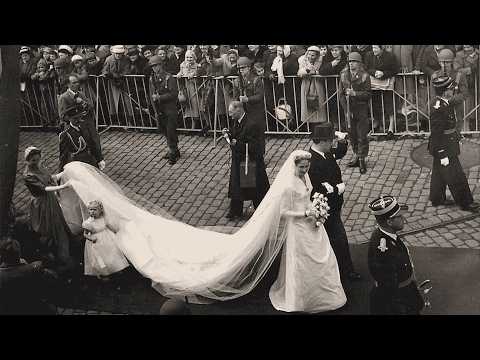
The first image was a wedding portrait—but not the kind that ever made the papers. There was no crowd, no flashing bulbs. Just a bride in a simple satin gown, her veil lifting in a breeze, and a groom whose face was half-hidden in shadow. Lena recognized the bride instantly: Vivian Hale, the silver-screen siren who was supposed to have married a studio mogul that same year. But the man beside her was not the mogul. He was someone else entirely—someone the world had never seen her with.
Lena’s hands trembled as she slid the negative into the scanner. The image flickered onto her screen, grainy but unmistakable. “This can’t be right,” she whispered. The man was Jack Mercer, a set designer who had been blacklisted by the studios in 1947. Their wedding, if it was one, had taken place in secret—no press, no guests, just the two of them and a witness whose face was turned away.
Why had Vivian hidden this? And why had the photos been left to rot in a vault? Lena knew she had stumbled onto something bigger than a simple love story. This was a secret that had been buried for over seventy years—and someone had wanted it to stay that way.
As she sifted through the remaining negatives, each frame revealed more of a romance that defied the strict morality clauses of the era. There were shots of Vivian laughing, her guard down, and Jack looking at her with a tenderness no paparazzi ever captured. But there were also darker images—a shadowy figure in the background, a car parked outside a motel, a letter half-burned in an ashtray. It was as if the photos were telling two stories at once: one of love, and one of fear.
Lena glanced at the clock. It was past midnight, but she couldn’t stop. She had to know how this story ended—and why it had been erased. The next negative showed Vivian in a wedding dress again, but this time her eyes were red-rimmed, and Jack was holding her hands as if saying goodbye. What had happened between those two moments?
She reached for the last envelope in the box, sealed with wax and marked with a single word: “Destroy.” Her heart pounded. Whoever had hidden these photos had left a final warning—or a final confession. Lena hesitated, then broke the seal.
Inside was not a photograph but a letter, written in Vivian’s unmistakable looping hand. The paper was thin and brittle, the ink smudged in places where tears had once fallen. “If you are reading this, then I am gone, and the truth has outlived me,” it began. Lena read slowly, her breath catching at every line.
Vivian wrote of a love that had to be hidden behind soundstages and locked dressing rooms. Jack Mercer, she confessed, was not just her secret husband—he was the father of her child, a daughter born in the spring of 1946 and given away within days. “They told me I could keep my career or my baby. I chose wrong. I have regretted it every hour since.”
Lena set the letter down and stared at the wall, her mind racing. A daughter. A child no biography had ever mentioned. If this was true, then Hollywood’s most guarded icon had carried a wound no fan ever saw.
She turned back to the negatives, searching now with different eyes. In one frame, Vivian stood on a porch, a bundle in her arms, her face angled away from the camera as if she couldn’t bear to look. In another, Jack sat alone on a bench, a small knit blanket draped over his knee. These weren’t just lovers’ keepsakes. They were evidence of a family torn apart.
The letter continued with a name—the couple who had adopted the child, a couple Vivian claimed she never met but whose address she had kept hidden for decades. “Find her,” Vivian had written, the two words underlined so hard the pen had torn the paper. “Tell her I never stopped loving her. Tell her I was a coward, but I never stopped.”
Lena’s phone buzzed. A message from her supervisor: the studio was sending someone to collect the box in the morning. They wanted it catalogued and sealed, no exceptions. She looked at the letter, then at the clock. She had six hours to decide whether to obey—or to finish what Vivian had started.
She pulled up the studio’s old employee records on her laptop, fingers flying across the keyboard. The adoptive couple’s name was there, buried in a file marked ‘confidential.’ A daughter, born April 1946. And a current address, less than an hour from the archive.
Lena grabbed her coat. The box could wait until morning. But the truth, she decided, had waited long enough.
The drive was quiet, the streets of Los Angeles slipping past in a blur of neon and shadow. Lena kept the letter folded in her pocket, its weight somehow heavier than the box she’d left behind. Every red light felt like a warning, every mile a step deeper into a story that wasn’t hers to tell.
The address led her to a modest house in Pasadena, its porch light still burning at nearly two in the morning. An old woman answered the door before Lena could knock twice, as though she had been expecting someone for years. Her eyes were Vivian’s eyes—that same startling gray, that same guarded flicker.
“You found the box,” the woman said, not a question. Her name was Margaret, and she had been waiting since 1946 for someone to come.
Lena stood frozen on the doorstep. “You knew about the photographs?” she managed.
Margaret stepped aside, gesturing toward a living room lined with books and old film posters. On the mantel sat a single framed portrait—Vivian Hale in her prime, signed with a flourish. “My mother sent me a letter once a year,” Margaret said quietly. “Never signed with her real name. But I knew. I always knew.”
Lena sank into a chair, the letter from the box suddenly redundant in her hands. Margaret explained that she had never tried to contact Vivian, bound by a promise made to her adoptive parents. “They loved me,” she said. “But they were terrified of her world. They thought if the truth came out, it would destroy us all.”
Then Margaret’s expression shifted, her voice dropping to a whisper. “There’s something else you should know. Something the letter didn’t say.” She crossed to a desk and unlocked a drawer, drawing out a second envelope—this one postmarked 1982, the year Vivian died.
“She didn’t just give me away,” Margaret said, handing it over. “She made me promise to protect someone. And I’ve spent forty years failing to keep that promise.”
Lena tore it open. Inside was a photograph of a young man in a naval uniform, a name scrawled on the back: Daniel Mercer, 1968. Below it, in Vivian’s trembling late hand, a single line: “Jack’s grandson. He doesn’t know we exist. Find him before the studio does.”
The studio. Lena’s blood ran cold. The box hadn’t been forgotten—it had been buried. And whoever wanted it sealed in the morning wasn’t just protecting a reputation. They were hunting the last living proof of a love that never should have been erased.
Margaret’s hand closed around hers, surprisingly strong. “You have until dawn,” she said. “After that, they’ll know you took the letter. And they’ll come looking for both of us.”
Lena looked at the photograph of Daniel Mercer, then at Margaret’s trembling hands. “We don’t have much time,” she said, already pulling out her phone. “Do you know where he is?”
Margaret nodded, her voice steadier now. “He runs a small theater in Santa Monica. Classic films. He doesn’t know why, but he’s always been drawn to them.” She paused, her gray eyes glistening. “He’s showing one of her films tonight. A midnight screening.”
Lena checked the clock. It was nearly three. “Then we go now. Before the studio’s people wake up.”
The theater was a relic itself—velvet seats, a hand-painted marquee, the smell of old popcorn and older dreams. Inside, a single lamp burned in the projection booth. Daniel was there, rewinding a reel, his back to them.
“Mr. Mercer?” Lena called softly. He turned, and she saw it instantly: Jack’s jaw, Vivian’s eyes. He was both of them, and he had no idea.
Margaret stepped forward, her voice breaking. “I’m your grandmother’s daughter. Your father’s half-sister. And I’ve been looking for you my whole life.”
Daniel stared, the reel slipping from his fingers. “My father never spoke of his family,” he said slowly. “He said they were gone. All of them.”
Lena handed him the photograph, the letter, the truth in a single trembling gesture. “They weren’t gone. They were hidden. And you’re the last piece of a story someone wanted erased.”
By sunrise, the three of them sat in the empty theater, the screen flickering with Vivian’s face—young, luminous, alive. Daniel held the letter to his chest, tears streaming freely. “She never stopped,” he whispered. “She never stopped loving any of us.”
Lena’s phone buzzed again. The studio. She silenced it, then looked at Margaret and Daniel. “They’ll come for the box. But they can’t erase what we know now. What do you want to do?”
Daniel stood, his voice steady for the first time. “We show the world. Every photograph, every letter. My grandmother’s story deserves to be told—not hidden in a vault.”
Margaret nodded, squeezing Lena’s hand. “Then let’s give them a premiere they’ll never forget.”
And as the sun rose over Hollywood, the truth—long buried, long silenced—finally found its voice. What would you have done with Vivian’s secret—sealed the box, or set it free?
Report this article
Select a reason for reporting:






