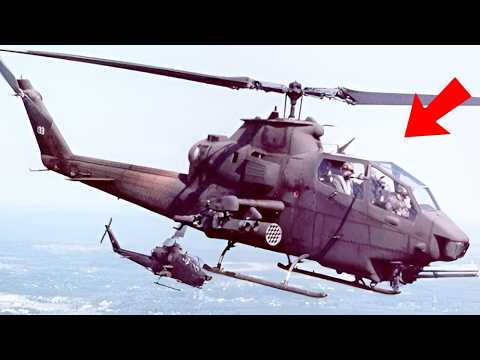
In the annals of aerial warfare, few machines have left a mark as deep and as haunting as the AH-1 Cobra. This was not a helicopter designed to ferry troops or evacuate the wounded. It was built for a single, uncompromising purpose: to kill. And the men who flew it discovered that a machine engineered for pure destruction does something to its operator that no amount of training can prepare them for.
The story begins not with the Cobra, but with a problem. By 1965, the U.S. Army’s strategy in Vietnam hinged on helicopters—specifically, the UH-1 Huey. On paper, the concept of air cavalry was brilliant: leap over the jungle, land behind enemy lines, and fight on your own terms. In practice, the Huey was a flying coffin.
The Viet Cong and North Vietnamese Army quickly learned the pattern. They would let the Huey commit to a landing zone—low, slow, and vulnerable—then unleash hell from the tree line. The Huey, with its 8-foot-wide profile and exposed belly, was a sitting duck. Helicopters were being shot down faster than Bell could build them.
The Army tried arming the Huey itself. Rocket pods, extra machine guns, armor plating—they called them “Hogs.” But hanging all that ordnance on a utility helicopter killed its speed. The “Hog” couldn’t keep up with the transports it was supposed to protect. It was wider than a barn and slower than the aircraft it escorted. The side-mounted guns forced pilots to expose their entire flank just to fire. The Army needed something radically different: not a transport with guns, but a helicopter designed from the ground up for one mission.
Bell Helicopter had already been thinking about it. In September 1965, test pilot Bell Quinland lifted off in the Model 209 prototype for a 12-minute flight that would change military aviation forever. Bell took the Huey’s engine, transmission, and rotor system—proven components already in the supply chain—and wrapped them in a fuselage so narrow it barely looked like the same species. Thirty-six inches wide. One-third the width of a Huey. The cockpit was tandem: gunner in front, pilot elevated behind, so the aircraft could point its nose at you and present almost no target. Top speed: 220 miles per hour. Stub wings for rockets and gun pods, and a chin turret the gunner aimed by moving his head. Wherever he looked, the guns followed.
Less than two years from first flight to combat deployment. Six Cobras arrived at Bien Hoa Air Base on August 30, 1967. Five days later, on September 4, a Cobra crew destroyed a Viet Cong boat—its first confirmed kill. The concept was validated before most of the Army even knew the aircraft existed. By 1972, over a thousand Cobras were operating in Vietnam at once, eventually logging more than a million combat flight hours.
But the numbers aren’t what made the Cobra terrifying. It was the way it hunted.
The most lethal tactic in helicopter warfare was called the “Pink Team.” One small scout helicopter—the OH-6 Loach—and one Cobra. The Loach flew at what pilots called “low-level hell”: ten to fifty feet above the ground, skimming the elephant grass. The pilot searched for signs of the enemy. Trampled plants, cooking fires, footprints. Sometimes the smell of cigarettes drifting up through the vegetation. Sometimes the Loach pilot deliberately drew fire, cruising and exposing himself as bait.
The Cobra orbited at 1,500 feet above, watching. The moment the Loach took fire, the scout pilot popped smoke to mark the position and banked hard, and the Cobra went into a diving attack. What happened next took about thirty seconds.
The pilot pushed the nose down and accelerated. The gunner locked the turret on the smoke. At the right moment, rockets went first—2.75-inch folding-fin aerial rockets, seven or nineteen per pod, hitting the position with blast and shrapnel. Then the minigun opened up. The M-134 fired 6,000 rounds per minute in some configurations, 4,000 in the standard setting. That’s sixty-seven rounds per second. Individual shots came so fast the human ear couldn’t separate them. It didn’t sound like a weapon. Veterans on both sides described it the same way: the sound of someone tearing a massive piece of cloth. A deep, sustained rip that meant everything in its path was being destroyed.
Then the Cobra rose, turned, and came around again. And again. Unlike a jet that screamed through at 500 knots and vanished, the Cobra lingered. It stayed there. It circled overhead like a patient thing, waiting for any movement, waiting for anyone still alive to make the mistake of running.
NVA troops learned to fear the sound of that rotor. Military historian Peter Davies documented that enemy forces often refused to fire on the scout aircraft—precisely because they knew the Cobra was circling above, waiting for the muzzle flash. The rational decision to shoot down the thing hovering over your position became suicide because of what was watching from 1,500 feet. This wasn’t just a weapon. It was a predator that turned your survival instincts against you. Fire, and you die. Don’t fire, and the scout marks you anyway.
And now, this is the part the spec sheet doesn’t cover: what it was like inside the cockpit. The Cobra pilot wasn’t pressing a button from 30,000 feet. He was flying at 200 feet above the jungle, watching his rockets hit their targets, watching the machine-gun rounds rake the tree line, watching people die.
The gunner in the front seat was closer still. He aimed the turret with his helmet, and his sight showed him exactly where every round landed. There was no abstraction, no distance, no such thing as “down there.” He saw it. Randy Zahn, a Cobra pilot who wrote about his experience, described the transformation from—in his words—a naive middle-class teenager into a hardened killer. He spoke of a mix of contradictory emotions: fear, revenge, hatred, and beneath it all, a compassion that never quite disappeared. Because the Cobra engaged at what he called “eye level,” and the results of a 4,000-rounds-per-minute burst on human bodies was something you couldn’t look away from.
Then there was the body count. After every engagement, crews were ordered to fly back over the target at low altitude and count the dead. This wasn’t the pilot’s idea. It was institutional policy, the Army’s metrics-based approach to measuring progress in a war where territory wasn’t changing hands in any meaningful way. So the men who had just killed from 200 feet were sent back down to 50 feet to verify what they’d done, to look at it, and to put a number on it.
And those numbers went up the chain of command, where—according to Zahn and others—officers regularly inflated them to advance their careers. The pilots did the killing. The institution counted the dead and called it progress. And the young men in the cockpit, averaging nineteen or twenty years old, absorbed all of it. Some didn’t survive what they absorbed.
One pilot, known only by a pseudonym in his memoir, wrote about his attachment to a particular aircraft. “Old 340,” the way another man might speak of someone he loved. He also wrote about a fellow pilot named Stauxtill who came home from Vietnam and killed himself. The memoir doesn’t diagnose Stauxtill’s condition, and it doesn’t need to. The line between twelve months of flying over kill zones and a quiet decision in a room back home is one the reader draws themselves.
During the Easter Offensive of 1972, the NVA sent Soviet-built T-54 tanks across the border in a conventional invasion. The Cobra was never designed to fight armor. Nobody believed the NVA would use tanks in the jungle. At the Battle of An Loc, Cobra crews attacked T-54s with rockets and 20mm cannons—weapons meant for fortifications and infantry, not heavy armor. They had to hit the tank itself multiple times just to try to disable a track or vision blocks. One crew, Major Larry McKay and Warrant Officer Barry McIntyre, fired a TOW missile at a T-54 and blew the turret clean off. After that, NVA tank crews began abandoning their vehicles the moment Cobras appeared in the sky.
Colonel William Miller, the senior advisor at An Loc, put it plainly: the Cobras were the instruments of our survival.
But the Cobra’s precision was always conditional. Over dense jungle from an aircraft moving at 170 miles per hour, the line between enemy combatant and civilian was sometimes invisible. “Free-fire zone” policies told pilots that anything moving in a designated area was a hostile target. A foreign service officer in Sau Duc province described repeatedly stopping Cobra pilots from targeting people wearing black clothing. That was the standard Viet Cong uniform—but it was also what every farmer in the Delta wore to work. Those who were stopped didn’t fire. Those who weren’t stopped… those calculations fall under a different ledger, and its numbers are uncertain because no one in the institution wanted to keep that statistic.
Over the course of the war, roughly 300 Cobras were destroyed. 247 crew members were killed. During Operation Lam Son 719 alone—eight weeks in early 1971—26 Cobras were destroyed and another 158 damaged. This wasn’t attrition. This was a meat grinder that consumed aircraft faster than the supply chain could replace them.
And the men who flew those missions and came out alive carried it differently than anyone else in the war, because their weapon wasn’t a rifle you fired and set aside. It was a machine they lived inside, bonded with, gave names to, and depended on. And the only function of that machine was killing at close enough range to see what killing looks like.
The Cobra proved that attack helicopters worked. Every attack aircraft that came after it—Apache, Viper, the Russian Havoc—borrowed the same 36-inch-wide fuselage, the tandem cockpit, the chin turret that a test pilot flew for twelve minutes in 1965. It permanently changed warfare. But the men who proved the concept, who flew a million hours at treetop level, who watched their rockets hit their targets and counted the bodies because the system ordered them to, and came home to hear the sound of rotor blades in their sleep for the next fifty years—they didn’t change the war. The war changed them. And most of them are in their seventies now, and they still hear
the rotors. Not the noise of battle, not the screams, but that steady, rhythmic thrum—the heartbeat of a machine that was never meant to save anyone.
Some of them found peace. Most found something quieter than peace: a life built carefully around the edges of what they’d done, never quite touching the center of it. They raised children, sold insurance, coached Little League. And on certain nights, when a helicopter passed over their house, they’d stop mid-sentence and look up.
The Cobra didn’t just change how wars are fought. It revealed something we’ve spent decades trying to forget: that the distance between a man and what he does can be erased entirely—and that once it’s gone, it never fully comes back.
So here’s a question worth sitting with: if we built a machine that made killing feel like eye contact, are we responsible for the war it changed—or for the men it broke?
Report this article
Select a reason for reporting:






