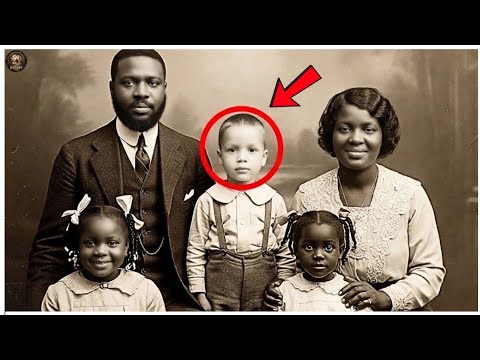
Eleanor’s eyes narrowed on the small hand resting on the mother’s shoulder. It was the first thing she noticed—not the woman’s face, nor the expensive dress, nor the strange little boy standing slightly behind the family. Just the hand. A child’s hand, fingers spread naturally, as if belonging to someone standing just outside the frame. Someone who should not have been there.
She had spent thirty years restoring historical photographs, and she knew immediately: this was wrong. Deeply wrong.
She placed the image under her magnifying lamp. Four fingers, one thumb—the hand was unmistakably real, yet there was no body, no arm, nothing attached. Just a hand. Eleanor leaned closer. Then she noticed something else: none of the family members were looking at the camera. Not the mother, not the father, not the two daughters, not the boy. They were all staring at a point just behind the photographer. As if someone stood there. Someone they knew. Someone important.
Her heart began to race. The photograph had been discovered three days earlier in the attic of an abandoned manor in northern England. The estate belonged to the Whitmore family. The last surviving member, Margaret Whitmore, had died at ninety-seven, leaving a strange clause in her will: every photograph found inside the house must be preserved. When workers opened the attic, they found hundreds of images—weddings, school portraits, holidays, military uniforms, children beside bicycles. But one was different.
It was hidden inside a locked wooden box. On the box, six words were scrawled: “Do not show this to anyone.”
Naturally, that was the first photograph Eleanor wanted to see. She had been hired by the local historical society to catalogue the collection. At first, she assumed the warning was written by a paranoid relative. But after examining the portrait, she wasn’t so sure.
The date on the back read 1920. The family was identified as the Whitmores: Thomas, his wife Clara, their daughters Rose and Evelyn, and their son Edward. Five people—yet the image seemed to hold six.
Eleanor flipped the photograph over. Faded handwriting on the back read: Taken 3 weeks before… The rest was scratched out.
Daniel, her assistant, walked in. “What did you find?” he asked. She didn’t answer. He stepped closer. “Is that the Whitmore family?”
“Yes.”
“What happened to it?”
“I think someone tried to hide something.”
Daniel looked at the picture. Then he laughed nervously. “That’s creepy. Look at the mother’s shoulder.” He leaned in. His smile vanished. “Is that a hand?”
“Yes.”
“Where’s the rest of the person?”
“That’s exactly what I want to know.”
They spent the rest of the afternoon examining the photograph. No signs of manipulation. No modern edits. No cropped edges. No pasted sections. The image appeared completely original. But something bothered Eleanor more than the mysterious hand.
The boy—Edward Whitmore. According to family records, Edward had died in 1919. One year before the photograph was supposedly taken. Eleanor checked the documents again. Edward Whitmore, born 1908, died November 17, 1919. Cause of death: pneumonia. Yet there he was, standing behind his mother, alive. At least, that’s what the photograph showed.
Daniel stared at the boy. “You’re saying this picture was taken after he died.”
“I don’t know yet. But the date is 1920.”
“Maybe the date is wrong.”
“Possible. Or maybe it’s not Edward.”
Eleanor zoomed in. The boy’s face was partially shadowed, but something about it was familiar. She searched through other Whitmore photographs. After an hour, she found one taken in 1917. Edward stood beside his father. Same ears, same eyebrows, same small scar near his chin. It was him. No doubt.
Daniel swallowed. “So the family photographed a dead child?”
Eleanor shook her head. “Not necessarily.”
“Then what?”
She pointed to the mysterious hand. “Maybe the photograph wasn’t taken in 1920.”
“Then why write 1920?”
She didn’t answer. Because there was another possibility. Someone had deliberately changed the date.
That evening, Eleanor took the photograph home. She placed it on her desk and continued studying it long after midnight. At 1:13 a.m., she noticed something she hadn’t seen before. Behind the family was a large mirror. The mirror reflected the room—but there was something inside the reflection. A figure. Eleanor froze. She leaned closer. In the mirror, behind the family, stood a woman. An elderly woman. She wore a dark dress and appeared to be holding something. Eleanor magnified the image. The woman wasn’t holding an object. She was holding a photograph. A photograph of the same family.
Eleanor’s hands began to tremble. She grabbed her phone and called Daniel. When he answered, she said only four words: “Come here. Now.”
The next morning, they returned to the manor. They searched the attic again. This time, they weren’t looking for photographs. They were looking for the room shown in the painting. After several hours, they found it. Behind a wall covered in faded wallpaper was a hidden staircase. The stairs led to a sealed room. Inside was an old writing desk, and inside the desk were diaries. The diaries belonged to Clara Whitmore. The first pages contained ordinary entries—household expenses, weather, family illnesses. Then they reached November 1919. The handwriting changed. The entries became shorter, more frantic. One sentence appeared repeatedly: Edward didn’t leave.
Eleanor read it twice, then a third time. On December 2nd, Clara wrote: “He came back tonight.” Daniel looked at Eleanor. “What does that mean?” She turned the page. The next entry was stranger. “Thomas says I’m imagining things, but I know my son.” “He stands outside my bedroom door every night.” Then, on December 18th: “I saw him in the garden.” And finally: If anyone finds these diaries, they must understand: the painting was not meant to prove Edward survived. Eleanor stopped. She turned the page. The next page had been torn out, but beneath it was a single sentence: The painting was meant to prove who came back.
And suddenly, the mysterious hand in the photograph no longer seemed the strangest part. The real mystery was this: if Edward Whitmore died in 1919, who was standing with the family in 1920?
Daniel broke the silence first. “Who came back,” he repeated slowly, as if saying the words aloud might make them less impossible. “Eleanor, this is starting to sound less like a photograph and more like a ghost story.”
“Then we treat it like evidence,” she said, though her voice lacked its usual certainty. She turned back through the diaries, page by page, searching for a name, a description, anything. Most of the later entries were ruined—water stains, torn corners, ink bled into the paper until the words dissolved into gray smears.
But near the back of the second diary, tucked into the spine, she found something that didn’t belong. A folded slip of paper, brittle as dried leaves. On it, in a different hand—smaller, more deliberate—was written: She is not to be photographed. She is not to be named. She is not to be fed.
Daniel read over her shoulder. “That’s not Clara’s handwriting.”
“No,” Eleanor said. “It’s Thomas’s. I compared it to the household ledgers.” She looked up. “Three rules. Like they were dealing with something that had to be managed.”
They searched the sealed room more carefully after that. Behind a loose panel beneath the desk, Daniel found a bundle of letters tied with black ribbon. The envelopes were addressed to no one. The letters were never sent. Each one began the same way: To the woman in the mirror.
Eleanor read the first aloud. “You have taken what was not yours to take. You wear her face, but you are not her. I know what you are.” She paused, her throat dry. “And I know what you want.”
The next letter was worse. We will do as you ask. We will stand where you tell us to stand. But you will not touch the children again.
Daniel set the letters down. “So they made a deal with it. Whatever it was.”
“They made a deal to protect the children,” Eleanor corrected. “And then they took a photograph. A photograph with a hand in it that belongs to no one.” She looked at the image again, at the small fingers resting on Clara’s shoulder. “What if the hand isn’t the intruder? What if it’s the one thing that didn’t belong to the woman in the mirror?”
Daniel frowned. “I don’t follow.”
Eleanor pulled up the scan of the 1917 photograph on her laptop—the one of Edward beside his father. She placed it next to the 1920 portrait and zoomed in on the boy’s hand. Same shape. Same short, slightly rounded fingers. “The hand on Clara’s shoulder,” she said quietly. “It’s Edward’s.”
Daniel stared. “But there’s no body. No arm.”
“Because the woman in the mirror is standing between them,” Eleanor said. “She’s in the way. The camera caught her—but only barely. She’s the one who’s out of place, not Edward.”
She flipped the photograph over again, staring at the scratched-out words. Taken 3 weeks before… Three weeks before what? Before Edward returned? Before the deal was broken? Before the woman in the mirror stopped being a reflection and started being a guest?
Her phone buzzed. A message from the historical society: The rest of the Whitmore collection has been catalogued. One item was mislabeled. It’s a photograph of the manor taken in 1921. You should see it.
Eleanor opened the attachment. The manor stood silent and gray against a winter sky. In the foreground, near the gate, stood a small figure. A boy. He was facing the house, his back to the camera. But it wasn’t his presence that made her breath catch.
It was the woman standing at the upstairs window. Dark dress. Elderly face. Watching him.
“Daniel,” she whispered. “The woman in the mirror. She’s still there.”
Daniel leaned over her shoulder, his face pale in the glow of the laptop screen. “That’s the same window. The one in the mirror’s reflection.” Eleanor nodded slowly, her mind racing through everything they had uncovered—the diaries, the letters, the three rules. “They didn’t just make a deal to protect the children,” she said. “They made a deal to keep her inside the house. The photograph was the seal.”
She pulled up the 1920 portrait again and stared at the mirror in the background. The elderly woman holding the smaller photograph. “She’s holding a picture of the family,” Eleanor murmured. “A picture of them all together. She wanted to be part of it.” Daniel’s voice was barely a whisper. “And Edward’s hand on his mother’s shoulder—he was trying to hold onto her. To keep her from taking Clara’s place.”
Eleanor sat back, the weight of it settling over her. The Whitmores had trapped something in that house, bound it with rules and rituals and a photograph taken at a precise moment. But the seal had cracked. Margaret Whitmore’s death, the emptying of the manor, the box opened after a century—the woman in the mirror was free to step outside the frame.
She looked at the 1921 photograph one last time. The boy at the gate. The woman watching from the window. “He’s still trying to protect them,” she said. “Even now.” Daniel asked the question neither of them wanted to answer: “What happens when she stops watching and starts walking?”
Eleanor closed the laptop and placed the old photograph back inside its wooden box. “We don’t show this to anyone,” she said. “That’s what the warning meant. Not to hide the truth—to keep her contained.” She locked the box and slid it into her desk drawer. But as she turned away, she could have sworn she heard something shift inside it. A small, patient movement. Like a hand pressing against the lid from the inside.
What would you do if you found a photograph that was never meant to be seen—and realized it had been watching you back?
Report this article
Select a reason for reporting:






