In the spring of 1943, the Eastern Front stood at a crossroads. The German army, bloodied but not broken, faced a Red Army that had learned hard lessons and was now poised to strike. The frozen plains of Russia held their breath as both sides prepared for a confrontation that would determine the fate of the war. The stage was set for the Battle of Kursk, a clash of armor and will that would go down in history as the largest tank battle ever fought.
Adolf Hitler, desperate to regain the initiative after the disaster at Stalingrad, pinned his hopes on a massive pincer movement to crush the Soviet salient at Kursk. “Operation Citadel” was to be a swift, decisive blow that would encircle and destroy five Soviet armies. But the Soviets, warned by intelligence and determined to hold, turned the region into a fortress, laying miles of trenches, minefields, and anti-tank guns. Both sides massed their forces, and the world watched as the greatest armored confrontation in history loomed.
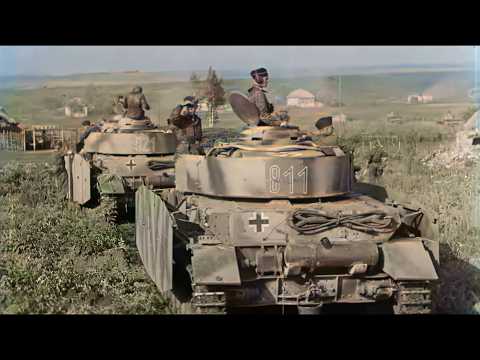
The seeds of this titanic struggle were sown in the bitter winter of 1942-1943. As the German Sixth Army surrendered at Stalingrad, the Red Army launched Operation Little Saturn, tearing a 160-300 km gap between German Army Groups B and Don. The Soviet advance threatened to cut off all German forces south of the Don River, including Army Group A in the Caucasus. In a desperate bid to stabilize the front, Hitler turned to Field Marshal Erich von Manstein, granting him operational freedom to counterattack. Manstein’s forces, bolstered by the arrival of the II SS Panzer Corps from France, struck back in the Donbass region, recapturing Kharkov and halting the Soviet drive.
By mid-March, the spring rasputitsa—the thaw that turned roads into rivers of mud—brought operations to a halt. The front lines solidified, leaving a Soviet salient protruding 250 km from north to south and 160 km from east to west into German-held territory, centered on the city of Kursk. This bulge became the focal point of German strategy. Manstein proposed a rapid offensive to pinch off the salient as soon as the ground hardened. Hitler, eager to regain the initiative, signed Operational Order No. 5 on March 13, authorizing several offensives, including one against Kursk.
But the Germans were not the only ones preparing. The Red Army, under the guidance of Marshal Georgy Zhukov and others, recognized the danger and began fortifying the salient with unprecedented depth. Thousands of anti-tank guns, trenches, and minefields were arrayed in belts up to 300 km deep. The Soviets also held back their mobile reserves, ready to counterattack. Meanwhile, Hitler postponed the offensive repeatedly, waiting for new weapons like the Panther tank and Ferdinand tank destroyer to bolster his forces. The delay gave the Soviets even more time to dig in.
On April 15, Hitler issued Operational Order No. 6, setting the start date for Operation Citadel as May 3 or shortly thereafter. The plan called for a double envelopment: General Walter Model’s Ninth Army would attack from the north, while General Hermann Hoth’s Fourth Panzer Army and Army Detachment Kempf would strike from the south. Their objective: to meet east of Kursk and seal off the salient, trapping five Soviet armies. The Germans massed 900,000 troops, 2,700 tanks, and 2,000 aircraft. The Soviets countered with 1.3 million men, 3,600 tanks, and 3,100 planes. The stage was set for a battle of attrition.
The offensive finally began on July 4, 1943, with preliminary attacks. The next day, the main assault commenced. In the north, Model’s Ninth Army, despite penetrating nearly 6 miles into Soviet defenses, was bogged down by the incredible depth of the Soviet positions. German tanks found themselves exposed to close-range anti-tank fire, and by July 7, the northern attack had ground to a halt, with 25,000 German casualties and 200 tanks lost. In the south, Hoth’s forces, spearheaded by the II SS Panzer Corps, pressed forward. They advanced 50 miles southeast of Kursk, nearing the small village of Prokhorovka.
It was there, on July 12, that the largest tank battle in history erupted. Some 1,500 tanks clashed in a swirling melee of dust and fire. The Germans’ superior tanks, like the Tiger and Panther, were neutralized by the close-quarters combat, where the Soviets’ numerical advantage and maneuverability came into play. By day’s end, the Germans had lost 350 tanks and 10,000 men. The battle was a tactical draw but a strategic defeat for Germany.
That same day, Hitler summoned Manstein and Field Marshal Günther von Kluge to his headquarters in East Prussia. The Western Allies had invaded Sicily, and Hitler, fearing further landings in Italy or southern France, decided to halt the offensive and transfer forces westward. Manstein protested, insisting that the mobile reserves committed by the Soviets were on the verge of being beaten. Hitler agreed to continue the southern offensive temporarily but ordered the II SS Panzer Corps to move south. Operation Roland, a follow-up attack, was launched on July 14 but failed to achieve decisive results.
By July 17, the Soviets launched a major counteroffensive across the Mius and Donets rivers, threatening Army Group South’s flank. Operation Roland was terminated, and the II SS Panzer Corps began withdrawing. The Germans had lost the initiative. The Battle of Kursk was over, and the Red Army would never again relinquish the strategic initiative on the Eastern Front.
The withdrawal from the Prokhorovka sector was not a rout, but it carried the bitter taste of a gamble lost. Manstein’s panzer corps, still capable of savage resistance, pulled back toward Belgorod, leaving behind smoldering hulks and the wreckage of Operation Citadel’s final hope. The Soviets, though bloodied far more heavily, pressed forward with relentless energy. The Voronezh Front, now reinforced, began to push against the retreating German lines, while the Steppe Front under General Ivan Konev prepared to unleash its reserves.
On July 23, the Germans had fallen back to their starting positions, and the salient at Kursk was secure. But the Red Army was not content with mere defense. Stalin and his Stavka had planned a series of follow-up offensives—Operation Kutuzov in the north and Operation Rumyantsev in the south—designed to shatter the German armies that had attacked them. The first blow fell on July 12, the same day as the Prokhorovka clash, when the Western and Bryansk Fronts struck the German Second Panzer Army near Orel.
The timing was no accident. The Soviets had deliberately timed their counterattacks to coincide with the climax of the German offensive, catching the Wehrmacht off balance and forcing it to fight on multiple fronts. The northern attack, Operation Kutuzov, aimed to liberate Orel and destroy Model’s Ninth Army, which had already been bled white in its failed drive on Kursk. Model, a master of defensive warfare, conducted a fighting withdrawal, but the Soviets had learned from past mistakes. They now used combined-arms tactics—tanks, infantry, artillery, and air support—to break through prepared defenses.
In the south, Operation Rumyantsev was launched on August 3. The Red Army aimed to retake Kharkov and Belgorod and to destroy the Fourth Panzer Army and Army Detachment Kempf. The Germans, exhausted and short of reserves, could only trade space for time. Manstein, still in command of Army Group South, pleaded with Hitler for reinforcements, but the Führer’s attention was fixed on Italy, where the fall of Mussolini on July 25 had plunged the Axis into crisis. The best units—including the II SS Panzer Corps—were being siphoned off to the Mediterranean.
The Soviets advanced rapidly, liberating Belgorod on August 5 and Kharkov on August 23. The recapture of Kharkov, after its loss and retaking in the spring, was a symbolic victory for the Red Army. It also marked the fourth and final battle for the city, which had changed hands multiple times since the war began. The Germans, despite fierce counterattacks, could not hold the line. The withdrawal was costly: entire divisions were mauled, and the Wehrmacht’s already thin reserves were stretched to the breaking point.
By the end of August, the front had been pushed back 150 km in some sectors. The Germans had lost the initiative for good. The Battle of Kursk, which began as a German attempt to regain the strategic advantage, ended as a Soviet triumph that set the stage for the liberation of Ukraine and the drive toward Berlin. The Red Army, though still suffering immense casualties, was now on the offensive, and the Wehrmacht could only react.
The cost of victory at Kursk was staggering. Soviet losses exceeded 800,000 men killed, wounded, or missing, along with thousands of tanks and aircraft. Yet the Red Army’s vast manpower and industrial reserves allowed it to absorb these blows and continue advancing. The Germans, by contrast, could not replace their losses. The Wehrmacht’s panzer divisions, once the terror of Europe, were now a shadow of their former strength.
In the months that followed, the Red Army pressed its advantage relentlessly. The liberation of Smolensk in September and the drive to the Dnieper River in the autumn shattered German hopes of a stable defensive line. By November 1943, Soviet forces had retaken Kiev, the capital of Ukraine, and were poised to sweep westward. The Eastern Front had become a relentless tide moving in one direction: toward Berlin.
Hitler’s gamble at Kursk had failed utterly. The Führer, who had once boasted of his military genius, now faced the consequences of his meddling. His decision to halt the offensive at its climax—just as Manstein believed victory was within reach—became a symbol of his increasingly erratic leadership. The generals who had warned him against the operation, including Guderian and Manstein himself, saw their fears confirmed.
The Battle of Kursk was more than a military defeat; it was a psychological turning point. For the first time, the German army had been stopped in a major summer offensive and then driven back. The myth of Wehrmacht invincibility, already dented at Stalingrad, was shattered beyond repair. Soviet soldiers, who had endured years of retreat and occupation, now marched westward with a new confidence.
As 1943 drew to a close, the Red Army stood on the threshold of the territories it had lost in 1941. The initiative, once firmly in German hands, now belonged irrevocably to the Soviets. The war on the Eastern Front would continue for another year and a half, with unimaginable suffering on both sides, but the outcome was no longer in doubt. Kursk had decided it.
What do you think was the single most decisive moment of the Battle of Kursk—the failure of Model’s northern pincer, the clash at Prokhorovka, or Hitler’s decision to divert forces to Italy? Share your thoughts in the comments below.
Report this article
Select a reason for reporting:






