The daguerreotype sat in a climate-controlled archive for over a century, its silvered surface reflecting nothing but the serene faces of a prosperous Virginia family. Dr. Sarah Whalen, a historian of antebellum photography, had seen hundreds like it—stiff poses, unsmiling mouths, the frozen dignity of the planter class. But on a quiet Tuesday morning in 2023, as she adjusted the digital scan, something in the background caught her eye. Two blurred figures near a garden wall, children, one white and one black, frozen mid-play. Her pulse quickened. This was no ordinary family portrait.
Sarah zoomed in, her breath catching as the blurred shapes sharpened. The white child held a carved wooden toy, a horse perhaps, while the black child—a girl in a threadbare shift—reached toward it with both hands. An innocent gesture, timeless and universal. But something else was visible now, something that made Sarah’s hands tremble on the mouse. The girl’s wrists. Even through the motion blur, the marks were unmistakable: circular scars, dark against darker skin, encircling both small wrists like terrible bracelets.
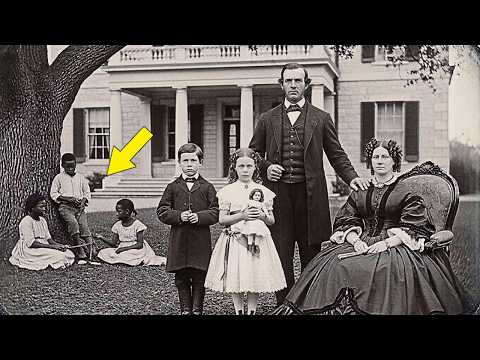
She called her colleague, Dr. Marcus Washington, a specialist in African-American history. “Marcus, I need another set of eyes,” she said, her voice tight. “There’s a black child in the background, playing with a white child. But her wrists—they’re scarred. Shackle marks, I think.” The silence on the line stretched. “Send it over,” he finally said, his voice grim.
Sarah spent the next three days pacing her office, the image burned into her mind. When the high-resolution scans finally arrived, she opened the file labeled background detail 201 children.tiff and gasped. The scars were even clearer now—complete rings of healed tissue, the result of sustained restraint. A child of four or five, shackled long enough to bear permanent marks. She called Marcus back immediately. “This child was restrained regularly,” she said, her voice barely steady. “For months, maybe years. She couldn’t have been more than a toddler when it started.”
Marcus’s face appeared on her screen, his jaw clenched. “Why would anyone shackle a child that young? She couldn’t run, couldn’t work. It makes no sense.” Sarah had no answer, only a growing dread. She dove into the archives, pulling the original donor records, census data, anything that might give the girl a name. The 1860 slave schedule listed a three-year-old girl, “mulatto,” in the Hendricks household. Could this be her? The plantation ledgers, preserved in Richmond, offered more: a child named Ruth, age four, “house servant, special duties.” And then, a notation that stopped Sarah cold: “Leather restraints ordered from Richmond, small size, $8.”
She read on, her anger mounting. Medical entries for “wrist inflammation” and “skin irritation” dotted the pages. A letter from Eleanor Hendricks to her sister confessed the truth: little Ruth had been shackled for the crime of “interfering with the children’s activities,” of wanting to play. “The child has adjusted to this arrangement,” Eleanor wrote, as if describing a minor inconvenience. Sarah sat back, tears stinging her eyes. The photograph was no peaceful family portrait—it was a crime scene, and Ruth’s scars were the evidence.
But the story didn’t end there. Freedman’s Bureau records revealed that Ruth survived the war, learned to read, married, and became a seamstress. She owned her home, raised children, and covered her wrists with long sleeves until the day she died. Her great-great-granddaughter, Patricia, still had the family Bible. When Sarah met her, they spread the documents across a table, the photograph linking them across 165 years. Patricia’s voice broke as she said, “My grandmother told me Ruth never talked about slavery. But she made sure every child learned to read. Now I know why.”
The exhibition they created, Invisible No More, opened in October 2024. Visitors stood before the enlarged photograph, the scarred wrists now impossible to miss. Schoolchildren stared in silence. Ruth’s story, once hidden in the background, had finally stepped into the light. But for Sarah, one question remained: How many other photographs held similar secrets, waiting for someone to look closely enough?
That question followed Sarah home from the gallery opening and refused to leave. Within a week she had drafted a grant proposal, and within a month the Virginia Historical Society had approved a pilot project with a name that felt almost like a dare: “The Background Project.” Its mandate was simple and enormous—re-examine every daguerreotype and ambrotype in the archive’s Southern collections, and look not at the subjects who had paid to be remembered, but at everyone else.
Marcus signed on as co-director without hesitation. They assembled a small team: two graduate students, a digital imaging specialist, and a metadata librarian who understood, better than anyone, how archives erase people simply by failing to describe them. “Every photograph is a document,” Marcus told the team at their first meeting. “The question is who wrote it, and who got left out of the caption.”
The work was slow and often heartbreaking. Of the first two hundred images they reviewed, forty-three contained background figures—servants, nurses, laborers, children—most of them unnamed, unmentioned, reduced to shadows at the edges of other people’s memories. The team catalogued each one, cross-referencing census schedules and plantation ledgers, occasionally recovering a first name, more often finding only an age and a color designation.
Then, on a rainy Thursday in February, one of the graduate students, a sharp-eyed young woman named Danielle, called Sarah into the imaging lab. “You need to see this one,” she said, her voice carefully flat. The photograph was another Richmond family portrait, dated 1857. In the doorway behind the seated family stood a young woman holding an infant. Danielle had magnified the doorway until the woman’s face filled the screen. Around her neck, just above the collar of her dress, ran a thin, pale line—a scar, perfectly horizontal, the unmistakable trace of a rope or chain worn long and tight.
Sarah stared at it for a long moment. Then she picked up her phone. “Marcus,” she said, “I think we’ve found another one.”
What struck her most, as she sat down to begin the research, was not the cruelty itself—she had long since stopped being surprised by that—but the sheer scale of it. Ruth had been one child in one photograph in one archive. There were archives in every Southern state, attics in every old family house, albums in every antique shop and county historical society. How many wrists, how many throats, how many silent faces waited in the silvered dark?
She opened a fresh document and typed a single line at the top: Subject: unidentified enslaved woman, approx. age 18, infant in arms. Visible scarring at neck. Then she saved it, and began, once again, to look.
By spring the pilot had grown into a statewide partnership, with archives in Maryland and North Carolina joining the effort. Danielle’s discovery became the project’s emblem—a woman they could not name, but could now describe, document, and refuse to forget. “We give them back their edges,” Marcus said at a conference that June. “One line of metadata at a time.”
Sarah returned to the Hendricks photograph one last time before the grant renewal. Ruth’s small hands were still reaching, still frozen in that impossible moment of play. The scars hadn’t changed. But everything around them had—the scholarship, the exhibition, the family who now claimed her.
She closed the file and looked out her office window at the dogwoods blooming along the quad. Somewhere in an archive, another photograph waited in the dark, another child at the edge of the frame. Someone had to keep looking.
So here is the question the project leaves with all of us: the next time you see an old family portrait, who will you notice first—the faces in the front, or the ones the photographer never meant you to see?
Report this article
Select a reason for reporting:






