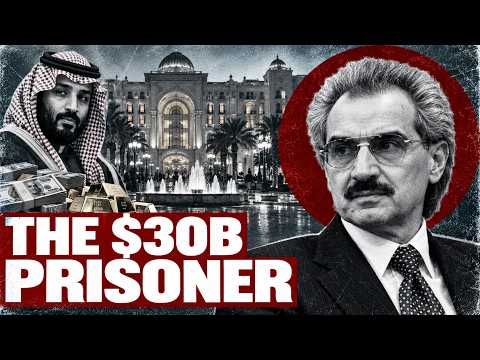
Imagine owning a private Boeing 747 nicknamed the Flying Palace, a yacht once owned by Donald Trump, and a 317-room Riyadh mansion dripping in Italian marble. Imagine holding stakes in Citigroup, Apple, Twitter, and the Four Seasons—all at once. Now imagine losing it all in a single night, locked inside a luxury hotel by your own cousin.
This is the story of Prince Alwaleed bin Talal, the so-called Warren Buffett of Arabia, and how the rise of Crown Prince Mohammed bin Salman brought him to his knees.
Alwaleed was born on March 7, 1955, in Jeddah—a grandson of Ibn Saud, the founder of Saudi Arabia, and the son of Riad El Solh, Lebanon’s first prime minister. His bloodline was woven into the founding of two nations. But his childhood was no fairytale. His parents divorced when he was seven, and he bounced between Riyadh and Beirut, between his father’s rigid Saudi world and his mother’s cosmopolitan Lebanon.
His father sent him to the King Abdulaziz Military Academy, a strict regimen that forged a quiet intensity—a hunger that would define everything that came next.
He followed a well-worn path for Saudi royals and headed to the United States, earning a bachelor’s degree from Menlo College in 1979 and later a master’s from Syracuse University. He was absorbing American capitalism at close range—watching how deals got done, how capital moved, how fortunes were built through leverage, timing, and nerve.
He returned to Saudi Arabia in 1979, right as the oil boom was flooding the kingdom with cash. His father gave him a modest loan—around $30,000—and a house. For a prince, that was practically nothing. But Alwaleed did something few royals would: he mortgaged the house and put his own skin in the game.
He started a construction company, Kingdom Establishment for Trading and Contracting. Early on, he landed a $16 million contract to build a military academy. The margins weren’t huge, but the momentum was real. He poured profits back into the business and started buying land in Riyadh, betting the capital would expand. He was right. Within a few years, his construction business had revenues exceeding $1.5 billion. By his early 30s, he was a billionaire.
But real estate was just the foundation. In 1990, he found the opportunity that would change everything: Citicorp, the parent of Citibank, was in serious trouble—hammered by bad loans and a collapsing real estate market. Investors were running for the exits. Alwaleed saw opportunity where others saw catastrophe.
He quietly accumulated shares, and by 1991, he boosted his total investment to $590 million, becoming the bank’s largest shareholder. It was a breathtaking bet—a Saudi prince in his mid-30s putting nearly $600 million into a bank many had written off for dead. The gamble paid off spectacularly. Citicorp merged with Travelers to form Citigroup, and Alwaleed’s stake eventually grew to over $5 billion. It was one of the most profitable contrarian bets in modern finance, and it put him on the global map overnight.
Suddenly, he wasn’t just another wealthy prince. He was a player. The press called him the Warren Buffett of Arabia—a title he embraced with relish.
From there, he went on an investment spree through Kingdom Holding Company, his publicly traded conglomerate. He invested in Apple when Steve Jobs was still fighting for survival, bought 7% of Rupert Murdoch’s News Corporation, poured $300 million into Twitter, and took stakes in eBay, Motorola, Amazon, Uber, and Lyft. He bought the George V Hotel in Paris, the Plaza Hotel in New York, and built Rotana, one of the largest Arab media companies.
At his peak, Forbes estimated his net worth at over $20 billion—though Alwaleed insisted it was closer to $30 billion. That discrepancy became a famous feud. He sued Forbes for defamation and began cooperating exclusively with Bloomberg instead.
His lifestyle was a calculated performance. His Riyadh palace sprawled across 250,000 square feet with 317 rooms, Italian marble, gold-plated fixtures, and more than 250 televisions. He owned 300 cars. His Boeing 747, the Flying Palace, featured a 14-seat dining room and a throne at the center of the cabin. He ordered a custom Airbus A380—the world’s largest passenger aircraft—with 20 staterooms, a marble Turkish bath, and a garage for his Rolls-Royce.
In 2015, he pledged to donate his entire $32 billion fortune to charity, drawing comparisons to Bill Gates and Warren Buffett.
But while Alwaleed was courting Western media and projecting himself as the modern face of Saudi Arabia, something was shifting beneath his feet. The name of that shift was Mohammed bin Salman.
MBS was born in 1985, the son of Prince Salman bin Abdulaziz. He wasn’t educated at elite Western universities. He studied law at King Saud University and spent his early career in his father’s orbit, learning the mechanics of power from the inside. He was ambitious in a way that made his more complacent relatives uneasy.
Everything changed in January 2015 when King Abdullah died and MBS’s father ascended to the throne. In just two and a half years, MBS went from an obscure junior prince to Crown Prince—the official heir and effectively the most powerful man in Saudi Arabia. It was a palace coup executed in plain sight.
He unveiled Vision 2030, an ambitious reform agenda to wean the kingdom off oil. He allowed women to drive, reopened cinemas, and invited international sporting events. To the West, he was a young, progressive reformer. But behind the glossy presentations, he was consolidating power with a ruthlessness that would have made the old Saudi kings blush.
He needed to neutralize anyone who could challenge his authority—anyone with independent wealth, independent power bases, or independent connections to the West. And the man who ticked every single one of those boxes was Prince Alwaleed bin Talal.
November 4th, 2017. The night everything changed. On MBS’s orders, Saudi security forces swept through the kingdom in a coordinated operation unlike anything the country had ever seen. They arrested princes, ministers, and billionaire businessmen. The official explanation was an anti-corruption campaign. The reality, according to critics, was the most audacious power grab in modern Saudi history.
More than 200 individuals were detained, including some of the most powerful people in the kingdom. They were all brought to the Ritz-Carlton Hotel in Riyadh. The hotel was sealed off. Normal bookings were suspended. The lobby, the ballrooms, the suites—all of it was converted into a gilded detention facility. The world’s most expensive prison, the media called it.
For Alwaleed, the detention was a profound humiliation. Here was a man who had spent decades cultivating an image of invincibility, of global reach, of being untouchable. He had dined with heads of state, negotiated with Wall Street titans, and publicly sparred with Donald Trump on Twitter. And now he was sitting in a hotel suite, watched by guards, unable to leave, unable to make calls, unable to control the narrative.
The markets reacted immediately. Shares in Kingdom Holding plunged nearly 10%. If the Saudi government could detain the kingdom’s most prominent businessman without warning, without charges, and without a clear legal process, then no investment in Saudi Arabia was truly safe.
Reports leaked out about what was happening inside. Some described it as relatively civilized—room service, television, exercise in suites. Alwaleed himself later insisted nobody was tortured, that the treatment was five-star. But other accounts painted a darker picture. The New York Times reported that at least 17 detainees required hospital treatment after physical abuse. Human rights organizations documented allegations of beatings, coercion, and forced asset transfers.
The process for release was straightforward in concept but devastating in practice: detainees could buy their freedom. Sign over a portion of your wealth to the state, or face formal prosecution and years in prison. Most chose to pay. Prince Mutaib bin Abdullah reportedly paid over $1 billion. The government claimed total settlements exceeded $100 billion. It was, in effect, the largest state-sanctioned shakedown in modern history—wrapped in the language of anti-corruption reform.
Alwaleed spent 83 days inside the Ritz-Carlton. 83 days of uncertainty, of behind-the-scenes negotiations, of watching his carefully constructed empire hang in the balance. The Wall Street Journal reported his settlement was approximately $6 billion. Alwaleed refused to confirm or deny the figure, saying only that he had reached a confidential understanding.
A source told Forbes that Alwaleed was giving up nearly all of his assets, that he would likely be given an allowance going forward, and that whenever he traveled abroad, he would be accompanied by a government-appointed minder. If he left Saudi Arabia and didn’t come back, the government warned, it would press charges and seek extradition.
He was released on January 27th, 2018. His daughter, Reem, posted a photograph of him on social media. He looked gaunt, physically diminished. She wrote in Arabic, “You’ve lit up the world. You are my world.”
A few hours before his release, Alwaleed had given a brief interview to Reuters from inside the hotel suite. He insisted there were no charges. He said it was just discussions. He maintained that everything was fine.
But everything was not fine.
The Alwaleed who emerged was a different man. The swagger was gone. The public feuds were over. The image of the independent, globe-trotting billionaire had been shattered. He now operated under the thumb of MBS.
In the years that followed, Alwaleed adopted a posture of conspicuous loyalty. He publicly supported Vision 2030 and engaged in talks with the Public Investment Fund (PIF), MBS’s primary economic instrument. In 2022, the PIF bought a 16.87% stake in Kingdom Holding for $1.5 billion, reducing Alwaleed’s ownership from 95% to roughly 78%. Some saw cooperation; others saw the Crown Prince planting his flag inside Alwaleed’s empire.
The Ritz-Carlton purge was about more than one billionaire. It fundamentally restructured power in Saudi Arabia. For decades, power was distributed among multiple branches of the royal family, each with its own fiefdoms. MBS demolished that model, concentrating military, economic, and intelligence power in his own hands to a degree unseen since Ibn Saud. The message was clear: no one was above his authority.
For international investors, the implications were enormous. If the kingdom’s richest citizen could be detained overnight and forced to surrender billions without due process, what protections did foreign investors have? Deals weren’t enforced by courts; they were enforced by the Crown Prince’s security services.
Less than a year later, Saudi operatives murdered journalist Jamal Khashoggi. Some individuals implicated were reportedly part of the same security apparatus that managed the Ritz-Carlton detentions. The pattern was unmistakable: the Ritz-Carlton was a proving ground, a demonstration that MBS could act with impunity.
Today, Alwaleed’s net worth is estimated between $14 and $27 billion. Kingdom Holding still operates, but within an ecosystem dominated by the PIF, which manages over $900 billion and answers to one person. The crown he once wore—the invisible crown of financial independence—was taken from him inside those hotel walls.
His story poses a larger question: in an autocratic state, private wealth exists only at the pleasure of the ruler. You can build a $30 billion empire, diversify across continents, and cultivate relationships with the powerful—and still have it all swept away in a single night if the person at the top decides your wealth is a threat.
As for Alwaleed, he remains a prince, a billionaire, and chairman of Kingdom Holding. But he serves now as a reminder of an uncomfortable truth: in the Kingdom of Saudi Arabia, there’s only one crown that matters. And the man who wears it isn’t sharing.
So, what do you think? Was Alwaleed’s fall inevitable, or could he have avoided it? Drop a crown emoji in the comments and let us know your thoughts.
Report this article
Select a reason for reporting:






