The attic smelled of dust and forgotten time. Sarah Mitchell, a documentary researcher from New Orleans, carefully lifted the corner of a moth-eaten blanket covering a stack of wooden crates. She was working on a project about post-Civil War Louisiana families, and this abandoned plantation house outside Baton Rouge had been donated to the Historical Society three months earlier. Her flashlight caught something white wedged between two leather-bound journals.
She pulled gently, revealing a photograph in a tarnished silver frame. Two girls, perhaps twelve and fourteen years old, sat side by side in an elegant studio setting. They wore identical white dresses with lace collars, their hair styled in the same elaborate braids. Their faces were solemn, as was customary for photographs of that era. Sarah studied the image more closely. The girls looked remarkably similar—same nose, same jawline, same intense gaze directed at the camera. Sisters, clearly. The photograph was dated on the back in faded ink: April 1867, Beaumont Studio, New Orleans.
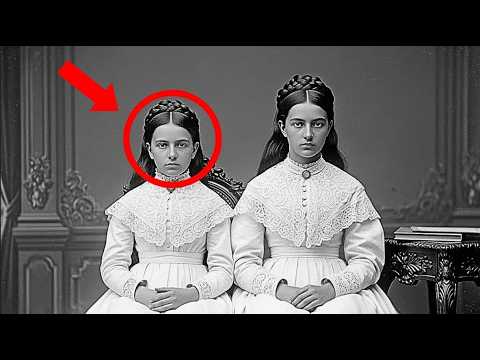
She photographed the image with her phone and sent it to her colleague, Marcus, a genealogist who specialized in Louisiana families. Within an hour, he called back.
“Do you know whose house this was?” he asked, his voice tight with excitement.
“The Beaumont estate,” Sarah replied. “Thomas Beaumont owned it before the war. Made his fortune in cotton and sugar.”
“I found records,” Marcus said. “Thomas Beaumont died in 1866, shortly after the war ended. He had one legitimate daughter, Catherine. But Sarah, I also found something else. There’s a freed slave registry from 1865. A woman named Eliza was listed as freed from the Beaumont plantation, along with a daughter named Marie, born in 1853.”
Sarah looked at the photograph again. Catherine and Marie—two sisters born of the same father but different mothers. One free, one enslaved until the end of the war.
“This photograph was taken in 1867,” Sarah said slowly. “Two years after emancipation. Why would they be photographed together like this?”
“Dressed identically, posed as equals?” Marcus replied. “That’s what we need to find out. Because in 1867 Louisiana, this shouldn’t exist.”
“Not like this. Not so openly.”
Sarah carefully removed the photograph from its frame. On the back, beneath the date, were words she hadn’t noticed before, written in a different hand—shakier and more desperate. “Forgive us for what comes next.”
Her hands trembled as she read those words again.
Sarah spent the next three days immersed in parish records, cemetery logs, and archived newspapers from 1860s Louisiana. Marcus joined her at the historical society’s research library, surrounded by leather volumes and microfilm readers that hummed in the silence.
“Thomas Beaumont was a complicated man,” Marcus said, spreading documents across the table. “He inherited the plantation from his father in 1840. Married a woman named Virginia from a prominent New Orleans family in 1842. Their daughter Catherine was born in 1851.”
Sarah pulled up a census record on her laptop. “And Marie was born in 1853 to Eliza, who was listed as property of the Beaumont household.” The words tasted bitter even as she said them. “Property.” A human being reduced to an entry in a ledger.
Marcus leaned back in his chair. “What’s unusual is what happened after Thomas died. Most plantation owners’ wills from this period are straightforward—property divided among white heirs, former slaves ignored or given token amounts. But Thomas’s will was sealed by the court. I requested access, but it’s going to take weeks.”
“What about Virginia, his wife?” Sarah asked. “What happened to her?”
“That’s where it gets interesting.” Marcus slid a newspaper clipping across the table. It was from the New Orleans Daily Picayune, dated June 1867. The headline read, “Widow Beaumont withdraws from society.” The brief article mentioned that Virginia Beaumont had ceased attending social functions and had closed the plantation house to visitors. Neighbors speculated about illness or grief, but no official explanation was given.
“Two months after that photograph was taken,” Sarah murmured. She pulled out the photograph again, studying the girls’ faces under the library’s harsh fluorescent lights. Catherine, the older girl, sat with perfect posture, her hands folded in her lap. Marie, younger by two years, mirrored her position exactly. But something in Marie’s eyes looked different—not defiant, but watchful, as if she expected the world to snatch this moment away from her at any second.
“There’s something else,” Marcus said quietly. “I found Eliza’s death record. She died in April 1867—the same month this photograph was taken.”
Sarah’s breath caught. “How did she die?”
“It doesn’t say. Just lists the date and natural causes. But Sarah, she was only thirty-two years old.”
Sarah stood outside what remained of the Beaumont studio building on Royal Street in the French Quarter. The ground floor was now a coffee shop, but the ornate ironwork balcony above still bore the faded letters: Beaumont Photographic Studio est. 1855. She had spent the morning tracking down the building through property records. The studio had been operated by Thomas Beaumont’s younger brother, Charles, a photographer who had made a name for himself capturing the faces of New Orleans’s elite before and after the war.
Inside, Sarah approached the owner, a woman named Diane, who had purchased the building fifteen years earlier. When Sarah explained her research, Diane’s eyes lit up. “The previous owner left boxes of old papers in the basement,” Diane said. “I kept meaning to donate them to the historical society but never got around to it. Come on.”
The basement was cool and dark, lined with metal shelves holding supplies for the coffee shop. In the far corner, covered with a plastic tarp, sat three large wooden boxes. Sarah’s hands shook as she opened the first one. Inside were glass plate negatives, carefully wrapped in cloth, along with ledger books listing clients and sessions. She found the ledger from 1867 and flipped through the pages.
April 14th, 1867. Beaumont, Virginia. Portrait, two subjects, full studio setup. Payment: $25.
Twenty-five dollars was an enormous sum for a photograph in 1867—equivalent to several months’ wages for most workers. This wasn’t a casual portrait. This was something carefully planned and expensive.
Sarah pulled out her phone and called Marcus. “I found the studio records. Virginia Beaumont commissioned the photograph herself. She paid a fortune for it.”
“So she wanted this photograph taken?” Marcus said slowly. “After her husband died, after Eliza died, she brought both girls to the studio and had them photographed as equals. But why?”
Sarah asked, “And what happened afterward that made her withdraw from society completely?”
Diane, who had been listening quietly, spoke up. “There’s something written on the inside cover of that ledger. I noticed it years ago but never understood it.”
Sarah turned to the front of the book. In faded pencil, someone had written: “Some debts cannot be paid with money. Some truths cannot be buried.” Beneath it was a signature: Charles Beaumont, photographer.
Sarah’s pulse quickened. The photographer himself had left a clue—and it pointed directly to the secrets buried in the Beaumont estate.
Back at the plantation house, Sarah returned to the attic with renewed focus. If Virginia Beaumont had commissioned the photograph intentionally, there had to be more evidence of her reasoning. She began opening every crate, every trunk, every sealed box that remained.
In a small leather case hidden beneath a stack of tablecloths, she found them—letters, dozens of them, tied together with a blue ribbon. The paper was yellowed and brittle, but the ink remained legible. The first letter was dated March 1867, one month before the photograph. It was written in elegant, flowing script.
“My dearest Catherine, you are old enough now to understand the truth, though it pains me to write these words. Your father was not a perfect man. He made choices that I cannot defend, but I can try to set right. Marie is your sister in every way that matters—in blood, in circumstance, in the loss you both have suffered. When I am gone, you must remember what I am about to do. You must remember that I chose love over propriety, truth over comfort. Your mother, Virginia.”
Sarah sat down heavily on an old trunk, her heart pounding. This wasn’t just a photograph. This was a declaration.
She read through more letters—some from Virginia to Catherine, others from Virginia to people she called friends, though their responses suggested otherwise. Each letter spoke of Virginia’s determination to raise both girls together, to give Marie the education and opportunities that Catherine would receive, to acknowledge publicly what society demanded she hide.
One letter, dated March 28th, 1867, was particularly painful to read. It was from someone named Margaret, apparently a childhood friend of Virginia’s. “You have lost your senses. I say this out of love, Virginia. That girl is not your daughter. She is the child of sin, the product of your husband’s weakness. To claim her as Catherine’s equal will destroy your reputation, Catherine’s future, and any hope of maintaining your position in society. Send her away. Give her money if you must, but do not do this thing you are planning. I beg you.”
Virginia’s response was paper-clipped to the letter. It was brief. Dear Margaret, my husband’s weakness does not diminish Marie’s humanity. My reputation means nothing if I cannot sleep at night. I have made my decision. Please do not write again. Virginia.
Sarah carefully photographed each letter, her hands trembling. This woman had known exactly what she was doing. She had known the cost and chosen to pay it anyway.
Marcus arrived at the plantation house the next morning with a thick folder of documents. His face was drawn, and he looked like he hadn’t slept. “I got access to Thomas Beaumont’s will,” he said, spreading papers across the dining room table. “Sarah, this changes everything.”
The will was written in formal legal language, but its contents were extraordinary. Thomas Beaumont had divided his estate into three equal parts: one-third to his wife Virginia, one-third to his daughter Catherine, and one-third to Marie, whom he explicitly identified as his daughter by Eliza.
“He acknowledged her,” Sarah whispered. “Legally. In writing.”
“There’s more,” Marcus said. “He wrote a letter to be opened after his death. It was sealed with the will. Listen to this.” He cleared his throat and read aloud. “I have lived as a coward, unable to claim publicly what I know in my heart to be true. Marie is my daughter as surely as Catherine is. Eliza was not my property, but the woman I loved, though the law forbade me from honoring that love openly. I beg Virginia’s forgiveness for the pain I have caused, and I beg my daughters’ forgiveness for the world I am leaving them to navigate. May Virginia have the strength I lacked to do what is right.”
Sarah felt tears sting her eyes. “So Virginia read this after he died, and she decided to honor it,” she said. “Despite everything it would cost her.”
“She brought both girls into her home, dressed them as equals, had them photographed together as sisters,” Marcus said. “She was making a statement—to society, to her family, to history.”
They sat in silence for a moment, the weight of Virginia’s choice settling over them.
“But what happened to them?” Sarah finally asked. “We know Virginia withdrew from society, but what about the girls? What happened to Catherine and Marie?”
Marcus pulled out another document. “That’s what I spent all night trying to find out. And Sarah, I think I found something. There’s a property deed from 1869—two years after the photograph. A house in the Garden District of New Orleans, purchased jointly by Catherine and Marie. No last names listed, just first names.”
“They stayed together,” Sarah said.
“It looks that way. But here’s where it gets complicated.” Marcus laid out a series of newspaper clippings. “I found mentions of them in society pages over the next few years, but they’re always referred to obliquely—the Beaumont sisters, the young ladies of Magazine Street. Never photographed again, never named directly. It’s like society knew they existed but refused to acknowledge them clearly.”
Sarah stared at the clippings, a fresh question forming. “If they were so determined to hide, why buy a house together in the most visible part of the city? Why not disappear completely?”
Marcus tapped the deed. “Because disappearing would have meant admitting defeat. This was their home, Sarah. They weren’t hiding. They were claiming their place.”
Marcus nodded slowly. “And claiming it cost them. I found a letter from a neighbor in the Garden District, complaining that the ‘Beaumont women’ entertained Black visitors in their parlor. The writer demanded they be run out of the neighborhood.”
“What happened?” Sarah asked.
“Nothing. The complaints went nowhere. Virginia’s money, and her reputation for being a little mad, made them untouchable.”
Over the following weeks, Sarah and Marcus pieced together the rest. Virginia died in 1873, and the girls left New Orleans soon after. They became teachers, then artists, and never married.
“They built a life,” Marcus said, “where the world tried to build a wall.”
Sarah looked at the photograph one last time. “Forgive us for what comes next,” Virginia had written. But there was nothing to forgive.
What would you have done, in Virginia’s place?
Report this article
Select a reason for reporting:






