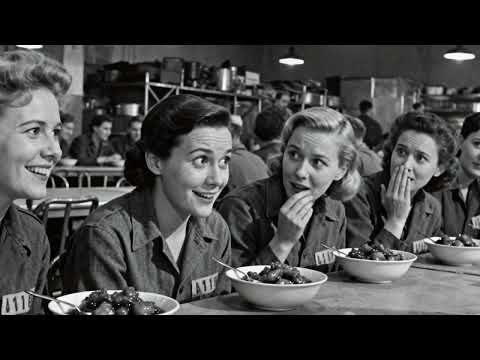
February 19th, 1945. The winter morning broke cold and gray over Camp Allegiance, a small prisoner-of-war facility nestled in the rolling hills of rural Pennsylvania. Inside the women’s barracks, 53 female German prisoners stirred from their bunks at the sound of the morning bell, preparing for another day of monotonous routine. But Private First Class Robert Lee, standing guard outside the mess hall, knew this day would be different from any other in the history of American prisoner-of-war operations.
Alfreda Richter, a 24-year-old former communications specialist from Dresden, pulled on her worn gray auxiliary uniform and smoothed her dark blonde hair into the regulation bun she had maintained even in captivity. Four months of imprisonment had taught her to expect nothing beyond basic survival: watery oatmeal for breakfast, thin soup for lunch, and bread with occasional meat for dinner. The routine had become almost comforting in its predictability, a small anchor of normalcy in a world turned upside down by capture and defeat.
When the women were called to assembly in the mess hall earlier than usual, confusion rippled through their ranks. Waltraud Hoffman, a sturdy 26-year-old from Cologne who had served as a radio operator, exchanged worried glances with Ingrid Becker, a slight 22-year-old translator from Frankfurt. In their experience, unexpected changes in routine meant trouble—interrogations, transfers, or worse. They filed into the mess hall with the mechanical obedience that had become second nature, their faces carefully neutral masks that revealed nothing of their fear.
But the scene that greeted them stopped the prisoners in their tracks. The usual long metal tables had been covered with white sheets that approximated tablecloths. Steam rose from dozens of serving dishes arranged along the tables in a display that seemed almost festive. The aroma that filled the hall was unlike anything the women had encountered during their imprisonment—sweet and tangy with undertones of ginger and garlic, mixed with the savory scent of fried rice and something else they could not identify.
Alfreda felt her empty stomach clench at the sight and smell of actual food. Real food that bore no resemblance to the bland military rations they had grown accustomed to. Plates were piled high with chunks of meat glazed in a reddish-orange sauce studded with pieces of pineapple and peppers. Other dishes held mounds of rice dotted with vegetables and egg, crispy golden rolls that glistened with oil, and steaming vegetables prepared in ways the German women had never seen.
Captain Helen Morrison stood at the front of the hall, her stern face softened by what might have been the hint of a smile. Beside her, Private First Class Robert Lee stood at attention, though his dark eyes moved across the faces of the shocked prisoners with an expression that Alfreda could only describe as hopeful. The Chinese American guard, who had been assigned to their facility four months earlier, had always seemed different from the other Americans—quieter, more observant, less openly hostile. But this elaborate display of food seemed impossibly generous for enemy prisoners.
As the women hesitated, unsure whether this was some cruel trick, Robert stepped forward. “Please, sit and eat,” he said in his careful English, his voice carrying a warmth that transcended the language barrier. “This is Chinese New Year feast. My grandmother’s recipes.”
The words hung in the air, incomprehensible to most of the prisoners. Chinese New Year? They had heard of such things in vague, exotic terms, but why would an American guard prepare a Chinese feast for German prisoners? The concept was so foreign, so unexpected, that several women wondered if they had misunderstood entirely.
Alfreda, her English the best among them, translated for those around her. The confusion only deepened. Some of the younger prisoners, their education limited by years of war and Nazi propaganda, whispered excitedly among themselves. “It must be Chinese New Year today!” one of them exclaimed in German. “They are celebrating their holiday with us!”
The misunderstanding spread through the hall like wildfire. The women, desperate for any semblance of normalcy and human connection, latched onto the idea that they were being included in a genuine cultural celebration. They did not know that Chinese New Year had actually fallen two days earlier, on February 17th. They did not know that Robert had spent days preparing this meal specifically for them, using ingredients sent by his grandmother from Chicago. All they knew was that someone had gone to extraordinary effort to create something beautiful in the midst of their bleak existence.
Captain Morrison watched the scene unfold with a mixture of satisfaction and concern. She had approved Robert’s proposal with strict conditions, never imagining the emotional impact it would have. The German women, who had maintained stoic dignity through months of imprisonment, were visibly moved. Some had tears streaming down their faces as they took their first bites of sweet and sour pork, the explosion of flavors awakening senses they had forgotten existed.
Robert moved through the hall with a large teapot, pouring hot jasmine tea into cups. He paused at Alfreda’s table, meeting her eyes as he poured. “You like?” he asked in his careful English.
Alfreda nodded, unable to trust her voice. She gestured to the food with her fork and managed to say, “Is beautiful. Thank you.” The inadequacy of her English frustrated her. She wanted to express what this meant, how this simple meal had reminded her that beauty and generosity still existed in a world that had seemed devoid of both.
As the meal progressed, the initial shock gave way to something approaching joy. The women laughed and talked, sharing stories of meals from their childhoods, comparing the unfamiliar flavors to foods they remembered from home. For this one evening, the rigid divisions between captor and captive had blurred into something approaching shared humanity.
But as the plates emptied and the tea grew cold, Alfreda noticed something that troubled her. The younger prisoners continued to speak excitedly about Chinese New Year, planning how they would celebrate it next year, asking Robert questions about Chinese customs and traditions. They believed this feast was a regular occurrence, that they were being welcomed into a cultural celebration as honored guests rather than enemy prisoners.
The misunderstanding was innocent, even touching, but Alfreda sensed a deeper truth beneath it. Robert had not prepared this meal because of a holiday coincidence. He had prepared it because he saw them as human beings worthy of care and effort. The distinction mattered, though she could not yet articulate why.
As the women filed out of the mess hall, their spirits lifted for the first time in months, Alfreda lingered behind. She watched Robert and the other guards begin clearing the tables, their earlier formality replaced by easy camaraderie. Something had shifted in Camp Allegiance that evening, something that could not be undone.
She did not know then that this meal was only the beginning. She did not know that Robert Lee would become her teacher, her friend, and eventually her husband. She did not know that the sweet and sour pork she had just tasted would become a symbol of everything she had lost and everything she would find in a new life.
All she knew was that for the first time since her capture, she felt hope. And that hope, fragile as it was, would carry her through the dark months ahead.
The days following the feast carried a strange, tentative lightness through Camp Allegiance. The women still woke to the same gray dawn and the same morning bell, but the whispered conversations in the barracks had changed. They spoke less of the war and more of the food—of the ginger and garlic, of the crisp spring rolls, of the way the sauce had tasted both sweet and sharp at once. Ingrid Becker confessed that she had dreamed about the fried rice and woken with tears on her face.
Alfreda found her thoughts returning again and again to Private Lee. Not to his face or his uniform, but to the quiet certainty in his voice when he had said the meal was his grandmother’s. He had offered them something private, something that belonged to his family, and he had done it without asking anything in return. The realization unsettled her in a way she could not name.
Three evenings later, she gathered her courage and approached the small kitchen annex where Robert sometimes worked after his shift. She stopped in the doorway, her English rehearsed twice over in her head. “Private Lee. I want to learn to cook this food. The rice. The rolls. Is it possible?”
Robert looked up from a pot he was scrubbing, and a slow smile spread across his face. “You want to learn?” He set the pot aside and wiped his hands on his apron. “Yes. It is possible. But it is much work. You must come every evening, and you must not be afraid of the knife.”
Alfreda lifted her chin. “I am not afraid of knives.”
He laughed then—a real laugh, unguarded and warm—and she felt something loosen in her chest that had been clenched tight since October. “Good. Tomorrow, we begin with vegetables. The knife is the first lesson.”
Captain Morrison approved the arrangement with a single condition: the lessons would take place in the open kitchen with the door left ajar, always within sight of the corridor guard. She said this without embarrassment, as though it were merely a matter of camp regulation, and Alfreda understood that the captain was protecting them both.
The first lesson was humbling. Robert placed a carrot before her and demonstrated the proper grip, the curl of the fingers, the steady rhythm of the blade. Alfreda, who had once typed coded messages with flawless precision, could not make her hands obey. Her carrot slices came out thick and uneven, and she felt her cheeks burn with frustration.
“Do not rush,” Robert said, gently pushing her fingers back into position. “The carrot is not the enemy. You are not at war with the carrot.”
She stared at him, and then—unexpectedly, helplessly—she laughed. It was the first true laugh she had given since Dresden, and it startled her so much that she pressed her hand to her mouth.
Robert pretended not to notice. He simply handed her another carrot. “Again.”
By the end of that week, she could dice an onion without weeping and slice ginger into paper-thin coins. By the end of the next, she had learned the names of a dozen ingredients in English and could pronounce them without stumbling. Robert wrote them out for her on scraps of paper, and she kept them folded in the pocket of her uniform, a secret vocabulary that belonged only to her.
Word spread through the barracks. Soon six other women were gathering in the kitchen each evening, their sleeves rolled to the elbow, their faces intent over cutting boards. Waltraud came, though she grumbled that she had never been permitted in her mother’s kitchen in Cologne. Ingrid came, her delicate hands clumsy at first and then surprisingly deft. The lessons became language lessons too, each ingredient named twice, once in English and once in a German echo, until the kitchen filled with a strange new dialect of its own.
One evening in early March, as a late snow fell against the windows, Robert set a small jar of dark paste before them. “Soy sauce,” he said. “From my grandmother. She sends it from Chicago.”
Ingrid touched the jar as though it were a relic. “Your grandmother sends food to a prison camp?”
Robert considered the question. “She says that when you are far from home, food is the only letter that always arrives.” He paused, then added quietly, “She also says kindness is never wasted, even on those who may not deserve it.”
The silence that followed was not uncomfortable. Alfreda looked at the jar of soy sauce, at the careful handwriting on the label, and thought of her own mother’s kitchen in Dresden, now ash and rubble. She thought of the letter from her aunt that had not yet arrived, of the news that would soon break her apart. She did not know it was coming. She only knew that she was learning to cook food from a country she had been taught to despise, taught by a man whose face her government would have called inferior, and that this was the most honest thing she had done in years.
Robert caught her eye across the cutting board and nodded, as though he understood exactly what she was thinking. “Tomorrow,” he said, “we make the sweet and sour pork. All of us. Together.”
They made the sweet and sour pork together, seven women and one guard, in a kitchen that smelled of vinegar and hope. When the first batch came off the fire, Robert let each woman taste her own work, and Alfreda found that it was not quite the same as the feast—rougher, less certain—and somehow better for it.
Captain Morrison watched from the doorway and wrote nothing in her notebook that night. Some things, she had decided, did not need to be recorded to be true.
Months later, when the war ended and the trains came to carry the women home, Alfreda stood at the fence with a folded paper in her pocket—a recipe in two languages, written in two hands. “You will write to me,” Robert said, and it was not a question.
She did write. And in time, she returned—not as a prisoner, but as a woman with a suitcase and a stubborn heart, ready to learn what America could yet become.
What would you have chosen, in her place—the ruins of home, or the stranger who taught you to cook?
Report this article
Select a reason for reporting:






