For over a century, a single photograph sat forgotten in the archives of the University of Alabama, cataloged simply as three sisters, Montgomery County, circa 1898. Historians had glanced at it, preserved it, digitized it—but no one paid it much attention. It seemed unremarkable, just another portrait of another family trying to survive the brutal realities of the Jim Crow South. Nothing about it suggested mystery. Nothing hinted at impossibility. Until Dr. Patricia Hayes zoomed in.
Dr. Hayes, a medical historian at Vanderbilt University, had spent three years digitizing photographs of black families from the post-Reconstruction era. She’d processed thousands of images, cataloging faces, clothing, locations. Most of the work was routine, repetitive. Then one afternoon in March 2023, she opened the file containing the three sisters. She began her usual examination, checking image quality, adjusting the resolution. And then she saw something in the youngest sister’s arms that made her breath catch.
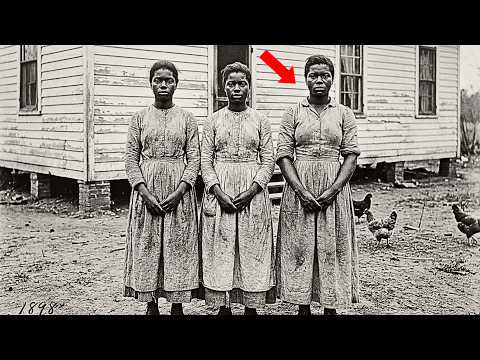
The musculature was wrong—not just strong, but impossibly dense for a 16-year-old girl living in poverty in 1898. The definition visible even through the fabric of her dress belonged on a laborer twice her age. Dr. Hayes leaned closer to her screen, her heart racing. She’d seen something like this before, but only in modern medical journals documenting one of the rarest genetic conditions known to science—a condition that wouldn’t be identified for another 99 years.
She picked up her phone and called Dr. Marcus Freeman, a geneticist at Johns Hopkins who specialized in muscle development disorders. When he answered, she didn’t waste time with pleasantries. “Marcus,” she said, her voice tight with suppressed excitement, “I need you to look at something. And I need you to tell me if I’m losing my mind.”
Two days later, Dr. Freeman stood in Dr. Hayes’s office at Vanderbilt, staring at the photograph displayed on her large monitor. He’d flown in from Baltimore that morning, skeptical but intrigued. Patricia Hayes didn’t make frivolous claims. If she thought she’d found something impossible, it deserved investigation.
The image filled the screen. Three sisters, Alabama, 1898. Patricia zoomed in on the youngest sister, isolating her upper body, her arms, her shoulders. The evidence was there, undeniable even in the limitations of 19th-century photography. Marcus leaned closer, adjusting his glasses, his trained eye cataloging what he was seeing.
Myostatin-related muscle hypertrophy—a genetic condition caused by mutations in the MSTN gene that regulates muscle growth. In normal human development, myostatin acts as a brake on muscle tissue, preventing excessive growth. When that gene is mutated, the brake fails. Muscle develops with extraordinary density and volume, creating a physique that appears almost sculptural, even without exercise or training.
The condition is vanishingly rare. Since its identification in 1997, fewer than 100 cases have been documented worldwide. Most are discovered in infancy when parents notice their baby is unusually muscular. The children grow into adults with twice the muscle mass of typical individuals, exceptional strength, and remarkable resistance to physical fatigue.
Marcus studied the youngest sister’s deltoid muscles, visible even through her dress fabric. Her forearms showed striations that would require years of intense manual labor in anyone without the condition. But this wasn’t just labor. This was genetic architecture written into her DNA, expressed in every muscle fiber. “The shoulder width,” Marcus said quietly, pointing to the screen. “The neck thickness, the visible muscle density in the forearms. Patricia, this fits every clinical marker we use for diagnosis today.”
Patricia nodded, her expression tense. “I know. But this is 1898,” Marcus continued, voicing the impossibility they were both thinking. “We didn’t identify this condition for another 99 years. There’s no way anyone looking at this girl would have understood what they were seeing.”
“Which means,” Patricia said slowly, “she went through her entire life with no one understanding what she was. No medical explanation, no framework for comprehension.”
Marcus sat down heavily in the chair across from Patricia’s desk. “We need to find out who she was. We need to know what her life was like.”
The back of the photograph provided their first clue. When Patricia had initially cataloged the image, she’d photographed both sides. On the reverse, in careful script faded to brown with age, someone had written: Ruby, Esther, and Grace. Montgomery County, summer 1898. Three names, no surname, no specific location beyond the county—but it was a starting point.
Patricia began with the 1900 United States Census, the closest complete record to the photograph’s date. Montgomery County, Alabama, had a black population of nearly 30,000 in 1900. Most worked as sharecroppers, domestic servants, or manual laborers. Finding three sisters with these specific names in that massive population would require patience and methodical searching.
She spent two weeks combing through digital census records, cross-referencing households that listed three daughters in the approximate age range. The work was tedious, eye-straining, filled with dead ends and near misses. Then, on a Thursday afternoon in late March, she found them.
A household headed by Caroline, age 42, occupation listed as laundress. Three daughters: Ruby, age 20; Esther, age 19; Grace, age 18. No father listed, no other family members in the household. An address in the rural outskirts of Montgomery County, near a crossroads settlement called Pine Level.
Patricia’s hands trembled as she copied the information into her research notes. Grace, the youngest sister in the photograph, age 18 in 1900—which meant she would have been 16 in 1898, exactly as Patricia had estimated. But the census revealed something else, something that made Patricia’s chest tighten. Caroline’s occupation: laundress. One of the most brutal forms of labor available to black women in the post-Reconstruction South—hauling water, heating it over open fires, scrubbing clothes by hand, wringing them dry with raw hands, hanging them in the brutal Alabama sun, then ironing them with heavy flat irons heated on wood stoves.
It was work that destroyed women’s bodies. Most laundresses didn’t live past 50, their backs broken, their hands gnarled, their spirits crushed by the relentless physical demands. Patricia thought about Grace standing in that photograph with her impossible strength. In a family surviving on a laundress’s income, a daughter who could lift twice what others could lift, who could work longer without tiring, who never seemed to wear down—such a daughter would have been invaluable. Such a daughter would have been exploited.
Marcus began researching the physiological implications while Patricia dug deeper into the historical record. They needed to understand not just what Grace’s condition was, but what it would have meant for her in 1898 Alabama. Montgomery County in the late nineteenth century was a place of rigid hierarchies and brutal realities—black families existing under the crushing weight of Jim Crow laws, sharecropping contracts that amounted to economic slavery, and the constant threat of violence.
Patricia found records showing that Caroline, the girls’ mother, had been born into slavery in 1858. She was nine years old when emancipation came. After the Civil War, she had worked as a domestic servant in Montgomery before moving to the rural outskirts, where she could take in laundry from white families while raising her daughters alone. The records showed no husband, no father listed for any of the girls.
Marcus explained what Grace’s condition would have meant physically. Myostatin deficiency doesn’t just create muscle mass—it fundamentally alters metabolism, bone density, and physical endurance. People with the condition typically have extremely low body fat, dense bones that resist fracture, and cardiovascular systems capable of sustaining intense activity for extended periods without fatigue.
For Grace, living in rural Alabama in 1898, these traits would have been both a blessing and a curse. A blessing because they made her capable of work that could help her family survive. A curse because they made her visibly different in a world that punished difference.
“Think about what this means,” Marcus said during one of their research calls. “Grace could have done the work of two or three people. And in a family struggling to survive on a laundress’s income, that ability would have been impossible to ignore.”
Patricia understood what he was saying. Grace’s strength hadn’t been a gift. It had been an obligation.
Patricia’s breakthrough came from an unexpected source—the diary of a plantation owner’s daughter preserved in the Montgomery County Historical Society. The diary, covering the years 1899 to 1902, contained scattered references to local black families, including several mentions of Caroline the laundress and her daughters.
The first reference was brief, dated February 1900. “Mother sent me to the laundress cottage to retrieve father’s shirts. The youngest girl was there—Grace, I believe. She was carrying water from the well with such ease that I could scarcely believe it. Two full buckets that would have strained our strongest field hand, yet she moved as though they weighed nothing.”
Patricia photographed the page with shaking hands. Physical evidence—contemporary documentation of Grace’s extraordinary strength, witnessed and recorded by someone who had seen her in person. But it was another entry, dated July 1901, that made Patricia’s throat tighten.
“Grace delivered the washing today, carrying a basket so heavy that Thomas, our man servant, struggled to lift it from the wagon. Yet she had carried it herself from the cottage, nearly a mile distant. I asked how she managed such weight. She only smiled and said she had always been strong. Mother remarked later that there is something unnatural about the girl’s strength. I confess I find it unsettling.”
The word unnatural stood out on the yellowed page. In 1901, in rural Alabama, a black girl with extraordinary physical strength would have been viewed with suspicion—perhaps fear. There was no framework for understanding what Grace was, no medical explanation that would make sense to the people around her.
Patricia found more references in local records. A ledger from a Montgomery County cotton gin showed that in 1902, a worker named Grace had been employed during harvest season. Next to her name, someone had written: “Exceptional output, equivalent to two field hands. Retained for extended season.”
Marcus reviewed the evidence with growing concern. “They were using her,” he said flatly. “They saw what she could do, and they extracted every ounce of work they could get.”
Patricia nodded. The pattern was clear. Grace’s strength had been noticed, remarked upon, exploited—but never understood, never accommodated, never valued as anything more than a capacity for labor that could be wrung dry.
Patricia found a hospital admission record from 1904 at a charity clinic in Montgomery. The handwriting was barely legible, the paper water-stained, but the content was unmistakable: Patient: Grace, age 22, laundress. Admitted for severe lacerations to both hands sustained while operating laundry equipment. Physical examination reveals extraordinary muscle development in arms, shoulders, and back. Musculature appears almost masculine in density and definition. No signs of disease. Etiology unknown.
Marcus examined the record. “The doctor had no framework for understanding what he was seeing,” he said. “He notes the musculature is unusual but can’t explain it. This was 1904. Genetics barely existed as a science.” But what struck Patricia was the injury itself—Grace’s strength had damaged the machinery, and the machinery had damaged her in return.
More records surfaced. In 1906, Grace worked at a lumber mill outside Montgomery. The ledger read: “Grace, exceptional strength. Capable of handling logs that require two men. Paid standard wage.” “Capable of doing the work of two men,” Marcus observed, “but paid the wage of one woman.” And in 1906 Alabama, that woman’s wage was a fraction of a man’s.
Grace married a sharecropper named Samuel in 1908, but the 1910 census listed zero children born, zero living. After that, the trail went cold—no death certificate, no property records, no church registry. She had vanished from history, as countless black women of her era did.
Then an email arrived from Lorraine Mitchell, a retired teacher in Birmingham: “I think my grandmother knew Grace.” Her grandmother Beatrice had grown up in Pine Level and often spoke of a woman who could lift a wagon wheel by herself, who worked alongside men without tiring. “But grandmother also said Grace was lonely. People were afraid of her strength or jealous of it or both. She died young, maybe in her early 40s. Just worn out, despite all that strength.”
Worn out, despite all that strength. Patricia read the words three times, her vision blurring with tears. It was the perfect, heartbreaking summary of Grace’s life.
But the records also revealed something else. Caroline stopped working as a laundress by 1905 and later owned her small house—payments made from an account under Grace’s name. Both sisters married and raised children. Grace’s strength had bought them time, security, and survival. “She was the reason they made it,” Marcus said. “Without her, that family doesn’t survive the turn of the century.”
Their paper, published in the Journal of Medical Genetics in late 2023, made international headlines. The photograph now resides in the Smithsonian’s National Museum of African-American History and Culture, its label explaining myostatin deficiency and honoring Grace as one of the earliest documented cases. Lorraine visited the exhibition and stood before the image for nearly an hour. “My grandmother said Grace never complained,” she told Patricia. “I’m glad she’s not invisible anymore.”
Patricia still returns to the photograph often—the protective hand near her sister’s shoulder, the slight tilt of her head, the eyes looking directly at the camera with an expression that could be read as defiance or simply presence. Grace stood in front of that camera in 1898, in the heart of Jim Crow America, and let herself be captured exactly as she was—strong, different, unbreakable. And 125 years later, the world finally looked closely enough to see her.
What forgotten face in your own family’s old photographs might be waiting for someone to look closely enough to finally see them?
Report this article
Select a reason for reporting:






