The tall elephant grass swayed gently in the humid morning air, but beneath that serene surface, death was waiting. On July 2, 1967, 140 Marines from Alpha Company, 1st Battalion, 9th Marines—known as The Walking Dead—marched into the quiet near Con Thien, a remote outpost in Vietnam. They had no idea that a carefully planned ambush was about to turn their routine patrol into a bloodbath.
Within minutes, the silence shattered. Heavy machine gun fire and mortar rounds erupted from hidden bunkers and trenches, tearing through the Marine ranks. Captain Sterling Coates, the commanding officer, was killed almost instantly. With communications jammed and their leader down, the Marines were trapped in a deadly kill zone. The North Vietnamese Army had been waiting for weeks, and now they sprung their trap with ruthless precision.
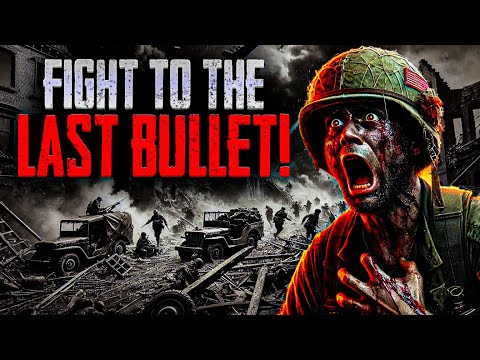
The battle that followed became one of the deadliest engagements of the Vietnam War. Outnumbered and surrounded, the Marines fought desperately. Some held their ground until their ammunition ran out; others played dead to avoid execution. Lance Corporal Billy Singleton, already wounded, grabbed his entrenching tool and smashed an enemy soldier’s skull before crawling to cover. Navy Corpsmen performed acts of pure bravery, dragging wounded Marines to safety while under heavy fire.
But the nightmare was just beginning. When reinforcements from Bravo Company rushed in, they too were slaughtered in a second ambush. The NVA had planned for everything. By the end of the day, over 80 more Marines were dead. The battle was spiraling out of control, and the US needed a new plan—one that didn’t involve sending more men into the enemy’s kill zones.
By July 3rd, it was clear that sending more Marines into the enemy’s kill zones was suicide. Instead, US commanders decided to unleash the full power of American firepower. B-52 bombers carpet-bombed the battlefield, F-4 Phantoms dropped napalm, and naval gunfire pounded NVA positions. The ground shook as fire and explosions consumed the enemy bunkers. After hours of bombardment, the Marines launched a brutal counterattack, fighting trench to trench. The NVA finally withdrew, leaving behind hundreds of dead.
The US declared Operation Buffalo a success, but the cost was staggering: 159 Marines killed, 345 wounded. The Marines of 1/9 had been nearly wiped out. For those who survived, the horrors of that day would haunt them forever. The battle exposed deadly failures in US intelligence and strategy—and proved that the NVA was a formidable enemy willing to pay any price in blood.
But the story of Operation Buffalo is more than just a tale of tragedy. It is a testament to the courage and resilience of the Marines who fought against impossible odds. Their sacrifices must never be forgotten. This is the untold story of Operation Buffalo—where heroes were made, lives were lost, and the cost of war was paid in blood.
The survivors of Alpha Company did not emerge from the tall grass as a unit. They came out as fragments—single men, pairs, small clusters, stumbling toward the perimeter of Con Thien with hollow eyes and blood-soaked uniforms. Some carried wounded comrades on their backs. Others walked alone, having left pieces of themselves behind in the kill zone.
Private First Class David Reyes was one of the last to crawl out of the elephant grass. He had spent six hours lying motionless beneath the body of his squad leader, listening to NVA soldiers move through the field, finishing off the wounded with single shots. When he finally reached the Marine lines, he could not speak. He could only shake. The corpsmen wrapped him in a blanket, but no blanket could warm what had gone cold inside him.
Back at Con Thien, the walking wounded gathered in stunned silence. There were no victory speeches, no triumphant reunions. Just the low murmur of men asking the same question over and over: “Where is he? Has anyone seen him?”
Names were checked against the roster. Some came back with a simple “present.” Others were met with silence. By nightfall, the full weight of the loss began to settle over the outpost like a fog. Alpha Company had ceased to exist as a fighting force. The 1st Battalion, 9th Marines—The Walking Dead—had suffered a wound that would never fully heal.
Yet even as the survivors mourned, the war demanded more. The NVA had withdrawn, but they had not vanished. Intelligence reports indicated they were regrouping, preparing for another strike. Operation Buffalo was over, but the fight for control of the DMZ was far from finished.
Three days after the ambush, a small patrol was sent back into the battlefield to recover the dead. The men moved in silence, their rifles held tight, their eyes scanning the tree lines for any sign of movement. What they found turned their stomachs.
The bodies of Marines lay where they had fallen, some stripped of their boots and weapons, others still clutching their rifles. The NVA had taken everything of value—and left behind a message scrawled in the dirt: “The Walking Dead are dead.”
The patrol gathered the fallen with a quiet fury. Each body was carried back to Con Thien, wrapped in ponchos, and loaded onto helicopters for the journey home. For the survivors, watching those choppers lift off was the hardest part. They had left their brothers behind once. Now they were leaving them again.
But the story of Operation Buffalo did not end on that battlefield. It followed the survivors home—into hospitals, living rooms, and sleepless nights. It echoed in the minds of men who flinched at the sound of a car backfiring or the sight of tall grass swaying in the wind. And it lived on in the letters they wrote to the families of the fallen, trying to explain a sacrifice that defied explanation.
One such letter, written by a sergeant who had survived the ambush, captured what so many could not say aloud: “Your son did not die alone. He died among brothers who loved him. And he died fighting—not for glory, not for country, but for the man beside him.”
The letter was never answered. It didn’t need to be. The words were enough.
For the men of 1/9, the days after Operation Buffalo blurred into a grim rhythm of patrols, funerals, and replacements. New faces arrived to fill the gaps in the ranks—young Marines barely out of boot camp, wide-eyed and eager. The veterans looked at them and said nothing. There was nothing to say that would prepare them for what waited beyond the wire.
Sergeant Thomas Hale, a squad leader who had survived the second ambush, was ordered to rebuild his team from scratch. He stood before a line of fresh recruits and felt the weight of their trust like a stone in his chest. He taught them what he could—how to read the grass, how to listen for the click of a rifle bolt, how to keep moving when every instinct screamed to freeze. But he knew the truth: the NVA had taught him those lessons with blood, and no amount of instruction could replicate that.
The battalion was no longer the same unit. The name The Walking Dead, once a grim joke among the Marines, had become something heavier—a badge of honor earned at a terrible price. Men wore it with a quiet pride, but they never spoke it loudly. It belonged to the fallen, not the living.
Meanwhile, the NVA had not abandoned their ambitions. The 324B Division, bloodied but unbroken, shifted their operations westward, probing for new weaknesses along the DMZ. Intelligence intercepted fragments of radio traffic suggesting another buildup near the Rockpile, a strategic outpost to the west of Con Thien. The pattern was familiar—too familiar.
Marine commanders faced a dilemma. They could not afford another Buffalo. But they also could not afford to let the NVA mass unchallenged. The decision came down from higher headquarters: a preemptive strike, smaller and more surgical than Buffalo, aimed at disrupting the enemy before they could dig in. The mission fell to a combined force of Marines and ARVN units, with heavy air support on standby.
Among the Marines chosen for the operation was Private First Class David Reyes, the young man who had spent six hours beneath his squad leader’s body. He had volunteered—not out of patriotism, but out of something harder to name. Survivor’s guilt, perhaps. Or the need to prove to himself that he could still stand and fight. When Sergeant Hale heard Reyes had volunteered, he found him cleaning his rifle and sat down beside him without a word.
After a long silence, Hale finally spoke. “You don’t have to do this, Reyes. Nobody would blame you.”
Reyes looked up, his eyes steady for the first time in weeks. “I know, Sergeant. But I need to.”
Hale nodded slowly. He understood. He had felt the same pull after his first firefight—the need to go back into the grass, to face the fear head-on, to prove that it hadn’t broken him. He clapped Reyes on the shoulder and stood.
“Then stay close to me,” he said. “And don’t you dare die out there.”
Reyes managed a thin smile. “Wouldn’t dream of it, Sergeant.”
The patrol assembled before dawn on July 9th, 1967—one week after the bloodbath at Buffalo. The men moved out in silence, their boots crunching softly on the red dirt, their eyes fixed on the tree line ahead. The grass was tall again, swaying gently in the morning breeze. And somewhere beyond it, the enemy was waiting.
The patrol moved through the elephant grass with a tension that bordered on suffocation. Every shadow, every rustle, every snapped twig drew a dozen rifles in its direction. Sergeant Hale walked point, his eyes locked on the tree line, his hand raised in a constant signal to halt and listen.
They found the NVA bunkers before the NVA found them. A forward scout spotted the freshly dug earth and the glint of a machine gun barrel poking through the grass. Hale called it in, and within minutes, artillery fire rained down on the enemy positions. The Marines watched as the bunkers crumbled, the NVA soldiers inside either dead or fleeing.
But the operation wasn’t over. The NVA had learned from Buffalo too—they had prepared fallback positions and hit the Marines with a vicious counterattack from the flank. Reyes found himself pinned down behind a fallen log, bullets chewing through the wood inches from his face. For a moment, the terror of Buffalo came flooding back—the screams, the blood, the bodies. He froze.
Then he heard Hale’s voice cutting through the chaos: “Reyes! You’re not dead yet! Move!” The words snapped him back. He rolled from cover, fired a burst at the advancing enemy, and scrambled to a new position. The Marines held their ground, and the NVA assault broke.
By nightfall, the operation was over. The NVA had been driven back, their buildup disrupted. The Marines had suffered casualties—eight killed, twenty-two wounded—but they had not been ambushed. They had fought on their terms, and they had won.
Back at Con Thien, Reyes sat alone on a sandbag wall, staring at the darkening sky. Hale found him there and sat down without a word. For a long time, neither man spoke.
Finally, Reyes broke the silence. “I froze out there, Sergeant. I heard the guns and I just… froze.”
Hale nodded slowly. “You froze. Then you moved. That’s what matters.” He looked at the young Marine beside him. “The men who don’t freeze are the ones who don’t care. You care. That’s why you’re still here.”
Reyes didn’t answer. But something in his chest loosened—just a little. The guilt didn’t vanish, but it shifted. He had survived Buffalo. He had survived this. Maybe, just maybe, he could survive the rest.
The war would go on for years. More battles, more ambushes, more names carved into the wall in Washington. But for the men of 1/9, Operation Buffalo remained the wound that never fully closed—and the lesson that never stopped teaching. They had walked into the tall grass as Marines and come out as something else entirely. The Walking Dead had earned their name, but they had also earned something more: the unbreakable knowledge that they could endure.
And for those who never came home, their brothers carried their memory forward—one step, one patrol, one day at a time.
What would you have done if you were in Reyes’s boots—frozen in the grass with the enemy closing in?
Report this article
Select a reason for reporting:






