The old soldier sat alone in the garden, his weathered hands trembling as he touched the petals of a rose. “You can ask the flowers,” he whispered, his voice cracking. “I sit for hours. Tell them all the bluebirds.” The words hung in the air, a fragment of a melody from a lifetime ago.
It was 1944, and the world was on fire. He was a paratrooper with the 101st Airborne, a young man with a heart full of dreams and a girl named Lily waiting back home. “The bluebirds,” he murmured, “they were her favorite.” Every letter he wrote from the front lines was filled with sketches of bluebirds, a symbol of hope in a time of chaos.
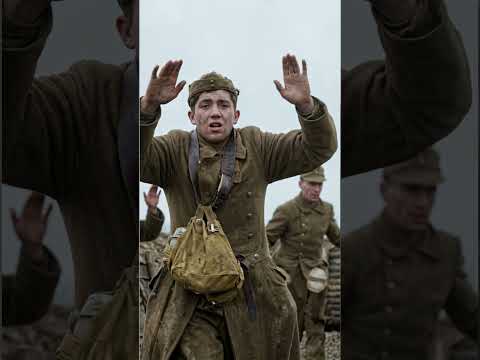
But war has a way of stealing hope. The skies over Normandy were dark with planes and flak, and the fields below were a maze of hedgerows and death. He remembered the weight of his rifle, the faces of his buddies, and the deafening silence that followed the artillery.
“Pretty little baby,” he sang softly, the tune a lullaby from his mother. “I’m so in love with you.” It was a song he had sung to Lily on their last night together, under a starlit sky. Now, it was a prayer.
The garden faded, and he was back in the muddy trenches of Bastogne, surrounded by the frozen bodies of his comrades. The Battle of the Bulge had been a nightmare of snow and blood. He had lost his rifle, his helmet, and nearly his mind. But the melody stayed with him, a fragile thread to sanity.
He never saw Lily again. A letter arrived after the war, telling him she had married another man. The bluebirds, she wrote, had stopped singing. He folded the letter and placed it in his pocket, next to a dried rose from their garden.
Now, decades later, he sat in that same garden, the flowers the only witnesses to his silent grief. “Tell them all the bluebirds,” he repeated, as if the flowers could carry his message to the beyond. The sun dipped below the horizon, casting long shadows.
And then, a sound broke the silence—a faint, familiar chirp. He looked up. A bluebird perched on the fence, its feathers bright against the twilight. It sang a few notes, then flew away.
He smiled, tears streaming down his cheeks. “You can ask the flowers,” he whispered one last time. And in that moment, he knew the story wasn’t over—not yet.
The next morning, the old soldier returned to the garden with a small notebook tucked under his arm. He had not written anything in years, not since the letter from Lily had arrived. But the bluebird’s song had stirred something loose in his chest, a door he’d kept bolted shut.
He sat on the same wooden bench, the paint peeling from years of sun and rain, and opened the notebook to the first blank page. His pen hovered. “Dear Lily,” he wrote, then stopped. The words felt strange, like speaking a language he’d half-forgotten.
He tried again. “Dear Lily, the bluebirds came back this spring.” The pen moved faster now, as if the ink itself had been waiting. He wrote about the garden, the roses, the way the light fell through the oak tree at dusk. He wrote about the war, too—the things he had never told anyone, not even his own children.
When he finished, his hand ached and the sun was high overhead. He read the letter twice, then folded it carefully and placed it in an envelope. But he had no address to send it to. Lily was gone, or at least the Lily he knew was.
It was then that he noticed the young girl standing at the garden gate, watching him with curious eyes. She couldn’t have been more than ten, with dark braids and a smudge of dirt on her cheek. “Mister,” she said, “why are you crying?”
He wiped his face with the back of his sleeve. “Because the flowers reminded me of someone,” he said. “Someone I loved a long time ago.”
The girl stepped closer, unafraid. She pointed at the envelope in his hand. “Is that for her?”
He nodded. “But I don’t know where she is.”
The girl tilted her head, thinking. “My grandma says if you tell the flowers, they’ll tell the wind, and the wind tells everyone.” She said it with such certainty that he almost believed her.
He laughed, a sound that surprised him. “Is that so?” He looked down at the letter, then at the roses. Slowly, he tore the envelope open and let the pages fall among the petals.
The girl smiled, satisfied. “See? Now she knows.” She turned and ran back toward the gate, her braids bouncing. He watched her go, and for the first time in years, the garden did not feel so empty.
That evening, he sat by the window and listened. The bluebird did not return, but the wind picked up, rustling the leaves of the oak tree. And somewhere in the sound, he could almost hear a voice—soft, familiar, singing the old lullaby.
He closed his eyes and let the melody carry him. There was still so much he did not understand, so much he had never said. But the flowers knew now, and perhaps that was enough to begin.
The days that followed brought a rhythm he had not felt in decades. Each morning he rose before dawn, made his coffee, and walked the short path to the garden. The roses seemed to lean toward him now, as if they recognized a fellow survivor.
He began writing again—not letters, but memories. Pages filled with names he had sworn never to forget: Kowalski, who laughed at everything; Sergeant Miller, who carried a photograph of his daughter into every foxhole; and a young private from Georgia who had never learned to tie his boots properly.
“I’m the last one,” he wrote one afternoon, the pen pressing hard into the paper. “The last one who remembers their faces.” The weight of that truth settled over him like the winter snows of Bastogne.
But the girl with the braids kept returning. Her name was Maya, and she lived three houses down with her grandmother. She brought him wildflowers and questions, endless questions about the war, about the bluebirds, about the girl named Lily.
“Did you ever find her?” Maya asked one Saturday, perched on the bench beside him. He shook his head slowly. “No. But I stopped looking.”
Maya frowned, kicking her feet against the bench legs. “Grandma says looking and finding are different things. She says sometimes you find people in ways you don’t expect.”
The old soldier considered this. He thought of the letter he had scattered among the roses, of the wind that had carried his words into the night. “Your grandmother sounds very wise,” he said.
“She is,” Maya replied matter-of-factly. “She also says you should come to dinner. She makes the best pot roast in the whole state.”
He hesitated. It had been years since he had sat at another person’s table, since he had allowed himself the simple comfort of company. But Maya was already tugging at his sleeve, and the garden suddenly felt too quiet, too still.
That evening, he found himself in a warm kitchen that smelled of rosemary and onions. Maya’s grandmother—a sturdy woman named Ruth with kind eyes and a no-nonsense manner—poured him a glass of sweet tea and asked no questions about the war.
Instead, she talked about her late husband, a farmer who had loved the land more than any person. She talked about Maya’s mother, who had moved to the city and rarely called. She talked about the bluebirds that nested in her eaves every spring, and how she believed they carried the souls of the departed.
“You don’t have to believe it,” Ruth said, passing him the potatoes. “But it helps, doesn’t it? Thinking they’re still out there somewhere, singing.”
He looked at the table—at the chipped plates, the mismatched silverware, the small vase of wildflowers Maya had picked from his own garden. “Yes,” he said quietly. “It helps.”
When he walked home that night, the stars were bright and the air was cool. And for the first time in a very long time, he did not feel alone.
Spring came early that year, and with it, a letter. It arrived in a plain white envelope, the handwriting shaky but unmistakable. “I heard the bluebirds are back,” it read. “I heard it on the wind.” It was signed, simply, Lily.
He sat down hard on the garden bench, the letter trembling in his hands. She was alive. She had heard—through Maya, through Ruth, through the strange and winding whispers of a small town. “She’s in a care home two towns over,” Ruth explained when he called her, breathless. “Her daughter found your name in an old diary.”
He visited her the next day. She was smaller than he remembered, her hair white as the Bastogne snows, but her eyes—those eyes still held the same light. “You never stopped singing,” she said, and her voice cracked on the last word.
He took her hand. “Neither did the bluebirds.” They sat together for hours, talking of the years lost and the years found, of the letter she had written and the one he had scattered among the roses.
That summer, they married in the garden. Maya scattered petals down the aisle, and Ruth cried into her apron. The bluebirds sang from the oak tree, and the old soldier knew, at last, that the melody had never really ended.
“You can ask the flowers,” he whispered to Lily as they danced beneath the string lights. “I sit for hours.” She laughed, and the sound was the answer to a prayer he had carried for seventy years.
So tell me—have you ever listened to the wind, or asked the flowers, and heard someone answer back?
Report this article
Select a reason for reporting:






