Step right up, folks, and buy your ticket to the greatest show on earth—just don’t breathe too deeply. Because the first thing that hits you at Buffalo Bill’s Wild West Show in 1885 isn’t the thunder of hooves or the crack of a rifle. It’s the smell. A sharp, sulfurous reek rising from the canvas, mixed with the stench of hundreds of unwashed horses and cattle. These animals didn’t see soap. They didn’t see a brush. They didn’t see a bath. Ever.
And in the middle of all that filth stands Annie Oakley—a tiny woman, barely five feet tall, in a clean, pressed dress, shooting glass balls out of the air while riding a bicycle. How did she manage to keep a lace tablecloth spotless in a place that smelled like a barn fire? That’s the story nobody tells you.
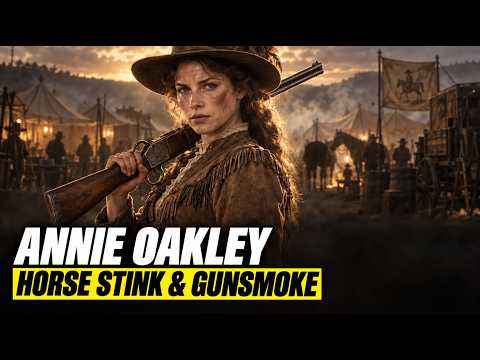
Most people know the outline: poor girl from Ohio, learns to shoot, joins Buffalo Bill’s show, becomes the most famous woman in America. Inspiring, sure. But nobody asks the obvious question—what happens when you cram 500 people, 300 horses, a herd of buffalo, and a mountain of gunpowder under a tent in the middle of July? The answer is: it gets disgusting. And Annie Oakley lived there for 17 years.
Let me paint the picture. Literally. The main tent covered 201,000 square feet—23 square yards of canvas, 1,100 tent pegs, 20 miles of rope. The grandstand held 20,000 spectators. This wasn’t a county fair; it was a moving city, built from scratch every morning, torn down every night, and loaded onto a train of 40 to 50 cars. Nine sleeping cars for 500 people. Not comfortable. More like a sardine can with a train schedule.
In 1898 alone, the show covered 10,253 miles of railroad, playing 133 towns in 26 states over 200 days. Two shows a day for six months. Daily expenses? About $4,000—over $140,000 today. Every single day.
Now, the horses. They were the backbone of the operation and the main source of the stench. In 1898, the show traveled with 329 performing horses, six mules, and 118 draft horses just to haul equipment. By 1911, after merging with Pawnee Bill, they moved 600 head of livestock, including elephants. That meant 20 tons of hay and 30 bushels of oats a day. And what goes in must come out. 600 animals produce a lot of what comes out.
Around 1905, things got worse. Glanders—a contagious, ugly disease—spread through the horses. About 300 animals were infected. The show covered it up. I mean, what’s the poster supposed to say? Come see Buffalo Bill’s Wild West Show, now featuring sick horses! Not a great marketing strategy.
But all that—the animals, the manure, the disease—wasn’t the worst thing you breathed in those grandstands. The worst part was man-made and hung in the air at every performance. In the 1880s and ’90s, black powder was the main propellant for firearms. It’s nasty stuff. Only 45% of it burns into actual energy. The other 55% comes out as smoke, ash, and a corrosive layer that starts rusting your rifle the moment it touches metal. Every time someone pulled a trigger, a thick cloud of sulfurous smoke shot into the sky—or into the air. Multiply that by hundreds of shots in an arena walled with canvas and packed with 20,000 people. The air turned into a gray soup that smelled like rotten eggs, burned your eyes, and crawled into your lungs.
Modern indoor shooting ranges won’t even allow black powder because their ventilation can’t handle it. Buffalo Bill’s arena didn’t have ventilation. It was open to the sky, but the grandstands were covered. So all that smoke rose, hit the roof, and rained back down on the audience. During the big battle reenactments, with dozens of performers firing at once, historical accounts describe the air as thick with powder smoke—so dense one observer joked the show wasn’t more accurate because the crowd came for the smoke and thunder. And they got it.
Health risks were real. Respiratory problems. Eye irritation. That’s before you count the dust kicked up by 300 horses from the arena floor. Performers had to cover their faces to protect their eyes and mouths from the sand. One historian summed it up: life in the Wild West shows was tough and rough, in a world of danger, with little sanitation or heating.
Hygiene in 19th-century traveling camps was, to put it mildly, limited. With few facilities, performers and workers tried to stay clean while tearing down a city every night and rebuilding it every morning. Dusty grounds and crowded camps were breeding grounds for disease. Hundreds shared a handful of facilities, slept in canvas tents or crowded sleeping cars, and ate three meals a day cooked on a 20-foot stove by a kitchen crew trying to feed 547 people. And maybe they had dogs to feed, too.
The show generated its own electricity and ran its own fire department—which tells you how many fires broke out. Pinkerton detectives infiltrated the operation from 1884 to 1908, their names listed alongside regular employees on the route books. They were there because a show moving that much money, equipment, and livestock was a prime target for the Jesse Jameses of the world. Well, not exactly at that time. But anyone who wanted to top them could do what they did, right?
It was a one-day city, and like any city, it had problems. Nate Salsbury was the man most responsible for keeping it financially stable—Buffalo Bill’s partner and co-producer. He handled contracts, routes, budgets, and the discipline that kept the whole thing from collapsing under its own weight. Without him, there’d be no Wild West Show as we know it in history.
And in the middle of all this, there was Annie Oakley. Five feet tall, maybe 100 pounds. Her father said living in a canvas tent didn’t mean you had to live like an animal. So Annie outfitted her tent with a Brussels carpet, a rocking chair, and a sitting table. She kept real silverware and china and lace. Between shows, she sat in that rocking chair with her guns hanging on the wall. She did fancy embroidery. After the show, she hosted guests with tea, punch, and cake in the middle of a camp filled with dust, smoke, and the smell of horse manure. This woman threw tea parties.
Her husband, Frank Butler, admitted flat out that Annie was a poor housekeeper—but she said she was excellent at furnishing a tent or a hotel room and at packing luggage. For most of their adult lives, Annie and Frank lived and dressed right out of a trunk. She didn’t even want closets in her house. She preferred a mobile home life. In fact, she mastered the art of mobile domesticity. She could turn a canvas tent into a proper sitting room in the time it took most people to find their luggage.
She wore dresses every day. In a place where everyone was covered in dust, soot, and horse sweat, Annie kept herself looking like it was a competitive event—which, in her line of work, it was. She understood that her image was part of the show. She wasn’t just a shooter; she was a lady who could shoot. And that distinction mattered to the newspaper sellers on the platform.
But the clearest example of Annie Oakley’s practicality was how she handled the black powder problem. She hated the stuff—not because she couldn’t shoot with it, but because it was messy and blocked her view of the target. Every shot put a cloud of smoke between her and the next glass ball. So she switched to Schultz powder, widely known as one of the first commercially successful smokeless powders. It was a white powder, 42 grains, capable of firing heavy charges without raising chamber pressure. We already believed the rifle wouldn’t explode. That’s what chamber pressure means—if it spikes, boom. This powder didn’t throw thick clouds of sulfur smoke or foul the barrel with corrosive residue. She stated in several interviews that it was the only powder she used in her shows because it was cleaner, more reliable, and let her see exactly what she was aiming at.
And here’s where the really great story begins. When the Wild West troupe went to France for the 1889 Paris Exposition, Annie brought 50 pounds of the stuff with her. When they reached the dock, someone told her French law banned the import of foreign gunpowder. So the most famous sharpshooter alive looked at 23 kilograms of smuggled powder and decided to smuggle it into France anyway. That’s what Americans do, right? Especially the ones who love shooting. Here’s how they pulled it off: they filled hot water bottles with gunpowder. Each woman in the group wore a dress with a prominent bustle and hid the bottles inside. As Annie later recalled, they drew attention coming down the gangplank because the bustle fashion had just started in France and was already losing its shine there. So you’ve got a group of American women waiting to disembark with suspiciously large rears, smuggling gunpowder into France in hot water bottles. Not something they teach in history class, is it?
It didn’t stop there. Later, still in France—everything happens in France, right?—Annie got a notice to pick up a box from customs sent by friends in England. It was a big box. Inside were two dozen fresh eggs and an unsigned note advising her to try the powder package in her rifle before throwing it away. The eggs were coated in gunpowder. Someone had sent her ammunition disguised as breakfast.
Over the years, some tried to downplay her skills by pointing out she used shot cartridges in her rifles instead of regular bullets. That’s largely true. She loaded shot cartridges with less than half an ounce of very soft, annealed lead. But that wasn’t because she couldn’t hit a target with a regular bullet—it was because she was shooting inside an arena surrounded by 20,000 people. A solid bullet that missed a glass ball, even if it shattered it, would keep going until it hit something. Like someone’s head. Or a spectator’s face, if not their head, stuck to the head. Shot cartridges were a safety measure. In rehearsals on an empty arena, Annie and Buffalo Bill fired regular solid ammunition and hit everything they aimed at. Her standard load was two drams of nitro powder and one ounce of shot, fired from rifles made by Lancaster, Parker Brothers, Stevens, Winchester, and Marlin.
Frank later joined as a representative for the Union Metallic Cartridge Company, which allowed them to keep touring while promoting ammunition. Nothing beats free bullets. I remember when I was in the Army, training with small arms. How I loved free government ammo! It’s better than government cheese, because, well, you have to load the bullets, but I figure if you eat enough cheese, you’ll load your cannon at the other end. Not something you shoot, but something you drop a trunk door on. Union Metallic was one of the biggest ammunition manufacturers in the country, and putting the most famous shooter in the world’s name on your product wasn’t simple. It was crucial. They were the original power couple—except instead of promoting protein shakes, they sold lead. That’s the American way.
Through all of it—the smoke, the dust, the horse diseases, the hard work of two shows a day—Annie Oakley kept shooting and performing, and somehow kept her Brussels carpet clean. She joined the show in 1885 and stayed for most of the next 16 years. She earned more money than anyone else in the troupe except Buffalo Bill himself. Thomas Edison filmed her in 1894 in his Black Maria studio. She performed for and wrote to royal families in London, where her show sold two and a half million tickets, and she delighted over two million people at the 1893 Chicago World’s Fair, also known as the World’s Columbian Exposition, which drew more than 27 million visitors. To put that in perspective, Buffalo Bill set up his pavilion just outside the official fairgrounds after being denied a spot inside, and still drew over two million people on his own.
Stories are told about Annie being so frugal she’d sip lemonade from Buffalo Bill’s pitcher and carry it back to her tent. Whether true or not, it reveals a lot about her. Annie grew up in deep poverty in Darke County, Ohio. Her father died when she was six. She taught herself to shoot to put food on the family table. She earned enough to pay off her mother’s mortgage while still a teenager. She never forgot her roots. And she never let the circus—literally or figuratively—change who she was.
The great Lakota leader Sitting Bull watched her perform in 1884 and was so impressed he adopted her and named her “Little Sure Shot.” This was the same man who led the Lakota, Cheyenne, and Arapaho warriors who defeated George Armstrong Custer at the Battle of the Little Bighorn just eight years earlier. A warrior who changed the course of American history took one look at a little farm girl from Ohio shooting glass balls from the back of a galloping horse and decided she was family.
Annie Oakley retired in 1913 and died on November 3, 1926. She was 66 years old. She spent 17 years living inside what can only be described as a magnificent, terrifying traveling city with enormous biological hazards. And she did it wearing a neat, pressed dress, with a cup of tea in her hand. Annie Oakley, the little sure shot.
So the next time you picture the Wild West, remember the truth beneath the canvas: the stink, the smoke, the thunder—and one small woman in a clean dress, holding her ground. She didn’t just survive the chaos; she made it look elegant.
That’s the real legend of Annie Oakley—not the glass balls, but the lace tablecloth in the middle of a manure pile. She aimed true, and she lived cleaner than the whole show.
Now, dear reader, I’ll leave you with this: if you had to spend 17 years in that tent, what would you pack first—your rifle or your teacup? Tell us in the comments below.
Report this article
Select a reason for reporting:






