On a dark, isolated street in Boiling Heights, California, the early hours of July 26, 1997, were shattered by the echo of gunshots. Bruce Cleland, a 43-year-old software engineer, lay dying on the asphalt, while his young wife, Rebecca, sat calmly on the hood of their car. She would later claim she had been knocked unconscious and remembered nothing. But as police arrived, they found her story already unraveling—her diamond ring was still on her finger, her purse untouched, and her demeanor chillingly composed. What had begun as a romantic evening of reconciliation had ended in a brutal execution, and the only witness was the woman who stood to gain a fortune.
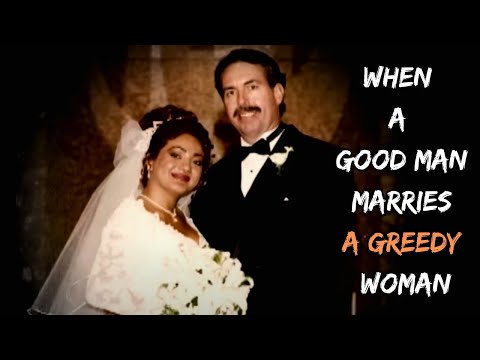
Bruce Cleland was never the kind of man who attracted attention. Growing up in South Pasadena, he was brilliant but awkward, a target for bullies who nicknamed him “Tiny Tim” after the frail Dickens character. “He often responded to bullying by making fun of himself rather than confronting others,” and he rarely expressed anger. Instead, he poured himself into his studies, earning degrees from Harvey Mudd and Stanford before landing a lucrative career as a software engineer. By 1987, he was earning over $100,000 a year, yet he lived frugally, driving old cars and saving every penny. He had never had a serious relationship—until he met Rebecca Salcedo at a swap meet in 1995.
Rebecca was everything Bruce was not: outgoing, confident, and stunningly attractive. She was selling spices when their eyes met, and Bruce was instantly smitten. Too shy to ask her out directly, he pretended to be looking for an IT recruit and asked for her CV. Within a week, she suggested they marry—and he, unaccustomed to such attention, agreed. He had no idea that Rebecca was a convicted felon, a mother of a young son by an unknown father, and a woman who had spent her life manipulating men for money. She saw Bruce as an easy mark, and he saw her as the love of his life.
Bruce lavished her with gifts: a car, a boat, cosmetic surgery, and a $350,000 house in Los Angeles. She demanded a $10,000 engagement ring and insisted on a lavish church wedding, all while refusing to consummate the marriage until after the ceremony. “She claimed she had only had one partner in her life, the father of her child,” but the reality was far darker. Rebecca had been arrested for drugs, served time in prison, and had a string of lovers—including women. Her own mother had committed suicide, and Rebecca had spiraled into parties and infidelity. Bruce, blinded by love, believed every word she said.
After the wedding in January 1997, the marriage quickly fell apart. Rebecca openly cheated, hosted parties in Bruce’s home, and told friends she had married him only for his money. When Bruce finally moved out and sought a divorce, he discovered that his premarital assets were protected—Rebecca would get only $2,500. Furious, she began plotting a more permanent solution. In June 1997, she forged Bruce’s signature on a $1 million life insurance policy. Then she called him, pretending she wanted to reconcile. On the night of July 25, they dined at their first-date restaurant, visited her uncle, and drove home. Rebecca pulled over, claiming she needed to check the tailgate. That’s when her cousin, Alvaro, stepped out of the shadows and fired the first shot.
Bruce tried to run, but a bullet struck his back. As he fell, the shooter approached and fired a final shot to his head. A neighbor witnessed the scene and called police, but by the time they arrived, Bruce was dead. Rebecca’s performance as a grieving widow was unconvincing—she was calm, self-absorbed, and her story full of holes. “She had no idea who had approached and killed her husband,” she claimed, but phone records showed she had contacted Alvaro before and after the murder. The stolen ring was later seen on her finger, and witnesses heard her speaking with the gunman moments before the shots.
It didn’t take long for investigators to uncover Rebecca’s scheme. Her cousins, Alvaro and Jose Casada, confessed to the murder at her behest. In June 2000, all three were convicted. Rebecca was sentenced to life without parole, while her cousins received the same. Bruce’s parents, Harold and Thea, who had tried to warn their son about Rebecca, were devastated. “She planned it from the beginning,” Harold said outside the courtroom. Bruce’s story is a tragic reminder of how trust can be exploited and how greed can destroy even the gentlest of souls.
Yet the story did not truly end in that courtroom. In the years that followed, Rebecca Cleland’s conviction was appealed, and in 2003 a retrial was ordered—a legal twist that forced Bruce’s aging parents to relive the nightmare all over again. They sat in the same hard benches, heard the same evidence, and watched the same cold, unrepentant face. This time, the verdict came back the same: life without the possibility of parole. Harold and Thea Cleland embraced outside the courthouse, but there was no joy in it—only the hollow relief of justice twice delivered.
Rebecca was transferred to the California Institution for Women in Corona, where she remains to this day. Prison records describe her as a model inmate—quiet, cooperative, unremarkable. She teaches literacy classes and attends chapel on Sundays. To the guards and counselors who know her, she is simply another number. But to those who remember the case, she is the woman who kissed her husband goodbye, then watched him die on a dark street for a million dollars she never received.
Her cousins, Alvaro and Jose Casada, were sent to separate state prisons, each serving life without parole. Alvaro, the triggerman, has reportedly expressed remorse in letters to victims’ advocates, though he has never testified against Rebecca. Jose, who drove the getaway car, maintains he was merely following family orders. Neither brother has ever explained why they agreed to kill a man they had never met. Some investigators believe Rebecca manipulated them with promises of money and family loyalty; others suspect a darker, older debt within the Salcedo clan that has never been fully uncovered.
Bruce’s house in Los Angeles—the four-bedroom home he bought for a wife who never loved him—was eventually sold. The proceeds went to his estate, which Harold and Thea donated to a scholarship fund at Harvey Mudd College in their son’s name. Each year, a plaque is awarded to a student in computer science who demonstrates “quiet integrity and uncommon kindness.” It is a small legacy, but it is the one Bruce would have wanted.
Virginia, the neighbor who witnessed the shooting from her window, never fully recovered from what she saw. She moved away from Boiling Heights within a year and rarely spoke of that night again. In a brief interview years later, she said only this: “I saw a woman sitting on a car, just sitting there, like she was waiting for a bus. I knew right then something was wrong with her soul.”
As for Rebecca, she has granted no interviews and filed no further appeals. She celebrates no holidays and receives no visitors. On the anniversary of Bruce’s death each July, she reportedly spends the day in the prison library, reading novels. Whether she feels anything—remorse, regret, or even memory—remains as unknowable as the woman herself. The only certainty is that Bruce Cleland, a gentle man who wanted nothing more than to be loved, died believing he had finally found it.
But the silence that settled over the case was not the same as closure. In the years that followed, true-crime writers and documentary producers began circling the story, drawn by its almost novelistic cruelty—the shy millionaire, the beautiful swindler, the hired cousins, the fake car trouble on a darkened road. Each retelling added new details, some confirmed, some invented, until the Rebecca Cleland of popular imagination bore little resemblance to the woman in the prison records. What remained consistent was the outline: a man who saved for decades and a woman who spent it in months.
One of the more persistent threads involved the money itself. Prosecutors had argued that Rebecca expected to collect roughly a million dollars from the forged policies, plus the house and Bruce’s accumulated savings. But insurance companies are not sentimental. Because the policies had been fraudulently obtained—and because the beneficiary was convicted of arranging the insured’s death—not a single dollar was ever paid out. The house went to Bruce’s estate. The stocks and accounts passed to his parents. Rebecca’s grand scheme netted her exactly nothing but a prison cell and a lifetime of institutional food.
That irony was not lost on the detectives who had worked the case. One of them, a homicide investigator who asked not to be named, later reflected on the sheer pointlessness of it all. “She could have walked away with a clean divorce and a few thousand dollars,” he said. “Instead she wanted everything, and she ended up with less than nothing. Bruce would have given her anything she asked for. That’s the part that keeps you up at night.”
Meanwhile, the Salcedo family fractured in the aftermath of the trials. Rebecca’s sisters, who had once competed with her for attention and affection, reportedly cut ties entirely. Her son—the boy Bruce had quietly helped raise, paying for his clothes and school supplies—was taken in by extended relatives and grew up far from the spotlight. He was never told the full story of what his mother had done, at least not by the family. Whether he learned it from a newspaper or a schoolyard whisper, no one can say.
Pedro Salcedo, the stepfather who had adopted Rebecca and her sisters, faded into obscurity. Neighbors in the old neighborhood remembered him as a quiet, hardworking man who had tried to hold a broken household together. “He didn’t deserve any of this,” one longtime resident said. “He married a woman with three girls and gave them a home. And look what came of it.”
The Cleland family, by contrast, chose to remember rather than retreat. Harold and Thea, both in their seventies by the early 2000s, continued to attend the scholarship ceremony at Harvey Mudd each spring. They shook hands with professors, listened to the citation, and sat quietly as the recipient read a short essay on integrity. They never spoke of Rebecca. They spoke only of Bruce—his love of air shows, his high-pitched laugh, his habit of bringing his parents small gifts from his overseas trips. “He was our friend as much as our son,” Thea said once. “That’s what we hold onto.”
Harold passed away in 2006, followed by Thea three years later. Their obituaries mentioned their son Bruce only briefly, but the scholarship fund they established outlived them both, quietly paying tuition for students who would never know the name behind the money. It was, in its own way, a final rebuttal to Rebecca’s greed—a fortune that had been meant for murder instead funded decades of young engineers and mathematicians.
The street in Boiling Heights where Bruce died has changed little. The houses are older, the trees taller, but the stretch of road remains dark and isolated at night. Residents still lock their doors early. Some of them know the story; most do not. But every so often, someone new to the neighborhood will ask about the faded memorial cross that appears each July, and the older residents will exchange a look and change the subject.
It was on one such July evening, years after the trials had ended, that a retired court reporter named Margaret happened to drive through Boiling Heights on her way home from a wedding. She had covered the Cleland case from the first preliminary hearing to the final verdict. She had heard Rebecca’s flat, rehearsed testimony and watched Bruce’s mother weep silently in the gallery. She pulled her car to the curb near the spot where the shots had been fired and sat for a long moment with the engine running.
Later, she would describe the feeling as a kind of unfinished sentence. “I kept thinking about the last thing he must have felt,” she said. “Not the bullet. The betrayal. He turned around and saw the person he loved standing there while a stranger shot him. That’s the part that never leaves you.” She drove home that night and did not speak of the case again for years.
Back at the California Institution for Women, Rebecca’s routine continued without interruption. She rose at the same hour, ate the same meals, and attended the same chapel services. According to a former inmate who shared a cell block with her in the mid-2000s, Rebecca rarely mentioned Bruce and never expressed regret. “She talked about her son sometimes,” the woman recalled. “And she talked about her ex-girlfriend Sher a lot. But the husband? Never. It was like he never existed.”
When pressed, the former inmate added one more detail—a small, unsettling one that has never been corroborated. “She had a picture taped inside her locker. Not of the husband. Of the house. That big house he bought her. She used to stare at it and say, ‘That was supposed to be mine.'” The woman shrugged. “Make of that what you will.”
In 2015, a true-crime podcast revisited the Cleland murder, and for a brief moment the case flickered back into public consciousness. Listeners were horrified, then fascinated, then—as always—moved on. Rebecca’s name trended for two days. Bruce’s name appeared only in the episode titles. By the following week, the internet had found new monsters to discuss, and the quiet software engineer from South Pasadena returned to the silence he had known all his life.
But one listener did not move on. A young woman named Elena, a graduate student in criminal justice at UC Irvine, wrote her thesis on the case—specifically on the way Rebecca had exploited Bruce’s isolation and inexperience. “He wasn’t stupid,” Elena argued in her defense. “He was lonely. Those are different things. Loneliness makes you believe things your intellect would otherwise reject.” Her thesis was published to modest academic acclaim and dedicated, in the front matter, to Bruce Cleland.
Elena eventually contacted Harold and Thea’s estate and asked permission to visit the scholarship ceremony. She was granted it. Standing in the back of the lecture hall, watching a nervous undergraduate accept the award, she felt something she had not expected: not sadness, exactly, but a strange, stubborn hope. The money Rebecca had wanted so badly had become something she could never have imagined—a quiet gift, passed hand to hand, year after year.
After the ceremony, Elena drove to the cemetery where Bruce was buried beside his sister. The headstone was simple: his name, his dates, and a line from a poem his mother had chosen. “He was a good man, and the world did not know it.” She stood there for a while, then left a small stone on top of the marker, as her grandmother had taught her to do.
The investigation was over. The trials were over. The appeals were over. And yet the story kept refusing to close, like a door that would not latch. Somewhere in a prison in Corona, a woman still stared at a photograph of a house she never owned. Somewhere in a lecture hall in Claremont, a student still read a plaque with a name that meant nothing to him. And somewhere on a dark street in Boiling Heights, a faded cross still appeared each July, placed by hands unknown, remembered by fewer every year.
What remained, in the end, was not the murder or the money or the trial. It was the question that had haunted everyone from the first night: how could a man so brilliant be so blind? And the answer, whispered by those who knew him best, was always the same. He wasn’t blind. He was hopeful. And hope, unlike greed, leaves no evidence behind.
Years later, a cold-case blogger revisited the Cleland file and found something everyone had missed: a single voicemail Bruce left his mother on the afternoon of July 25, 1997. “She called, Mom. She wants to try again. I think this time it’s real.” His voice was light, almost giddy. Thea had saved it for decades, never able to erase it.
The blogger played it for her readers, and the comments filled with grief. Here was a man on the edge of joy, hours from death, believing in a future that was already sold. Rebecca had booked the hit before she ever dialed his number.
Elena, now a professor, listened to the voicemail twice and closed her laptop. She thought of the stone she had left at his grave and wondered if hope ever truly dies—or if it just waits, quietly, for someone else to pick it up.
So here is the question that outlives the verdict, the appeals, the faded cross on that dark street: if you knew your trust would be used against you, would you still choose to love? Tell us in the comments.
Report this article
Select a reason for reporting:






