The flashbulb popped, and for a split second, the mask slipped. In a smoky Beverly Hills ballroom, a screen legend laughed so hard she doubled over, her diamond earrings swinging wildly. This wasn’t the polished smile for the fan magazines—this was real. And it was captured on film, hidden away for decades.
These are the photos the studio bosses never wanted you to see. The ones taken after the cameras stopped rolling, when the champagne flowed and the rules of glamour were temporarily forgotten. From the golden 1940s to the neon 1980s, the biggest stars in the world let their guard down—and someone was there to document it.
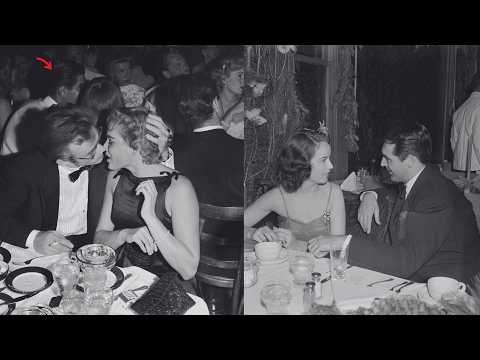
“Every photo tells a story you weren’t supposed to hear,” whispers the archivist, her white gloves handling a fragile negative. She’s spent years tracking down these images—estate sales, forgotten trunks, private collections. Each one is a window into a world where Clark Gable danced on tables and Audrey Hepburn kicked off her heels to join a conga line.
But why were these moments hidden? Some were too scandalous for the era. Others were simply too personal, too raw. “The studios controlled everything,” she explains. “A candid shot of a star drunk or crying could destroy a career. So they buried them.”
Now, for the first time, these rare photographs are seeing the light. The collection spans four decades of Hollywood history, from the glamorous parties of the 1940s to the wild disco nights of the 1970s. “You’ll see stars you thought you knew, but not like this,” the archivist says with a knowing smile.
There’s the one of Marilyn Monroe, caught mid-laugh, her platinum hair a mess, looking more human than any studio portrait ever allowed. And the shot of Frank Sinatra, arm around a fellow crooner, singing off-key with a glass of bourbon in hand. These aren’t icons—they’re people.
But the collection isn’t just about the famous faces. It’s about the moments between the moments—the whispered conversations, the stolen glances, the quiet tears after a lost award. “These photos capture the truth behind the tinsel,” she says. “And the truth is always more interesting.”
As she turns the page of a worn album, a particular image catches her eye. She pauses, her expression shifting. “This one,” she murmurs, “this one changes everything.” The photo shows a group of stars at a private party in 1954—but there’s someone in the background, a figure no one has ever been able to identify. “We don’t know who it is,” she admits. “But the way everyone is looking at them… it’s like they’re the most important person in the room.”
The mystery deepens. Could it be a studio executive? A hidden lover? Or something else entirely? The archivist won’t say more, but her eyes flicker with excitement. “You’ll have to see the rest of the collection,” she says, closing the album. “The story is just beginning.”
The album isn’t the only thing she’s been chasing. In a climate-controlled back room, a row of cardboard boxes sits stacked nearly to the ceiling, each labeled in faded marker. She pulls one down and sets it on the table between us. “This came from the estate of a studio photographer who died in 1971,” she says, peeling back the lid. “His family had no idea what was inside. They almost threw it out.”
Inside, hundreds of negatives are wrapped in wax paper, each one tagged with a date and a single word—after. After the premiere. After the wrap party. After the cameras went home. She lifts one to the light, and a scene emerges: a young James Dean, alone on a soundstage, sitting cross-legged on the floor and staring up at a single spotlight as if waiting for an answer.
“Nobody posed for these,” she says quietly. “That’s what makes them dangerous. A posed photo is a performance. This is a confession.”
She moves through the box with the care of someone defusing something. A 1957 shot of Elizabeth Taylor, barefoot in a hotel corridor, laughing into a payphone. A 1962 frame of Judy Garland mid-song at a private piano, eyes closed, entirely at peace. “That one,” the archivist says, tapping the Garland photo, “was taken three weeks before everything fell apart for her. You can see it, can’t you? The calm before.”
Then she finds it—a negative sleeve marked only with a date: August 4, 1962. She goes very still. “I’ve been looking for this for eleven years,” she whispers. “I wasn’t sure it actually existed.” She doesn’t open it. Not yet. She sets it aside like it might burn her.
The date alone is enough to make my skin prickle. Everyone in this room knows what happened on August 5, 1962. Everyone knows whose house the photographer would have been near that night. “Let’s just say,” she says, choosing each word carefully, “that this collection is about to become a lot more than a coffee-table book.”
She glances toward the door, then back at me, and lowers her voice. “There are people who would prefer these stay buried. I’ve already had two phone calls this week. Anonymous. Polite. The kind of polite that isn’t polite at all.”
She slides the sleeve into her bag and reaches for her coat. “Come back tomorrow,” she says. “And bring a lawyer.”
The next morning, the archive feels different. Colder. The climate-controlled hum seems louder, and the empty chair where she usually sits is pushed back at an odd angle, as if she left in a hurry. A man in a gray suit is waiting by the door, arms folded, a smile that never reaches his eyes.
“Miss Vance won’t be joining us today,” he says, flashing a badge too quickly to read. “She’s been called away on urgent business. I’m here to make sure the collection is… properly catalogued.” He says catalogued the way someone might say confiscated.
I ask about the August 4th sleeve. His smile tightens by a fraction. “There is no sleeve with that date,” he says smoothly. “I’ve reviewed the inventory myself. Whatever Miss Vance told you, she was mistaken. Archivists get excited. They see patterns where there are none.”
But he’s wrong about one thing—she wasn’t mistaken. Because on the table, tucked under a stack of contact sheets, I can see the corner of a wax paper sleeve, marked in her neat handwriting with a single word she never used on anything else: keep.
He follows my eyes. The room goes very quiet. “I’d advise you to leave now,” he says, and for the first time the politeness drops away entirely. “This doesn’t concern you. It concerns people who have spent sixty years making sure it stays exactly where it is.”
I don’t move. “And where is that?” I ask. “Buried? Like Judy Garland’s calm before? Like James Dean waiting under a spotlight?” Something flickers across his face—surprise, maybe, that I know that much.
He steps closer. “You think you’re the first person to walk into this room and feel like a detective?” he says softly. “Miss Vance has been chasing that sleeve for eleven years. Do you know how many people have chased it before her? Some of them are still alive. Some of them are not.”
He reaches past me and picks up the contact sheets—and the sleeve beneath them—with the casual confidence of a man who has done this many times before. “Tell her,” he says at the door, “that the offer still stands. She knows the number.”
He’s gone before I can answer. I stand alone in the humming silence, staring at the empty space on the table. But then I notice something he missed—a single negative, slipped free of its sleeve and left behind on the light box. Just one frame.
I switch on the lamp and lean close. It’s a driveway at night, shot from across the street. A car in the foreground, its door hanging open. In the background, a house with a lit window, and in that window, the unmistakable silhouette of a woman—hair falling loose, one hand raised as if she’s holding a phone, or reaching for something just out of frame.
On the back, in pencil, in a hand that isn’t the archivist’s: He was there. He saw. Ask him why he never spoke.
My phone buzzes. A text from an unknown number, three words only: “Don’t trust him.” Then, a second message, arriving a heartbeat later: “Basement. Now. Come alone.”
I look at the negative one more time. The woman in the window. The car in the drive. The date that started all of this. Then I pocket the frame, switch off the light, and head for the stairs.
The basement stairs are narrow and unlit, each step groaning under my weight. At the bottom, a single bulb sways above a row of metal cabinets, and beneath it stands Miss Vance—alive, unharmed, and holding a manila envelope like it’s a weapon.
“I knew you’d come,” she says. “And I knew he’d follow.” She nods toward the shadows behind me, where the gray-suited man has just appeared at the foot of the stairs, his polished shoes clicking against the concrete.
“You should have taken the offer, Eleanor,” he says, and for the first time, he uses her first name—and she flinches like he’s struck her. “Sixty years of silence, and you throw it away for a photograph of a driveway.”
She doesn’t flinch again. Instead, she slides the negative from the envelope and holds it up to the bulb. “This isn’t a photograph of a driveway,” she says. “It’s a photograph of a witness. And witnesses don’t stay buried forever.”
The man takes a step forward, but I’m already between them, my phone raised, the frame already sent to three newsrooms. “You’re too late,” I tell him. “Whatever this is, it’s out.” His jaw tightens, and for a moment, I see something human in his eyes—fear, maybe, or grief. Then it’s gone.
He turns and climbs the stairs without another word. When the door clicks shut, Miss Vance exhales like she’s been holding her breath for eleven years. “The woman in the window,” she says quietly, “was my mother. She saw everything that night. And she never spoke a word until the day she died.”
She presses the negative into my palm. “Now it’s our turn to speak.”
The story broke three days later. The sleeve, the silhouette, the witness who waited sixty years—it all came out, and the silence that had protected the powerful finally cracked open. Miss Vance stood on the courthouse steps and told the cameras, “The truth behind the tinsel was never buried. It was just waiting for someone brave enough to develop it.”
What would you have done, standing in that basement with the negative in your hand—kept the silence, or broken it?
Report this article
Select a reason for reporting:






