It was supposed to be just another old family photograph. A faded room, stiff formal clothing, and serious faces staring directly into the lens. Standing slightly apart from the group, a Black man whose presence seemed almost secondary. For over a century, anyone glancing at this image would have looked right past him. Then someone noticed his wrist—and suddenly, the photograph was no longer ordinary.
The image dates to 1864, a year when the United States was still mired in the violence of the Civil War, and slavery remained a defining reality of American life. The photograph itself looks calm, almost peaceful. No battlefield, no shouting crowds, no visible violence—just people standing motionless before the camera. But photographs can be deceptive. They freeze a single moment while hiding everything that came before and after. And sometimes the smallest detail can raise the biggest questions.
The man standing near the family is one of those details. His expression is hard to interpret. His body language seems constrained. His position within the composition is noticeably different from the family members. Then there is his arm. At normal viewing size, the wrist looks like nothing more than a dark smudge. Perhaps part of his clothing, a shadow, or something else entirely. But when the image is magnified, the shape becomes clearer. It appears to form a tight band around the wrist—raising an immediately unsettling possibility.
Could it be some kind of restraint?
No one can simply assume the answer. Old photographs are full of visual traps. A scratch in the photographic emulsion can look like a line. A fold in the paper can resemble a chain. A dark shadow can turn into an apparent object when enlarged. Historians examining such an image must proceed with caution. The first question is not, “What shocking secret have we found?” The first question is: What can we actually prove?
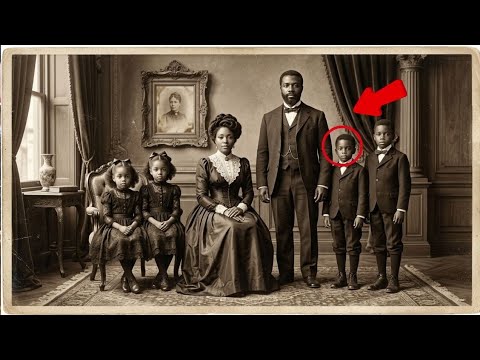
That distinction matters, especially when the photograph is connected to slavery. In 1864, slavery was still legal in parts of the United States. The Emancipation Proclamation had taken effect in 1863, but its reach was limited by geography and the circumstances of war. The Thirteenth Amendment, which abolished slavery throughout the United States except as punishment for a crime, was not ratified until December 1865. So the year printed beside the photograph can provide context, but it cannot tell us the full story of the person in it.
Perhaps the Black man was enslaved. Perhaps he was formerly enslaved. Perhaps he was a free man. Perhaps he was a servant or a laborer. The photograph alone cannot settle that question. Yet the composition of the image makes it impossible to ignore. Why was he there? Why was he standing in that exact spot? Who arranged the people in this photograph? And why did the photographer choose to capture the entire group this way?
Photography in the nineteenth century was entirely different from snapping a picture with a phone today. Creating a formal portrait required preparation. Camera equipment was expensive. Exposure times could be long. People often had to remain perfectly still. Clothing mattered. Posture mattered. The arrangement of people mattered. A formal photograph was usually premeditated, not spontaneous. That means every person in the frame becomes significant—even the one standing at the edge. Especially the one standing at the edge.
So the man’s wrist becomes more than just a strange visual feature. It becomes a gateway to a much larger historical question. What was life like for people whose freedom had been taken away? What did power look like inside an ordinary household? And how did those relationships appear to the people who lived through them?
The photograph cannot answer all those questions, but it preserves evidence. Look at the distance between the family members. Look at the way they occupy the center. Then look at the Black man. He is visible, but he does not appear to occupy the same social position. That distinction may have been intentional, or it may simply reflect the photographer’s arrangement. Again, we cannot know without additional evidence.
And here is where the investigation becomes fascinating. Researchers would want to know the provenance of this photograph. Was it discovered inside an old family album? Was it purchased from an antique collection? Was it found in someone’s estate? Was there writing on the back? Was a location mentioned? Were names written beneath the people? A single handwritten word could change the entire investigation. A name could lead to census records. A county could lead to property records. A family name could lead to letters and diaries. A plantation name could lead to tax documents and other historical records. The photograph itself may be just the first piece of evidence.
And that is where many mysteries become more complicated than they first appear. Because the wrist may not be the final discovery. It may simply be the clue that forces someone to look more carefully at everything else. The man’s clothing, his position, his expressions, the room around him, the people beside him, the date, the location, and the historical circumstances surrounding the photograph.
One small detail can make you reconsider the entire image. And once that happens, the photograph stops being just a picture. It becomes a historical document. A document that may contain information its creator never expected future generations to notice.
But before researchers can understand the wrist, they must understand the man. And that means going beyond what is in the photograph. Because the most important mystery is not simply what was around his wrist. It is who this man was. And what happened to him after the camera captured that single moment in 1864.
Here the story becomes darker and more human. Chapter Two: The Wrist and the World Hidden Behind It.
The more historians scrutinized nineteenth-century photographs, the more they realized how much information could hide behind seemingly ordinary details. A hand resting on a chair, a child’s expression, a piece of jewelry, a doorway, a formal suit—or a mark around someone’s wrist. But the challenge lay in separating evidence from imagination. And that becomes especially important when dealing with images connected to slavery.
If the mark around the man’s wrist was a restraint, that would be historically significant. But if it was merely a cuff, a shadow, or a damaged portion of the image, then calling it a restraint would create a story the evidence does not support. So researchers examine the photograph from multiple angles. They might compare the visible shape to the man’s clothing. Does the form continue behind his arm? Does it cast a consistent shadow? Does the material appear metallic? Is there evidence of a binding mechanism? Does the same visual pattern appear elsewhere in the image?
Every answer matters, and sometimes the evidence remains inconclusive. That is not a failure. It is part of responsible historical research. But even without determining what the object is, the photograph can still tell us something important. The Black man stands within a carefully arranged scene during one of the most turbulent periods in American history.
The Civil War had transformed the country. Enslaved people were fleeing plantations in search of freedom. Union armies were moving through the South. Families were being separated. Communities were being destroyed and reshaped. And the institution of slavery itself was approaching its legal end. Yet in a photograph like this, everything can seem strangely calm. That contradiction is powerful and affecting.
History rarely feels dramatic while people are living through it. Someone who woke up in 1864 did not know that historians would later describe that year as a turning point. They simply lived their day. They worked. They ate. They traveled. They raised children. They worried about money. They worried about the war. They worried about survival. And for the enslaved, daily life was shaped by a system that stripped them of their basic freedom. That reality was present even when there was no visible violence before the camera.
This is one of the reasons historical photographs are so misleading. An image can document silence without documenting its causes. It can show order without revealing the coercion that maintained that order. It can display people standing together without revealing whether they stood by choice. That is why context is essential.
Suppose researchers discovered the photograph was taken on a large agricultural estate. That would provide one piece of information. Then suppose records revealed the family owned enslaved workers. That would provide another. Then imagine a document identified the Black man by name. At that point, the investigation would become far stronger.
But even then, researchers must be careful. The presence of slavery on a plantation does not automatically prove the legal status of every Black person appearing in it. Establishing historical identity requires multiple pieces of evidence. A census record, a plantation ledger, a family letter, a court document, a military record, a later post-emancipation census, a marriage record, a burial record. Each source can either strengthen or weaken the hypothesis.
And here the true power of the photograph emerges. It can link visual evidence to documentary evidence. Imagine discovering a record from the same county describing a man of roughly the same age. Then another document mentioning a similar name. Then a later record showing the man living independently after emancipation. Suddenly, the anonymous figure in the photograph transforms from a mere unknown face into a historical person. A person whose life continued beyond the frame of the image.
This matters because slavery often erased personal identity from official records. People were frequently listed as property rather than treated as individuals. Names could be omitted, family ties ignored, a person appearing in a ledger without a surname, a child separated from parents, or a family divided and sold. This makes every surviving personal detail extraordinarily precious.
The man’s face matters, his clothing matters, his posture matters—and yes, even his wrist matters. But the wrist should not become a subject of sensationalism. It should become a reason to ask deeper questions. Was he restrained? If so, why? Was he being punished? Was the object symbolic? Was it simply an ordinary piece of clothing? Or was the apparent restraint merely an illusion caused by the age of the photograph?
There may never be a definitive answer, and that ambiguity should remain part of the story. What we can say is that the photograph belongs to a historical period in which physical control over the enslaved was a documented reality. We can also say that the institution of slavery shaped the lives of millions of people, and its consequences endured long after legal emancipation.
So the wrist remains a question mark, but the man himself refuses to stay one. Researchers would trace him forward—through the chaos of war’s end, through the uncertain years of Reconstruction, through a world that offered freedom on paper but rarely in practice. Every census line, every marriage record, every plot of land registered in his name would be a small victory against erasure.
Perhaps he became a farmer. Perhaps a minister. Perhaps a father whose children never knew the weight of a chain. Or perhaps the trail simply vanishes—swallowed by fire, flood, or the casual neglect of institutions that never considered him worth recording.
Either way, the photograph has done its quiet work. It has turned a forgotten face into a question that demands an answer. Not “What was on his wrist?” but “Who was he, and why did no one think to write his name?”
That is the real secret hidden in the image—not a single shocking detail, but the stubborn, human refusal to disappear. The camera froze him for a moment. History tried to freeze him forever. It failed.
Now it’s your turn: if you found an old photograph with a mystery like this, would you dig through archives to give that stranger a name—or would you let the silence stand?
Report this article
Select a reason for reporting:






