May 24, 1967. The Ham Luong River before dawn. Two patrol boats drifted with the current, engines dead, four men in each boat. The tree line on both banks was so close a man could touch the leaves. Then, without warning, fire erupted from both shores at once. Bullets came from positions the crew couldn’t pinpoint or see the end of. A recoilless rifle round struck the first boat’s bow in the opening seconds. The patrol leader was dead before the explosion’s echo rolled across the river. The boat began to spin at full throttle, the coxswain’s hands locked on the controls, while the remaining crew fired into a tree line they couldn’t see the end of, from a distance close enough to hear the men they were killing.
One in three. That was the casualty rate for river patrol sailors in Vietnam. Not over a career—in a single tour of duty. This is the story of what the Navy built when it had no other choice, what it cost the young men they put inside them, and what the institution did with everything those men learned after the war ended.
Speed is armor—until it stops being armor. The Mekong Delta isn’t just geography. It’s a trap built by 10,000 years of river water carving channels through flat land, covering roughly 15,000 square miles of southern Vietnam. Nearly 3,000 nautical miles of rivers, canals, and streams—natural highways that rarely exceeded 10 feet in depth. The sub-channels were shallower. During the rainy season, floodwaters expanded to include the rice paddies themselves, creating routes that appeared on no military map. During the dry season, those routes shrank and left vessels stranded in the open. The terrain breathed. And the men who had fought on it for decades understood its rhythm.
Nearly 40% of South Vietnam’s total population lived here. The Delta was the country’s food source, its commerce, its circulatory system. Everything moved by water—fish, rice, medicine, families—and everyone hid in plain sight among 50,000 registered civilian boats. Weapons, money, and insurgent fighters who had been working these waterways since before the first American advisor landed in the country.
The U.S. Navy arrived in 1965 with destroyers and cruisers. Destroyers need 20 to 30 feet of water. The Delta offered 10 feet at best. The warships anchored offshore and watched a war unfold in waters they couldn’t reach. What do you build when your fleet draws 30 feet, but the enemy fights in nine?
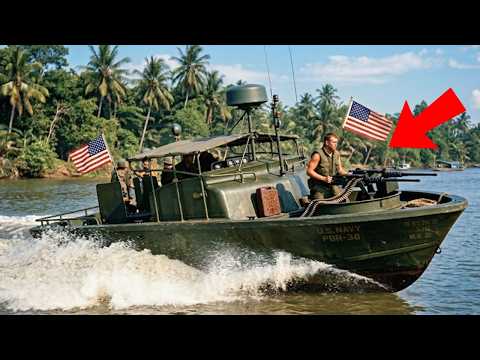
On December 18, 1965, the Navy officially acknowledged what geography had already decided. Task Force 116, Operation Game Warden. The mission: deny the enemy the use of South Vietnam’s inland waterways. A direct order, an impossible environment, and nothing in the arsenal capable of executing either. The contract went to United Boat Builders in Bellingham, Washington. Engineers designed a prototype in seven days, basing the hull on an existing civilian recreational boat. A 31-foot fiberglass river patrol boat. Twin Detroit diesel engines driving Jacuzzi water jet pumps. No propellers to snag on weeds and canal sediment. Just two pumps pushing 6,000 gallons per minute through rear nozzles. A skilled coxswain could execute a full reversal within the boat’s own length. Could stop dead from top speed. Could angle the hull sideways against the current to hold position alongside a suspect boat while the forward gun watched the banks.
The first boats began operating in the Delta in March 1966. About 250 were eventually built. The Navy called it a technological leap. But the men who crewed them called it something else. Speed is armor—until it stops being armor.
Here’s what a PBR could do. Twin .50-caliber Browning machine guns. M60s in the bow. A single .50 or M60 in the stern. M60s amidships. Grenade launchers. Four men who also carried M16s, shotguns, and pistols. For a boat smaller than most living rooms, it could generate a volume of fire unmatched by ships three times its size. Here’s what it couldn’t do. Survive a direct hit. Fiberglass was chosen because it was light enough to meet draft requirements and fast enough to deploy—not because it was safe. The hull offered no protection of value against anything heavier than small arms. The B40 rocket, the insurgents’ standard shoulder-fired weapon available in massive quantities, punched through fiberglass with little resistance. When it exploded inside the hull, the boat itself became a weapon. Fiberglass doesn’t shatter like steel. It disintegrates. Thousands of microscopic shards propelled at high velocity inside the boat, through clothing, through flesh. Those shards were invisible on X-rays. Surgeons couldn’t see them on X-ray films. Men carried pieces of their boats inside their bodies for decades after the war. Some still do.
Consider that for a moment. The designers knew all of this before the first boat shipped. They built it anyway because the alternative wasn’t a better boat. The alternative was sending nothing to the Delta at all, leaving the war to be fought there without any American presence capable of contesting it. This isn’t negligence. This is the logic of an impossible dilemma where every choice costs someone everything.
Mine explosions under the hull were different. A command-detonated mine transferred the full energy of the blast vertically through the deck, with nothing to absorb it. The usual injuries were traumatic amputations, spinal compression, pelvic fractures. The river mud that filled those wounds—contaminated and biological, carrying everything the water had swept from 15,000 square miles of agricultural delta—turned survivable injuries into fatal infections. Sepsis became a leading cause of death in wounds sustained in this environment.
In cases where the initial blast wasn’t enough to kill, the narrow canals eliminated every option the designers had built into the boats. They narrowed to 30 feet in operation areas, some to 15. At that width, both banks are within grenade range. The tree line closed to within a few feet of a passing boat. The engines of the PBRs produced a distinctive acoustic signature. Fighters who knew this river could identify an approaching patrol by sound alone, with enough time to prepare and position before the boat appeared on the horizon. You couldn’t escape an ambush when the walls were only 30 feet apart. River Division 531 lost seven of its ten assigned boats to rocket hits within 40 days.
Speed is armor—until it stops being armor.
His name was James Elliott Williams, Boatswain’s Mate First Class, from Darlington, South Carolina. He had spent enough time on the river to know the sound of a sampan engine at 400 yards in the dark, and what it sounded like at 200 yards, and what the difference between those two sounds meant for the next sixty seconds of his life. He knew the number. Every man on that boat knew the number. One in three.
A standard patrol lasted 12 hours, sometimes 24. Patrols operated in pairs. One boat conducting inspections, the second circling with weapons covering both banks. Task Force 116 logged about 70,000 patrol hours per month at peak operations. Nearly 80 firefights per month on average. Those numbers describe the shape of the war from the outside. From the inside, a patrol was this.
Kill the engines and let the current carry you forward. The brush closes over your head as the canal narrows. The water is brown and warm, and it smells like something agricultural and something biological and something you stop trying to name after the first week. The only sounds are the current, the insects, and the low murmur of the cover boat 200 yards behind you. You watch the banks, and the banks watch you back. The difference between a fisherman checking his nets before dawn and a mine engineer waiting for your hull to pass over a tripwire isn’t always clear until the moment it stops mattering.
Then a wooden sampan appears out of the darkness. It closes fast. You slow to come alongside. One crewman crosses to the other boat. He has about 12 seconds. Not because there’s a rule that says 12 seconds. Because 12 seconds is the geometry of two boats in a moving current, at the point where holding position becomes impossible without revealing your exact location to everyone on both banks. Twelve seconds to read a boat that might be carrying fish or might be carrying weapons or might explode the moment a hand goes under the surface. Twelve seconds to search among ceramic jars of nuoc mam. Fermented fish sauce, a staple on every Vietnamese table. It smells like something that drowned and was never recovered. Knowing that a B40 rocket hidden inside that smell, surrounded by rice and dried fish, is physically indistinguishable from stored provisions until your fingertips touch metal.
What do you do in those twelve seconds?
In November 1966, Game Warden forces boarded over 16,000 sampans in a single month, detained approximately 600 suspects, and recorded 76 armed engagements. Multiply 12 seconds by 16,000 every month.
For years, men aged 19 to 21, with only 6 to 8 weeks of training, whose only tactical education was a river that kept changing the exam questions. The constant vigilance the job demanded, the acoustic monitoring, the 12-second assessment windows, the inability to fully relax during a 12-hour patrol followed immediately by another 12-hour patrol—it doesn’t stop when the man returns to American soil. The nervous system that learned to read threat from the pitch of an engine in the dark doesn’t forget that at a naval air station gate in California. This isn’t a metaphor. It’s a documented mechanism researchers spent decades tracing after Vietnam. The bodies of veterans, their sleep records, their nightmares.
Williams knew this. Every man on that river knew this. They started the engines the next morning anyway.
When the Tet Offensive began in January 1968, Game Warden held. By the time the heavy fighting receded, Task Force 116 had recorded 40 killed and over 400 wounded since operations began. During the 40-day peak of Tet, eight killed, over 130 wounded, and hundreds of confirmed enemy dead. Strategic calculations said those numbers were in our favor. Human calculations said three men returned to a barracks that held four, then became one, then three. They held. The waterways around the provincial capital stayed open. Viet Cong defectors later reported that the interdiction pressure was so severe that units in the Delta sometimes went days without food, and weapons shipments were delayed by weeks at a time. The mission worked.
The Navy officially ended Operation Game Warden in March 1973. Then it did something with everything those men had paid for. It forgot. The river force was decommissioned and its crews dispersed. Operational doctrine was archived and never retrieved. The institutional memory of everything they had learned in blood on the Ham Luong and Bassac rivers was lost. Those warnings were allowed to evaporate because the Cold War was redirecting the Navy toward deep oceans. And the lesson about 30-foot canals and fiberglass hulls no longer fit the force structure anyone was building. This wasn’t a conspiracy. It was something more ordinary and, in its own way, more damaging. Bureaucratic amnesia. The assumption that a war that ended was a problem that had been solved.
In 2004, American soldiers in Iraq were welding scrap steel onto vehicle doors and calling them improvised armor because there was no purpose-built alternative. That improvisation was identical in principle and execution to what the brown-water Navy had done in 1966. No one in the supply chain seemed to remember why.
In 2006, the Navy created a new river squadron almost from scratch because it no longer had the doctrine, the training programs, or the organizational structure to operate in contested shallow waterways. It rebuilt from first principles. It rebuilt 40 years of hard-won knowledge from archive visits and veteran consultations, because the institution had allowed the men who held that knowledge to disperse, age, and die without writing any of it down where it could be easily found.
The riverine operations craft used today carries a water jet propulsion system, a shallow draft, heavy armament, and a small crew. It is a direct conceptual descendant of the PBR. Better sensors, better medicine, better materials. The same trade-off the designers accepted in 1965. The same canal geometry, the same fundamental truth about what happens when speed is your only armor and the walls are 30 feet apart.
James Elliott Williams received the Medal of Honor for his actions on October 31, 1966, on the Mekong River. His patrol boat came under fire from both banks. He engaged a group of enemy sampans in a battle that lasted for hours. His crew fought forces that outnumbered them by a margin he couldn’t count from his position. The citation is part of the public record. He survived the war. He returned home to South Carolina. He died in 1999.
The river he fought on is still there. The PBR solved the problem it was built for. The major waterways of the Delta came under Allied control. Viet Cong logistics were disrupted. The supply lines held. Task Force 116 suffered 272 killed and missing across all its units. 137 of them were PBR sailors—the most decorated Navy unit of the Vietnam War. Two Medals of Honor, 14 Navy Crosses. The Navy took that knowledge and that cost and put it in a closet. And 30 years later, other men bled while the institution searched for what it had already paid for.
He knew the hull was fiberglass. He knew the canal was 30 feet wide. He knew the number—the one that meant one in three men who did this job came home injured or came home in a coffin. He knew all of it. He started the engines the next morning.
One in three. That was the price.
The men who crewed those boats came home to a country that had moved on before they landed. No parades for the brown-water sailors. No doctrine waiting for them in the next war. Just a closet, a locked archive, and a generation of nervous systems calibrated to a river that no longer existed.
James Williams died in 1999, twenty-six years before the Navy finally rebuilt what he and his crews had already learned. He never got to see the institution admit it had forgotten. The river kept the rest.
So here is the question the record leaves open. When a nation asks young men to pay one-in-three in water ten feet deep, then files the receipt in a drawer no one opens for thirty years—who exactly is the lesson for? Was the price the men paid, or the cost of making the next generation pay it again?
Report this article
Select a reason for reporting:






