Rebecca Thornton had handled thousands of old photographs in her years as an archivist, but none had ever made her blood run cold like this one. The 1907 wedding portrait was a masterpiece of Edwardian elegance—the groom beaming, the bride radiant in Belgian lace, the parlor of the Hargrove mansion overflowing with San Francisco’s elite. It was the picture of joy, a moment frozen in silver gelatin. Then her eyes drifted to the ornate mirror behind the bride.
There, in the glass, stood a woman no one else seemed to notice. Her face was a mask of anguish, her body half-hidden in the doorway as if she were a specter haunting the celebration. “Dr. Levenson,” Rebecca whispered, her voice tight, “I think you should see this.”
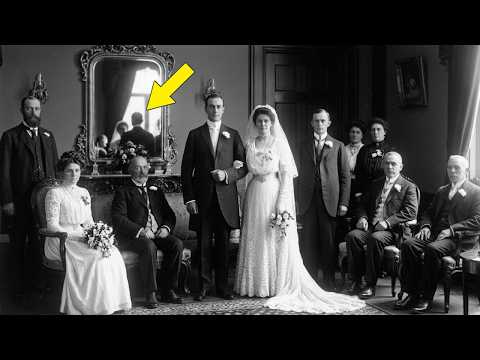
The photograph had arrived anonymously at the historical society, tucked inside a leather album with a note that read only: These should be preserved. Now, under the cold light of the conservation lab, Dr. James Levenson adjusted his magnifying lens and leaned in. “This was taken with a flash powder system—cutting edge for 1907,” he murmured. “The photographer likely never noticed her reflection.”
But Rebecca noticed. And the woman’s expression—a raw mix of grief and fury—didn’t belong in a wedding picture. She wasn’t among the guests; she was apart, a ghost at the feast.
Their search led them through yellowed newspaper archives and family ledgers. The wedding of Elizabeth Hargrove to Victor Matson was the social event of the season, but a small item in the San Francisco Chronicle mentioned an “unfortunate disturbance” that delayed the ceremony by an hour. No details. No names.
Then came the letters—a bundle tied with faded blue ribbon, hidden in a box labeled Elizabeth, personal. The handwriting was passionate, intimate, and signed with a single initial: T. Thomas Aldridge, a young architect from Boston, had been courting Elizabeth before the earthquake. His letters spoke of a future home they would design together, of love nurtured in the chaos of a broken city.
But the final letter, dated August 1906, was never sent. “Thomas, father has forbidden me to contact you. He says the incident with Victor has changed everything. I tried to explain, but his mind is made up. The banking partnership means everything to him now.”
Rebecca’s pulse quickened. “The banking partnership,” she breathed. “Hargrove Shipping was failing after the quake. Matson Banking offered a lifeline—but it came with a condition.”
Dr. Levenson nodded grimly. “A marriage between the families. And Thomas Aldridge was in the way.”
They dug deeper, into the archives of the San Francisco Call, and found a photograph from August 1906. It showed the aftermath of a brawl outside the Olympic Club: Thomas Aldridge being restrained, his clothes torn; Victor Matson on the ground, blood on his face. And on the periphery, a young woman with the Matson chin—Victor’s sister, Katherine—her expression a storm of distress and defiance.
“She was there,” Rebecca said. “And she was reaching for Thomas.”
The pieces clicked into place. Katherine Matson, the groom’s estranged sister, had been in the doorway that day. Her reflection, caught by accident, was the only evidence of a secret that the families had buried for over a century. But why was she there? And what had she lost?
Rebecca turned to the next page of Katherine’s diary, her hands trembling. The entry was dated the day of the wedding. “Tomorrow E will marry V, cementing the business arrangement that father and Mr. Hargrove have orchestrated. I have promised father I will attend and maintain appearances, but he cannot dictate my heart.”
The story was far from over—and Rebecca knew that the woman in the mirror held the key to a truth that had waited a hundred years to be told.
Katherine Matson’s diary continued, each page a window into a world of quiet rebellion. Rebecca read aloud the entry from the morning of the wedding: “I will stand in the back of the parlor, unseen. If E needs me, she will know I am there. That is all the defiance I can offer.”
Dr. Levenson set down his pen. “She never intended to be photographed. She came only for Elizabeth.”
But the next discovery complicated everything. Among Katherine’s letters was a telegram from Chicago, dated April 1907, sent by Thomas Aldridge. It read simply: “Do not attend the wedding. It will only cause pain. Let her go. T.”
Rebecca frowned. “She disobeyed him. Why?”
The answer lay in a later diary entry, written three days after the wedding. “T wired me not to go, but he does not understand. E sent word through her maid that she needed to see my face one last time. To remember that someone in that house loved her for herself, not for what she could secure.”
Dr. Levenson exhaled slowly. “Elizabeth asked her to come. The reflection wasn’t an accident of defiance—it was a lifeline.”
Rebecca stared at the photograph again. The bride’s serene smile now seemed less like joy and more like a performance. The mirror behind her held the only honest face in the room.
They returned to the Chronicle’s photo archive, searching for any image of Elizabeth after the wedding. They found one from 1910—a charity luncheon, Elizabeth seated stiffly beside Victor, her eyes hollow. In another, from 1912, she stood alone at a garden party, her hand resting on an empty chair.
“She never had children,” Rebecca noted. “And no records of any close friendships after the marriage.”
Dr. Levenson closed the folder. “She lived the life her father bought for her. But Katherine—Katherine built her own.”
The contrast was stark. Katherine’s later photographs showed her laughing among artists, her gallery walls crowded with bold new work. She had turned her back on the Matson fortune and made something entirely her own.
Yet one question remained unanswered: what had happened at the Olympic Club that night? The legal records were sealed, but a letter from a Johnston & Associates clerk, misfiled in the Hargrove business papers, offered a fragment. “Mr. Matson’s accusation regarding Miss K. was proven false, but the damage to Mr. Aldridge’s reputation could not be undone. Settlement conditioned upon his departure from California within thirty days.”
“Victor accused Thomas of impropriety with Katherine,” Rebecca said, her voice low. “It was a lie—but it served its purpose.”
Dr. Levenson nodded. “It removed Thomas from Elizabeth’s life and silenced Katherine in one stroke. William Hargrove got his banking partnership, and Charles Matson got his son a wealthy bride. Everyone got what they wanted—except the people in the photograph.”
Rebecca looked again at the woman in the mirror. Katherine’s face was no longer a mystery. It was a warning—a reminder that behind every polished historical narrative, someone’s truth had been sacrificed. And somewhere in the archives, she suspected, more of that truth was still waiting to be found.
Rebecca spent the next week chasing the ghost of that night at the Olympic Club. The Johnston & Associates files had been absorbed decades ago into a larger corporate law firm, and the clerk’s letter was only a fragment. But a search of the San Francisco Call‘s police blotter from August 1906 produced something the society pages had omitted: a brief entry noting that officers had responded to a disturbance at the Olympic Club at eleven o’clock, and that no charges were filed.
“No charges,” Dr. Levenson repeated. “Because the families settled it before the police could write a report.”
Rebecca nodded. “And the settlement came with a condition—Thomas leaves California. But there’s something else I want to check. Katherine’s diary mentions being sent to Boston. If she was exiled too, how did she end up at the wedding?”
The answer came from an unexpected place: a bundle of receipts tucked into the back of Katherine’s diary. A train ticket from Boston to San Francisco, dated May 14th, 1907—four days before the wedding. And beside it, a handwritten note from Elizabeth, smuggled out of the Hargrove mansion.
“K—I know what they did to you because of me. I know what they did to him. I am not brave enough to run, but I am brave enough to ask you to stand where I can see you. One last time. —E.”
Rebecca set the note down carefully. “Elizabeth risked everything to bring her back. If William Hargrove had found out—”
“He would have cut her off entirely,” Dr. Levenson finished. “But she did it anyway. That’s not the act of a passive bride accepting her fate.”
Rebecca looked again at the wedding photograph, at Elizabeth’s composed smile. “She was performing. For her father, for the guests, for Victor. But the mirror—the mirror was the one place she didn’t have to pretend.”
They decided to trace the photographer, Henri Dubois. His memoirs had mentioned the wedding, but his studio records, donated to the society in the 1960s, contained something more: a handwritten log of his commissions, with notes in the margins. Beside the Matson-Hargrove wedding, he had written a single line: “The sister came. The bride wept after. I said nothing.”
Dr. Levenson read it twice. “He knew. He saw Katherine leave, and he saw Elizabeth afterward. And he kept their secret for eighteen years until his memoirs.”
“Because he understood what the photograph was,” Rebecca said. “Not a celebration. A record of survival.”
She turned to the final section of Katherine’s diary, the pages written after her return to San Francisco in June 1907. The tone was different now—harder, more determined. “I have taken apartments on Russian Hill. Father has cut my allowance, which is no matter. I have my own money from grandmother, and I intend to use it. If I cannot have the life I wanted, I will build one that no one can take from me.”
And then, a line that made Rebecca’s breath catch: “T writes from Chicago. He says the city is rebuilding, and so must we. He has sent drawings for a gallery. I have not answered yet. Perhaps I am not ready. Perhaps I never will be. But I keep the drawings.”
“She kept them,” Rebecca said softly. “For thirteen years, she kept them. And then she built the gallery.”
Dr. Levenson looked at the 1920 photograph on the exhibition wall—Katherine standing proudly beside the architectural model, Thomas Aldridge credited as the designer. “Some bridges, once burned, cannot be rebuilt. But maybe they can be built anew, in a different form.”
Rebecca was about to respond when her phone buzzed. A message from the society’s front desk: a visitor had arrived, asking specifically for the archivist who had curated the Reflections exhibition. The name on the card was Eleanor Hargrove Whitfield.
Rebecca stared at the screen. “Dr. Levenson—there’s a Hargrove here. A descendant.”
He straightened. “Then the story isn’t finished after all.”
Eleanor Hargrove Whitfield was a slender woman in her seventies, with Elizabeth’s unmistakable jaw and a quiet, deliberate manner. She carried a small velvet box. “I read about your exhibition,” she said. “My grandmother was Elizabeth’s niece. When she died, she left me this—and a letter saying it should go to whoever finally told the truth.”
Inside the box lay a photograph Rebecca had never seen: Elizabeth and Katherine, older now, seated together in a sunlit garden. On the back, in Elizabeth’s hand: “K—the only honest day of that year. E.”
Dr. Levenson studied it. “They found each other again.”
Eleanor nodded. “Every year, on the anniversary, Elizabeth visited Katherine’s gallery. Victor never knew.”
Rebecca placed the photograph beside the wedding portrait, and for the first time, the woman in the mirror no longer looked like a ghost. She looked like a witness.
What other truths are hiding in plain sight, waiting for someone to finally look?
Report this article
Select a reason for reporting:






