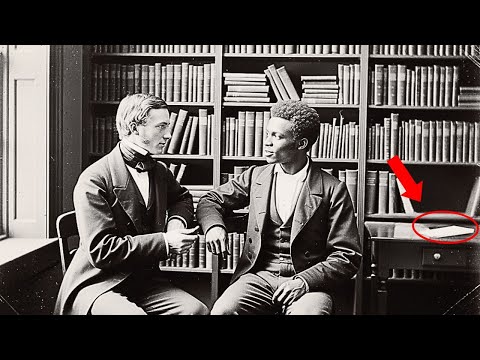
Dr. Maya Johnson adjusted the high-powered magnification lens over the daguerreotype, her breath held in concentration. The November afternoon light filtered through the tall windows of the Charleston Museum of Confederate History’s conservation lab, casting long shadows across her workspace. At 38, Maya had restored hundreds of Civil War-era photographs, but this one presented unusual challenges. The silver-plated copper sheet was severely tarnished, with dark oxidation obscuring much of the image. What she could discern showed two young men, perhaps in their early twenties, seated side by side in what appeared to be a library or study. The informal pose was unusual for the era. Most daguerreotypes from 1863 showed subjects rigidly formal, unsmiling, posed at careful distances from each other.
“Any progress?” asked Dr. Robert Chang, the museum’s director, stopping by her workstation. Maya had been working on this piece for three days since it arrived from the Whitmore estate liquidation. The family, once prominent Charleston plantation owners, had donated their entire collection of historical materials before selling their ancestral home.
“It’s challenging,” Maya replied, not looking up from her microscope. “The tarnishing is extensive, and there’s some kind of residue—possibly from improper storage—that’s created additional complications. But I’m seeing interesting details as I work through the layers digitally.” She’d already completed high-resolution scans under multiple lighting conditions: raking light, transmitted light, infrared, ultraviolet. Now she was processing those images through specialized software that could digitally remove deterioration and reveal the original photograph beneath decades of damage.
Robert leaned closer. “The catalog card says two unidentified men, circa 1863. No other information, nothing.”
“It was boxed with dozens of other family photographs, but this one had no notation, no names written on the backing. Just tucked in an envelope marked ‘miscellaneous.'” She found that curious. Most family photographs, especially from that era, were carefully labeled and preserved. Why had this one been relegated to miscellaneous status?
As Robert left, Maya returned to her painstaking work. She had chosen this career specifically because of moments like these—the possibility of recovering lost stories, of bringing forgotten faces back into clarity, of preserving the fragile material evidence of lives lived long ago. Every photograph told a story if you knew how to look.
Maya arrived at the lab before dawn the next morning, unable to sleep after the previous evening’s work. She’d left the restoration software running overnight, processing thousands of calculations to remove digital noise and reveal the underlying image. Now, as she pulled up the results on her large monitor, her coffee cup froze halfway to her lips.
The difference was remarkable. The two men now showed in stunning clarity. The man on the left was white, with dark wavy hair and refined features, wearing a well-tailored dark suit that spoke of wealth and status. The man on the right was black, slightly older perhaps, with an intelligent face and serious eyes, dressed more simply but with equal dignity. Both sat in comfortable proximity to each other—not touching, but close. Their body language suggested ease and familiarity rather than the stiffness typical of formal portraits.
But what made Maya’s pulse quicken was something she hadn’t noticed in the damaged original. In the upper right corner of the photograph, partially obscured by the ornate frame of a bookshelf, sat a small wooden table. On that table lay what appeared to be a letter—a single sheet of paper with visible writing.
Maya immediately increased the magnification on that corner of the image. The restoration software had done its work beautifully. She could actually see text on the letter, though it was small and would require significant enhancement to read. Her hands trembled slightly as she selected that portion of the image and began a new round of processing, specifically targeting the document.
“Please be legible,” she whispered to the screen. “Please.”
Two hours later, as her colleague Dr. Sarah Kim arrived for the day, Maya was still staring at her monitor, tears streaming down her face. Sarah rushed over, alarmed.
“Maya, what’s wrong?”
“Look,” Maya said, her voice choked with emotion. She’d managed to enhance the text on the letter enough to read it. The handwriting was elegant, the words heartbreaking.
Sarah leaned in and began reading aloud. “Samuel, my brother in everything but blood. When you see this photograph, I will have already departed to enlist in the Confederate Army by obligation to my family…” The letter continued, “A farewell between friends—no, between brothers—being torn apart by the Civil War.”
Thomas writing to Samuel. A white plantation owner’s son writing to a black man he called brother, acknowledging they would soon be fighting on opposite sides of the most brutal conflict in American history.
“They posed with the letter in the frame,” Maya said deliberately. “They wanted it preserved in the photograph, but subtle enough that casual observers wouldn’t notice. It’s been there for over 160 years, waiting for someone to actually look.”
Maya spent the entire day enhancing and transcribing the letter. The resolution wasn’t perfect—some words remained unclear—but she could read most of Thomas’s farewell message. She created a detailed transcript, marking uncertain words with brackets.
Samuel, my brother in everything but blood. When you see this photograph, I will have already departed to enlist in the Confederate Army by obligation to my family. You will depart for the North to fight for the Union by choice of your conscience. This damned war forces us to opposite sides of a battle that should never exist. But know this: no matter what uniform I wear, my heart remains always beside yours. We are proof that friendship transcends the lines men draw. May this image and this letter prove that love and loyalty know no color. If I fall, remember me not as a soldier, but as your brother. — Thomas Whitmore, April 15th, 1863.
Maya sat back, overwhelmed by the intimacy and pain in those words. Thomas Whitmore. She finally had a name, and presumably Samuel’s last name would be findable in historical records if she could connect him to the Whitmore family somehow.
She called Robert into the lab and showed him everything. He read the letter transcript in silence, then studied the enhanced photograph.
“This is extraordinary,” he finally said. “A documented cross-racial friendship from 1863 Charleston is rare enough, but this level of intimacy, this explicit language of brotherhood… Maya, do you understand what you found?”
“A story that someone in the Whitmore family wanted hidden,” Maya said. “That’s why this photograph was never labeled, never displayed. They kept it but buried it in miscellaneous. Someone couldn’t quite bring themselves to destroy it, but they couldn’t acknowledge it either.”
Robert nodded slowly. “We need to research this thoroughly. Find out who these men were, what happened to them. This could be significant—not just for our collection, but for understanding the complexities of relationships during the Civil War era.”
Maya was already pulling up historical databases on her laptop. Thomas Whitmore, Charleston, 1863, she typed into the South Carolina Historical Society archives. Within minutes, she had results. Thomas Whitmore, born 1841, son of plantation owner Edward Whitmore, enlisted in the Confederate Army, Company H, First South Carolina Infantry, April 1863.
“I found him,” she said. “Now I need to find Samuel.”
Sarah, who’d been listening quietly, spoke up. “If Samuel was a free black man in Charleston in the 1840s and ’50s, records will be much harder to find. The documentation of black lives—especially free black lives—was often minimal or non-existent.”
“I know,” Maya said, her determination hardening. “But I’m going to find him anyway. He deserves to be remembered, too.”
Maya dove into research with an intensity that worried her husband, David. She brought work home every evening, covering their dining table with printouts of census records, military enlistment documents, and scanned pages from historical archives. David, a high school history teacher, understood her passion but grew concerned when she barely slept, consumed by the search for Samuel.
“You need to pace yourself,” he said gently on the third night. “This man has been gone for 160 years. A few more days won’t matter.”
“It matters to me,” Maya replied, not looking up from her laptop. “Thomas called him brother, David. In 1863 Charleston. That was… it was revolutionary, dangerous. And Samuel’s been erased from history. His name isn’t on that photograph. There’s no record of him in the Whitmore family papers. It’s like they made him disappear.”
She’d been searching census records, but Samuel’s last name remained elusive. Free black residents of Charleston were documented, but incompletely. She’d found several men named Samuel in the right age range but couldn’t definitively connect any of them to Thomas Whitmore.
Then Maya remembered something from the letter. You will depart for the North to fight for the Union. If Samuel had enlisted in Union forces, there would be military records. She shifted her search to the National Archives database of United States Colored Troops, the segregated black units that fought for the Union.
It took hours of searching through digitized enlistment records, but finally, at two in the morning, Maya found him. Samuel Freeman enlisted in Philadelphia, Pennsylvania, August 1863. 54th Regiment, Massachusetts Volunteer Infantry. Place of birth: Charleston, South Carolina. Previous occupation listed as tutor.
“David,” Maya called out, waking her husband. “I found him. Samuel Freeman. He made it north and enlisted in the 54th Massachusetts—the same regiment that fought at Fort Wagner. Right here in Charleston.”
David, bleary-eyed but caught up in her excitement, came to look at the screen. “The 54th Massachusetts—that was the unit in the movie Glory, wasn’t it? They led the assault on Battery Wagner in July 1863.”
Maya’s excitement suddenly chilled. She pulled up more information about the 54th’s service history. The assault on Fort Wagner, July 18th, 1863, had been a bloodbath. Nearly half the regiment had been killed, wounded, or captured. She searched the casualty list with trembling hands, terrified of what she’d find.
Samuel Freeman’s name appeared on the wounded list. He’d survived, though with injuries serious enough to be documented. Relief flooded through Maya, followed immediately by a new urgency. If Samuel survived the war, there might be more records—pension applications, post-war life, maybe even descendants.
Maya presented her findings at the weekly museum staff meeting. She prepared a comprehensive presentation: the restored photograph displayed prominently, the enhanced image of the letter, her transcription, and biographical information about both Thomas Whitmore and Samuel Freeman.
The room fell silent as she showed the photograph. Dr. Patricia Morrison, the museum’s chief historian and a Charleston native from an old family, stared at the image with an expression Maya couldn’t quite read. When Maya finished her presentation, Patricia spoke first, her voice tight.
“This is… problematic,” Patricia said carefully. “The Whitmore family are significant donors to this museum. Edward Whitmore was a respected plantation owner, a pillar of Charleston society. His son Thomas died serving the Confederacy. This photograph suggests a relationship that’s highly unusual for the time and place.”
“Unusual doesn’t mean it didn’t exist,” Maya replied, keeping her voice level. “The evidence is right there. The letter, their poses, the care with which this photograph was taken—it all points to a genuine, deep friendship between these two men.”
“Or,” Patricia countered, “it could be misinterpreted. Perhaps Samuel Freeman was a servant and Thomas was simply being kind. The letter could be read as paternalistic rather than brotherly.”
Maya interrupted, her voice firm. “Thomas called him brother. He explicitly states that love and loyalty know no color. There’s nothing paternalistic about that language. Dr. Morrison, these were friends. Real friends.”
The tension in the room was palpable. Robert intervened diplomatically. “I think Maya has done excellent work uncovering the story. We should continue researching both men’s lives. Patricia, perhaps you could look into the Whitmore family records more deeply. And Maya, keep tracking Samuel Freeman’s postwar history. Let’s gather all the information before we make any conclusions about how to present this.”
After the meeting, Sarah caught up with Maya in the hallway. “Patricia’s worried about the narrative,” Sarah said quietly. “Her whole career has been built on presenting the Confederacy in the most sympathetic light possible. A story about genuine cross-racial friendship challenges that narrative.”
“Good,” Maya said bluntly. “History isn’t about making people comfortable. It’s about truth.”
That evening, Maya returned to her research. She’d found Samuel Freeman’s military service records, but what had happened to him after the war? She searched postwar census records, city directories, anything that might show where Samuel had gone after his discharge in 1865.
Finally, she found him in the 1870 census. Samuel Freeman, age 32, Philadelphia, Pennsylvania. Occupation: school teacher. Married to Ruth Freeman, age 28. Two children listed: Thomas Freeman, age 4, and Grace Freeman, age 2.
Maya stared at the name of Samuel’s eldest son. Thomas. He’d named his firstborn after his friend—after the white Confederate soldier who’d called him brother.
While Maya tracked Samuel’s survival and postwar life, Patricia Morrison grudgingly began investigating Thomas Whitmore’s military service and death. What she found disturbed her carefully maintained historical narrative.
Patricia called Maya into her office a week later, her expression troubled. “I found Thomas Whitmore’s complete military record,” she said, sliding a folder across her desk. “It’s not what the family history claims.”
Maya opened the folder and began reading. Thomas had indeed enlisted in April 1863, as his letter indicated. He’d served with the First South Carolina Infantry through the summer and fall of that year. But in January 1864, his record showed something unexpected: Deserted. Whereabouts unknown.
“He deserted?” Maya said, looking up at Patricia.
“It gets worse,” Patricia replied, her voice strained. “Or better, depending on your perspective. I found a notation in Union records from March 1864. A Confederate deserter named Thomas Whitmore was stopped trying to cross Union lines near Chattanooga, Tennessee. He claimed he was attempting to reach Pennsylvania to find a friend in the 54th Massachusetts Infantry.”
Maya’s breath caught. He was trying to reach Samuel.
“He never made it,” Patricia continued. “According to the report, he was shot by Confederate scouts who’d been tracking him. They killed him as a traitor before Union forces could bring him in. The Union soldiers buried him in an unmarked grave. His family was told he died heroically in battle near Chattanooga. They never knew the truth.”
Maya sat back, overwhelmed by the tragedy. Thomas had tried to cross the lines to reach his friend, to choose loyalty over obligation, and it had cost him his life.
“Does the family know this now?”
“No,” Patricia said. “The records I found were in military archives, never connected back to the family. As far as the Whitmore descendants know, Thomas died fighting for the Confederacy. This truth has been buried for 160 years.” She paused, then added quietly, “Maya, I owe you an apology. I was wrong to dismiss your findings. This story is important. These men were brave in ways that go beyond battlefield courage.”
Over the following days, Maya and Patricia worked together to piece together the complete story. Thomas had struggled with his conscience for months after enlisting. Letters to his father, preserved in the family collection, showed his growing disillusionment with the Confederate cause and his anguish over fighting for a system he’d come to recognize as evil—likely because of Samuel’s influence.
Samuel educated him. Maya realized the letter said Samuel was Thomas’s tutor. He didn’t just teach him academic subjects. He taught him to see the humanity of enslaved people, to question the entire foundation of Charleston society.
They found one more crucial document: a letter from Thomas to his mother, written in December 1863, never sent, found among his possessions after his death and quietly hidden away by the family. In it, Thomas wrote: Mother, I cannot continue to fight for a cause I know is wrong. Samuel was right about everything. Slavery is sin, and I am ashamed I ever wore this uniform. I must try to reach him, to fight on the side of righteousness. Please forgive me. I am your son, but I am also Samuel’s brother, and that bond demands I choose justice over heritage.
Maya knew the story was incomplete without speaking to the descendants of both men. Thomas’s family was easy to find—they had donated the photograph collection—but Samuel’s descendants required more detective work.
She traced Samuel Freeman through census records: Philadelphia, 1870, 1880, 1890. He taught school for 30 years, raised four children, and died in 1902 at age 64. His son, Thomas Freeman—named after his father’s friend—had become a minister. Thomas’s daughter, Grace Freeman, had attended college—remarkable for a black woman in the early 1900s—and become a teacher like her grandfather.
Following the paper trail forward, Maya eventually found a living descendant: Dr. Marcus Freeman, age 57, a history professor at Temple University in Philadelphia and Samuel’s great-great-grandson.
When Maya called him and explained what she’d discovered, there was a long silence on the phone. “I need to see this,” Marcus finally said, his voice thick with emotion. “My great-great-grandfather never spoke much about the war. Family oral history said he’d had a white friend in Charleston before the war, someone who influenced his education, but we thought it was probably a typical patronizing relationship. This… this is completely different.”
Marcus drove to Charleston that weekend. When Maya showed him the photograph and the enhanced image of Thomas’s letter, he wept openly. “Look at them,” he said, studying the image. “They’re sitting as equals. That was almost unthinkable in 1863 Charleston. And Samuel kept his copy of this photograph his entire life. We have it in the family archives in Philadelphia. I just never looked closely enough to see the letter on the table.”
“You have another copy?” Maya asked excitedly.
“In better condition than this one,” Marcus confirmed. “Samuel treasured it. According to family stories, he kept it on his desk in every school where he taught. After he died, my great-grandmother preserved it, said it was his most precious possession besides his Bible.”
Marcus had brought Samuel’s personal papers, hoping they’d provide context. Among them was a journal Samuel had kept during the war. Maya and Marcus spent hours reading through it. Most entries were brief descriptions of camp life, battles, his wound at Fort Wagner, his slow recovery. But one entry, dated March 1864, made them both fall silent.
Word reached camp today through a Confederate deserter. Thomas is dead. Shot by his own side while trying to reach our lines. They called him traitor. I call him the bravest man I ever knew. He gave his life trying to choose right over wrong. Friendship over obligation. I name my firstborn son Thomas so his name and his courage will never be forgotten. My brother, my friend, the best of us.
Maya knew she had to contact the Whitmore descendants before publicly presenting the full story. The family’s matriarch was Elizabeth Whitmore Hammond, 73, who lived in Charleston’s historic district and had personally overseen the donation of the family collection to the museum.
Maya and Robert requested a meeting at Elizabeth’s home, bringing copies of everything they’d discovered. Elizabeth received them in her formal parlor, surrounded by portraits of her Confederate ancestors. Her demeanor was gracious but wary. She’d heard through Patricia that Maya had been researching Thomas extensively.
Maya presented the findings carefully: the restored photograph, the letter, Thomas’s military records, his desertion and death, the connection to Samuel Freeman. Elizabeth listened in silence, her expression unreadable behind her polite Southern composure.
When Maya finished, Elizabeth stood and walked to a mahogany secretary desk in the corner. She unlocked a drawer and removed a small bundle wrapped in cloth. “I think you should see this,” she said quietly.
Inside the cloth was another copy of the same photograph—the Whitmore family’s original, in better condition than the damaged one that had gone to the museum. And beside it, a letter in Thomas’s handwriting, addressed to his mother but never sent, dated April 14th, 1863—the day before the date on the letter in the photograph.
“My grandmother showed this to me when I was 16,” Elizabeth said, her voice strained. “She swore me to secrecy. She said Thomas had shamed the family, that this friendship was an aberration we didn’t speak about. I’ve kept that secret for 57 years.”
The letter was longer than the one in the photograph, more detailed. Thomas described his love for Samuel as the purest friendship he’d ever known. His anguish at being forced by family obligation to fight for a cause he despised. His hope that someday the world would understand that brotherhood transcended race.
“I’m tired of keeping secrets,” Elizabeth said, tears now visible in her eyes. “I’m tired of pretending my ancestor was a simple Confederate hero when the truth is so much more complicated—and so much braver. Thomas Whitmore deserted the Confederate army to reach his black friend fighting for the Union. He died trying to do the right thing. That’s the story that should be told.”
She looked directly at Maya. “I give you permission to tell the complete truth. All of it. Thomas and Samuel deserve to be remembered accurately—not as master and servant, not as some simplified narrative about the Old South, but as two young men who loved each other as brothers and were torn apart by a war neither wanted.”
Maya felt tears streaming down her own face. “Thank you,” she whispered. “Thank you for trusting me with their story.”
Three months later, the Charleston Museum of Confederate History opened a new special exhibition: Brothers in Everything But Blood: Thomas Whitmore and Samuel Freeman. Maya had worked tirelessly to create a comprehensive presentation of their story, with help from Marcus Freeman and—surprisingly—Elizabeth Whitmore Hammond.
The centerpiece was the restored photograph, displayed large-scale with a detailed magnification of the letter visible on the table. Beside it hung Samuel’s copy of the same photograph, lent by the Freeman family. The exhibition included excerpts from Thomas’s letters and Samuel’s journal, military records from both sides of the war, and a timeline showing their parallel lives: Thomas’s journey from privileged plantation heir to disillusioned deserter; Samuel’s journey from tutored free black man to Union soldier to educator.
The exhibition also addressed the hard truths: the reality of slavery that undergirded Charleston society, the violence of the Civil War, the danger both men faced for their friendship, and the deliberate erasure of their story by a family and society unwilling to acknowledge such bonds could exist.
The opening drew unprecedented attention. Local and national media covered the story. Historians debated its significance. The exhibition sparked difficult conversations about race, friendship, and memory in the American South.
Not everyone was pleased. Some traditionalist groups protested, claiming the museum was defaming Confederate memory. Online comments ranged from moving to hostile. Maya received both grateful emails and anonymous threats. But the public response was overwhelming. Families, black and white, came to see the photograph and read the story. Teachers brought school groups. People stood in front of the display and wept.
An elderly white woman told Maya that her ancestor had also deserted the Confederate army and been killed—a secret her family had kept for generations. “Maybe now I can tell the truth,” she said.
Marcus Freeman gave a talk at the exhibition opening, speaking about Samuel’s life after the war, his dedication to education, and how he passed down the story of his friendship with Thomas to his descendants. “My great-great-grandfather named his son Thomas Freeman,” Marcus said to the assembled crowd. “That name carried through our family. I have a nephew named Thomas. That legacy of friendship, of choosing love over hate, of seeing humanity across the divisions society imposes—that’s Samuel’s gift to us. And it was Thomas Whitmore’s gift to him.”
Elizabeth Whitmore Hammond also spoke, her voice shaking but clear. “My family kept this story hidden because we were ashamed. Ashamed that Thomas deserted. Ashamed of his friendship with a black man. Ashamed that he’d chosen conscience over heritage. But I’m here to say: Thomas Whitmore was the best of us. He had the courage to love across the boundaries his society drew, and the courage to die for what was right. I’m proud to call him my ancestor.”
Six months after the exhibition opened, Maya stood in the museum’s conservation lab with a new photograph to restore. This one came from Marcus Freeman’s family collection: a portrait of Samuel Freeman taken in the 1880s, showing him as a middle-aged teacher surrounded by his students, his hand resting on the shoulder of a young black boy. The inscription read, Mr. Samuel Freeman and students, Philadelphia, 1885. The boy Samuel’s hand rested on was his grandson, also named Thomas Freeman—Marcus’s grandfather.
Marcus had brought it personally, asking Maya to restore it for a companion exhibition they were planning in Philadelphia. “Samuel never forgot Thomas Whitmore,” Marcus told Maya as she examined the photograph. “Every generation of our family heard the story. How Samuel’s white friend had tried to cross the lines to join him. How Thomas had given his life trying to do the right thing. Samuel taught us that true friendship, true brotherhood, requires courage. Sometimes the ultimate courage.”
The original Charleston exhibition had become permanent, continually drawing visitors. Schools throughout South Carolina incorporated the story into their curricula. A documentary film was in production. Most significantly, it had opened space for other hidden stories to emerge—other cross-racial friendships, other acts of conscience during the Civil War, other narratives that complicated the simple tales both sides had told about that era.
Maya had received a letter from a woman in Virginia whose ancestor, a white Union soldier, had been best friends with a black soldier in his regiment. They’d saved each other’s lives multiple times but had been separated by military regulations that prevented them from serving in the same unit. For 150 years, my family had their letters but never talked about the friendship, the woman wrote. Now, because of Thomas and Samuel, I can finally honor that bond publicly.
David found Maya in the lab one evening, staring at the photograph of Thomas and Samuel—the image that had started everything. “You did something important,” he said, putting his arms around her. “You gave them their voices back.”
“They gave themselves voices,” Maya replied. “By posing with that letter visible in the photograph, they knew it might be seen someday. They left a message for the future, hoping someone would eventually look closely enough to find it.”
She thought about Thomas dying in an unmarked grave, branded a traitor by the cause he’d rejected. She thought about Samuel carrying the grief of his friend’s death for decades, teaching children and naming his son as a memorial. Two young men who dared to be brothers in a time and place that forbade it, who’d paid devastating prices for that love, and whose story had been deliberately buried for 160 years.
But truth, like friendship, has a way of surviving. A simple portrait of friendship, appearing unremarkable to casual observers, had carried its secret message through generations, waiting for restoration—not just of the damaged image, but of the memory it preserved.
Maya returned to her work, enhancing the new photograph of Samuel with his students. In the corner, on Samuel’s desk, barely visible, sat another photograph: the 1863 portrait of him and Thomas. Samuel had kept it with him always—a reminder of what friendship could be, even in the darkest times.
The restoration work would continue. There were more hidden stories waiting to be discovered, more forgotten friendships waiting to be acknowledged, more truths waiting to be told. Thomas and Samuel had shown the way, leaving their message in silver and light—in a letter placed carefully on a table, captured forever in a photograph that said, We existed. We mattered. We loved each other as brothers. Remember us.
And finally, after 160 years of silence and deliberate erasure, the world was remembering—not as their societies had wanted them remembered, not as master and servant, not as opposite sides of an unbridgeable divide, but as they truly were: two friends who’d chosen love over hatred, conscience over obligation, brotherhood over the lines history had drawn.
Their photograph, once hidden and damaged, now stood restored—both the image and the truth it contained. A simple portrait of friendship that had exposed a story the world needed to hear.
Months later, a package arrived at the lab from Elizabeth Whitmore Hammond. Inside was a small, leather-bound diary—Thomas’s, kept during his final weeks as a soldier. Maya opened it with trembling hands and found one last entry, dated January 1864: “I am leaving tonight. If I am caught, let them call me traitor. I would rather die reaching for Samuel than live another day defending a lie.”
She scanned the final page and found a pressed sprig of rosemary—for remembrance—tucked beside a single sentence: “Tell him I kept my promise.” Maya closed the diary and looked up at the photograph on her wall, the two young men still seated side by side, still waiting.
She picked up her phone and called Marcus. “There’s one more thing you need to see,” she said softly. “Thomas never stopped trying to reach him.”
What other forgotten promises do you think are still waiting in the archives for someone to finally look?
Report this article
Select a reason for reporting:






