Dr. Robert Hayes had cataloged thousands of old photographs. He knew their language—the stiff poses, the painted backdrops, the way early studios froze families into forever. But on this gray Massachusetts afternoon, one image refused to stay silent.
It was a simple portrait: twin boys, seven years old, in matching sailor suits, holding tin toys and a small drum. On the back, in faded pencil: “Thomas & William, 1910.” At first glance, it looked like any other keepsake from a wealthy New England family. But something about the clarity of the print—the unnatural sharpness of every button, every strand of combed hair—pulled Robert closer.
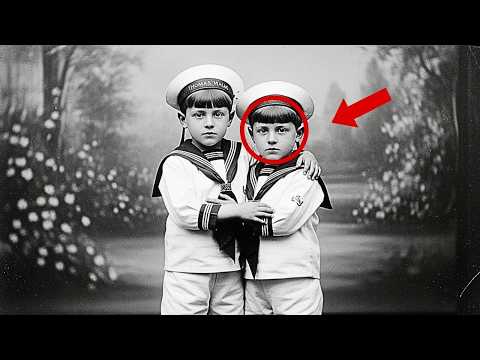
He placed the photograph under his archival magnifying glass, expecting nothing. Then he moved the lens over William’s face. His breath caught. A dark bruise on the boy’s left cheek—not a shadow, not a flaw in the plate, but a mark on the skin itself. His hand trembled as he adjusted the focus. There, half-hidden by the high collar of the sailor suit, another mark. The edge of what looked like a handprint.
Robert had spent thirty years studying historical photographs. He knew how light and shadow could lie. But these were not tricks of the lens. These were carefully concealed injuries, preserved forever by the camera’s unblinking eye. He moved the glass to William’s hands. The knuckles looked swollen. A dark band circled the wrist where the sleeve had been pulled back—a mark consistent with forceful restraint.
He sat back, the room suddenly cold. Thomas, the taller twin, stood with his chin lifted, eyes confident. William, a step behind, his gaze lowered, his posture shrinking. One boy owned the frame; the other seemed to be disappearing inside it.
Robert turned the photo over again. No family name. No context. Just two names and a year. Why would a seven-year-old boy bear such marks? And why had no one ever noticed?
That night, he couldn’t sleep. The image of William’s bruised face haunted him. By morning, he had made a decision: this was no longer a catalog entry. William deserved more than a file number. He deserved to be seen—and maybe, a century late, to be heard.
Robert drove to the Worcester Public Library as soon as it opened. In the local history room, surrounded by the smell of old paper and dust, he pulled the 1910 census records. The Whitmore family—James, a mill foreman, Eleanor, and their twin sons, Thomas and William. Born 1903. Both alive. Both seven.
He printed the page and started a new folder: Whitmore Investigation. The familiar thrill of research quickened his pulse, but this time it felt different. More urgent. More personal. He needed to know what happened inside that house on Pleasant Street.
Hours later, he found the school records. Thomas had perfect attendance that autumn. William’s file showed repeated absences—five days in September, four in October, six in November. The teacher’s notes listed only “illness.” But combined with the photograph, the pattern pointed to something darker.
Then came the newspaper clipping, dated December 1910: “Mill Foreman’s Son Hospitalized After Fall.” Three sentences. William Whitmore, age seven, treated at City Hospital for a broken arm. His father claimed the boy fell from a tree in the yard. Expected to recover fully.
Robert read it three times. A broken arm—one of many injuries. He clenched his jaw. The pieces were falling into place, but the story was far from over. He needed the hospital records. He needed to know if William ever escaped.
That evening, he drafted a formal request to the hospital archives, citing historical and social significance. He was no longer just a cataloger. He was a witness.
And somewhere in the back of his mind, a question burned: what happened to Thomas? And why did William vanish from every family photograph after 1913?
Robert returned to the historical society the next morning and pulled every Whitmore photograph from the collection—seventeen images spanning 1905 to 1925. He laid them out chronologically on his examination table, a silent timeline of a family’s unraveling.
The early pictures told a familiar story: James and Eleanor on their wedding day, stiff and formal; the twins as infants in matching lace; two toddlers in identical sailor suits, always posed side by side, always dressed alike. But from 1910 onward, the images changed. In every photograph where both boys appeared, William faded into the background while Thomas stood front and center.
In a 1911 family portrait, William’s face was turned slightly away from the camera. In a 1912 beach photograph, his expression was blank and distant while Thomas smiled broadly. Robert examined each image under magnification. The 1911 portrait showed William in a high-collared shirt despite the warm weather—perhaps to hide marks. The 1912 beach photo revealed faint scars on his hands, though the black-and-white film made certainty impossible.
After 1913, William simply disappeared from the photographic record. Only Thomas remained. No more portraits. No more posed shots. It was as if William had been erased from the family’s official history.
Robert’s phone buzzed. The hospital records department had approved his request. William’s file from December 1910 was available. Could he come tomorrow morning?
He confirmed the appointment, his heart racing. That evening, he searched death records, almost afraid of what he might find. But there was no death certificate for William Whitmore in Worcester between 1910 and 1920. The boy had survived—at least into adolescence. But where had he gone?
The next morning, Robert sat in a small reading room in the basement of the old City Hospital building, now converted to administrative offices. Michael, a clerk, brought him a thin folder labeled Whitmore, William—1910. The paper crackled as Robert opened it.
The admission form was dated December 18, 1910. Primary complaint: left arm, swollen. Mechanism of injury: patient fell from a tree in the yard, according to father. But it was the doctor’s examination notes that made Robert’s hands shake.
Dr. Henry Chen, attending physician, had recorded a sharp fracture of the left arm at midshaft. Swelling and deformity noted. However, examination revealed multiple other concerning injuries: bruising on the upper arms consistent with grip marks, healing lacerations on the left forearm, a small circular burn scar on the right shoulder of unclear origin, and a partially healed fracture of the right clavicle—previously untreated.
Dr. Chen had underlined one sentence twice: “Injury pattern inconsistent with a single fall from a tree. Indicates repeated blunt force trauma. Child is extremely withdrawn. Flinches on contact. Recommend police consultation.”
Robert sat back, his eyes burning. A doctor in 1910 had seen what Robert had seen. He had recognized the signs of abuse. He had tried to intervene.
He turned the page. A second note, dated December 20, recorded that police had been consulted. Officer Murphy had interviewed the father, James Whitmore, who stated the boy was clumsy and accident-prone. The mother, Eleanor, was not present during the interview. The officer concluded there was no evidence of wrongdoing. The child was released to his parents with his arm in a cast.
That was the end of the file. Despite a doctor’s clear concern, the system had failed. William was sent home to Pleasant Street.
Robert photographed every page, then sat in the quiet reading room, trying to process what he had learned. The evidence was undeniable: William had been systematically injured. Given the family dynamics, the most likely perpetrator was his twin brother, Thomas—perhaps with their parents’ knowledge or willful ignorance. In 1910, sibling abuse was rarely recognized, and intervention was almost unheard of.
Michael returned to collect the file. “Did you find what you needed?” he asked quietly.
Robert nodded slowly. “I think I did. And I wish I hadn’t.”
He stepped out into the cold November air, his breath misting. William had been seven years old when that photograph was taken—already marked by violence, already fading from his own family’s story. But Robert was no longer just a cataloger. He was a witness. And he was going to find out what happened to that boy.
His next lead came from the church bulletin he had found earlier. Eleanor Whitmore had been active in the Ladies’ Aid Society of the First Congregational Church. If the family had any connection to the church, its records might hold more answers.
The First Congregational Church still stood on Main Street, its white steeple visible from blocks away. Robert met with Reverend Sarah Mitchell, the unofficial church historian, in a cluttered office lined with leather-bound record books.
“The Whitmore family,” she murmured, pulling down a volume labeled Parish Records, 1900–1920. “Yes, I remember that name. Let me look.”
She turned the brittle pages carefully. “Here—Thomas and William Whitmore were baptized in April 1903. Parents James and Eleanor are listed as sponsors. And here—Sunday school attendance records. Both boys enrolled in 1908. Regular attendance until 1910. Then—” She frowned. “In January 1911, William stopped coming. Thomas continued until 1917.”
Robert leaned forward. “Is there any indication why William stopped attending?”
“Nothing official,” Reverend Mitchell said. “But we have pastoral visit logs from that era. The minister at the time, Reverend Martin, visited families whose children stopped attending. It was considered a serious matter.” She turned another page. “Here—February 1911. Visited the Whitmore home at 47 Pleasant Street. Purpose: to inquire about William’s absence from Sunday school.”
“Does it say what happened during the visit?”
“Only that Father James reported William had been sent to stay with relatives in Vermont for health reasons. The family requested privacy. The matter was not pressed.”
Robert felt a chill. Vermont. William had been sent away—separated from his twin, from the house on Pleasant Street. But was it truly for health reasons, or something else? And what had happened to the family afterward?
“Did the family have any further contact with the church?” Robert asked.
Reverend Mitchell nodded. “Eleanor Whitmore continued attending for a few more years. But her participation in the Ladies’ Aid Society declined. By 1915, the family seems to have stopped attending entirely.”
Robert wrote carefully in his notebook: Vermont relatives. 1911. First thread leading away from Worcester. He thanked Reverend Mitchell and walked back to his car, the story now stretching beyond Worcester—toward a new state, a new set of records, and perhaps, a new chance to understand what had become of William Whitmore.
He drove back to the historical society, his mind already turning to the Vermont Historical Society’s online archives. Eleanor’s maiden name was Foster. Her family had originally come from the Burlington area. If William had been sent to relatives, it would have been on her side of the family.
For the first time since finding the photograph, Robert felt a surge of hope. William had not died. He had been sent away—perhaps rescued, perhaps abandoned. Either way, the trail was no longer cold.
Robert spent two days combing through digitized records of the Burlington area, searching for any mention of the Foster family. He found Eleanor’s parents, John and Mary Foster, who had lived on a small farm in Shelburne. Both died in 1918 and 1920, but they had other children—Eleanor’s siblings. Census records showed Eleanor had two sisters and a brother. Her younger sister, Margaret, had married John Stevens and lived on Pearl Street in Burlington.
Robert searched for Margaret and John Stevens in the 1920 census. What he found made his heart leap. In their household were their own three children and a 17-year-old “nephew,” William, born in Massachusetts. William had been living with his aunt and uncle for at least nine years—long enough to grow from a traumatized seven-year-old into a young man on the brink of adulthood.
Robert immediately called the Vermont Historical Society and spoke with Elizabeth, a researcher. She agreed to pull the Stevens family’s physical records. Two days later, she called back. “I found quite a bit,” she said. “John Stevens was a schoolteacher and respected in the community. Margaret was active in the local Episcopal church. And there are numerous references to William in school records.”
“What kind of references?” Robert asked.
“He attended Burlington High School from 1911 to 1919. Graduated with honors. There’s a note about him winning a prize for mathematics in 1918. He played violin in the school orchestra. He was captain of the chess club.”
Robert felt a lump in his throat. William had not just survived—he had thrived. Away from his twin, away from whatever happened on Pleasant Street, he had been given a chance to become himself.
“Is there any information about what happened to him after high school?” Robert asked.
“Yes, actually. He enrolled at the University of Vermont in 1919. Studied engineering. There’s a reference to him in the university’s alumni records. He graduated in 1923 and went to work for General Electric in Schenectady, New York.”
Robert wrote furiously. “Is there any mention of his childhood? Any explanation for why he was living with his aunt and uncle?”
“Nothing explicit. But there is an interesting document. In 1911, Margaret Stevens wrote to the Burlington School Board requesting that William be enrolled. She mentions that due to difficult family circumstances, William had come to live with them permanently and needed a stable, nurturing home. The school board approved the enrollment and waived the usual residency requirements.”
“Difficult family circumstances.” Margaret had known what was happening. She had taken her nephew in and given him the stability he needed.
“Is there any way to find out if William is still alive? Or if he had children?” Robert asked.
“We can check death records. And I can search for a marriage certificate.” The typing paused. “No death certificate in Vermont. But here—he married in 1928. His wife’s name was Helen Baker. They had two children: a son, David, born 1930, and a daughter, Susan, born 1933. David still lives in Vermont. I have an address in Montpelier.”
Robert’s hand shook as he wrote down the information. William had lived a full life. He had escaped, been saved by his aunt, built a career, married, had children. There was relief in that—and yet, one question remained: what had happened to Thomas?
Robert debated for two days whether to contact William’s son. This was no longer just historical research; it was family history. Painful family history. But he believed David had a right to know what the photograph revealed—and what his father had endured.
He wrote a careful letter, explaining who he was, how he had found the photograph, and what his research had uncovered. He included copies of the photograph, the hospital records, and the documents showing William’s move to Vermont. He emphasized that his goal was not to cause pain, but to understand and honor William’s story.
Two weeks later, his phone rang. “Dr. Hayes? This is David Whitmore. I received your letter.” Robert’s heart pounded. “Thank you for calling.”
“I’m not sure I’m glad you did,” David said quietly. “My father died in 1996. He was 83. He never spoke about his childhood in Worcester. Not once. When I was young, I asked him about his parents, about growing up. He would say only that he was raised by his aunt and uncle in Vermont and that they were wonderful people. That was all. He never mentioned a twin brother. We thought it was strange, but we respected his silence. We assumed it was painful memories—perhaps poverty, or something.”
“Did he ever have any contact with Thomas or his parents?” Robert asked.
“Never that we knew of. My grandmother—his mother, Eleanor—died in 1945. He didn’t attend the funeral. That seemed odd, but again, I didn’t push.”
David paused. “Ten years ago, when our family genealogy was being researched, I discovered Thomas. I found census records showing the twins. I tried to find out what happened to Thomas, but I hit a wall. Some information I found, but—”
“I can tell you what I know,” Robert said carefully. “Would you like to hear it?”
“Yes. Please.”
Robert took a breath. “Thomas stayed in Worcester. He married in 1931, worked, had three children. He died in 1973. I haven’t contacted his descendants yet. But based on the records, he lived a conventional life. Active in his church, on the local school committee—a respectable citizen on all outward appearances.”
“And what he did to my father?” David asked, his voice tight. “No one ever knew?”
“Not publicly. But your father’s aunt, Margaret, clearly knew. She rescued him. She gave him a home and a future.”
David was silent for a long moment. “Dr. Hayes, I want to thank you for this research. It’s difficult, but it’s important. My father deserved to have his story known. He was a good man—a kind man. He was a devoted husband and father. Whatever happened to him, he overcame it. But he shouldn’t have had to carry that silence alone.”
“Would you allow me to present this research publicly?” Robert asked. “As a case study in child abuse and as a historical record?”
“Yes,” David said firmly. “Absolutely. If my father’s pain can help people understand what children endure—if it can help someone recognize the signs of abuse—then his suffering will have meaning. That’s what he would have wanted.”
Robert felt a wave of relief. “Thank you. I’ll make sure his story is told with dignity.”
“One more thing,” David added. “Do you have that photograph? The one from 1910?”
“Yes.”
“Could you send me a copy? I’d like to see my father as a child. Even if it’s painful, I want to see his face.”
Three months later, Robert stood before a packed audience in the lecture hall of the Massachusetts Historical Society. Behind him, projected on a large screen, was the 1910 photograph of Thomas and William. The audience could see what Robert had seen: two boys in sailor suits, one confident, one withdrawn, the magnified details revealing the hidden injuries.
Robert walked through his research—the hospital records, the school attendance patterns, the church records, the path to Vermont. He showed photographs of William as an adult, provided by David: a serious but gentle-faced man, an engineer, a father. A man who had built a life despite a traumatic start.
“William’s story is remarkable,” Robert said. “Not because abuse is rare—sadly, it is not—but because his suffering and survival were documented. Because his aunt recognized what was happening and intervened. Because he was given a second chance.”
He paused, looking at the photograph. “But this story also forces us to confront uncomfortable questions. Thomas was also a child—seven years old, the same age as William. What made him capable of such cruelty? The records suggest their father, James, was strict and perhaps violent. Thomas may have been repeating what he had learned. We don’t have all the answers. But we have evidence that in 1910, multiple adults saw signs of abuse and either dismissed them or felt powerless to act.”
He advanced to his final slide: a modern photograph of David Whitmore standing beside a portrait of his father from the 1960s. “But one person did not fail. William’s aunt, Margaret Stevens, saw the truth and acted. She brought him to Vermont, enrolled him in school, and gave him stability and love. She saved his life in every meaningful sense.”
Robert’s voice grew stronger. “William graduated from university with honors, had a forty-year career as an engineer, was married for sixty-eight years, and raised two children. He was known for his patience, his kindness, and his deep devotion to his family. He played violin until arthritis made his hands clumsy. He was famous for his chess games in the park and the mechanical toys he built for his grandchildren. He carried his silence about what happened to him because that was how he chose to survive. We must honor that choice while also honoring his experience.”
He looked at the audience. “This photograph has been donated to the Massachusetts Historical Society’s permanent collection, along with the research materials. It will be used for educational purposes—to train social workers and teachers in recognizing signs of child abuse, to document the history of child welfare in America, and to ensure that William’s experience is not forgotten.”
“Every historical photograph is a window into the past,” Robert concluded. “But some—like this one—are also mirrors, reflecting truths about violence, resilience, and the enduring impact of cruelty and kindness. William’s story reminds us to look closely. To see what is really there. And to act when children need protection. Because every child deserves what William eventually found: safety, love, and the chance to be seen for who they truly are.”
The room erupted in applause. Robert stepped back, his eyes returning to the photograph. William’s young face gazed back at him across more than a century. Finally seen. Finally understood.
After the lecture, David approached him, his eyes wet. “Thank you,” he whispered. “Thank you for giving my father a voice.”
Robert shook his hand. “Your father gave himself a voice by surviving and building the life he did. I just made sure people could hear it.”
As the crowd dispersed, Robert took one last look at the projected photograph. The archive would preserve it. Teachers would study it. Future researchers would learn from it. But more than that, William’s story would live on—a testament to human resilience and the power of one person’s decision to intervene. The photograph would never again be just another image in a file. It had become a bridge between past and present, a reminder that every face in every photograph represents a real person who deserves to be known.
William’s silence had been broken. His truth had been told. And somewhere, a seven-year-old boy in a sailor suit could finally rest, knowing he had not been forgotten.
What would you have done if you found such a photograph? Would you have looked closer, or turned the page?
Report this article
Select a reason for reporting:






