Sarah Mitchell had been sorting through her late grandmother’s estate for three days when she found the wooden box tucked behind a stack of moth-eaten quilts. Inside, wrapped in yellowed tissue paper, was a photograph in a tarnished silver frame. She lifted it carefully into the dim light filtering through the attic window.
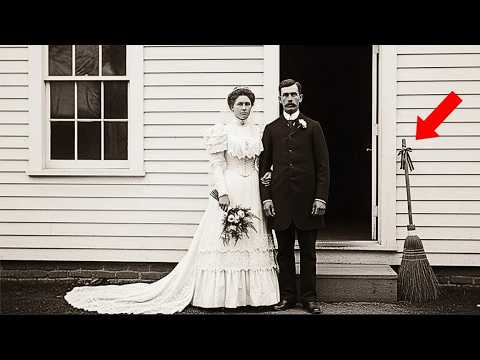
The image showed a wedding couple from another era. The woman in a high-necked lace dress with leg-of-mutton sleeves. The man in a dark suit with a stiff collar. They stood before a simple wooden house. Their expressions serious in the formal style of early photography. The date June 1911 was written in faded ink on the back.
Sarah smiled, assuming these were distant relatives she’d never known. But something about the photo nagged at her. She pulled out her phone and took a picture, then zoomed in on the screen. Her breath caught.
There, positioned deliberately to the right side of the couple, partially obscured by the bride’s voluminous skirt, was a broom. Not an ordinary broom—this one was decorated with strips of colorful fabric tied around the handle, and even in the faded sepia tones, she could make out what looked like carved symbols on the wooden shaft.
Sarah’s hands trembled slightly as she zoomed in further. The fabrics weren’t random. They were carefully knotted in specific patterns, and those symbols on the handle, though worn and difficult to see clearly, appeared intentional, deliberate.
She sat back on her heels, her mind racing. Her grandmother had never mentioned this photograph. In fact, her grandmother had rarely spoken about the family’s history before the 1950s, always changing the subject when Sarah asked about their ancestors.
Sarah carefully removed the photo from its frame and turned it over again. Besides the date, there was a single word written in the same faded ink.
Truth.
The afternoon sun shifted, casting new shadows across the attic floor. Sarah looked at the photo again, at the couple’s faces, at their careful positioning, at that decorated broom placed so deliberately in the frame. Something about this wedding wasn’t what it appeared to be. And someone long ago had wanted that truth preserved, hidden in plain sight, waiting for the right person to look closely enough to see it.
Two weeks later, Sarah sat across from Dr. James Harrison in his cluttered office at the Virginia Historical Society. Books lined every wall, and photographs from various eras covered his desk. He was a specialist in early 20th-century American social history, and his eyes lit up when Sarah placed the photograph before him.
“1911, you said?” He adjusted his reading glasses and leaned closer. “Beautiful example of early portrait photography. The composition is quite formal, typical of the era. The couple appears affluent. That dress would have been expensive, and the house behind them suggests—” He stopped mid-sentence. His finger hovered over the right side of the image. “Is that—?”
He reached for a magnifying glass from his desk drawer and bent over the photograph. For a long moment, he said nothing. Then he looked up at Sarah. His expression changed entirely.
“Where did you get this?”
“My grandmother’s attic. Why? What is it?”
Dr. Harrison sat back in his chair, still holding the magnifying glass. “Do you know what a jumping broom ceremony is?”
Sarah shook her head.
“It’s an African-American wedding tradition that dates back to slavery,” he explained carefully. “Enslaved people weren’t allowed to legally marry, so they created their own ceremonies. Jumping over a broom together symbolized sweeping away the old life and beginning a new one. After emancipation, many Black communities continued the tradition.” He pointed to the decorated broom in the photo. “These fabric strips, these patterns—they’re consistent with that tradition. And these marks on the handle, they look like Adinkra symbols. West African.”
Sarah felt her stomach tighten. “But the couple in the photo—they’re white.”
“Are they?” Dr. Harrison looked at her intently. “In 1911, Virginia had some of the strictest anti-miscegenation laws in the country. The Racial Integrity Act wouldn’t pass until 1924. But even before that, interracial marriage was effectively illegal and socially impossible.” He turned the photo toward her. “Look at the bride’s face. Really look. The positioning of this broom isn’t accidental. It’s intentional. Someone wanted this documented.”
“You’re saying my ancestor was—”
“I’m saying,” Dr. Harrison interrupted gently, “that this photograph may document something extraordinary and dangerous. If your ancestor had African heritage but appeared white, she could pass in white society. But including this broom in her wedding photo—” he shook his head in wonder. “That took remarkable courage.”
Dr. Harrison pulled out his laptop and opened several databases. “We need to find out who these people were. Do you have any names? Any family records?”
Sarah retrieved a small notebook from her bag. “My grandmother’s maiden name was Elellaner Whitfield. I found some old documents. Her mother was Clara, born around 1910. But before that, everything just stops. No birth certificates, no records.”
“That’s not uncommon for people who were passing,” Dr. Harrison said quietly. “They often had to erase their past entirely.”
“What about the date? June 1911.”
He typed rapidly, accessing historical newspaper archives and county records. “Richmond, June 1911. Let’s see what we can find.”
The search yielded hundreds of results. Birth announcements, society pages, business transactions. Dr. Harrison added filters, narrowing by wedding announcements and marriage licenses. “Nothing in Richmond proper,” he murmured. “But that doesn’t mean much. If this was a passing situation, they might have married in a different county or not registered at all.”
Sarah watched the screen, feeling increasingly frustrated. “So we might never know.”
“Not necessarily.” Dr. Harrison zoomed in on the photo again, this time focusing on the house in the background. “Architecture can tell us a lot. This style, the porch columns, the window placement—it’s common in rural Virginia from that period. And look here.” He pointed to something barely visible in the background. “Is that a church steeple?”
Sarah squinted. There in the far distance was indeed what looked like a white church steeple rising above the trees.
“Small town, rural setting, close to a church,” Dr. Harrison said, making notes. “That narrows it down. Virginia had hundreds of small communities in 1911, but not all of them had photographers capable of this quality of work.” He pulled up another database. “Professional photographers were relatively rare outside major cities. They traveled between towns, advertising in local papers. If we can identify the photographer, we can track where this was taken.”
For the next hour, they pored over records, cross-referencing photographer advertisements with small Virginia towns that had churches matching the architectural style. Finally, Dr. Harrison stopped scrolling.
“Ashland County,” he said. “Thirty miles northwest of Richmond. There was a photographer named Robert Hayes who worked that circuit in 1910 and 1911. And look—there’s a note in his obituary from 1945.” He read aloud. “Hayes was known for his sympathetic portraiture and his willingness to photograph all members of the community.”
Sarah leaned forward. “All members? You think that means—?”
“I think,” Dr. Harrison said, “we need to go to Ashland County.”
Ashland County was smaller than Sarah expected, its main street lined with buildings that hadn’t changed much since 1911. The county clerk’s office occupied a brick building with tall windows, and inside, rows of leather-bound record books lined the shelves.
The clerk, an elderly woman named Mrs. Peterson, looked at them skeptically when Dr. Harrison explained their search. “1911 marriage records? We keep everything,” she said, gesturing at the volumes. “But not all marriages were recorded officially back then, especially if—” She trailed off, glancing at Sarah, then at the photograph Dr. Harrison had placed on the counter.
“Especially if what?” Sarah pressed.
Mrs. Peterson sighed. “If there was something irregular about the union. People found ways. Had to, or they couldn’t be together at all.” She pulled down a heavy ledger marked 1910–1912 and opened it carefully. “What names are you looking for?”
“That’s the problem,” Dr. Harrison admitted. “We don’t have names. Just this photo, dated June 1911, and we believe it was taken somewhere in this county.”
Mrs. Peterson pulled out her reading glasses and examined the photograph. Her expression shifted almost immediately. She looked up at Sarah, then back at the photo, then at Sarah again. “You related to these people?”
“We think so. My grandmother was Elellaner Whitfield. Her mother was born around 1910.”
Mrs. Peterson was quiet for a long moment. Then she closed the ledger she’d opened and reached for a different one from a lower shelf. The leather was more worn, the pages more yellowed.
“This isn’t the official record book,” she said quietly. “This is what we call the shadow registry. Marriages that happened but couldn’t be properly recorded. A minister would note them here, just in case, but they weren’t legal documents.”
She opened it carefully and ran her finger down the page. “June 1911. June—here. Thomas Reed and Katherine Miller, married June 18th, 1911. Reverend Samuel Morris presiding. Witnesses: Mary Morris, John Blake.”
Dr. Harrison leaned in. “No ceremony details? No location?”
“Never specific locations in the shadow registry. Too dangerous if the wrong people found it.” Mrs. Peterson looked at Sarah. “The name Katherine Miller mean anything to you?”
Sarah shook her head, but something stirred in her memory. “Wait—my grandmother mentioned once a great-aunt Catherine. She said Catherine went north before she was born.”
“That was the common story,” Mrs. Peterson said softly. “When someone was passing, families would say they moved away. Safer for everyone.”
Dr. Harrison found the church records in the county’s historical archive the next morning—a collection of handwritten journals kept by Reverend Samuel Morris from 1905 to 1923. The pages were brittle and had to be handled with gloves, but they were remarkably detailed.
Sarah sat beside him in the archives reading room as he carefully turned each page. Most entries were mundane: baptisms, Sunday services, community gatherings. But then, in June 1911, they found it.
June 18th, 1911. Performed marriage ceremony for Thomas Reed and Katherine Miller. May God protect their union and keep them safe in these difficult times. The broom was blessed and placed in their home as a reminder of her mother’s love and sacrifice.
Sarah’s breath caught. “Her mother’s love and sacrifice. What does that mean?”
Dr. Harrison continued reading. “There’s more. Catherine’s mother, Ruth, came to me in tears three weeks ago. She is dying and wishes to see her daughter married before she passes. Catherine has chosen to live as she must, but Ruth wanted her to remember who she is, where she comes from. I agreed to include the tradition in the photograph, though Thomas understood the risk. They are brave beyond measure.”
Sarah felt tears prickling her eyes. “Ruth—that was my great-great-grandmother’s name. I remember seeing it on an old family Bible, but there was no other information.”
Dr. Harrison turned more pages carefully. “Here. Two months later. Ruth Miller passed August 3rd, 1911. She died knowing Catherine was married and safe. I conducted a private service. Only five attended. Catherine could not come—too dangerous now that she lives in town as Mrs. Reed. I think of her often, living between two worlds, belonging fully to neither.”
They sat in silence for a moment. The archives’ fluorescent lights hummed overhead, and outside, traffic passed on the modern street. But in this room, they were connected to 1911—to a dying woman who wanted her daughter to remember her roots, and to a reverend who risked his position to honor that wish.
“Do the journals mention anything else?” Sarah asked. “About Catherine or Thomas?”
Dr. Harrison continued scanning. “In November 1911: Thomas and Catherine have left Ashland County. They told neighbors they were moving to Richmond for Thomas’s work. I pray they find peace. Catherine left me a note thanking me and asking me to watch over her mother’s grave. I will.” He turned another page. “Then in 1913—received a letter from Catherine. She has a daughter. She named her Elellaner.”
Sarah’s hand flew to her mouth. “That’s my great-grandmother. Elellaner.”
The Richmond City Directory from 1912 listed a Thomas Reed, clerk, residing at 412 Elm Street. Three days later, Sarah and Dr. Harrison stood outside the address. The building was gone, replaced by a parking garage in the 1970s, but the neighboring structures told the story. “Working-class neighborhood,” Dr. Harrison observed. “Mixed community in those days. Segregation wasn’t as rigid in poorer areas where everyone struggled together.”
The 1920 census showed Thomas Reed, his wife Catherine, and daughter Elellaner, age seven. Under race, Catherine and Elellaner were marked W for white. “That’s what passing looked like on paper,” Dr. Harrison explained. “Census takers went by appearance. If Catherine looked white and lived as white, that’s what got recorded.”
Sarah noticed something else—a barely legible margin note beside Catherine’s name: Home teacher. “Some women who were passing taught their children at home to avoid questions at school,” Dr. Harrison said. “Or she may have been passing the knowledge on to other children in the community.”
That evening, Sarah called Patricia Johnson, a woman in Philadelphia who had responded to her genealogy query. “My grandmother told me stories about her aunt Catherine who married a white man and moved away,” Patricia said. “She used to say Catherine made an impossible choice—to live as white to protect her daughter. But she never forgot who she was. She’d send letters, no return address, and sign them, ‘Your sister always.'”
Months later, Sarah stood at the cemetery gates with Dr. Harrison and Patricia. They found Ruth Miller’s grave first, the inscription nearly worn away, and twenty feet away, Catherine’s. Sarah placed a small broom she’d made—decorated with blue, yellow, and white ribbons—at the base of Catherine’s headstone. “For you,” she whispered. “You didn’t forget, and now we won’t either.”
An elderly Black woman approached slowly, leaning on a cane. “Is that Catherine Reed’s wedding picture?” she asked. “My grandmother was Mary Morris—the witness at that wedding. She said Catherine was the bravest woman she ever knew. She worried that one day there’d be nobody left who knew the truth.” She touched the photograph gently. “But you found her. That’s what matters.”
Six months later, Sarah stood in the Virginia Historical Society watching visitors examine the new exhibition, Hidden Histories: African-American Heritage and the Practice of Passing in Early 20th Century Virginia. Catherine and Thomas’s wedding photograph was the centerpiece, accompanied by Reverend Morris’s journals, the shadow registry, and family letters Patricia had contributed. Dr. Harrison had found six other families with similar histories—all honored here, all people who’d left small clues, tiny acts of resistance, messages for the future.
A school group gathered around the photograph. “Why did she hide her hand like that?” a young girl asked. “Because she wanted to leave a message,” the educator explained. “A message that said, remember who you are, no matter what you have to do to survive.”
Sarah placed her hand on the glass case protecting the photograph. Across 113 years, Catherine was still speaking—ensuring that even if she had to hide who she was in life, the truth would survive in this single image. “We remember,” Sarah whispered. “We remember now.”
What hidden truths might be waiting in your own family’s attic—and would you have the courage to look closely enough to see them?
Report this article
Select a reason for reporting:






