Imagine walking into a grand department store in 1928 with no cash, no checkbook, and no credit card—because credit cards don’t exist yet. You leave an hour later with a new radio, a winter coat, and a diamond watch, all on credit. How is that possible? The answer lies in a forgotten world of charge coins, installment plans, and shadowy loan sharks that shaped American consumerism long before plastic.
This is the story of how America bought on credit for over a century before anyone ever heard of a credit card. It’s a tale far stranger and darker than most imagine, woven into the fabric of everyday life from colonial general stores to the glittering department stores of the Gilded Age.
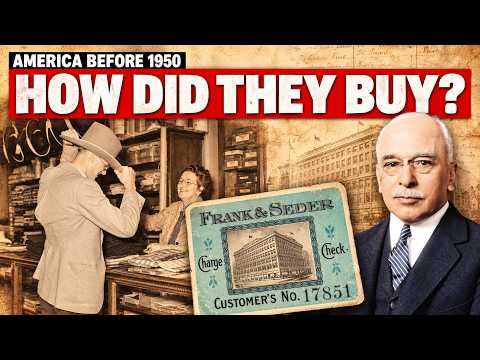
In the 1700s, hard currency was scarce. The village general store became the heart of a trust economy, where shopkeepers kept leather-bound ledgers recording every family’s debts. “Put it on my account” was the original credit card—no contract, no interest, just a running tab settled at harvest time or paid in chickens.
This system, called book credit, was the backbone of American commerce for over a hundred years. Reputation was collateral, and shame was the enforcement mechanism. A man who defaulted didn’t just lose access to the shop; he lost his standing in the community.
Then came the industrial revolution, and with it, a problem book credit couldn’t solve. In 1850, Isaac Singer patented an improved sewing machine, a marvel that could stitch trousers in an hour instead of fourteen. But at $75 to $125—three to five months’ wages for a laborer—nobody could afford it outright.
Singer’s business partner, Edward Clark, had a radical idea: “$5 down, $3 a month, for as long as it takes.” This was the birth of the modern installment plan in America. Ownership and payment were decoupled. You could take the machine home today, use it to earn money, and pay off the debt with the income it generated.
Singer’s agents fanned out across the country, notorious for their aggressive door-to-door tactics. The joke of the era was that a Singer salesman could sell a sewing machine to a woman who had no hands. By 1876, Singer had sold 2 million machines, most on installment. The lever of mass consumption had been pulled.
Furniture companies, piano manufacturers, even undertakers copied the model. The installment plan became the quiet engine that made Victorian America possible. But it worked best for big-ticket items where the merchant could repossess goods if payment stopped.
For everyday purchases—a hat, a pair of gloves, some ribbon—a new system emerged, pioneered by the glittering giants of American retail. The first department store to formalize charge accounts was Cowperthwait & Sons in 1807, but it was the post-Civil War giants like Marshall Field’s, Wanamaker’s, and Macy’s that built massive charge account systems for their best customers.
Keeping track manually was a nightmare. Clerks fumbled with paper ledgers, errors multiplied, and fraud was common. By the 1870s, stores experimented with the charge coin—a small token embossed with the customer’s account number. Mrs. Vanderbilt would hand her brass coin to a clerk at Lord & Taylor, who pressed it onto a sales slip. Fast, legible, no errors. By 1900, hundreds of stores issued charge coins, and wealthy women carried pouches jingling with a dozen different tokens.
But charge coins only solved the problem for the rich. For working-class families, the financial universe was far more dangerous. Banks wouldn’t lend small sums to wage earners, and usury laws capped interest at 6–8%, making small loans unprofitable. Into that void stepped the loan shark.
By the early 1900s, illegal small loan operators thrived in industrial cities, advertising phony company names and specializing in “salary buying”—a legal fiction where they bought your next paycheck at a steep discount. You’d sign over $5 of next Friday’s wages and receive $4 today—an annual interest rate over 500%. Fail to pay, and the shark had men who specialized in persuasion. The payday loan was already ubiquitous by 1910.
Reform came in 1916 with the Uniform Small Loan Law, which legalized interest rates up to 3.5% per month—roughly 42% per year—on small consumer loans. It sounded shocking, but by making small loans legally profitable, it brought legitimate companies like Household Finance into the market, offering working families a safer alternative to the sharks.
But even as legal personal loans arrived, something far bigger was about to transform American credit—something with four wheels and a tin roof.
In 1908, Henry Ford rolled out the Model T. By 1924, a brand new runabout cost just $260, yet it was still a stretch for a factory worker earning $25 a week. Ford, stubbornly opposed to installment buying, offered a layaway plan: bring in $5 a week until you’d saved the full price. General Motors, led by John Jakob Raskob, saw an opportunity.
In 1919, GM founded the General Motors Acceptance Corporation (GMAC) to lend money directly to car buyers. By 1924, GMAC had financed its 4 millionth vehicle, and GM’s market share surged past Ford’s. Henry Ford, humbled, finally launched Ford Motor Credit—but it was too late. GM had trained a generation to think of a car not as something you saved for, but as something you financed.
By the mid-1920s, roughly 75% of all automobiles sold in the US were purchased on installment credit. The automobile became the first mass-market product an average family could buy on long-term debt. And once Americans learned they could do it with a car, they wanted to do it with everything else.
The 1920s became the decade credit went mainstream. By the end of the decade, about 60% of automobiles, furniture, radios, washing machines, and refrigerators were bought on installment plans. Advertising campaigns urged: “Enjoy while you pay. A dollar down, a dollar a week. Buy now, pay later.” In 1919, Americans owed about $100 in installment debt; by 1929, that number had exploded to over $3 billion—a 30-fold increase in a single decade.
Culturally, something strange was happening. In 1850, debt was a mild moral failure. By 1925, it was marketed as a sign of modernity, success, and good citizenship. The man who paid cash was increasingly viewed as old-fashioned, suspicious, maybe even stingy.
Of course, this credit explosion wasn’t equally distributed. African Americans were systematically excluded, immigrants faced discrimination, and rural families relied on general store book credit and mail-order catalogs from Sears Roebuck and Montgomery Ward.
But for white middle-class urban Americans, the 1920s were a time of unprecedented access to goods they couldn’t actually afford. And right in the middle of this credit frenzy, in a nondescript office in Boston, a company called Farrington Manufacturing invented something that would quietly change American retail forever.
In 1928, Farrington rolled out the Charg-A-Plate—a small rectangle of sheet metal, embossed with the customer’s name, address, and account number. When you walked into a participating department store, you handed over the plate. The clerk placed it in a mechanical imprinter, laid a sales slip over it, and pulled a lever. Three copies in six seconds—no handwriting, no errors. The Charg-A-Plate was essentially a credit card without being called one.
Through the 1930s and 1940s, Charga-Plate associations formed in cities across America. Each plate was tied to a specific store or group of stores, not a universal network. Some stores kept the plates in a drawer behind the counter, pulling them out when a trusted customer walked in. By the mid-1940s, Charga-Plates were ubiquitous in American department stores, and some retailers used them into the 1970s.
But the Charga-Plate had a crucial limitation: it was always local. You couldn’t use your Boston plate in San Francisco. Something more flexible and universal was needed before credit could truly become the fuel of American daily life.
Then, the music stopped. In October 1929, the stock market crashed. By 1932, unemployment hit 25%. The ecosystem of 1920s consumer credit collapsed. Families who had bought refrigerators and radios on 24-month contracts suddenly couldn’t make payments. Repossession squads crisscrossed neighborhoods hauling furniture and appliances out of homes while children watched from front porches.
But credit didn’t die in the Depression. It mutated. Department stores got more aggressive about installment terms on smaller items. The federal government, through the New Deal, actively promoted consumer credit to restart growth. The Federal Housing Administration made the modern long-term home mortgage a reality. Through the darkest years, Charg-A-Plate systems kept functioning. The infrastructure of consumer credit survived, battered but intact.
By the late 1930s, Americans knew credit’s power—and exactly how much pain it could inflict when it went wrong. Then World War II arrived and everything paused. From 1941 to 1945, consumer durable goods virtually disappeared. Factories converted to war production. Regulation W restricted installment credit. Americans accumulated savings instead of debt, pouring billions into war bonds.
But those four years created a bottled-up pressure that would explode after the war. By 1945, households had enormous pent-up savings and demand. They wanted new houses in the suburbs, cars, washing machines, and television sets. A generation of returning veterans, backed by the GI Bill, were ready to buy on terms their parents could never have imagined.
The stage was set for a transformation in American credit. And in 1946, in a brick bank building in Brooklyn, a mid-level banker with a pencil and an idea was about to light the fuse.
John C. Biggins of Flatbush National Bank called his invention the Charg-It card. It worked at participating local merchants within a few blocks of the bank. The merchant deposited the slip, the bank reimbursed him immediately, and billed you at month’s end. Three things made Charg-It genuinely new: it was issued by a bank, not a store; it worked at multiple merchants; and it shifted the bookkeeping burden onto a central financial institution.
Charg-It was tiny—Brooklyn only, a handful of merchants, never national. But in 1951, Franklin National Bank expanded the concept into what is often cited as the first true revolving credit bank card. And 3,000 feet from Franklin’s offices, at a restaurant near the Empire State Building, another man was about to kick off the credit card era for real.
Frank McNamara, who ran a small finance company, was dining at Major’s Cabin Grill in 1949 when the bill arrived and his wallet wasn’t there. His wife had to drive over with cash. Humiliated, he imagined a world where this could never happen to a businessman again. He teamed up with attorney Ralph Schneider and PR man Matty Simmons, and they started signing up Manhattan restaurants.
On February 8, 1950, McNamara returned to Major’s Cabin Grill. When the check came, he handed the waiter a small cardboard card. The waiter filled out a Diners’ Club slip in triplicate. McNamara signed. The meal was paid for without a single dollar changing hands. Within the industry, that moment is now called the first supper.
The card listed 27 participating restaurants on the back. Diners’ Club charged restaurants 7% of each bill; cardholders paid a small annual fee and settled in full every 30 days. Within a year, it had 10,000 members. By 1953, it was the first internationally accepted charge card. In 1958, American Express and Carte Blanche entered, and Bank of America mailed 60,000 unsolicited BankAmericard cards to Fresno residents—a gamble that became Visa.
Plastic replaced cardboard in 1959. The age of the credit card had begun—built brick by brick on more than a century of hidden infrastructure. The invention of the credit card wasn’t the beginning of American consumer debt. It was the culmination of it.
Every element of the modern credit economy existed before 1950: revolving credit, merchant fees, universal acceptance, monthly billing, interest on carried balances, collection agencies, risk-based pricing. The card didn’t create these mechanisms—it packaged them into a single, portable product any bank could issue.
Today, total US household debt sits above $17 trillion, with credit card balances past $1 trillion. The plastic rectangle didn’t just make credit convenient—it made it unavoidable, transforming it from an occasional tool into an everyday metabolic function of American economic life.
The ghosts linger. Every payday loan at 400% interest is the salary-buying scheme of 1910 reborn. Every unsolicited card offer is the Fresno drop replayed. Every swipe is a continuation of their invention. The plastic rectangle is new. The behavior it enables—buying today what you’ll pay for tomorrow—is as old as the Republic itself.
So the next time you tap your card for a cup of coffee, remember Edward Clark signing housewives up for sewing machines, Mrs. Vanderbilt’s brass charge coin, the loan shark counting bills in a tenement hallway, and Frank McNamara red-faced at that payphone.
Now here’s the question for you: if credit has always been woven into the American story, what does it say about us that the plastic rectangle—not the habit—was the only thing that ever really changed? Tell me in the comments below.
Report this article
Select a reason for reporting:






