Newport, summer of 1895. A white marble palace overlooks the sea, built as a birthday gift. Somewhere inside, a daughter sits behind a locked door. But the house shows no mercy. Her letters are intercepted before she can read them. One account claims her mother said she would rather kill the man her daughter loved than see them married. Below the sealed room, some thirty-six servants run the household. Fires are lit, trays are carried, and the steel grille on the back staircase stays shut. Thirty-one years later, the mother will tell a courtroom: “I forced my daughter to marry the Duke.” So what did the house see? And why did the woman who owned it end up alone inside?
If you love stepping into Gilded Age worlds and meeting the people who kept these houses running, subscribe and I’ll keep opening doors for you.
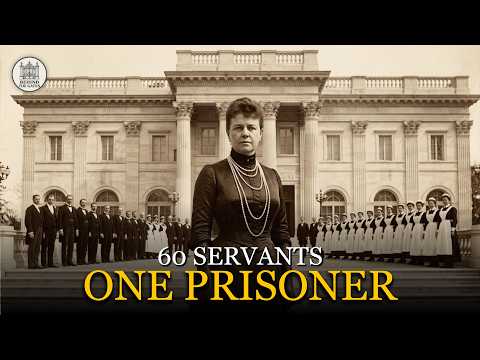
A birthday gift built behind walls. In 1888, on Bellevue Avenue, fences went up around a plot of land in Newport. According to one account, no visitor was allowed through them. The streets were used to construction. Along the cliffs overlooking the Atlantic, America’s wealthiest families were building summer cottages of wood and stone. But this site was different. It was sealed. Whatever grew behind those walls was ordered to grow in privacy.
The man who paid for it was William Kissam Vanderbilt, grandson of the Commodore, the railroad king who made the Vanderbilt name. The woman it was designed for was his wife, Alva. The man who designed it was Richard Morris Hunt, America’s most famous architect, who had already built for the Vanderbilts in New York and knew exactly what this family wanted from a building. They wanted the building to speak before anyone inside said a word.
So Hunt looked to France. His model was the Petit Trianon, the small palace built in the 1760s on the grounds of Versailles as a royal retreat. A royal garden hideaway would become a railroad heiress’s summer cottage. The lines were sharp, the facade temple-like, and everything was white, made of marble down to the last balustrade. The stone came from Tuckahoe, New York. Every exterior surface of the house would be cut from it: the walls, the carvings, the terrace, the carriage slope, the balustrade along the roofline.
The Patterson, C., and Eisele company of New York handled the interior and exterior marble. A foundry in New York cast the massive bronze grille for the entrance. Sculptor Carl Peter Meidel carved portrait medallions in white marble. From Paris came the firm of Allard and Sons, who decorated the rooms in French style, down to the gilding and bronze. According to one account, the craftsmen who came to do this work were brought from France and Italy, housed on the estate itself, and not allowed to talk about what they were making. Another account goes further, claiming workers were chosen so that none of them spoke English. The stories disagree on details. They agree on the purpose. Newport was not supposed to see this house until it was finished.
Others joined them. Sculptor Giuseppe Moretti carved friezes and statues in marble. Outside, landscape architect Ernest Bowditch designed the gardens stretching from the main street toward the sea. Architects would later classify the entire design under the Beaux-Arts style, the opulent classical style taught in Paris, with its symmetry, columns, and sense of permanence. Hunt himself had trained in this style. He knew how to make a building look as if it had always existed, as if it would always remain.
For nearly four years, the house grew behind its walls. Imagine the street growing, like something alive and hidden, devouring stone. Blocks went in and did not come out. Load-bearing brick walls rose and were covered in white. The house was thirsty before it was a house, and what it wanted most was marble. What this thirst cost showed in the numbers the press printed at the time. Contemporary newspapers reported that Marble House cost $11 million to build, making it Newport’s most expensive house. By usual estimates, about $7 million of that went to marble alone, with 500,000 cubic feet poured into a house of about 50 rooms over nearly four years. One modern estimate puts the $11 million at roughly $394 million in 2025 value. The National Park Service cautiously notes only that the figure comes from newspapers of the time. That caution matters—some later writers questioned the $11 million, and one encyclopedia cites nine million—but no one doubts the scale of the cost. This house was built to be talked about, and talk was part of its purpose.
It was also a gift. When completed, William gave it to his wife for her 39th birthday. The Preservation Society of Newport County, which owns the house today, documents this clearly. A husband gave his wife a marble palace, and the palace was hers. Remember that fact well, because everything that follows revolves around it. The house did not belong to the Vanderbilt fortune at large; it belonged to one woman. She decided who entered, who stayed, and who was kept upstairs. She decided when its doors opened and when they closed.
Over the next forty years, Marble House would become many things: a trophy, a fortress, a cage, a laundry, a stage, and something sold for a pittance. Every one of those lives began with her. And behind the marble, from the first season, people would live. The walls hid craftsmen during construction. Once finished, the house itself took on the task of hiding. It was designed from the start to keep a whole second group out of sight, in rooms no guest would enter, on floors that seemed not to exist from the garden. But that would come later. First, there is the question the walls raise: why would anyone want a house like this? Why would a woman need $11 million of stone to feel she had arrived?
The answer lies in her beginnings. The woman the marble was built for had once known uncertainty. She was the girl from Mobile who needed the marble. Alva Erskine Smith was born in Mobile, Alabama, in 1853, into a family whose wealth would not survive the war. Her father was a cotton merchant, and the South she was born into was about to be torn apart. By war’s end, the Smiths had left for New York, and her comfortable childhood world had dissolved. For a time, she was educated at a private boarding school on the outskirts of Paris. There, most likely, she first saw what French taste could do, how a building could announce a family before its members spoke. She never forgot it. Years later, the house she loved most was modeled on a French palace.
But the family’s position was fragile. After the war, the Smiths returned to New York, and in 1871 her mother, Phoebe, died. One biography suggests the family was in financial distress then, worsened by the expectation that four daughters would marry. There was no fortune to rely on, only the hope of finding a suitable match. On April 20, 1875, Alva married William Kissam Vanderbilt at Calvary Church in New York. According to her later account, she did it to save her family from ruin. Others whispered at the time that she did it for money and fame. Perhaps both were true. Either way, the girl from Mobile married into America’s richest family.
But money was not enough for welcome. New York society in those years was ruled by Caroline Astor and her set, families whose wealth was measured in generations and who saw the Vanderbilts as loud new money. The Commodore’s heirs could buy anything but an invitation. Alva was determined to change that, and her weapon was a building. With Richard Morris Hunt, she built a French palace on Fifth Avenue, completed in 1882, known among its fans as the “Petit Chateau.” Then, in March 1883, she used it. She held a costume ball there that cost, by usual accounts, more than a quarter of a million dollars. All of New York wanted to attend. A story has been told ever since about that night. Caroline Astor is said to have finally relented and said: “We have no right to exclude those whom this great country has brought forward. The time has come for the Vanderbilts.” The words are attributed to her, not documented, and may be closer to legend than fact. But the result was real. The Vanderbilts were welcomed. Alva had broken into their world.
She did not stop at one house. She worked with Hunt on Idle Hour, the family’s country place on Long Island. Each project was a step, and each step raised her. And the Vanderbilt world she joined was a world of inspiration. The family took long cruises on its yacht. Among the friends who sailed with them was a man named Oliver Hazard Perry Belmont, son of banker August Belmont and an old friend of her husband. In those years, he was simply part of the group on deck. No one could have predicted the role he would play in the life of the house not yet built.
That was her way, and she never lost faith in it. One contemporary noted that she loved nothing more than being steeped in mortar. She worked side by side with Hunt on house after house, arguing over plans and details. Years later, she would be counted among the first women elected to the American Institute of Architects. For Alva, a building was not just a place to live. It was an argument, and she was determined to win it.
It is worth asking why she chose this path, because the rest of her life flows from the answer. A girl who watched her family lose its footing learned early that status could vanish. Marriage saved her. Building raised her. She had forced Caroline Astor to yield through sheer will. The reasonable guess—only a guess—is that Alva trusted one thing above all: control. Control over the plan, the guest list, and everything under her roof. Every time she used that control, it worked. So when her husband set out to build a summer house for her in Newport, it was never going to be modest.
Newport in summer was the capital of the world she had fought her way into. For a few weeks each year, the same families who ran New York gathered along Bellevue Avenue and the cliffs, comparing their houses. A cottage there was a public statement, and Alva intended hers to be the most prominent on the street. It would stand next to Beechwood, Caroline Astor’s own Newport home. The woman who had barred the Vanderbilts from entering would now look across her lawn at a temple of white marble. The house rising behind the walls was not just a gift; it was a monument to victory. It was proof that the girl from Mobile had arrived and meant to stay. Every stone of Tuckahoe marble said the same thing: we are here.
But keeping a monument is not easy. Marble needs cleaning, bronze needs polishing, fires need lighting, meals need cooking, and guests need receiving—all without being seen. The more the house wished to appear effortless, the more effort it hid.
By summer 1892, the walls were ready to come down. The house was finished, the rooms furnished, and the servants who would feed it waited below. All it needed now was one night to reveal itself.
“The house was her stage, and she controlled every part of it.” She chose the guests, the rooms they entered, and the order of their entrance. She chose when doors opened and when they closed. For a woman who had always drawn strength from control, the house was the perfect instrument.
It was also, in the language of houses, alive. It woke when the family came from New York in summer. It breathed through open windows onto the garden. It glowed at night like a lantern on the cliff. And it had needs. It needed heating, lighting, cleaning. It needed food cooked and carried, silver polished, linen washed and ironed, bronze doors opened on cue. A house like this does not maintain itself. It must be fed.
None of the guests that first night saw who fed them. They were not supposed to. The staircase they climbed was marble, but there was another staircase in the house, a wooden one, that their feet never touched. The rooms they passed through spanned two floors, while the house had four. The front was a temple. The back, the basement, and the top floor belonged to someone else entirely.
Every guest in August climbed two flights of marble. None of them saw the other two floors. Two floors the lawn was never meant to see. Stand on the lawn at Marble House and count the stories—you will find only two, and that is exactly what Hunt intended. A grand ground floor with tall windows, a second floor of bedrooms above it. Then a line of stone balustrade reaching toward the sky, and nothing more. It looks like a temple inhabited by people. In fact, the house has four stories. The basement held the kitchen and servants’ rooms. The ground floor held guest reception rooms. The upper floor held family bedrooms. And the top floor was for servants. Then came the sentence that explains the whole design: the basement was hidden underground, while the top floor for servants was hidden behind the balustrade. Read that again as if the house itself were reading it. A floor carved into the earth, and another hidden behind a stone railing invisible from the garden. The two floors where staff lived and worked were the two floors the building was designed to conceal. Marble House kept its servants inside its frame, above and below, as the body hides its organs behind skin.
Go down first. The basement was the house’s belly, built for work. At its heart was a massive French-style range, made in New York, with four ovens, a grill, and a cooking surface 14 feet long and 3 feet deep. Another account prepared for visiting students describes it differently, as a coal-fired range 25 feet long. The stories disagree on its size, but they agree it was enormous and it burned. Next to the kitchen was the dishwashing room. The original icebox still stands, along with a soapstone sink and a water heater made in Pittsburgh. Nearby was the butler’s office, furnished in simple oak. Here the house did not need to impress anyone. It had to work hour after hour as long as the family was in residence.
Now look at the staircase. The family and their guests went up and down on marble beneath the gilded bronze cups copied from Versailles. The staff had their own staircase, made of wood. It ran down to the basement and was the passage through which everything the house consumed entered and everything it used exited. Two staircases in one building, one of stone and one of wood, were never meant to meet. At the bottom of that wooden stair, the builders placed something that tells us more about Marble House than any gilded panel. The National Park Service describes it precisely. A steel grille enclosing the staircase at basement level. The report explains that this system provided security by preventing access to the rest of the house during deliveries of ice, wine, groceries, and flowers. Imagine how it worked: a cart arrives loaded with ice for the icebox, crates of wine for the cellar, food for the range, and bouquets for the upper rooms. The men carrying it all descend to the basement and go no further. A steel barrier stands between them and the marble. They hand over what the house needs, then leave. Food enters the house through a sealed hatch, and the barrier stays shut. Above, the house remained a temple. The barrier was invisible, and so was everything it protected. That was the essence of the design: luxury on one side of a steel gate, hard work on the other, and a simple wooden staircase carrying one to the other without being seen.
Then go up, if you can, to the top. The servants’ quarters lay under the roof behind the balustrade that looked like ornament from the garden. It was a curtain too. The same line of stone that finished the temple hid the maids’ and servants’ bedrooms. The house hid its servants as a crown hides its lining, tight, never showing. The contrast between the two bedroom floors is a kind of measurement in itself. On the family floor, an early survey counted no more than eight or nine bedrooms, furnished in French style for parents, three children, and their guests. On the top floor, a modern guide to the house simply calls it a hidden third floor for servants’ quarters. The family floor was described room by room, style by style. How many narrow rooms lay under the roof, how many people shared each room? The surviving descriptions do not answer. The house measured luxury precisely. It did not measure crowding at all.
How did they get up there? And how did other things go up and down four floors? For most of the house’s life under Alva, the answer seems to have been stairs. The elevator in the house today was installed only in the 1930s by a later owner and brought used from a New York hotel. Before that, it is reasonable to assume trays, trunks, hot water jugs, and coal scuttles were carried up and down on foot, on the wooden staircase, by people whose names were not recorded in the house’s records. There is something strange about the silence of those upper rooms in the records. The Gold Room was described in inches and carats. The Gothic Room was itemized piece by piece. But the top floor, where people actually slept, left almost no trace in the documents. Its rooms were not built to impress, so no one bothered to be impressed by them. The house’s papers repeat the house’s design. What was hidden from sight was hidden from history too.
It is useful to see the building as it would have seen itself, if a house could see. It had a public face of polished white stone. It had an underground entrance protected by steel. It had a roof capped with balustrade and wooden stairs running between floors, working around the clock to carry warmth, food, water, and clean linen to the visible parts. The design was perfect. A guest could spend an entire summer evening at Marble House without once seeing the machinery that made that evening possible. Dinner simply arrived, rooms simply warmed, flowers simply bloomed. All those small miracles were carried up the wooden stairs. The house was built with rooms in which servants hid. The question is: how many of them disappeared each summer to keep the marble shining?
Thirty-six people for a few weeks of summer. The usual record cites a number, 36, then goes quiet because their names were not kept. This number appears again and again in the house’s records. The fifty-room palace, as one reference states, required a staff of 36 servants, including butlers, maids, coachmen, and footmen. This list deserves a moment because it is almost all we have. The butlers who ran the household and the wine, the footmen who served meals. The maids who cleaned, helped with dressing, and attended the family. The footmen who opened doors, carried plates, and stood behind chairs. The coachmen who brought the carriages and drove the family along the drive. The coachmen are already inside the house’s number 36. So the count extends beyond the house’s walls, out to the stables. This number omits much. It is an approximation repeated from source to source. The institutions closest to the house ignore it entirely. The Preservation Society, which owns Marble House, mentions no staff number in the house’s history. The two lengthy National Park Service studies mention none either. No surviving record counts every individual. No one recorded how many laundresses came on wash days, how many gardeners tended the lawn to the sea, or how many extra men were hired on the night of a ball. The 36 are the people someone thought to count. Every summer in Newport, others surrounded them whom no one counted.
What is recorded is one expensive exception. One account says the Vanderbilts hired a French chef at a salary so astronomical that people talked about it. A chef from France for the basement range, paid well enough to be discussed. Even among servants, the house had ranks, and the man who ran the kitchen held a privileged place. As for the rest, the only way to understand their summer is to look at how Newport houses were run in general. To be clear, this is the pattern of the colony, not a memoir from inside Marble House. Great families spent most of the year in New York. When summer came, a core staff traveled with them. An advance team went ahead to open the shuttered cottage, remove dust covers, and prepare the rooms. In Newport, the house hired more workers from the town itself, which had grown a permanent service community, mostly Irish, to meet exactly this need. This pattern was not unique to Newport. In those years, domestic service across America was the largest employment sector for women. For young women without much education, often newly arrived from Ireland or elsewhere, living in a great house meant a roof, food, and wages they could send home or save. It was hard work, but it was steady, and for many it was the best work available. The grand houses on Bellevue Avenue did not need to look for workers; the workers came to them. And the need was short-term. The Newport season, at its peak, lasted about 6 to 8 weeks during July and August. During those weeks, the colony ran at full capacity. Then the families returned to New York, and many houses closed again for the rest of the year. A maid’s summer in a house like Marble House was an intense, exhausting stretch of work followed by departure.
The numbers show the scale of the problem better than any individual life. In 1895, reports counted about 2,287 servants working in Newport, roughly 10% of the town’s total population. One house on the street, Marble House, needed about 36 servants for a season of 6 to 8 weeks. Daily hours, by the domestic service calculations of the period, ranged from 14 to 18. A maid living in America could expect to earn between $18 and $25 a month, including room and board. But that wage was measured against the value of the house she served. $18 a month, or $11 million by newspaper estimates, reckoned in marble, bronze, and gold. A maid might work her whole life and never earn the price of one door of the house. Days off were rare, often limited to one afternoon and evening a week, not necessarily the same day. The rest of the time, the maid belonged to the house. A bell might ring at any hour, a guest might arrive late, a ball might last until dawn, and still the rooms had to be set before the family woke. The house did not sleep, and neither, for long, did those who tended it.
Where did they sleep when they slept? On the top floor, behind the balustrade, in the rooms the lawn does not see. They came down the wooden stair at dawn to light fires, prepare the range, and open the grille for carriages. Then they climbed at night, the last of them carrying the last candle or the last tray to the last room. The path between the hidden floors was the course of their entire working day. It is tempting to imagine them, and the house invites it, but honesty requires admitting what cannot be known. No one today can name the housekeeper. No one can say which footman stood at which door on the house’s opening night, or where each maid came from, whether she arrived from New York with the family, walked up from a Newport street, or how long she stayed. The house kept its marble in excellent condition for over a century. It did not keep the names of those who polished it. This silence is part of the story, and it comes from the design. A house built to hide its staff while they were there would hide them just as efficiently after they left. The gilded rooms above were photographed, measured, and written about. The people who made them shine were counted once as a round number, then left to disappear. Thirty-six then, and the rest uncounted. A small army marched into a palace at the height of summer, built to entertain a family of five, then released. The numbers tell us the count, but they do not tell us the real purpose of all those hands. To know that, you must enter the dining room and look at the chairs.
A footman behind every bronze chair. The dining room chairs at Marble House were cast in bronze, and each was so heavy that a lady could not move it alone. Descriptions of the room agree on the weight. Each side chair weighed about 75 pounds. The two armchairs at the ends of the table weighed about 100 pounds each. No guest in evening dress could pull 75 pounds of gilded metal across a marble floor. The chair had to be pulled back and pushed in after she sat, so the house provided this service. According to one guide to the room, each chair was so heavy that a footman was required behind every chair to assist the guest. Another guide describes the same thing more clearly: the chairs required a footman to move them. Imagine what that means. The furniture itself was designed to need a servant. You could not sit down to dinner at Marble House without a man standing behind you to make it possible. The ratio that governed the whole house—many hands for few people—was built into the design of the chairs. For every guest at the table, a person standing. The room around them was designed to dazzle. The walls were of that dark pink marble from Algeria. By one account, the table extended 34 feet. In the evening light, the whole room must have glowed. Pink stone and dark bronze. The guest who lifted her eyes from her plate saw only beauty. The guest who looked over her shoulder saw a servant, still, silent, waiting for the moment to move her chair.
Now go back in time, down into the house. Every dish that reached that table began at the great range in the basement, at the far end of the wooden stair. Every ingredient entered through the steel grille, transferred from a delivery cart and handed over at the bars. Ice for the icebox, wine for the glasses, groceries for the kitchen, flowers for the table. Everything came in through the barred hatch below and went up through the house to the jewel box above. The evening at Marble House began further away, on the main road. The carriage slope rising to the house’s facade was made of Tuckahoe marble, like the walls. A coachman brought the carriage around that slope and up. A footman stood at the entrance. The great doors, each weighing about a ton and a half, pivoted on their axles. The guest stepped through them into the yellow glow of the brownish-red stair hall without touching anything heavy. Along the main road, the other great cottages ran their own machines. Every guest had their own stair, their own kitchen, their own servant behind their chairs. Picture the dining room at Marble House along the cliffs of Newport, and you will understand why the town needed so many servants simply to get through July and August. A single evening’s luxury was a local industry.
Weigh the house the way its servants had to weigh it: a ton and a half at every front door, 75 pounds at every chair around the table, a hundred pounds at each of the two armchairs, and 34 feet of table—if the calculations are right—set and cleared. Four ovens and a grill below, feeding a cooking surface 14 feet long. The house was heavy everywhere a guest might touch it, and light everywhere a guest might look. The difference between the two was carried by people. This is the quiet genius and quiet cruelty of the design. Guests were never supposed to feel the weight. Marble House made its luxury look effortless by moving the effort elsewhere: down the stairs, up the stairs, behind the chairs, behind the grille. The smoother the evening seemed, the more labor it proved. Dinner in Newport in those years was a kind of theater, and a house like this was its stage. The guests were audience and actors at once. The staff were stagehands, and the skilled one is the one no one notices. The footman behind the chair existed to be forgotten. If a guest remembered him, something had gone wrong. What did those servants see, standing behind the bronze chairs night after night through the season? They must have heard every conversation at the table. They watched who sat next to whom, who was placed near the hostess and who was pushed to the far end. They saw marriages made in public and quarrels settled over soup. The house was built to hide them, and by hiding them, it made them perfect witnesses. No one guards their words in front of a chair. None of these servants left an account that reached us. Their memories, if they ever shared them, went back with them to New York or to the streets of Newport and were lost there. But they were present at everything the house did in those first summers, and the house was about to do something none of its guests expected.
Because the dining room was only as stable as the marriage that funded it. The bronze was solid, the marble was solid, but the family seated at the head of the table was not. For three summers, the machine worked exactly as Hunt designed it. Carriages came up the marble slope. Doors opened. Chairs were pulled back, a footman for each. Dinner rose from the basement, and the grille closed again behind the carriages. Everything worked. Then, when the season ended, the machine stopped. All over Newport, as families returned to New York, the great houses went dark for most of the year. It is easy to imagine what that meant for a room like this. The bronze chairs pulled back against the pink marble walls. The long table empty. The footman gone. The range cold. The grille shut with no carriage to open it. 75 pounds of metal waiting in the dark for a summer that would bring the hands back.
The house could wait. It was built to last forever, and it was patient. And by the spring of 1895, the house was running well. The marriage was not.
The divorce that shook Bellevue Avenue. In March 1895, Alva Vanderbilt did what women of her class did not do: she asked a court to end her marriage. In the world of Newport cottages, marriage was a merger, a treaty, and a public performance all at once. A wife who went to court broke the first rule of the game she had spent twenty years learning to win. The cause was William’s adultery. That was the charge before the court. But even then, people wondered. One source notes that some believed William hired a woman to pose as his mistress so that Alva would divorce him. The story was gossip then, and it is gossip now. No one can be certain. What it shows is how strange the whole affair seemed to observers. A marriage ended in a scandal that may have been engineered. A massive financial settlement followed. Alva left the marriage with a large settlement, said to exceed $10 million, plus several properties. And she left with Marble House.
Here the record is precise, and it matters. The house was already hers. She had received it as a birthday gift before any lawyer said a word. When the marriage ended, Marble House on Bellevue Avenue did not pass to anyone else. It simply remained with the woman it was built for. Imagine how she felt then. A girl who married, as she said, to protect her family from ruin now stood on the other side of that marriage, rich by her own account, and mistress of Newport’s most expensive house. No one could take it from her. No one could close its doors on her. Whatever she lost in the courtroom, she kept the building.
The man who paid for it disowned its story almost immediately. William Kissam Vanderbilt, by press estimates, spent $11 million on Marble House, and he gave away every stone of it. The records barely preserve anything about what he thought of the house, then or later. One of the strange facts about the building is that its builder left only a faint mark on it. The marble belonged to Alva, and so, in a sense, did the memory.
The servants now had one mistress and no master. Whatever arrangements had governed the house during the marriage, the house came under a single authority from that spring on. For the butler and his oak office, for the chef before the great range, for the footmen, maids, and coachmen, there was no other power in the family. Every order, from that spring forward, came from her, and there was no one left in the house to soften it.
It is worth pausing on the numbers that shaped her character that spring, because they show the scale of the gamble. The settlement was said to exceed $10 million. The house cost, by newspaper estimate, $11 million, of which $7 million was marble. Twelve years earlier, a single costume ball at her Fifth Avenue house cost more than a quarter of a million dollars. And before the year was out, shares in railroad stock worth two and a half million dollars were being traded as the price of a marriage she was about to arrange. In the eyes of Newport, the house took on a new meaning. Once a husband’s gift to his wife, it became a divorced woman’s fortress. A house that had announced a family’s arrival now announced one member’s independence. Society talked. Divorce in 1895 was a scandal, and Alva was among the first in her circle to do it. One imagines some doors on the Avenue closing more slowly than before.
Meanwhile, the staff kept working. Whatever happened in the courtroom, the range still had to be lit, the chairs pulled back, the grille opened for carriages. Servants in a house like this lived every family crisis up close, and they were expected to keep perfect silence. The house did not stop running because its mistress’s marriage stopped; it needed to feed the family whatever happened, and those it fed kept their silence and their opinions to themselves.
It is useful here to understand Alva as she understood herself. She had spent two decades using the tools the world gave her: marriage, wealth, parties, and the building. Each one raised her. Now, at forty-two, she proved she could use the courts too. The lesson she seems to have drawn was the same one she had always drawn: if you want something, you control it, and you get it now. And there was one thing she wanted badly: a daughter of marriageable age.
Consuelo had been raised for this moment. Her mother had supervised her education, her manners, and even, by one account, her posture, forcing her to wear a metal brace to learn to stand perfectly straight. Every part of the girl’s upbringing was arranged for one goal: to marry greatly, and to Alva, as her choices that summer would show, marrying greatly meant a title. In the summer of 1895, the two of them settled into Marble House for the season. The house that had been a monument to Alva’s victories, then her fortress, was about to become something else entirely. It was about to become the stage for the most important deal of her life.
But there was a problem. Consuelo had plans of her own. She had fallen in love with a man a few years older, entirely unsuitable in her mother’s eyes. She intended to marry him. Alva intended her to marry a duke. The house was about to take sides.
The daughter locked inside the marble. Consuelo Vanderbilt had already chosen the man she wanted to marry, and her mother had already decided she never would. His name was Winthrop Rutherfurd. He was an American gentleman, about fifteen years older than Consuelo, and he had reached a secret understanding with her. To a girl raised under supervision her whole life, it must have seemed a way out. But Alva had other plans, and she did not bother to hide them. According to one account, she said she would rather kill Winthrop herself than see them married. When Consuelo planned to elope, as the story goes, her room was sealed while her mother threatened to kill the man she loved. Her mail was intercepted, and she was cut off from any contact with him. Even before that summer, the pressure had been building. One account says her mother took her to Europe to put distance between her and Rutherfurd. Other suitors were paraded before her, including a German prince, Francis Joseph of Battenberg, and Consuelo’s own recollection of that offer shows how clearly she saw the life being arranged for her. She wrote that such a marriage could only mean unhappiness. “Separated from my family and friends, living in a provincial capital, bound by strict rules to a man with the bigoted views of a German prince, how could I reconcile myself to such a life?” She escaped the prince, but she would not escape the house.
That summer at Marble House, her mother is said to have denied her even the comfort of her personal belongings in her room. No personal possessions, according to one biographer. A room in a palace stripped of everything that belonged to the girl who slept in it. The house had rooms for gold and rooms for Gothic treasures. It had no room that summer for anything that was hers. The house built as a birthday gift for her mother became, for the daughter, a place she could not leave.
Consuelo herself later wrote about her mother’s methods in a memoir she called “The Glitter and the Gold.” One line from it has stuck more than any other because it summarizes the relationship in a single sentence. Her mother told her: “I do not ask you to think. I think, and you obey.”
Here the house shows its darkest face. Everything that made it magnificent also made it a perfect prison. One museum recounts her memoir describing the house as like a jail, with its high walls and heavy curtains shutting out the sun and the sea. The palace built to be admired from outside became a place to hold someone inside.
And what of the thirty-six, and all the uncounted others? They were in the house the whole time. A girl was confined behind a door on the family floor, and below and above her, the servants kept working. Trays went up, linens came down. The footman stood behind the bronze chairs at dinner as usual. It is reasonable to assume that someone carried food to that locked room. Someone surely heard raised voices through the walls. But the records say nothing about them. No worker at Marble House left any account of that period that reached us. Whatever they saw, they kept or lost with them. The house was designed to hide the servants from view. In the summer of 1895, it silenced them too.
Carriages still came to the basement, men still handed ice, wine, and flowers through the bars, and the doors and windows stayed shut. Consuelo held out for a time, and then a new pressure came, the one that finally broke her. Her mother’s resistance was said to threaten her health. According to the story, Alva appeared to be on her deathbed. A daughter who had resisted threats could not resist the thought that she was killing her mother, so she gave in. Then, as one account notes coolly, Alva made a remarkable recovery from her supposed illness.
The man her mother had chosen was the Duke of Marlborough, an English duke bearing one of the greatest titles in that kingdom. According to one account, the proposal was made at Marble House itself, in the gloomy Gothic Room among the carved wood and medieval treasures in the dark chapel of the palace. The room built to hold Alva’s collection now held the moment of her daughter’s birth as a title.
It is useful to understand both women here, for neither was a simple villain nor a simple victim. Consuelo, by all accounts, did not want this marriage and gave in only when she believed her refusal was destroying her mother. She was young, isolated, and no match for the most powerful woman in American society. Alva, for her part, had won everything she won by refusing to accept refusal. She had married to save a family. She had forced her way past Caroline Astor. She had faced a husband in court. In her mind, she seems to have been doing for her daughter what had been done for her, forcing a very young girl into a better life. And the fact that she was crushing that girl’s will does not seem to have troubled her.
The wedding took place on November 6, 1895, at St. Thomas’s Church on Fifth Avenue in New York. By one account, Consuelo stood at the altar weeping behind her veil. Her dowry was two and a half million dollars in railroad stock. The Duke went home with a fortune. The house on Bellevue Avenue went quiet, and its door finally opened, because there was no one left to close it.
Consuelo became a duchess. The marriage was unhappy almost from the start. Years later, it ended in separation, then divorce, and finally an annulment that required her mother to explain in detail to a court what had happened that summer at Marble House. But that explanation was still decades away. For now, Alva had what she wanted. Her daughter was married to a duke. Her divorce was behind her. And within weeks, she did something that surprised Newport as much as the divorce itself. She married again and moved out of the house she had fought so hard to keep.
Twelve years with the windows shut. In January 1896, Alva married Oliver Belmont and moved to a nearby house on Bellevue Avenue, leaving Marble House behind. The man who had been a guest on the Vanderbilt yacht, an old friend of her former husband, was now her husband. The wedding was on January 11, only two months after Consuelo’s. Oliver Belmont had his own Newport house called Belcourt, a vast house of about 60 rooms. Alva moved into it. Together they set about redesigning it with a mix of French and English Gothic and Renaissance styles, the kind of project she had always loved. A woman who loved nothing more than working on a building had found herself a new building to reshape.
And so Marble House stood. Here the story takes a strange turn. Newport’s most expensive cottage, the house of the opening ball, the Gold Room, and the bronze chairs, was, by one account, effectively closed for 12 years. She kept it. By the same account, she continued to use it for washing and ironing her clothes. A marble palace worth $11 million was said to have become a laundry. Imagine the house through those years as the story fades. Shutters closed over the tall windows. The Gold Room dark, its gilded panels reflecting no light. The Gothic Room silent. The place where a marriage was proposed closed with its treasures. The bronze chairs leaned against the pink marble walls. And somewhere in the house, on at least some days, came the sound of washing, the heating of irons, the ironing and folding of linen and its carriage back to Belcourt. How many servants stayed through those years? The records do not say. Someone must have run the laundry, kept the roof sound, and kept the marble from staining. But the number and the names have disappeared. The thirty-six of that great summer may have shrunk to a handful. They may have been dismissed and scattered to other houses. There is no way to know now. The scale of the waste is easier to grasp than the number of those inside it. Twelve years with the windows shut. A house of about fifty rooms emptied of its family, while that family lived in another house of about sixty rooms a few steps down the same street. Two palaces on one avenue for one woman. And the larger of them, by one account, was used to wash her clothes. Newport has seen much extravagance, but it has rarely seen extravagance this quiet. Neighbors drove along the Avenue past this white temple season after season. Its windows shut, its garden stretching empty to the sea.
Then, in 1898, nothing changed. And in 1900, nothing changed either. The years passed and the house waited as it had waited every winter. But this time, summer did not bring the family back. It was death that woke it.
Houses like this do not choose their seasons; they open and close with the lives of their owners. For twelve years, Marble House was not needed. And now it was. In 1908, Oliver Belmont died suddenly. Alva, now a widow, left for Europe while his estate was settled. And when she returned, she did what no one expected. She reopened Marble House.
So here she was at last, alone in Marble House, a widow in her fifties living in a house of fifty rooms built for a family of five, furnished to host a season of parties. Her husband was gone. Her daughter was a duchess in England. Somewhere in those years, she had seen something that would change the course of her life. In London, she watched a march of the Women’s Social and Political Union, the militant suffrage movement led by Emmeline Pankhurst. Women marching, speaking, demanding. Alva had spent her life taking power by the only means her world allowed a woman: through marriage, money, buildings, and will. Here were women taking it openly in the street. She returned to her house and found a new use for everything she owned.
The house she returned to had been built for an entirely different life. The sources do not describe how she spent her days in it, but the image remains: a woman alone amid all that marble. She did not remain alone for long, and she did not stay silent. In 1909, she founded a new organization, the Political Equality Association, and threw herself into the fight for women’s suffrage. She put the house to work for the cause. In late August 1909, Marble House opened to the public for a conference on women’s suffrage. About a thousand people attended. Admission to the lectures was one dollar, five dollars to hear the lectures and see the house as well. Speakers included the poet Julia Ward Howe and Dr. Anna Howard Shaw. Every dollar went to the campaign. That was only the beginning.
In the winter of that same year, she supported the strikes of garment workers in New York. In 1912, she led her association’s branch in the great suffrage march through the city. Afterward, she described the march, which stretched for fifty blocks, as a terrible physical ordeal. The woman who had attended balls in costume now attended rallies on foot. Newport, it was said, became the country’s summer propaganda center. Alva explained her position to the New York Times, and her words were a small confession. She said: “Until now, I have always felt that it was better not to open Marble House to the public because it was used as my own residence. But I am breaking that rule because I believe it may increase interest in the suffrage campaign.” This was the transformation the whole house had been reaching toward. Marble House was never a house to be kept closed; it was a tool to serve whatever purpose its owner set. The same palace that had held a daughter behind a locked door now opened all its doors to strangers for a dollar a head.
But one open day was never going to be enough for Alva. She wanted a building for the cause, and she wanted it on the edge of the cliff. A temple on the cliff for votes. At the far southeastern corner of the garden, where the lawn gives way to rock and sea, Alva built one last room. It was designed in 1913 by Joseph and Richard Howland Hunt, the sons of the man who had drawn Marble House itself. The Preservation Society completed its restoration. The Society’s account, 1914. Her father built her a French palace. Her sons built her a Chinese temple. They designed it, as the Park Service records, after the Song dynasty temples of twelfth-century southern China. Red wooden columns carried a roof of glazed terracotta tiles. An early survey described it simply as a one-story temple on fortifications above the water. From the garden, it looked like a jewel dropped on the cliff’s edge, bright red against the gray Atlantic. Everything about it was different. Marble House was white, severe, and French. The tea house was red, curved, and Eastern. Marble House was built to receive society. The tea house was built, in the end, to receive a movement. Alva used it for suffrage gatherings, and it became Newport’s most unexpected political meeting hall. A pavilion at the end of a palace garden where women gathered to talk about the vote.
In the summer of 1914, the grounds opened again for what she called a conference of great women. Among the speakers was the Duchess of Marlborough. Consuelo, the daughter who had been held behind a locked door in this house, returned to it to speak for women’s rights. The conference was followed by the first national meeting of the Congressional Union. Special china was made for the occasion, inscribed with the words “Votes for Women.” The house where dinner had been served on bronze chairs now served tea for a cause. There is a symmetry here that is hard to miss. Nineteen years earlier, Consuelo had been confined in this house until she agreed to a marriage she did not want. Now she stood on its lawn and spoke about a woman’s right to determine her own fate. What passed between them in private is not recorded. In public, the two women who had fought so hard over the meaning of that house were on the same side.
That same year, Alva brought the British suffragette Christabel Pankhurst across the Atlantic to speak in America. She joined the executive committee of the Congressional Union. In 1916, with Alice Paul, she helped found the National Woman’s Party. In January 1917, the party organized the first picket of the White House. Women stood at the gates of the President’s house. That December, Alva chaired a meeting at the Belasco Theatre to honor the victims of what became known as the Night of Terror. Her money played a major role in making the event possible. The Library of Congress, reviewing the events, notes that she was the most important financial supporter among the leaders of the Congressional Union for Woman Suffrage and the organization that succeeded it, the National Woman’s Party. The fortune that had once bought a costume ball and a duke for her daughter was now buying pickets, pamphlets, and bail. She even turned to the stage. In 1916, she wrote, with another writer, a suffrage operetta called “Melinda and Her Sisters,” and saw it performed at the Waldorf-Astoria Hotel in New York. The hostess who had thrown a costume ball to force her way into society now staged a musical to force her way into the ballot box. The same method, but a new goal.
Arrange the years and you will see how the house slid from the center of her life to its edge. 1913, the tea house designed. 1914, the conference of great women on the lawn. 1916, the National Woman’s Party. January 1917, the first White House pickets. 1919, Marble House closed for good. 1921, Alva elected president of the party. 1926, a court on the matter of her daughter’s marriage. 1928, her Gothic collection sold. Fifteen years, and the marble palace turned from a stage into an empty shell. She was building elsewhere by then, of course. She never stopped. On Long Island, she built a new house at Sands Point, Beacon Towers, finished in 1918 and closed again in 1925. In France, she restored an old palace, Augerville, dating from the sixteenth century. And in 1919, by the usual account, she closed Marble House for good and moved to France, where she spent most of the rest of her life near her daughter. And the vote came in 1920, when the Nineteenth Amendment to the U.S. Constitution was ratified. The following year, Alva became president of the National Woman’s Party, and she held that office until her death. The girl from Mobile, who had once needed a man’s name to secure her place, now led a movement for women’s equality before the law.
There was one last reckoning still to come, and it concerned the summer of 1895. Consuelo’s marriage to the Duke had failed long before. The couple separated in 1906 and divorced in 1921. Then, in 1926, Consuelo sought an annulment, a declaration that the marriage had never been valid, on the grounds that she had been forced into it. So the court needed a witness. It needed the one person who knew for certain what had happened in the rooms. Of Marble House. Alva gave that testimony, and her words are the clearest confession ever made about that house. She said: “I forced my daughter to marry the Duke. I have always had absolute power over my daughter. When I issued an order, nobody discussed it. So I did not beg her; I ordered her to marry the Duke.”
Listen to her in light of everything that came before: the locked door, the intercepted letters, the emptied bedroom, the illness that vanished, and the proposal in the dark Gothic Room. All those stories had been told about her. Now, more than thirty years later, she told her own story, without softening it. Why did she say it so boldly? It is useful to see her as she had become. The woman of 1895 seems to have believed that control was love, and that forcing a title on her daughter was what gave her a future. The woman of 1926 had spent years fighting a system in which others dictated the fate of women. Whatever she felt, the result was the same. Her testimony helped free her daughter. The same iron will that had locked Consuelo in now opened the door.
One account says the two remained close for the rest of their lives. The mother lived near her daughter in France. The Duchess who had wept at her wedding stood beside the woman who had forced her into it. Meanwhile, Marble House stood closed on the other side of the ocean. Its owner was gone, and its tea house stood empty on the cliff. Now it was just a vast and expensive building no one lived in. All that remained was to determine its value.
In 1932, Marble House was sold for a price that would have bought a few of its chairs. The buyer was Frederick Prince, a financier from Boston. By one account, the price was about $100,000. But another account is stranger still: one dollar for the house itself, and $99,999 for everything inside it. Compare that with the beginning. Newspapers reported the house cost $11 million to build, of which $7 million was marble. After forty years, it sold with its contents for about $100,000. Less than 1%, as one writer noted, of what it had cost. One dollar for the building, if the second account is true, and the rest for the furniture. As for the marble, most of it had been consumed. The value of what remained of her fortune, by this reckoning, is barely mentioned.
The sale came at exactly the right time. On January 26, 1933, Alva Belmont died in Paris at the age of eighty, after illnesses of the bronchial tubes and heart. Her body was brought to New York. The funeral was held at St. Thomas’s Church on Fifth Avenue, the same church where her daughter had stood weeping behind her veil thirty-seven years earlier. This time, the church filled with a large crowd of suffragists, and all the pallbearers were women. She was buried beside Oliver Belmont in the family mausoleum at Woodlawn Cemetery in the Bronx. She left behind another building, far from Newport. In 1931, she had bought and given it as headquarters for the National Woman’s Party at the Capitol in Washington. In 2016, it became a national monument to gender equality, bearing the names of Belmont and Alice Paul. Of all the houses she built, bought, and rebuilt, this one… perhaps this was the one she would have been proudest of.
Marble House passed into a quieter life. The Prince family owned it for more than 30 years. In the 1930s, they installed an elevator, used, from a New York hotel. For the first time, perhaps, the house could move its own goods up and down without a servant on the stairs. Frederick Prince died in 1953, and the house waited again. Then the youngest son came back to take it. Harold Vanderbilt, the boy who had once been one of a family of five, who grew up to win the America’s Cup three times, gave the money that allowed the Preservation Society of Newport County to buy Marble House from the Prince estate in 1963. Much of the original furniture came with it. About 70 years after his father gave the house to his mother, the son gave it to everyone.
The house opened to the public as a museum, by one account, in 1964. It was listed in the National Register of Historic Places in 1971. In 1980, a room was dedicated to displaying Harold’s yachting trophies. In 1982, the Chinese tea house, which had been creeping toward the edge of an eroding cliff, was moved to safety. For the house’s centennial in 1992, a long restoration began to return the rooms to their appearance in their first summer. New windows were made in Paris, silk was rewoven in New York, and embroidery was restored by members of the Hmong community in Rhode Island, refugees from Laos, whose hands now decorate the Vanderbilt palace.
In 2006, Marble House was declared a National Historic Landmark. Today, visitors walk the same path the guests of 1892 walked. The bronze doors pivot on their axles. The brownish-yellow stair hall glows. The Gold Room burns with its 22-carat panels. And in the pink marble dining room, the story of the bronze chairs, too heavy to move, is told. Any guest is still asked to manage alone. On the cliff, the tea house serves tea, but the house now has a second route, leading where no guest was ever meant to go, down the wooden stair to the basement. The route passes the great range, the dishwashing room, the soapstone sink, the old icebox, and the butler’s oak office. The National Park Service, in its description of the house in its landmark documents, noted that the steel grille still encloses the servants’ staircase at basement level, where it once turned back the men who brought ice, wine, and flowers, and the grille stayed shut. The grille is still there, and the doors above it now open for anyone.
Of the thirty-six and all the other uncounted names, there is no memorial, no list of names hung beside the range. The house kept its marble, its gilding, its bronze, and its tea house. It kept the staircase the servants climbed and the floor they slept on. It did not keep them. They exist only in the shape of the building, in the places where they were. Built to be hidden.
Alva’s own words about the house survived her. By her account, as recorded by the Preservation Society, Marble House was like a fourth child to me. It is a revealing thing to say. She had three children, and she ruled one of them with absolute authority. The other, the house, she ruled as well, and it obeyed her in everything. It was a fortress, a cage, a laundry, and a stage.
In 1888, walls went up on Bellevue Avenue so that no one could see what was being built behind them. In 1895, a door was closed on the family floor so that one of her daughters could not leave. For forty years, the house was built around what must not be seen and who must not come out. Now its walls are gone. Its doors are open, and anyone can walk down the wooden stair and stand at the grille on the side where the servants stood.
If this house has held your attention, subscribe, because there are more doors to open and more people waiting behind them. And tell me below—if you had been one of the thirty-six, would you have stayed at Marble House through its years of silence, or would you have packed your bag for another house?
Report this article
Select a reason for reporting:






