For over a century, the photograph sat forgotten in a dusty family album, wedged between faded wedding portraits and anonymous school pictures. It looked painfully ordinary—a young nurse in a crisp white uniform, seated on a wooden chair, a small child resting on her lap. The nurse stared directly at the camera. The child did not. That was the first detail no one noticed.
Then, in 2026, a collector bought the album at an estate auction. He almost threw the damaged photo away—torn corners, a pale stain, scratches obscuring the child’s face. But something about the nurse’s expression made him pause. She wasn’t smiling. That wasn’t unusual for 1904; long exposures forced people to stay still, and smiles were rare. Yet her eyes were fixed strangely on the child, not the camera. The child.
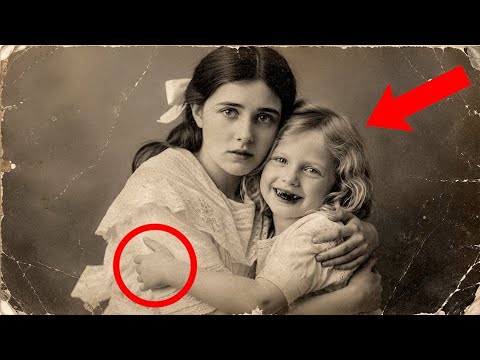
He scanned the image at high resolution and sent it to a group of historical photograph restorers. He expected them to fix the scratches. Instead, one of them sent back a message that changed everything: “Did you notice the child’s hand?”
At first, he saw nothing. Then he zoomed in. The child wore a light-colored dress—or perhaps hospital clothing. One hand rested on the nurse’s sleeve. The other was partially hidden. But between the child’s fingers was something small, something dark, something that looked almost like a folded piece of paper. The collector assumed it was part of the clothing. The restorers disagreed. They enhanced the contrast, examined the original print, compared the shadows. It wasn’t attached to the child’s clothes. The child was holding it.
But why? And what was written on it? That question pushed the photograph into an entirely different investigation.
The first clue came from the nurse herself. The style of her uniform suggested she worked in a medical institution in the early 1900s. The architecture behind her looked institutional too—tall windows, painted walls, a narrow wooden cabinet. But researchers couldn’t pinpoint the location. No hospital logo, no medical equipment, no sign. Then a historian noticed something on the nurse’s collar: a small emblem. It looked like a cross enclosed in a circular frame.
They searched archives for nursing institutions operating in 1904. Dozens appeared, then hundreds. But one name kept surfacing: a small children’s dispensary that operated in the area around that time. The problem? The institution’s official records contained almost no photographs. And one year was strangely incomplete—1904.
The researchers grew suspicious. They dug through old newspapers, census records, nursing logs. Finally, they found the nurse’s name: Eleanor Whitmore. According to the records, Eleanor was twenty-six in 1904. She had trained as a nurse and worked with children. But the photograph posed a problem. The child on her lap did not appear in any clear record linked to Eleanor. No adoption record, no family connection, no birth certificate that matched directly.
They began searching for missing children—and that’s when the story turned darker. A newspaper from late 1904 contained a brief notice about a young girl admitted to a local institution under an unknown name. The girl was described simply as female, approximately four years old. No surname, no known parent, no address, no explanation. The record stated that a woman had brought the child in and refused to reveal her identity. The woman reportedly left before authorities could question her. The child’s identity remained unknown.
At first, researchers wondered if this was the same child. But there was one major problem: the newspaper said the unknown girl was admitted in November. The photograph appeared to have been taken much earlier—unless the date on the back was wrong. Suddenly, those four pencil marks on the back mattered enormously. 1904. Was that really the year the photo was taken, or had someone written the date years later? No one knew.
The investigation continued. Then the restorers returned to the child’s hand. They enhanced the image of the small object between her fingers. The shape became clearer. It wasn’t paper. It was a small metal card—a hospital identification card—with two barely visible symbols: 17. A silence fell over the room. According to the institution’s surviving patient admission records, Patient Number 17 had vanished from the records shortly after being admitted. No discharge date, no death certificate, no transfer document. Nothing at all.
The researchers now had three strange facts: a nurse, an unidentified child, and a missing patient record. But the most unsettling evidence was still waiting inside the photograph. When they digitally enlarged the child’s face, they noticed she wasn’t looking at the camera. She was staring directly at something outside the frame. Something that seemed to frighten her.
Suddenly, that quiet photograph no longer felt quiet. It felt like a moment frozen just before something happened. The question was no longer: Who is the nurse? It was: What was this child trying to show them? And the answer was hidden in the smallest detail of the entire image. The child’s hand. Because beneath the metal card, almost entirely covered by her fingers, was a second object. A small key. And that key would lead investigators to a room that had never officially existed.
The key was barely visible. But once the restorers spotted it, they couldn’t unsee it. Small enough to fit between the child’s fingers, old-fashioned, metal, with a narrow shaft and a rounded head. The kind of key that might belong to a cabinet, a drawer, or a small interior door.
They enlarged the photograph again. The nurse’s hand curled protectively around the child’s waist. But her other hand was placed strangely, almost deliberately—as if she were covering part of the child’s clothing. At first, they assumed she was simply holding the child securely. Then someone noticed the nurse’s thumb. It was pointing toward the key.
That changed the interpretation entirely. Perhaps the nurse knew the child was holding it. Perhaps she wanted the camera to capture it. Or perhaps she was trying to keep anyone from seeing it. No one could be certain.
So the researchers searched for the institution linked to Eleanor Whitmore. Eventually, they found an architectural drawing. The building had been expanded several times. The original structure was two stories. The children’s wing was on the second floor. The nursing station sat at the end of a long corridor. And according to the floor plan, there was no room behind the spot where the photograph appeared to have been taken.
Yet the image showed what looked like a doorway. A narrow wooden door. The researchers compared the wall pattern. The windows. The trim around the ceiling. The conclusion was unsettling: the photo was likely taken inside the institution—but the room behind Eleanor did not exist on the surviving floor plan.
That raised an obvious question. Why? Perhaps the answer was buried in renovation records. A document from 1907 described the closure of part of the building after structural alterations. No explanation was given. A later plan simply showed a solid wall. No doorway. No room. No indication that anything had ever been there.
The researchers became obsessed with one possibility. What if the room had been deliberately removed from the official plans? They searched newspaper archives about the building. Most articles described the institution as a respectable children’s home. Clean, orderly, charitable. But one article was different. It mentioned a dispute involving several nurses and administrators. The details were vague. The article hinted at irregularities concerning patient documentation. The story vanished from the paper after two days. No follow-up. No investigation. No explanation.
Then the researchers found Eleanor Whitmore again. Her nursing career ended abruptly. In 1905, she resigned. No reason was listed. She disappeared from nursing records entirely. For a woman who had devoted years to caring for children, the sudden disappearance was strange. But another discovery was stranger still. A letter Eleanor wrote months before she left. Only a fragment survived. Most of the page was destroyed. But one sentence remained legible: “The child knows what happened even if she cannot explain it.”
The researchers stared at the sentence. Who was the child? And what had happened? The letter didn’t say. But perhaps the photograph did. They returned to the metal card. Patient Number 17. They searched the surviving admission records. Eventually, they found a matching entry. The record was incomplete. The child’s name was listed as “Clara.” Nothing else. No surname, no parents, no place of birth—just Clara, age four, health status fair, admission status temporary.
A few pages later, a note appeared. Transferred. No destination, no date, no signature. That was unusual. Institutions documented patient transfers carefully. But there was another entry beside the number—a small handwritten symbol. A circle. Inside the circle, the number three. No one knew what it meant.
Until a retired archivist suggested something. The institution sometimes used coded symbols for children whose identities were under investigation. If true, perhaps Clara wasn’t an ordinary patient. Perhaps she was an unidentified child.
The researchers began searching newspapers for missing children around 1903 and 1904. Several cases surfaced, but one stood out. A four-year-old girl had vanished from a nearby town. Her name was Clara Bellamy. Her mother, Margaret, had reported her missing. The newspaper described the child as having a small scar above her left eyebrow. The photograph showed something similar—a faint mark above the child’s left brow.
They thought they had finally found the child’s identity. But a problem emerged. Margaret Bellamy was alive in 1904, and according to newspaper records, she never stopped searching for her daughter. Why would the institution keep Clara under an unknown name? Why not contact the mother? Unless the child had been brought there under circumstances no one wanted recorded.
They searched for the mother. Her name was Margaret Bellamy. She had filed multiple notices requesting information. Then, in early 1905, the notices stopped. Not because Clara had been found, but because Margaret disappeared. Her home was abandoned, her belongings sold, and no explanation was ever given. The photograph now seemed to link three people: Eleanor Whitmore, Clara Bellamy, and Margaret Bellamy. But what connected them?
The answer came from behind another photograph. A second image was found in the same estate collection. It showed the same building, but this time from the outside. In one of the upper windows stood a small figure. The researchers zoomed in. It looked like a child—and beside the window was a woman, possibly Eleanor. The photo was taken from across the street. The child seemed to be pressing something against the glass, something rectangular, a piece of paper. The researchers enhanced the image. Three words became visible: “Please find Mother.”
If the photograph was real, the child had somehow communicated from inside the building. But why? And why was Eleanor standing beside her? The researchers returned to the original photo. This time, they looked beyond the child. They examined the nurse’s expression. Her eyes were no longer ambiguous. They were exhausted, almost fearful. The child wasn’t simply holding a key. She was holding a key to something the institution wanted forgotten—a locked cabinet or a locked room. Perhaps the key was never supposed to leave the building, but it ended up in the photograph somehow.
That meant the photo might not have been a posed portrait at all. It might have been evidence, deliberately preserved by someone who knew the truth would eventually surface. There was only one way to know. The researchers had to find the original building. When they finally located it, they discovered something impossible. The old institution had been demolished decades ago, but one part remained: a basement wall. And inside that wall was a locked metal box.
The box had no label, no date, no name. It was discovered during renovations after decades of closure. Workers reportedly thought it was empty. But it wasn’t. Inside were dozens of documents, patient notes, letters, old identification cards, and photographs. Most were too damaged to identify, but one envelope was still sealed. On the front were six words: “For whoever finds the truth.” The researchers immediately compared the handwriting. It matched Eleanor Whitmore’s.
Inside the envelope was a letter—and finally, the puzzle of the photograph began to make sense. Eleanor wrote that the child known as Clara had been brought to the institution by a woman who claimed she had abandoned her. But Eleanor didn’t believe her. The child asked repeatedly for her mother. She knew her mother’s name. She knew where she lived. She insisted she had been kidnapped.
Eleanor investigated quietly. She discovered that Clara had indeed disappeared from her mother’s home, but the official explanation was fabricated. The child had not been abandoned. She had been taken by someone who wanted Margaret Bellamy to appear unstable. Why? Because Margaret had discovered something—something about the institution. Eleanor’s letter explained that Margaret had briefly worked in the building as a cleaner. During that time, she discovered that patient records were being falsified. Some children were admitted under aliases. Some were transferred without proper documentation. Several records had vanished entirely.
Margaret tried to report what she found. Instead, her credibility was attacked. Then her daughter disappeared. Eleanor believed Clara was taken to prevent Margaret from exposing the records. But there was one thing the administrators underestimated. Clara remembered everything. She remembered her mother’s name. She remembered the room she was kept in. She remembered the key. The key opened a cabinet containing copies of the original records. Eleanor had discovered the cabinet herself. She knew that if those records were destroyed, there would be no proof. So she helped Clara hide the key. Then she took the photograph. The photo was never meant to be a normal portrait. It was a message. The child held the key on purpose. The nurse looked at the child because she knew exactly what the photo represented. And the camera captured the evidence before anyone could stop them.
But Eleanor knew she might not survive professionally. She wrote: “If this photograph survives, perhaps someone will understand.” Then came the final revelation. The photo was not from 1904. It was from late 1905. Someone had written 1904 on the back years later. Why? Perhaps to mislead anyone searching the records. Or perhaps because 1904 was the year everything began.
Clara was eventually reunited with her mother. At least, that’s what Eleanor’s letter claimed. But there was no official record to confirm it. The researchers searched Margaret Bellamy’s later life. They found one entry in a later census. A woman named Margaret living under the same surname. Beside her name was a young girl, Clara. The ages matched. The researchers believed the family had survived.
But Eleanor’s story didn’t end happily. She left nursing shortly after. She never returned to the institution. And for decades, the photograph disappeared into private collections. Then came the strangest discovery of all. When restorers examined the original glass negative, they found something invisible in the printed photo. In the background, behind the nurse’s shoulder, was a small reflection. A mirror. And in that mirror was another person. A woman standing in the doorway. The researchers initially thought it was a reflection of someone already in the room. But the angles didn’t match. The woman’s position seemed impossible. She stood in a part of the room that shouldn’t have been visible from the camera’s perspective.
Some later interpreted the figure as supernatural. But historians offered a more realistic explanation. Perhaps the mirror was placed at an unusual angle. Perhaps the photo was taken in a narrow room, and the woman could have stood just outside the camera’s frame. There was no evidence of anything supernatural. Yet the reflection remained significant because the woman appeared to be holding something—a folder—and on the folder was the same symbol found in Clara’s patient record. A circle with the number three inside.
The symbol remained unexplained. Perhaps it represented a room, a case file, a patient category, or simply an administrative mark whose meaning was lost. The truth is, some parts of the photograph may never be fully understood. But one thing became clear. The child wasn’t just sitting quietly in a nurse’s arms. She was holding evidence. And the nurse wasn’t just taking a portrait. She was preserving proof.
Over a century later, a photograph that seemed quiet became the start of a historical investigation. It reminds us how easily a single detail can vanish. A hand, a key, a hospital card, a name, a missing record. Sometimes history doesn’t hide in grand documents or famous events. Sometimes it hides in the corner of an old photograph. And sometimes the person holding the smallest object in the frame is the one holding the biggest secret. Perhaps the 1904 photograph seemed calm, but once experts looked closely at the child she was holding, the peaceful image became something else entirely.
What do you think—was the reflection in the mirror just a trick of the light, or did it hold a clue that even Eleanor never dared to write down? Share your thoughts in the comments below.
Report this article
Select a reason for reporting:






