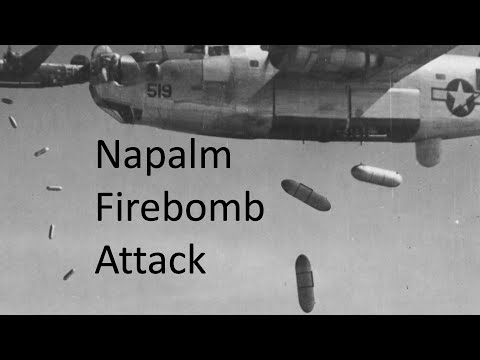
The sky over Royan, France, was thick with the roar of 843 heavy bombers—B-17s and B-24s—their bellies filled with a weapon never before used on such a scale: napalm. On April 15, 1945, the Eighth Air Force launched Operation Venerable, a mission to incinerate German fortifications along the Atlantic Wall. They dropped 375,000 gallons of napalm in a single day. The result? A stunning failure that military planners never anticipated.
As the first canisters tumbled from 15,000 feet, the crews believed they were about to deliver a decisive blow. Instead, they would learn a brutal lesson about the limits of incendiary warfare against hardened concrete.
The target was a cluster of fortifications known as Target 11, part of the Atlantic Pocket defenses. Six 155mm gun bunkers with 7-foot-thick roofs, three 75mm gun positions, four 37mm emplacements, and an ammunition depot—all built to withstand heavy bombardment. The plan was simple: saturate the area with napalm, let the flaming gel sweep over the structures, and trap the defenders inside. But the bombs had other ideas.
Many canisters burrowed into the soft soil and detonated harmlessly. Others tumbled in midair, colliding with each other and exploding 40 to 50 times before reaching the ground. Of the 577 incendiary and firebombs dropped over Target 11, only 25 were accounted for. The napalm that did hit hard surfaces burned in a single blob, its radius of burst and scatter a mere 10 to 15 feet—far too small to engulf the massive bunkers.
German soldiers inside the fortifications reported that the attack was barely noticeable. “If a napalm glob did contact their person, they just brushed it off,” one post-strike report noted. The odor was annoying, they said, but only one prisoner found the attack demoralizing. The concrete roofs held. The guns remained intact. The ammunition depot stood untouched.
Ground observers watching from three miles away concluded the obvious: the firebombing had no effect on structures, gun emplacements, or personnel inside. Even soldiers caught in the open were only slightly affected. The napalm failed to burn through landmine trip wires. It didn’t suffocate anyone. It didn’t start fires.
As the bombers returned to England, the Eighth Air Force faced an uncomfortable truth. They had deployed their heaviest bombers with a weapon designed for area denial, only to find that against the Atlantic Wall, napalm was practically useless. A June 1945 evaluation board would later summarize the lesson in stark terms: “Don’t attack concrete structures with napalm.”
But the story of Operation Venerable wasn’t over. The failure at Royan would echo through subsequent operations, raising questions about how to crack the toughest fortifications—and what it would take to finally breach Hitler’s Atlantic Wall.
The failure at Royan did not stop the Allies from trying. Just weeks later, during the assault on the Metz forts in northeastern France, napalm was deployed once more against concrete fortifications. The result was identical: no hits were found, and no damage was recorded. The lesson from Royan had been ignored, and the same mistakes were repeated.
What made the failure so complete was not just the weapon itself, but the entire delivery system. The 108-gallon British paper tanks were fragile and unguided. Without aerodynamic stabilization, they tumbled unpredictably after release. Between 40 and 50 canisters detonated midair, likely after colliding with one another during the fall. The bombs that did reach the ground often struck at angles that prevented the napalm from spreading into the fortifications.
Even the fuse system was inadequate. The M13 and M14 igniters were designed to detonate on contact, but against thick concrete or soft soil, they performed poorly. Some bombs failed to ignite entirely on target contact. Others burned as a single large blob, wasting the incendiary effect on a small patch of ground while the bunkers stood untouched just yards away.
What the planners had failed to understand was the fundamental physics of the Atlantic Wall. The 155mm gun fortifications at Royan had roofs seven feet thick. The 75mm positions had roofs six and a half feet thick. These were not wooden buildings or open trenches—they were hardened concrete structures designed to survive direct hits from heavy artillery. Napalm, which burns at around 1,200 degrees Fahrenheit, could not generate enough sustained heat to crack or penetrate such mass.
Moreover, the fortifications were designed with small apertures and multiple chambers. Even if flaming napalm had poured over the structure, it could not have flowed into the interior. The German defenders had learned to seal their bunkers during bombing raids, waiting out the attacks in underground shelters with their own ventilation systems. The napalm never had a chance to reach them.
The psychological impact, which some planners had counted on, was equally disappointing. German prisoners interviewed after the attack described the napalm as annoying but not terrifying. They brushed off burning globs like one might brush off a clinging insect. The smell was unpleasant, they said, but that was all. Only a single prisoner admitted to being demoralized by the attack.
What the prisoners did reveal, however, was far more telling. They admitted that had they been caught in the open during the high-explosive bombing the previous day, they would have been terrified. The conventional explosives had shaken them; the napalm had not. This admission underscored a bitter irony: the weapon meant to incinerate and terrify had done neither, while the older, more conventional bombs had at least achieved a psychological effect.
As the evaluation reports piled up, a clearer picture emerged. The Eighth Air Force had committed over 800 heavy bombers to a mission that achieved virtually nothing. The 375,000 gallons of napalm dropped on Royan had failed to destroy a single gun emplacement, breach a single bunker, or kill a single defender inside the fortifications. The operation was not just a failure—it was an expensive, dangerous, and entirely avoidable one.
Yet the story of Operation Venerable was not simply one of waste. It became a case study in what not to do, a cautionary tale that would influence future bombing doctrine. The June 1945 evaluation board’s conclusion was blunt and unambiguous: napalm was the wrong tool for concrete structures. To be effective, the report noted, napalm would need to be squirted directly into the fortification’s small apertures—an impossibility during a high-altitude bombing run.
The men who flew that mission returned to England with their bomb bays empty and their confidence shaken. They had been told they were delivering a decisive blow against Hitler’s Atlantic Wall. Instead, they had delivered a lesson in the limits of air power—and a warning that would echo through the final weeks of the war in Europe.
Yet the failure at Royan was not the only problem facing the Allied planners in the Bay of Biscay. While the bombers droned homeward on April 15, another crisis was unfolding on the ground. The French Resistance had been reporting for weeks that the German garrison at Royan was not merely holding out—it was thriving. The Atlantic Pocket at Royan had been stockpiled with enough food, ammunition, and fuel to last months, not weeks. The bunkers were not isolated tombs; they were connected by a network of underground tunnels that allowed the defenders to move freely between positions without ever exposing themselves to aerial attack.
This was the detail that the Eighth Air Force’s target folders had failed to capture. The fortifications at Target 11 were not individual strongpoints standing alone—they were part of an integrated defensive system. When napalm poured over one bunker, the defenders simply retreated through the tunnels to another position and waited for the flames to die down. The firebombing, even if it had worked perfectly, could never have trapped them.
And there was another factor that made the Royan mission even more puzzling in retrospect. The Germans had already been cut off. By April 1945, the Atlantic Pockets along the Bay of Biscay were completely isolated from the Reich, surrounded by Allied forces and the French Resistance. They posed no offensive threat whatsoever. The only reason they remained in German hands was Hitler’s order to hold them to the last man and the last bullet.
So why commit 843 heavy bombers to an operation that could not possibly change the strategic situation? The answer lay in the nature of the Allied command structure in the final months of the war. Eisenhower’s headquarters wanted the Atlantic Pockets eliminated before the war ended, if only to free up the French forces besieging them. The French wanted Royan liberated for reasons of national pride. And the Eighth Air Force, flush with bombers and eager to demonstrate the versatility of air power, was willing to try anything once.
The result was a mission that satisfied no one. The French forces surrounding Royan would eventually have to storm the fortifications the old-fashioned way—with infantry, artillery, and tanks. The liberation of Royan would not come from the air, but from the ground, at a cost of hundreds of French lives.
And the napalm? It sat in the bomb bays of the Eighth Air Force, unused for the rest of the war in Europe. The lessons of Operation Venerable had been learned, but they had come at a steep price—not in aircraft or crews, but in confidence. The weapon that had been hailed as a revolution in aerial warfare had been exposed as a dud against the one target it was supposed to defeat.
Yet even as the evaluation boards filed their reports and the planners moved on to other targets, a darker question lingered. If napalm could not crack the Atlantic Wall, what would? The answer, as it turned out, was already being developed in the laboratories and factories of Allied nations—a weapon that would make the firebombing of Royan look like a footnote in the history of destruction.
But the most damning evidence came not from the bombers, but from the ground. The French forces who eventually stormed Royan in the days following the air raid found the German bunkers largely intact—and the defenders still fighting. The napalm had scorched the grass, blackened a few concrete faces, and left a smell that the Germans described as unpleasant. Nothing more.
The liberation of Royan, when it finally came, was achieved by infantry and artillery, not by fire from the sky. French troops paid in blood for every yard of ground, and the Atlantic Pocket that 843 bombers could not crack fell to soldiers with rifles and grenades. The contrast could not have been starker.
In the end, Operation Venerable was not a turning point, not a breakthrough, not even a useful experiment. It was a cautionary tale about the danger of assuming that a new weapon will solve an old problem. The Atlantic Wall was built of concrete, steel, and earth. It was defeated by patience, siegecraft, and infantry assault—the same methods that had worked for centuries.
The Eighth Air Force never firebombed another Atlantic Wall fortress. The 375,000 gallons of napalm dropped on Royan became a footnote in the official histories, a single paragraph in the tactical mission reports. The weapon that would later define modern warfare had failed its first major test against the hardest targets in Europe.
And yet, the men who flew that mission and the analysts who studied its results left behind a lesson that still resonates today: no weapon is a silver bullet, and the most expensive bomb is the one dropped on a target it was never designed to destroy.
What do you think—was Operation Venerable a necessary experiment or a costly blunder? Share your thoughts in the comments below.
Report this article
Select a reason for reporting:






