The boy stood in the doorway of the medical tent, his right arm hanging stiff at his side, fingers curled inward like a claw. He was seven years old, silent as stone, his father’s hand resting on his shoulder. The American medic, Corporal James Holland, gestured them inside. The tent smelled of iodine and canvas heat. When Holland reached to examine the arm, the child’s voice came small and certain: “It burns when you touch it.”
That was the summer of 1944, at Camp Concordia, Kansas—a dusty expanse of barbed wire and barracks holding 600 German prisoners. The boy, Klaus, had been injured months earlier in Italy when an Allied bomb threw him fifteen feet. The burns healed badly, but the pain never stopped. Now, beneath the scarred tissue, Holland would discover something no one expected: shrapnel, buried deep, still burning.
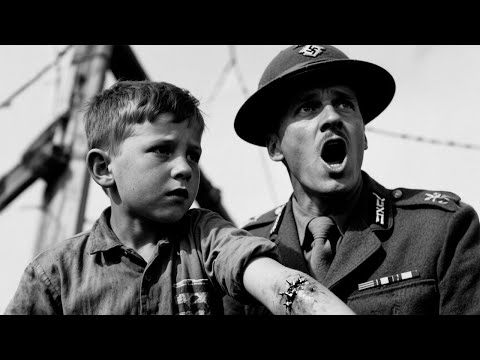
Holland was twenty-four, a combat medic from Kentucky with a slight hitch in his walk from shrapnel at Anzio. He had seen pain before, but never in a child so young. Klaus’s father, Friedrich, a German officer captured at Normandy, watched with desperate hope as Holland gently touched the scarred forearm. The boy gasped, tears springing to his eyes, but made no sound.
“How long has it been like this?” Holland asked. Four months. It healed, but the burning never stopped. Holland sat back on his heels, thinking. Burns this old should not still produce heat. Something else was wrong.
He prepared a syringe of morphine, explaining through Friedrich what he intended to do. Klaus watched with wide, frightened eyes. He had received morphine before, during the initial treatment. He knew what it meant. Holland administered the injection with practiced efficiency.
When the morphine took effect, Klaus’s expression softened. Holland worked carefully, using forceps and gauze to soften the scarred tissue. What he found made him stop and stare: metal fragments, embedded in the tissue, moving slightly with muscle contraction, grinding against flesh. Shrapnel from the original explosion, missed during initial treatment, now causing chronic damage.
“There’s metal in there,” Holland said quietly. “Shrapnel, multiple pieces embedded deep.” Friedrich’s face went pale. “Can you remove it?”
Holland met the father’s eyes. “Yes, but it’s going to require surgery. Real surgery.” He hesitated. “It should have been removed months ago. Every day it stays in there causes more damage.”
Friedrich’s voice carried quiet desperation. “We had no facilities. We were retreating. No hospitals, no equipment. The medic did what he could.” Holland nodded. He understood. War made triage inevitable. A child’s arm, burned but not bleeding, got bandaged and morphine and moved to the back of the line while soldiers with arterial bleeding claimed the limited medical resources.
“I’ll need to schedule operating time,” Holland said. “Talk to Major Daniels. Get proper authorization. This isn’t emergency room stuff, but it can’t wait much longer either.”
Two days later, Holland stood in the medical tent at dawn, scalpels and forceps laid out on a sterile cloth. Klaus lay on the examination table, his small chest rising and falling under the anesthesia. Friedrich stood behind Holland, silent and pale. The surgery took three hours. Each fragment required careful extraction, some buried deep near the radius bone. Holland worked with concentrated silence, aware of the boy’s shallow breathing, aware of his own hands moving through flesh with practiced precision.
The largest fragment was half an inch long, lodged near the radial nerve. Holland excavated carefully, conscious that one wrong move could leave the boy with permanent paralysis. When he finally grasped it with forceps, he dropped it into a metal tray where it clinked against seven other pieces. Behind him, Friedrich made a small sound—grief or relief, impossible to distinguish.
“That’s the last one,” Holland said quietly. “Now we close.”
He sutured in layers, deep tissue first, then muscle, finally skin. When he finished, Klaus’s forearm was dressed in clean white bandages. Holland stepped back, peeling off blood-stained gloves. “He’ll sleep for another hour. When he wakes, he’ll have pain. I’ll give him morphine for that. But the burning—” He paused. “That should be gone.”
Friedrich stared at his son’s bandaged arm. “Thank you,” he said in heavily accented English. Then again in German, with more words that Holland did not understand but whose meaning was clear in the tone: gratitude mixed with something like shame—the shame of owing kindness to an enemy.
Klaus woke in the afternoon with pain radiating from his arm like fire—a different fire than before. Surgical fire, Holland told him through Friedrich’s translation. Healing fire, not burning fire. The distinction seemed meaningless to a seven-year-old struggling with post-operative agony. But as the days passed, the burning never returned. Klaus began using his right hand again, tentatively at first, then with increasing confidence.
One afternoon in August, Klaus appeared at the medical tent carrying something wrapped in newspaper. Inside was a carved wooden horse, three inches tall, rendered with meticulous detail. “For you,” Klaus said in heavily accented English. “Because you fix my arm.”
Holland turned the horse over in his hands. It was beautiful folk art, the kind of object that carried value beyond its material. “This is too nice to give away,” he said gently. Klaus shook his head firmly. “Gift for you. You make the burning stop.”
Holland felt something shift in his chest—gratitude and sadness and recognition that this child had experienced things no child should have to carry. “Thank you,” he said quietly. “I’ll keep it safe.”
Klaus smiled—the first genuine smile Holland had seen from him—transforming his serious little face into something briefly carefree. He said something in German, too rapid for Holland to catch. “What did he say?” Holland asked Friedrich, who had appeared in the tent doorway.
Friedrich’s expression was complicated—pride and sorrow mixing together. “He said, ‘You are a good doctor, better than the doctors in the German army. Because you did not ask if he was worth healing before you healed him.'”
The comment landed like a physical blow. Holland didn’t respond immediately. Finally, he said, “Every patient is worth healing. That’s what medicine means.”
Friedrich translated. Klaus nodded solemnly, as if this confirmed something he had suspected but needed to hear stated explicitly. After they left, Holland sat at his desk holding the carved horse, staring at it for a long time. Eventually, he placed it on the shelf above his medical supplies, where it would remain for the rest of his time at Camp Concordia—a small wooden reminder of why the work mattered, regardless of which uniform the patient wore.
But the war was not finished with any of them. In November, Holland received transfer orders to a combat hospital in France. Klaus appeared at the medical tent the day before he left. “You go?” he asked in English. “Yes,” Holland said. “New assignment in Europe.” Klaus processed this silently. “Then you will see Germany.” “Maybe.” “Probably.”
Holland knelt to eye level. “Your arm looks good. Keep it clean. Don’t let anyone tell you it can’t work. It works fine now.” “I know.” Klaus extended his right hand. “Thank you for fixing.” Holland shook the small hand carefully, feeling the normal grip strength. The surgery had worked. The healing was complete.
Friedrich appeared in the doorway. He shook Holland’s hand—enemy soldier and American medic, connected by the strange circumstance of a child’s injury and recovery. “You saved his arm,” Friedrich said in careful English. “Maybe saved his future. I do not forget this.” “Just doing my job,” Holland said. But both men knew it was more than that—or less than that—or somehow both simultaneously.
“If we meet again, after the war,” Friedrich said, “I would like to thank you properly.” Holland nodded. He didn’t say that they probably wouldn’t meet again, that the war would scatter them to different continents and different futures. Some things didn’t need to be spoken aloud.
Holland served in France through the winter, treating casualties during the Battle of the Bulge, participating in the final push across the Rhine. He kept the carved wooden horse in his medical kit, wrapped carefully in cloth. Sometimes, during brief respites between casualties, he would take it out and hold it, remembering a Kansas summer when healing was simple and possible—when a child’s arm could be fixed with surgery and patience, when the burning could actually stop.
The war ended in May 1945. Holland was in Germany by then, working in a field hospital near Stuttgart. He treated German civilians alongside American soldiers, watched the defeated population struggle with occupation and scarcity, wondered occasionally about Friedrich and Klaus Vber—whether they had survived, where they were now, what their futures might hold. He never saw them again.
After the war, Holland returned to Kentucky. He completed his medical degree using GI Bill benefits, opened a family practice in Louisville. He married, had three children, practiced medicine for thirty-seven years. The carved horse sat on his office desk throughout that time—a small wooden reminder that patients were people, regardless of which flag they served.
Then, in 1982, a letter arrived, forwarded through a veterans organization. It was written in English, the grammar precise if slightly formal. “Dear Dr. Holland, I do not know if you remember me. I was seven years old in Camp Concordia, Kansas, in 1944. You removed metal from my arm, stopped the burning that I had lived with for months. I am writing now to tell you what became of that arm. I became an engineer. I work with precision instruments, designing industrial equipment. My hands work perfectly, both of them. The scarring is barely visible. I have full strength, full flexibility. I can build things.”
Holland read the letter three times, his hands trembling slightly—age and emotion mixing together. Klaus wrote of his father’s death in 1967, of his own three children, of the lesson he had carried forward: that humanity can survive anything, even war, if we remember to see each other as human. “Thank you for the burning you stopped,” the letter ended. “Thank you for the future you gave me. With deep gratitude, Klaus Vber.”
Holland pulled out stationery and wrote a response. He told Klaus that healing is always worth attempting, regardless of politics or nationality. That pain is pain, suffering is suffering, and medicine exists to reduce both. “Keep building things,” he wrote. “Keep using those hands. That’s thanks enough.”
They exchanged Christmas cards after that, annual updates documenting children growing, careers progressing, the slow accumulation of peaceful ordinary years. The cards came faithfully until Holland’s death in 1997. Each one signed in precise handwriting that showed no tremor, no lingering damage from seven decades earlier.
The carved wooden horse remained on Holland’s desk throughout. After his death, his children found it and asked their mother what it meant. She told them the story—or the version of it she knew, filtered through fifty years of her husband’s careful retellings. She gave the horse to their oldest son, who kept it on his own desk—a family heirloom whose meaning had evolved beyond the specific circumstances of its creation.
Camp Concordia closed in 1946. Its prisoners repatriated to a Germany that barely resembled the nation they had left. The camp itself was dismantled, barracks torn down, fences removed, the land returned to agriculture. Kansas wheat grew where German soldiers once waited for the war to end. But the medical tent’s work echoed forward through decades.
Klaus Vber became exactly what his letter described—an engineer, a father, a man whose life extended far beyond the war that shaped his childhood. When his own children asked about the war, he told them the truth: that it was terrible, that it destroyed his mother and displaced his childhood, that it represented humanity’s capacity for organized violence. But he also told them about the medical tent in Kansas, about the American doctor who removed the burning from his arm, about the small moment of care that suggested something else was possible.
“The war taught me what we can destroy,” he would tell them. “But Dr. Holland taught me what we can repair. Both lessons mattered. Both were true.”
In the end, that was the story’s simplest truth. It burns when you touch it—until it doesn’t. Until someone cares enough to remove what’s causing the burning, until healing becomes possible again. And then life continues, scarred but functional, marked but whole, carrying forward the evidence that recovery, however unlikely, however difficult, can actually happen.
Years later, Klaus’s daughter, a pediatric surgeon in Hamburg, held her father’s scarred forearm under a bright lamp and traced the thin white line. “This is where the burning stopped,” she said. Klaus nodded. “The war taught me what we can destroy. Dr. Holland taught me what we can repair.”
He had told her the story many times, but that evening he told it slowly, as if handing her something precious and breakable. The wooden horse, she knew, still sat on a desk in Kentucky, or on a grandson’s shelf, its meaning carried forward like a torch passed hand to hand.
When Klaus finished, his daughter was quiet for a long moment. Then she asked the question he had never been able to answer: “How many others, Papa? How many could have been healed if someone had only stopped to look?”
What would you have told him—that medicine is only medicine when it refuses to ask who deserves it?
Report this article
Select a reason for reporting:






