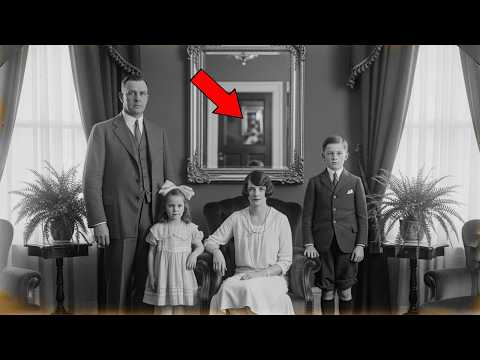
Margaret Chen had spent 23 years appraising antiques, but nothing could have prepared her for the chill that ran down her spine as she examined the sepia-toned photograph. It was a typical 1925 family portrait—a wealthy clan posed stiffly in their Victorian parlor—until her magnifying lens caught something impossible. In the ornate mirror behind the family, a gaunt, hollow-eyed man stared back—a face that didn’t belong to anyone in the picture.
That autumn morning in Milbrook, Connecticut, Margaret had arrived early at the Whitmore estate sale, drawn by the promise of forgotten treasures. The mansion had been sealed for decades, ever since its last owner, Elellanar Whitmore, vanished in 1987. For $45, Margaret bought the portrait, a modest investment that would soon consume her every waking thought.
Back in her Hartford office, under professional lighting, the image revealed its secret. The man in the mirror wore working-class clothes—a cap pulled low, his expression a mix of rage and desperation. “This is unprecedented,” murmured Dr. James Morrison, a photography historian from Yale, after examining the print. “The shadows, the depth of field—everything suggests a single exposure. But how?” His hands trembled as he photographed the mirror’s reflection. He had no explanation, but he knew someone who might: Detective Sarah Rodriguez of the Connecticut State Police Historical Crimes Division.
Detective Rodriguez listened intently, then pulled a thick manila folder from her cabinet. “The Whitmore name is familiar,” she said, spreading yellowed police reports across her desk. “We have several unsolved cases dating back to the 1920s.” The first: Patrick Murphy, a 34-year-old carpenter who disappeared in September 1925—just months after the portrait was taken. His description matched the mirror figure perfectly: tall, gaunt, angular features, a worker’s cap, and hollow eyes.
Over the next 15 years, three other workmen vanished after jobs at the Whitmore estate. Thomas Whitmore, the family patriarch, was questioned but never charged. “He was a prominent businessman with political connections,” Rodriguez explained, her tone bitter. “The investigations were limited by the standards of the era.” She fixed Margaret with a serious stare. “If this photograph captured Murphy on the night he disappeared, it might be the first real evidence we’ve had in nearly a century.”
The team entered the mansion on a gray November afternoon—Margaret, Rodriguez, Dr. Morrison, and a forensics photographer. The parlor was frozen in time, the same ornate mirror still hanging in its original position. As they positioned the portrait where the 1925 photographer would have stood, the angles matched perfectly. But when Morrison examined the mirror’s current reflection, he froze.
Faint scratches marred the silver surface—almost invisible unless viewed from a specific angle. Under magnification, they formed crude, desperate letters: “HELP” and “MURPHY” and a date: “SEPT 15 1925.” The forensics photographer’s voice was barely a whisper. “Someone carved these deliberately—possibly with a fingernail. The depth suggests extreme distress.”
Rodriguez immediately called for a full forensics team. As they waited, Margaret stood before the mirror, holding the portrait. They might be looking at evidence of Murphy’s final moments—captured not just in the photograph, but literally etched into the mirror as a desperate cry for help that had gone unheard for nearly a century. The basement, she knew, would be next.
The forensics team descended the narrow wooden stairs into the basement, their flashlights cutting through decades of darkness. The stone walls showed signs of recent disturbance—patches of mortar removed and replaced, creating a patchwork pattern that suggested multiple renovations over the years. But it was the discovery of a hidden room behind a false wall that made Rodriguez’s breath catch.
Inside the concealed space, forensics uncovered remnants of personal belongings: a worker’s cap matching Patrick Murphy’s description, fragments of 1920s working-class clothing, and most significantly, a carpenter’s toolbox bearing Murphy’s initials carved into the wooden handle. “This changes everything,” Rodriguez said, her voice steady but eyes wide. “We now have physical proof that Murphy was in this house—and that something prevented his normal departure.”
Dr. Morrison made an additional discovery. Behind the false wall, carved into the stone with what appeared to be a chisel from Murphy’s toolbox, was a crude map of the mansion’s layout. The drawing showed the parlor, the basement, and a detailed sketch of the mirror’s position relative to the photographer’s setup. “He knew he was being watched,” Morrison realized. “Murphy understood that his presence was being recorded—either intentionally or accidentally. This map suggests he was trying to document the truth of what happened to him.” Under magnification, notes in Murphy’s handwriting became visible: They see everything. The mirror knows.
As the forensics team processed the scene, Margaret felt the weight of nearly a century of silence pressing down on them. The portrait had been more than an accidental capture—it was Murphy’s final testimony, preserved in silver halide and glass, waiting for the right moment to reveal its secrets.
The breakthrough led Rodriguez to track down living descendants of both families. Patrick Murphy’s granddaughter, Maria Santos, had spent decades researching her grandfather’s disappearance. “My grandmother never stopped believing that Patrick was murdered,” Maria told Rodriguez at the Hartford Historical Society. “She kept everything—newspaper clippings, police reports, and most importantly, Patrick’s final letter to her, written the day before he disappeared.”
The letter revealed Murphy’s growing fear. He described strange sounds in the basement, tools that went missing and reappeared in different locations, and the constant feeling of being watched. Thomas Whitmore follows my every move, Murphy had written. I’ve seen him standing in doorways watching me work. Something isn’t right about this job.
Meanwhile, Rodriguez’s investigation into the Whitmore family revealed a pattern of suspicious behavior spanning generations. Thomas Whitmore’s business records showed unusually high turnover in household staff and contractors, with many workers listed as terminated without notice. Financial records indicated payments to workers that were never collected—suggesting they disappeared before receiving their final wages.
Eleanor Whitmore’s personal diary, discovered in the mansion’s attic, provided the most damning evidence. Entries from 1925 described her father’s basement projects and her growing fear of what she called “the men who never left.” At age seven, Eleanor had witnessed more than a child should ever see, and her diary entries suggested a lifetime of trauma stemming from her family’s dark secrets. “Eleanor knew the truth,” Rodriguez explained to Margaret. “Her disappearance in 1987 wasn’t random. She was the last person alive who could testify about what happened in that house. Someone wanted to ensure she never talked.”
The investigation was revealing layers of conspiracy and cover-up that extended far beyond a single murder in 1925. Dr. Morrison’s research into Hartwell Studios revealed another crucial piece of the puzzle. The photographer who captured the 1925 portrait, Edmund Hartwell, had left behind detailed business records—including an unusually lengthy entry about the Witmore portrait session.
Hartwell’s journal, preserved at the Connecticut Historical Society, described the September 1925 session as “the most disturbing commission of my career.” He noted that Thomas Whitmore had insisted on a specific setup in the parlor, positioning the family precisely where the mirror would capture the entire room. Most telling was Hartwell’s observation that he had heard sounds of distress from the basement during the session, but was told by Whitmore that it was merely construction work being completed.
“Hartwell suspected something was wrong,” Morrison explained to Rodriguez and Margaret. “His technical notes indicate he deliberately used a longer exposure time and wider aperture than necessary for the lighting conditions. He wanted to capture as much detail as possible—including anything reflected in that mirror.”
The photographer’s business correspondence revealed that he had attempted to contact police about his suspicions, but was discouraged by Thomas Whitmore’s political connections. A letter dated October 1925 showed Hartwell writing to the Hartford police chief: I believe my recent portrait session may have inadvertently documented evidence of a serious crime. I request permission to submit my negatives for official examination.
The police response, also preserved in the archives, was dismissive: Your concerns regarding the Whitmore family have been noted. No further action is required at this time. The letter was signed by Chief William Hartford—Thomas Whitmore’s brother-in-law.
Morrison’s final discovery proved that Hartwell had created multiple prints of the portrait, keeping one for his own records out of fear for his safety. “He knew this photograph was important evidence,” Morrison concluded. “Edmund Hartwell risked his career and possibly his life to preserve the truth of what he witnessed that day. The portrait wasn’t just a family commission—it was his insurance policy against a powerful man who thought he could literally get away with murder.”
With mounting evidence pointing to a century-old conspiracy, Detective Rodriguez faced the challenge of pursuing justice in a case where all the original perpetrators were long dead. However, the investigation had revealed modern connections that demanded immediate attention—particularly concerning Elellanar Whitmore’s 1987 disappearance and potential ongoing criminal activity.
Thomas Whitmore Jr., the current owner of the family estate and grandson of the original Thomas, had been quietly monitoring the investigation through his legal connections. When Rodriguez requested a formal interview, his response revealed the family’s continued involvement in covering up their dark history. “My grandfather was a respected businessman who employed many local workers,” Whitmore Jr. stated during the recorded interview. “These allegations, based on an old photograph, are nothing more than sensationalist conspiracy theories.” But his nervous demeanor and defensive responses suggested he knew more than he was admitting.
Margaret’s role had evolved far beyond appraiser. Her analysis, combined with Morrison’s research, formed the backbone of Rodriguez’s case. Now, as they prepared to present findings to the district attorney, Margaret felt the weight of giving voice to Patrick Murphy’s century-old testimony. The breakthrough came when forensic analysis of the basement revealed additional human remains—not just Murphy, but at least three other victims spanning decades. DNA confirmed two victims from missing-person cases in the 1930s and 1940s, both employed by the Whitmore family.
“This wasn’t a single crime of passion,” Rodriguez declared at a packed press conference. “We’re looking at systematic murder spanning generations, with the Whitmore family using wealth and political connections to cover up their crimes.” The portrait had opened a window into a century-long pattern of violence and intimidation. As news spread, other families came forward with stories of missing relatives who had worked for the Whitmores—a pattern law enforcement had failed to recognize for nearly a hundred years.
Thomas Whitmore Jr. was charged with conspiracy to conceal evidence and obstruction of justice in connection with Elellanar Whitmore’s 1987 disappearance. While the original perpetrators were beyond earthly justice, the legal system could still hold accountable those who continued the cover-up. Maria Santos, Patrick Murphy’s granddaughter, finally received the closure her family had sought for generations. “My grandfather couldn’t speak for himself for nearly a century, but his image in that mirror became his testimony,” she said at the memorial service for the identified victims. “Thanks to everyone who refused to let his story be forgotten, he can finally rest in peace.”
Dr. Morrison published his findings in the Journal of Historical Photography, establishing the 1925 Whitmore portrait as one of the most significant examples of accidental forensic photography in American history. Margaret donated the original portrait to the Connecticut State Police Museum, where it serves as a reminder that truth has a way of surfacing. She returned to her antique appraisal work with a deeper understanding of the stories objects can tell—and the responsibility that comes with uncovering hidden history.
The Whitmore mansion was sold to developers who converted it into affordable housing. A memorial plaque in the lobby honors Patrick Murphy and the other victims. The ornate mirror from the parlor was preserved as evidence, its scratched surface bearing witness to one man’s desperate attempt to leave behind proof of the truth. In her final report, Detective Rodriguez wrote: “This case reminds us that justice delayed is not always justice denied. Sometimes evidence waits patiently for the right person at the right moment to recognize its significance and give voice to the silent witnesses of the past.”
What forgotten object in your own family’s history might be waiting to tell its story?
Report this article
Select a reason for reporting:






