Rebecca Martinez felt an immediate chill when she first laid eyes on the photograph at the Riverside County estate sale. Unlike the other vintage images scattered throughout the collection, this portrait seemed to radiate an unsettling energy that made her hesitate before picking it up. The sepia-toned image showed a young woman in an elaborate Victorian dress standing in what appeared to be a professional photographer’s studio. Her dark hair was styled in the fashion of the early 1880s, but her eyes held a haunted quality that seemed to pierce through the decades.
What dominated the composition was an enormous bouquet of wildflowers pressed tightly against her chest. Prairie roses, Indian paintbrush, and desert marigolds arranged so densely they created an almost defensive barrier. But there was something deeply wrong with the scene. The woman’s knuckles were white from gripping the flower stems, and her forced smile couldn’t mask the terror in her eyes. The flowers themselves seemed wilted despite the photograph’s clarity, as if they had been hastily gathered and arranged to conceal something urgent.
Rebecca turned the photograph over and found an inscription that made her stomach drop. Eleanor Hartwell, Wichita, Kansas, October 1882. Below that, in different handwriting with what looked like dried brown stains, someone had scrawled, “Justice for what he did to Mary.”
The photograph’s technical quality was exceptional for a frontier studio, but more disturbing was the composition itself. The photographer had positioned Eleanor at an odd angle, as if trying to capture something specific about what she was holding. The lighting created dramatic shadows that seemed to emphasize the weight of whatever was hidden beneath those flowers.
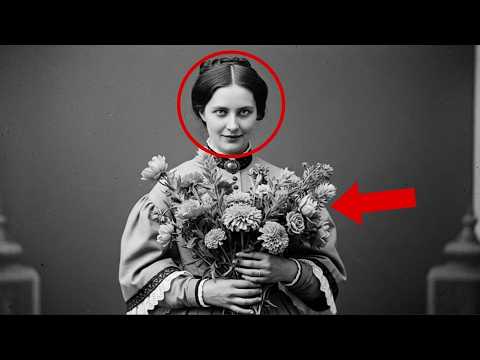
Rebecca paid for the photograph with trembling hands, unable to shake the feeling that she was looking at evidence of something terrible. The estate sale volunteer mentioned that the items had come from an old house in Pasadena that had been abandoned for decades with no known relatives to claim the belongings.
That evening, Rebecca couldn’t stop staring at Eleanor Hartwell’s haunted expression, wondering what tragedy had driven a woman to pose for such a disturbing photograph. In her home office, Rebecca positioned the photograph under her professional magnifying equipment, steeling herself for what she might discover.
As she focused on Eleanor’s hands, she noticed they were positioned unnaturally, not just gripping flower stems, but supporting something heavy and solid hidden within the bouquet. Using her highest power lens, Rebecca could make out the edge of a metallic object between the prairie roses.
At first, she thought it might be a picture frame or jewelry box, but as she adjusted the lighting and angle, the horrible truth became clear. It was the barrel of a gun, specifically, what appeared to be a Colt revolver carefully positioned among the flowers with only a small portion visible to the camera. The weapon was stained with what looked like dark spots, and Rebecca’s hands shook as she realized what those stains likely represented.
Eleanor Hartwell wasn’t just holding flowers in this photograph, she was displaying the murder weapon while posing as an innocent young woman. The image was a confession, a taunt, or perhaps evidence preserved for reasons Rebecca couldn’t yet understand.
She photographed the detail with her digital camera, enhancing the contrast on her computer screen. The gun was definitely there, deliberately positioned so that careful examination would reveal it, but casual observers would see only an elaborate floral arrangement.
Rebecca immediately called Dr. Michael Torres at the Kansas State Historical Society, her voice barely steady as she explained her discovery. “Michael, I need you to look at something, but I have to warn you. This isn’t just a historical photograph. I think I’m looking at evidence of a murder from 1882.”
Dr. Torres arrived the next morning bringing equipment from the university’s forensic laboratory. When he saw the enhanced images Rebecca had created, his face went pale. “My God, Rebecca. This woman is posing with what appears to be a murder weapon. We need to contact the authorities immediately.”
“But it’s from 1882,” Rebecca protested. “Surely any investigation would be closed by now.”
“Not necessarily,” Dr. Torres replied grimly. “There’s no statute of limitations on murder, even historical ones. And if this photograph is authentic, it could solve a cold case that’s been open for over 140 years.”
Rebecca and Dr. Torres drove to Wichita to research the city’s records from October 1882. What they discovered in the police archives sent chills down their spines. October 1882 had been marked by a series of brutal murders that had terrorized the growing frontier community.
The first victim was Mary Garrett, a 19-year-old school teacher who had been found shot to death in her boarding house room on October 8, 1882. The second victim, discovered 3 days later, was Thomas Sullivan, a local merchant who had been killed in his store after hours. Both had been shot with the same weapon, a Colt revolver, but the gun had never been found.
The police records, written in faded ink, described a community gripped by fear. “The killer strikes without warning and leaves no witnesses,” wrote Police Chief William Murphy. “We believe the same individual is responsible for both murders, but we have no suspects and no motive. The weapon appears to be a standard Colt .45, but such guns are common on the frontier.”
Rebecca found the connection she was looking for in a witness statement dated October 12th, 1882. A neighbor of Mary Garrett’s had reported seeing a well-dressed woman leaving the boarding house around the time of the murder. The witness described her as young with dark hair and an expensive dress carrying a large bouquet of flowers.
Dr. Torres discovered another crucial detail in the coroner’s reports. Both victims had been shot at close range suggesting they knew their killer and had allowed the person to approach them. “This points to someone the victims trusted,” the coroner had noted. “Perhaps a woman as they would be less likely to perceive her as a threat.”
The investigation had stalled after several weeks with no arrests made. The final police report dated November 15th, 1882 stated, “Case remains open pending new evidence. The killer has seemingly vanished leaving only death and fear in their wake.” Rebecca realized that Eleanor Hartwell’s photograph might be that new evidence. 140 years too late to bring her to justice, but perhaps finally able to solve the mystery of who had murdered Mary Garrett and Thomas Sullivan in the autumn of 1882.
The wreath inscription on the photograph now made horrifying sense. “Justice for what he did to Mary.” Eleanor hadn’t been the random killer the police had assumed. She had been seeking revenge for something that had happened to Mary Garrett.
Rebecca and Dr. Torres located the site of Mary Garrett’s former boarding house, now occupied by a modern office building. However, the Wichita Historical Museum had preserved extensive records about the building and its residents from the 1880s. The museum’s archivist, Patricia Coleman, showed them the boarding house register from 1882.
“Mary Garrett lived here for 8 months before her death,” Patricia explained. “She was well-liked by the other residents and had no known enemies. Her murder shocked everyone who knew her.”
But as they examined the register more closely, Rebecca found a disturbing entry. Eleanor Hartwell had also lived in the same boarding house, occupying a room just down the hall from Mary Garrett. According to the records, Eleanor had moved out abruptly on October 10th, 1882, just 2 days after Mary’s murder.
Patricia pulled out a collection of letters that had been donated by former boarding house residents. Among them was a letter from another resident dated October 5th, 1882, just 3 days before Mary’s death. “My dear sister, I must tell you about the strange situation developing here at Mrs. Henderson’s boarding house. Our newest resident, Miss Eleanor Hartwell, has become quite agitated about something involving poor Mary Garrett. Eleanor claims that Mary has been interfering with her beau, though Mary insists she has done nothing wrong. The tension between them is becoming quite uncomfortable for all of us.”
Another letter, dated October 7th, provided more disturbing details. “Eleanor’s behavior has become frightening. She accused Mary of trying to steal her intended husband, though none of us have ever seen this mysterious suitor. Eleanor has been making veiled threats, saying that Mary will pay for her betrayal. Mrs. Henderson is considering asking Eleanor to leave, but we all fear what she might do if confronted.”
Rebecca felt sick as she read these accounts. Eleanor Hartwell hadn’t been seeking justice for Mary Garrett. She had been the one who murdered her, driven by jealousy and delusion over an imaginary romantic rival. The photograph now took on an even more sinister meaning. Eleanor had posed with the murder weapon, not as evidence for justice, but as a trophy, a chilling memento of her crime hidden beneath innocent flowers while she maintained the facade of a respectable young woman.
Dr. Torres discovered the connection between Eleanor Hartwell and the second victim, Thomas Sullivan, in the merchant’s personal papers preserved at the Kansas State Archives. Sullivan had kept detailed records of his business dealings, including a disturbing series of interactions with Eleanor in the weeks before his death.
Sullivan’s diary entries from September 1882 revealed growing concern about a customer who had become obsessed with him. “The young woman who calls herself Miss Hartwell continues to visit my store daily, purchasing unnecessary items and lingering for hours,” he wrote on September 25th. “She speaks of marriage as if we have an understanding, though I have never encouraged such notions. Her attention has become quite unsettling.”
By early October, Sullivan’s entries showed real fear. “Miss Hartwell’s behavior has become frightening. She insists that we are engaged, despite my repeated explanations that I am already promised to Miss Catherine Wells of Lawrence. When I mentioned Catherine today, Miss Hartwell flew into a rage, declaring that any woman who interfered with her happiness would meet the same fate as that school teacher.”
Rebecca’s blood ran cold as she read Sullivan’s final diary entry dated October 10th, the day before his murder. “I have learned that Miss Hartwell was acquainted with the murdered school teacher, Mary Garrett. She has been making increasingly violent threats against anyone who betrays her. I fear she may be responsible for Miss Garrett’s death, and I worry that I may be her next target. I have written to the police expressing my concerns, but they seem to believe that a well-dressed young woman could not be capable of such violence.”
The police had apparently dismissed Sullivan’s concerns, a tragic example of the era’s assumptions about women and violence. Sullivan’s letter to the police, found in the investigation files, had been marked unfounded concerns and filed away without action.
Dr. Torres found evidence that Eleanor had indeed visited Sullivan’s store on the evening of October 11th. A witness statement from a neighboring shopkeeper described seeing a young woman with dark hair carrying flowers entering Sullivan’s store just before closing time. The witness had thought nothing of it at the time, assuming she was a late customer.
Eleanor’s pattern was becoming clear. She used flowers as both a disguise and a weapon concealment method, approaching her victims under the pretense of innocent social calls while carrying the murder weapon hidden beneath elaborate bouquets.
Rebecca tracked the photography studio to Marcus Webb, whose appointment book confirmed the October 15th session. “Client insisted on specific positioning and lighting. Unusual request to photograph flowers. Paid in advance, cash only.” Webb’s letter to his brother revealed Eleanor’s final demand: multiple copies, preserved indefinitely, given to authorities if anything happened to her.
Eleanor had sold everything and vanished by October 17th, boarding a train to Denver as Elizabeth Harrison. Rebecca followed the trail through newspaper archives—Denver, Colorado Springs, Pueblo, Santa Fe, Flagstaff. In each city, a refined woman carrying flowers left bodies in her wake.
The killing spree ended in Los Angeles, March 1883, when a witness saw Eleanor discarding blood-stained clothing. Her journal confessed to at least twelve murders: “The flowers make it so easy. People see beauty and never suspect death walks among the petals.” She was hanged that September, unrepentant to the end.
Rebecca stood in the Los Angeles Police Museum, staring at Eleanor’s serene portrait—the gun still hidden among prairie roses. The flowers had remembered everything, waiting 140 years for someone to look closely enough.
What would you have done if you’d found this photograph first?
Report this article
Select a reason for reporting:






