He had rehearsed this moment a thousand times—the lowered eyes, the mumbled apology, the retreat before the words “we don’t serve your kind” could even be spoken. But on this sweltering March afternoon in 1942, as the screen door of a small Queensland café swung shut behind him, the script he’d carried since childhood suddenly felt obsolete.
The air inside was thick with the smell of frying scones and stale tea, and a ceiling fan clicked overhead like a slow heartbeat. Behind the counter, a woman with tired eyes and flour-dusted hands looked up. She didn’t scowl. She didn’t point to the back alley. She simply said, “What will it be, love?”—and in that instant, the world he knew cracked open.
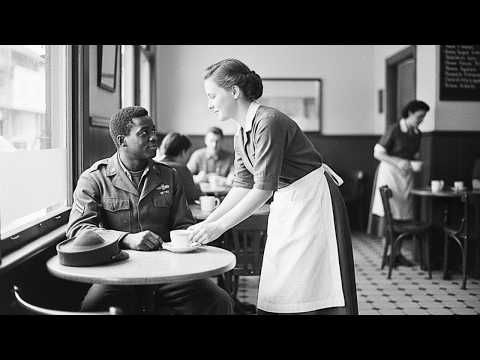
He was Private First Class Elijah Turner, a 23-year-old from Mississippi, a man who had spent his entire life navigating a labyrinth of “whites only” signs and unspoken rules that could get him killed for a wrong glance. He’d been in Australia for three weeks, building airstrips with the 96th Engineer Battalion, and every day he’d watched white soldiers swagger into shops and be greeted like heroes. He’d never dared follow them in.
But today, something—exhaustion, maybe, or the strange, sweet smell of eucalyptus drifting through the open door—pushed him forward. He sat at a corner table, hat in hand, and waited for the rejection he was sure would come.
Instead, the woman brought him a cup of tea and a plate of scones, and she called him “love” again, as if he were just another customer. As if he were normal.
He didn’t know it yet, but that small act of decency was about to collide with the full weight of the United States military—and the fallout would echo for decades.
Because the American military police were always watching. Word traveled fast in a town full of soldiers: a black man had been served in a white establishment. Within hours, two MPs in white helmets and armbands pushed through the café door, their faces hard, their clubs swinging at their belts.
They pointed at Elijah. “You. You know you’re not supposed to be in here. Get out.”
The woman behind the counter didn’t flinch. She wiped her hands on her apron, stepped between the MPs and the table, and said words that would have gotten her arrested back in Mississippi: “This is my shop, and I’ll serve whoever I please. He’s a soldier, same as you. Now get out of my café.”
The MPs threatened to shut her down, to put her business off-limits to all American troops. She didn’t care. She’d already lost her husband to the war in North Africa; she wasn’t about to lose her self-respect.
That night, Elijah returned to camp and told no one. But the story spread anyway—through barracks whispers, through the quiet network of black soldiers who traded addresses of friendly towns and safe pubs. And in the weeks that followed, the same scene played out again and again across Queensland: a black GI hesitating at a door, a shopkeeper offering a smile instead of a slur, an MP showing up to enforce a color line that Australians simply refused to see.
The Americans had assumed Australia—with its White Australia policy and its brutal treatment of Aboriginal people—would fall in line with Jim Crow. They were wrong. Because in the pubs and cafés of Queensland, a different kind of rebellion was brewing, one cup of tea at a time.
And the white American soldiers were watching. Their rage was building, a pressure cooker of resentment that would soon explode into violence on the streets of Brisbane. But that’s a story for another day.
The MPs left that day with their threats hanging in the air like smoke, but the woman—her name was Margaret, though Elijah wouldn’t learn it until his third visit—didn’t so much as blink. She poured herself a cup of tea, sat down at the counter, and watched them go. When Elijah tried to apologize, to say he didn’t want to cause trouble, she waved him off with a floury hand.
“Trouble? Love, trouble is a war in New Guinea and ration books and my husband somewhere in the desert. You drinking a cup of tea is not trouble.”
He laughed—a real laugh, rusty from disuse—and something loosened in his chest that he hadn’t known was tight.
Word of Margaret’s café reached the 96th Engineer Battalion within days. Black soldiers began finding excuses to pass through that particular Queensland town on their leave days, their pockets light but their hopes heavy. They came in twos and threes, hats in hands, and Margaret served them all. Some she recognized. Others she didn’t. It made no difference.
But the military police hadn’t forgotten. They never did.
Two weeks later, a captain from the provost marshal’s office arrived at the café with a typed order and a face like a closed fist. He informed Margaret that her establishment was now officially off-limits to all American personnel—white and black alike. No soldiers. No business. No exceptions.
She read the order slowly, then set it down on the counter and smoothed it flat with her palm.
“These boys came nine thousand miles to fight for us,” she said, loud enough for the half-dozen customers in the room to hear. “And you want me to turn them away because of the color God gave them? You can take your order and post it on the town hall door. I’ll still be open in the morning.”
The captain left. The order went up on the town hall door. And the next morning, Margaret opened as usual—and found a line of Australian soldiers waiting outside, men in slouch hats who’d heard what happened and decided they’d spend their pay at a place that stood its ground.
They ordered tea and meat pies and sat shoulder to shoulder with black American GIs, and when the MPs drove past on their patrol, they found a café packed to the rafters with men who refused to be separated.
Elijah heard about it three days later, from a soldier in the 394th who’d been there. He sat on his bunk that night and stared at the canvas ceiling, and for the first time since he’d left Mississippi, he allowed himself to imagine what it might feel like to go home to a country that had changed.
He didn’t know yet how much blood would be spilled before that day came—or how far the ripples from Margaret’s café would travel.
The captain’s order went up on the town hall door, and for a week the MPs congratulated themselves on a victory. But the war had a way of making fools of men who thought they could draw lines on a map and call it order. Because something was happening in the barracks and the back rooms and the kitchens of Queensland that no typed order could touch.
Australian families had begun inviting black GIs to Sunday dinner. It started quietly—a mother stopping a soldier on the street, asking if he had somewhere to go. Then it spread, one household at a time, until the invitations became a quiet flood. A man from Alabama sat at a wooden table in Ipswich with roast lamb growing cold on his plate because he couldn’t stop staring at the white family passing him the potatoes. The father asked about his mother back home. The children asked if he’d ever seen a kangaroo. Nobody asked him to leave.
Elijah received his own invitation in late April, from a woman named Doris who ran a fruit stall near the camp and had a son fighting in New Guinea. “You look like you haven’t had a proper meal in a month,” she told him. “Sunday. Two o’clock. Bring your appetite.”
He went. He sat at her table with her husband and her daughter and ate until he couldn’t move, and when he tried to thank her, she waved him off the way Margaret always did.
But kindness has a way of making cruelty angry, and the white American soldiers had been watching all of it—the dances, the dinners, the women who laughed at jokes told in Southern drawls that weren’t their own. The rage had been building for months, and it was no longer a matter of if it would break. Only when.
It broke in Townsville first. A group of white soldiers cornered three black GIs outside a dance hall, and the fight that followed left one man with a broken jaw and another with a knife wound in his side. The MPs arrived, took statements, and filed the whole thing away where no one would find it.
Then came Rockhampton, where a white sergeant fired two shots at a black soldier walking home from a pub. He missed. He claimed the man had insulted a white woman. No one asked which woman. No one asked anything at all.
Each incident was buried, hushed, smoothed over. The military did not want anyone to know that American soldiers were drawing blood from each other on Australian soil. But the black troops knew. They traded the stories the way they traded addresses and names, and the knowledge settled into them like a stone.
Elijah heard about the shooting in Rockhampton from a friend in the 567th. He sat on his bunk that night and thought about Margaret’s café, about Doris’s Sunday table, about the way the world had looked for one bright moment like it might be different.
Then he thought about the men who wanted to take it all back.
And he understood, with a clarity that chilled him, that the storm was no longer coming. It was already here.
The storm broke on the night of November 26th, 1942, in Brisbane—not with a single thunderclap but with a slow, ugly unraveling. Near the American Post Exchange on Adelaide Street, an MP struck an Australian soldier, and months of resentment between the two armies poured into the streets. Fists, bottles, clubs. Windows shattered. Men bled on the sidewalks. Then the shots rang out, and a young Australian private named Norbert Grant fell dead.
The Battle of Brisbane, they called it. Two nights of chaos that the censors buried so deep most Australians wouldn’t learn the truth for decades. But Elijah didn’t need a newspaper to understand what had happened. He could feel it in the way the MPs watched the black troops afterward, harder and meaner. He could feel it in the silence of the white soldiers at the mess hall.
And still, the cafés stayed open. Margaret kept pouring tea. Doris kept setting an extra place on Sundays.
When the war ended in 1945, Elijah boarded a ship home with a letter from Margaret folded in his pocket and a truth burning in his chest. He stepped off the gangplank into a Mississippi that had not changed—the same fountains, the same back seats, the same lowered eyes. But he had changed. You cannot show a man another world and expect him to forget it.
He registered to vote. He joined the NAACP. He told his children about a woman who called him love and a country that treated him like a man, and those stories became the fuel for a fire that is still burning today.
So here is the question I leave with you: if a single cup of tea, offered without hesitation, could help crack the foundation of Jim Crow—what small, ordinary kindness might you offer today that could ripple further than you will ever know?
Report this article
Select a reason for reporting:






