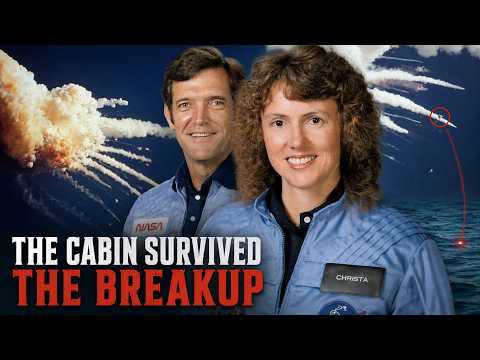
Most people believe the seven astronauts aboard the space shuttle Challenger died instantly. That the moment the shuttle broke apart on that cold January morning in 1986, a sudden explosion consumed them in a flash of fire and they felt nothing. That version of events is comforting. It is also almost certainly not what happened.
What really happened is far more disturbing and far more human than the sanitized version NASA allowed the world to believe for years. Because the crew cabin – the reinforced compartment where all seven astronauts were seated and strapped in – survived the breakup of the vehicle. It held together.
It was ejected from the expanding fireball more or less intact. And it continued to climb, carried by the momentum of its own velocity, arching upward to a peak altitude of roughly 65,000 feet before beginning a long silent ballistic descent toward the Atlantic Ocean below.
That descent lasted 2 minutes and 45 seconds, and there is physical forensic evidence recovered from the ocean floor weeks later that at least some of the crew were alive and conscious during part of it.
This is the story that NASA did not want to tell. Not because they were hiding a conspiracy, but because the truth revealed something far worse than an engineering failure. It revealed a systemic institutional blindness, a culture of bureaucratic arrogance, and a failure to protect the lives of the people it sent into the sky.
And it raises a question that has haunted the families, the investigators, and the engineers who tried to stop this launch for nearly four decades: If we had simply listened, would any of this have happened at all?
To understand why the crew cabin surviving matters so much, you first need to understand the world that built the Challenger disaster in the first place.
By the mid-1980s, NASA had transformed the space shuttle from a marvel of engineering into something it was never supposed to be: a routine bus service to orbit. The agency was under immense political and budgetary pressure to prove that the shuttle was safe, economical, and reliable. 15 flights were on the manifest for 1986 alone.
Commercial payloads, military satellites, scientific experiments – all stacked up like flights at a congested airport. The shuttle was supposed to be America’s workhorse, launching so regularly that space flight would become as ordinary as catching a commercial airliner.
But the shuttle was not ordinary. It was one of the most complex machines ever built. A vehicle that straddled the line between aircraft and spacecraft with over two and a half million individual parts. And among those millions of components, there were a handful that engineers had been worried about for years.
Chief among them were small rubber seals called O-rings, nestled in the joints between the segments of the shuttle’s massive solid rocket boosters. These O-rings were supposed to expand under pressure and heat, sealing the joints and preventing superheated exhaust gases from leaking out during the violent ignition and ascent.
But the O-rings were made of synthetic rubber. And rubber, as any materials engineer will tell you, behaves very differently in the cold.
Going into the winter of 1985 and 1986, engineers at Morton Thiokol, the Utah-based contractor that manufactured the solid rocket boosters, had been documenting a troubling pattern. On previous shuttle flights, particularly those launched in cooler temperatures, inspections of the recovered boosters revealed alarming signs of erosion and blow-by on the O-ring seals. The rubber was stiffening, losing its resiliency, failing to seat properly in the joint.
In March of 1985, internal tests confirmed that the O-ring material had significant resiliency problems when temperatures dropped below roughly 53°F. By July of that year, one Morton Thiokol engineer had circulated a memo expressing, in his own words, a definite fear of losing a flight due to these conditions. The word he used to describe what would happen if the seals failed was catastrophe. The loss of human life.
His name was Roger Boisjoly, and he was about to be proven right.
The mission designated STS-51L had already been delayed six times. Originally scheduled for the previous week, it had been pushed back repeatedly due to weather, technical issues, and delays in getting the prior shuttle mission back on the ground. But the powers at NASA were running out of patience.
This was not just another flight. This was the flight that carried Christa McAuliffe.
McAuliffe was a 37-year-old social studies teacher from Concord, New Hampshire. She had been selected from over 11,000 applicants for NASA’s Teacher in Space Project, a public relations initiative designed to bring space flight to the American classroom and reignite public excitement about the shuttle program. She was supposed to become the first private citizen in space. She was supposed to teach lessons live from orbit, broadcast into schools across the country.
She said when she was first announced that it was not often that a teacher was at a loss for words, and that though it was one body going up, she was taking 10 souls with her. She was bright, charismatic – the kind of person who made space feel accessible and human. And her presence on this flight was the centerpiece of NASA’s public engagement strategy.
President Ronald Reagan was scheduled to deliver his State of the Union address the very evening of the planned launch, and the intention was to mention McAuliffe and the Teacher in Space mission. According to the mission plan, McAuliffe would broadcast her first lesson from orbit on the fourth day of the flight. A Tuesday launch meant a Friday broadcast when students would be in school. A Wednesday launch pushed it to Saturday. NASA wanted that Friday window.
The pressure was immense, but so was the cold.
On the evening of January 27th, 1986, Central Florida was struck by a severe cold wave. Temperatures at the Kennedy Space Center plunged well below freezing. Icicles formed on the launchpad, on the service tower, on the cameras, on the walkways. The only emergency evacuation route the crew could use was coated in ice.
A team from the Thiokol ice and debris assessment was sent to inspect the pad, and what they found was alarming. The ambient air temperature around the right solid rocket booster was measured at roughly 8°F – far below the threshold the O-ring engineers had warned about.
That night, in a now infamous teleconference between Morton Thiokol engineers in Utah and NASA managers at the Marshall Space Flight Center in Alabama and the Kennedy Space Center in Florida, the engineers made their case. Roger Boisjoly and his colleague Bob Ebeling argued forcefully that the launch should be delayed until temperatures rose above 53°F. They presented data. They showed charts. They argued that the O-rings would stiffen in the cold and would not seal properly. They recommended explicitly that NASA not launch.
At first, the Thiokol executives on the call agreed. They said they would not approve the launch. But NASA’s reaction was not what the engineers expected.
Lawrence Mulloy, the manager from NASA’s Marshall Space Flight Center, responded with incredulity. According to Ebeling’s recounting, Mulloy fired back something to the effect of, “My god, Thiokol, when do you want me to launch? Next April?”
This was the pressure point. The Thiokol executives asked NASA to hold while they discussed internally. Boisjoly, Ebeling, and the other engineers in the room were insistent. It was too dangerous. But the senior vice president Jerry Mason began polling the executives. Three quickly agreed to reverse the engineers’ recommendation and approve the launch. Then Mason turned to Bob Lund, the vice president of engineering, who hesitated, visibly conflicted. Lund was the last holdout – the man caught between his engineering judgment and his management obligation.
He relented.
The engineers were devastated. Boisjoly later testified before Congress, choking back tears, that he had fought like hell to stop that launch, that he was so torn up inside he could hardly talk about it. Bob Ebeling, who was among the first to sound the alarm, would carry the weight of that night for the next 30 years. In 2016, just weeks before his death at 89 years old, Ebeling told a reporter that putting him on that conference call had been one of the mistakes that God made – something he prayed about constantly.
The engineers at Thiokol knew. They knew what was going to happen. And they were overruled.
The morning of January 28th dawned bright and bitterly cold. The temperature at the launch pad at the time of launch was 36° Fahrenheit – 15° colder than any previous shuttle launch. The icicles on the launch pad were photographed extensively.
Inside the orbiter, the crew strapped in, suited in their standard flight jumpsuits and helmets, but critically not wearing pressurized space suits. That decision, born from NASA’s confidence that the shuttle was a routine vehicle, would become one of the most damning details of the investigation that followed.
At 11:38 in the morning, Eastern time, the Space Shuttle Challenger lifted off from launchpad 39B at the Kennedy Space Center.
Seated on the upper flight deck were Commander Francis “Dick” Scobee, a Vietnam War veteran and experienced test pilot on his second shuttle mission. Beside him was pilot Michael Smith, a Navy test pilot, making his very first trip to space. Behind them sat mission specialists Ellison Onizuka, a quiet, steady Air Force engineer from Hawaii, and Judith Resnik, a brilliant electrical engineer who had already flown on the shuttle once before. On the lower mid-deck, where there were no windows, sat mission specialist Ronald McNair, a physicist and the second African-American to fly in space; payload specialist Gregory Jarvis, an engineer from Hughes Aircraft; and Christa McAuliffe, the teacher.
For the first few seconds, the ascent appeared nominal. The shuttle cleared the tower. The solid rocket boosters were burning. Mission control gave the call for throttle up, and Commander Scobee acknowledged.
Then, at approximately 73 seconds after liftoff, at an altitude of roughly 46,000 feet, traveling at nearly twice the speed of sound, everything fell apart.
The O-ring in the right solid rocket booster had failed exactly as the engineers predicted. The cold had stiffened the rubber, and a tiny gap – less than a millimeter – had opened between the booster segments. Within seconds of ignition, hot exhaust gases began burning through the joint. A small plume of flame appeared on the side of the booster, growing rapidly, and within 3 seconds, it had breached the external fuel tank’s thin aluminum skin.
The tank ruptured. Liquid hydrogen and liquid oxygen mixed violently. The resulting fireball was enormous. But it was not, strictly speaking, an explosion in the way most people imagine it. The shuttle was not blown apart by a detonation. It was torn apart by aerodynamic forces.
The fuel tank disintegrated, releasing a massive cloud of propellant and fire. The orbiter, suddenly exposed to the full force of the airstream at Mach 1.92, was ripped to pieces. The wings sheared off, the tail section separated, the payload bay fractured.
And then something happened that almost nobody expected.
The crew cabin – the reinforced double-walled aluminum compartment that housed all seven crew members – separated from the rest of the vehicle largely intact. The same aerodynamic forces that destroyed the rest of the shuttle effectively sheared the crew compartment away from the disintegrating airframe, ejecting it from the expanding cloud of fire and debris. It was still in one piece.
Now, let us stop and consider the physics of what happened next. Because this is where the official story and the uncomfortable reality begin to diverge.
The crew cabin separated from the vehicle at roughly 48,000 feet. At that moment, based on NASA’s own later analysis, the acceleration forces acting on the cabin were between 12 and 20 G’s, lasting for less than 2 seconds before quickly dropping to around 4 G’s and then stabilizing into free-fall within 10 seconds. These forces were violent, yes, but according to the Rogers Commission and NASA’s own post-accident analysis, they were – and this is a direct finding – probably not sufficient to cause death or serious injury.
The crew module stabilized in a nose-down orientation within 10 to 20 seconds of separation, and it continued to coast upward, carried by its residual velocity, climbing to a peak altitude of approximately 65,000 feet before beginning its long curving descent toward the ocean.
At 65,000 feet, the atmospheric pressure is almost negligible. Without a pressurized cabin or pressurized space suits, human consciousness at that altitude would be measured in seconds. If the cabin lost pressure during the breakup – which most investigators believe is likely – the crew would have been exposed to a near vacuum and rapid loss of consciousness would have followed within approximately 6 to 15 seconds.
This is the most charitable interpretation, and the one that NASA officially leaned toward: that the crew was rendered unconscious almost immediately after the breakup and felt nothing during the descent.
But the evidence is not entirely consistent with that conclusion.
When recovery divers located the crew cabin on the ocean floor on March 7th, 1986 – roughly 6 weeks after the disaster – what they found told a more complicated story. The cabin was crushed and mangled from its impact with the water, having hit the surface of the Atlantic at approximately 207 mph, generating an estimated 200 G’s of force – far beyond any possibility of survival.
But within the wreckage, investigators found something that changed the narrative entirely.
Four personal egress air packs, known as PEAPs, were recovered. These were small emergency breathing devices mounted on the backs of the astronauts’ seats, designed to provide roughly 6 minutes of breathable air in case of an emergency on the launchpad – such as a cabin fire or a toxic atmosphere during ground evacuation. They were never intended for in-flight use. They were not designed to supply pressurized air at high altitude. They simply provided a flow of breathable air through a hose connected to the crew member’s helmet.
Of the four PEAPs recovered, three had been manually activated. The one that had not been activated belonged to Commander Scobee. One of the activated packs was identified as belonging to pilot Michael Smith. The remaining two that were activated could not be definitively associated with specific crew members, but based on their location, investigators concluded they belonged to mission specialists Ellison Onizuka and Judith Resnik.
Here is where it gets important. The activation switch for Smith’s PEAP was located on the back of his seat. Smith, strapped into the pilot’s seat facing forward, could not have reached it himself. Someone behind him – either Resnik or Onizuka – had reached forward and turned it on for him.
Think about that for a moment.
In the immediate aftermath of the most violent structural failure imaginable, with the shuttle disintegrating around them, at least two crew members had the presence of mind, the composure, the raw courage to reach forward and activate their pilot’s emergency air supply. There was nothing in their training that covered this scenario. The PEAPs were designed for ground emergencies. No one had ever trained for activating them during an in-flight breakup. And yet, someone did it anyway.
Fellow astronaut Mike Mullane, who was close to the crew, later reflected on this moment. He wondered whether he would have had the presence of mind to do the same thing, or whether he would have been locked in paralytic fear. The fact that Resnik or Onizuka had reached for that switch – had blocked out the terrifying sights and sounds and motions of the shuttle’s destruction and acted – he described as the mark of a true astronaut. Maintaining composure in the direst of circumstances. He called it heroic.
Further forensic analysis of the wreckage revealed additional evidence that at least some crew members were conscious after the breakup. Several electrical switches on the pilot’s control panel had been moved from their launch positions. These were not switches that would have been displaced by impact forces or random vibration. The pattern was consistent with pilot Mike Smith attempting to restore electrical power to the cabin – a deliberate, purposeful action.
The voice recorder captured Smith uttering a single phrase just before the breakup: the now-famous quiet “Uh oh.” The last sound recorded before all data was lost. After that, the cabin had no electrical power, no communications, no telemetry. The crew was in a dead ship falling.
But were they conscious for the entire fall? This is the question that has haunted investigators, families, and the broader space community ever since. And the honest answer – the one that NASA’s own Dr. Joseph Kerwin provided in his official crew report released in July of 1986 – is that we do not know for certain.
Kerwin, a biomedical specialist from the Johnson Space Center, was commissioned to examine all available evidence and determine what happened to the crew. His conclusions were carefully worded but devastating in their implications. He found that the forces during the orbiter breakup were probably not sufficient to cause death or serious injury. He found that the crew possibly, but not certainly, lost consciousness in the seconds following the breakup due to loss of cabin pressure. He found that the activation of the PEAPs could have been an instinctive response to unexpected decompression rather than evidence of sustained consciousness. He noted that at 48,000 feet and above, without supplemental oxygen at proper pressure, loss of consciousness would have been rapid. And he concluded finally that the cause of death of the Challenger astronauts could not be positively determined because the violence of the ocean impact had destroyed most of the forensic evidence.
In other words, the official finding was inconclusive. The crew may have been unconscious for the majority of the fall, or they may not have been. The PEAPs were not designed to provide pressurized air at altitude, so even if they were activated, they would not have sustained consciousness above roughly 20,000 feet. But the cabin was reinforced, double-walled, and designed to withstand significant structural loads. There is a real possibility that the cabin maintained its structural integrity and at least partial pressurization during the initial seconds after breakup, even if it eventually depressurized at some point during the descent.
Some investigators, including three-time shuttle commander Robert Overmyer – who was one of Commander Scobee’s closest friends and owned a plane with him – were more direct. Overmyer stated flatly that there was no question the astronauts survived the breakup, and that he knew Scobee well enough to know that Scobee would have done everything in his power to save his crew.
The crew cabin fell for 2 minutes and 45 seconds. It stabilized in a nose-down attitude, yawing back and forth slightly during its ballistic descent. To the crew, if any of them were conscious, the experience would have been a slow, grinding free fall with the ocean growing closer and closer in whatever fragments of the shattered windows remained visible. They would have had no control surfaces, no engines, no communications, no way to slow down, and no way to escape.
The shuttle had no ejection seats. It had no crew escape system. It had no parachutes. Those systems had been deliberately omitted from the shuttle’s design – partly to save weight, partly because NASA believed the shuttle was safe enough to not need them. That decision, in the cold light of the Challenger aftermath, was exposed as a catastrophic institutional failure.
When the cabin finally struck the Atlantic, it was traveling at roughly 207 mph. The impact generated forces estimated at more than 200 G’s. The cabin shattered on contact, and the broken wreckage sank to the ocean floor, scattering across a debris field approximately 60 feet wide at a depth of roughly 100 feet.
The remains of all seven crew members were eventually recovered from within the wreckage, still strapped into their seats with all harnesses locked.
The recovery operation itself was grim and painstaking. Divers Terry Bailey and Mike Mallister were the first to find the cabin. They were nearly out of air in their tanks, swimming through murky wind-churned water near the ocean floor when they almost bumped into what appeared to be a tangle of wire and metal. Then Bailey noticed something that stopped him cold: an inflated space suit floating legs-up toward the surface, with someone inside it. He corrected himself quickly, remembering that shuttle astronauts did not wear pressurized space suits during ascent. It was one of the two spacewalk suits that had been stowed aboard, inflated by the water. But that suit was tangled in what turned out to be the wreckage of the crew cabin.
The divers marked the site with a buoy and surfaced to report what they had found. The next morning, the USS Preserver recovery ship deployed its full diving team. They worked slowly and carefully. The wreckage was twisted, jagged, and dangerous, with sharp metal edges jutting in every direction. The first remains recovered were those of Judith Resnik, then Christa McAuliffe. The operation had to be paused and the wreckage itself hauled to the surface because the tangled debris was too hazardous for the divers to continue working underwater.
Eventually, the remains of all seven crew members were recovered, transported to Dover Air Force Base in Delaware, and returned to their families for final disposition.
The emotional toll of the disaster was immense and far-reaching. But what made it worse – what turned grief into outrage – was what the investigation revealed about how preventable it had been.
The Rogers Commission’s findings, delivered in June 1986, laid bare a culture that had normalized deviance. Each successful flight with O-ring anomalies had made the next anomaly seem more acceptable. The baseline shifted. What began as a concerning deviation became expected variation and then, eventually, just normal operation.
Richard Feynman’s simple demonstration – a piece of O-ring rubber clamped in a vise and dipped in ice water – made the failure undeniable. “For a successful technology,” he wrote, “reality must take precedence over public relations, for nature cannot be fooled.”
NASA implemented over 200 changes: redesigned booster joints, pressure suits, escape poles. Yet 17 years later, Columbia repeated the pattern – engineers raised concerns, warnings were diluted, and management normalized the risk. Nature was not fooled again.
Roger Boisjoly spent his remaining years lecturing on engineering ethics, dying in 2012. Bob Ebeling carried the guilt for 30 years until, weeks before his death, hundreds of listeners wrote to tell him he was not to blame. June Scobee Rogers founded the Challenger Center, reaching millions of students – carrying forward the mission her husband never completed.
The crew cabin survived the breakup. Whether the crew survived it too may never be answered. But the activated air packs, the repositioned switches – these speak to who they were. Not passive victims. Even in catastrophe, they acted.
That is what Challenger teaches us: when institutions prioritize image over truth, when the people closest to the risk are overruled by those furthest from it, tragedy follows. If we had simply listened, would any of this have happened at all?
What would you have done in that conference call – would you have held the line?
Report this article
Select a reason for reporting:






