In 1893, the Waldorf Hotel opened as a gleaming beacon of luxury for New York’s elite, but beneath its polished exterior lay a hidden world. For every four or five guest rooms, there was a secret floor—100 servant rooms where a workforce of hundreds labored around the clock. This invisible army sustained the Waldorf’s reputation, ensuring immaculate service while remaining unseen. But when this hidden labor force struck in 1934, the delicate balance of wealth, class, and power was disrupted forever. What happens when the invisible hands that keep luxury alive decide to be seen?
William Waldorf Astor stood at the corner of Fifth Avenue and 33rd Street in 1891, surveying the plot that would transform his family’s legacy. The Astors had built their fortune on fur trading and Manhattan real estate, accumulating wealth rivaling European royalty. But wealth alone was not enough. William Waldorf wanted something more permanent than money—a temple to American aristocracy that would outlast him and define what it meant to live at the pinnacle of society. The vision was audacious: 450 guest rooms across 13 floors, each suite designed to rival the private residences of millionaires, with hand-carved mahogany furniture, silk wallpapers, and Persian rugs. The hotel would offer unheard-of amenities: private bathrooms with hot and cold running water, electric lighting, and telephone service. Architect Henry Hardenberg received a simple directive: “Build the most magnificent hotel in the world. Spare no expense.” The budget ballooned to $1.5 million—over $47 million today.
But the true genius of the Waldorf lay not in what guests could see, but in what they could not. For the hotel to function, it required an infrastructure as complex as a small city: kitchens serving hundreds of meals simultaneously, laundries processing thousands of sheets daily, and housing for the army of workers who operated this machinery of luxury. The Gilded Age demanded perfection, with service instantaneous and invisible. Hundreds of people working in coordinated silence, maintaining the illusion that luxury simply existed naturally, requiring no human effort. Astor and Hardenberg understood this fundamental truth: the hotel’s grandeur depended entirely on hiding the mechanisms that produced it. The question was not whether to employ hundreds of workers, but how to keep them out of sight. The answer would be built into the very architecture, creating a two-tiered world that defined class division in physical space.
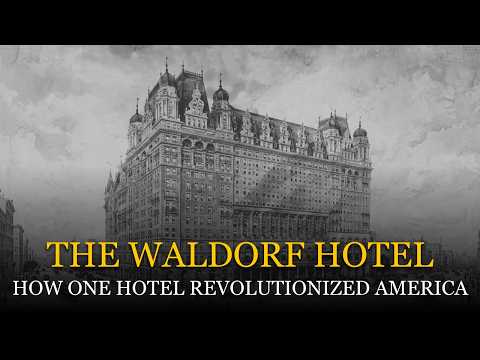
When the Waldorf opened on March 13, 1893, New York society marveled at the marble staircases and gilded ballrooms. They praised the innovation and ambition, but never thought to ask about the hands that polished those marble floors or the bodies that hauled luggage up back staircases. The dream had been realized. Now it had to be maintained. As construction began, the design decisions by Astor and his architects set the stage for a labor force that would remain unseen. The blueprints revealed a building designed for segregation—not legal, but architectural, making class division seem natural and inevitable. Henry Hardenberg divided the 13-story building into distinct zones. The first two floors belonged to the public: grand lobbies with 20-foot marble columns, reception halls with coffered ceilings, and the famous Peacock Alley, a 300-foot corridor where society women promenaded in gowns worth thousands. Floors 3 through 12 housed guest rooms—the profit centers, with 30 to 40 suites per floor. The 13th floor was different. This was where the hidden world began: 100 servant rooms, each roughly 10 by 12 feet, deliberately isolated from the guest experience, accessible only through separate staircases that began in the basement and bypassed every guest floor entirely.
The architecture enforced invisibility through deliberate design. Service elevators ran in separate shafts from guest elevators. Staff corridors paralleled guest corridors but never intersected. Kitchen access came through underground tunnels, ensuring delivery wagons never appeared at the main entrance. Every four to five guest rooms required one servant room—a precise ratio for 450 guest rooms, 100 servant rooms housed the essential overnight staff: chambermaids, night porters, laundry workers, and kitchen staff. The spatial organization created a vertical hierarchy mirroring social hierarchy. The wealthy occupied the middle, the most desirable space with the best views. The working class occupied the extremes—the basement and the top floor, farthest from public view. But segregation went beyond floor assignments. Servant quarters featured none of the luxuries of guest rooms: no private bathrooms, no telephones, no carpeting. Plain plaster walls painted institutional white, bare wooden floors, windows facing alleys and rear courtyards. In summer, the top floor became stifling as heat rose; in winter, it was the coldest area of the hotel. The coal-fired heating system prioritized guest comfort over worker welfare.
Hardenberg had created what architectural historians would later call a servant architecture—a design philosophy that treated workers as functional components rather than human occupants. The servant rooms were storage spaces for labor, designed for maximum efficiency rather than livability. The genius of the system was its invisibility to those it was designed to serve. Guests arriving at the Waldorf saw only the front stage: the marble, the gold, the crystal. They never glimpsed the backstage: the narrow corridors, the institutional dormitories, the industrial machinery. The architecture made it easy to believe that the hotel simply functioned through some mysterious alchemy, that clean sheets appeared and dirty dishes disappeared through forces as natural as the sunrise. This was not accidental. This was intentional. The building itself was a mechanism for maintaining class boundaries, for ensuring that the wealthy never had to confront the human cost of their comfort. And it worked for 40 years. It worked perfectly until the day the invisible became visible and the architecture of class could no longer contain the people it was designed to hide.
Beneath the Waldorf’s lavish exterior, more than 600 workers toiled in silence, maintaining the hotel’s world-class standards. The workforce was an organism: complex, interconnected, precisely calibrated. 637 employees on the opening day roster; by 1895, over 800. Each person occupied a specific role in an intricate hierarchy. At the top stood managers earning $50 to $75 per week, living in private apartments outside the hotel. Below them, department heads—head concierge, chief engineer, head housekeeper, executive chef—earning $30 to $40 per week, living in modest apartments in Manhattan or Brooklyn. Then came skilled workers: waiters earning tips that could double their $12 base salary, bartenders, cooks, tailors. But the majority existed at the bottom: chambermaids, porters, dishwashers, and laundry workers earning between $6 and $10 per week. Women earned less than men for comparable work. African-American workers earned less than white workers, regardless of skill or experience. For many, the servant rooms on the 13th floor were not temporary housing—they were home.
A chambermaid named Mary Sullivan started at the Waldorf in 1894 and lived in room 1327 for 11 years. Her entire life fit into a 10×12-foot space: a narrow bed, a small dresser, a single chair, a kerosene lamp. Mary’s day began at 5 a.m. She would dress in her uniform—a simple black dress with white apron and cap—and descend the back stairs to receive her assignment: 12 rooms to clean before the 1 p.m. deadline. 12 rooms meant making 24 beds, emptying and cleaning 12 chamber pots, dusting every surface, sweeping and mopping floors, replacing towels and linens, ensuring everything appeared untouched. The work was exhausting. A chambermaid walked an estimated 8 to 10 miles per day, climbing stairs, pushing heavy carts, hauling buckets of water. Her hands were perpetually raw from harsh soaps; her back ached from bending and scrubbing. And she was expected to be invisible. If a guest appeared in a hallway, she was to flatten herself against the wall and lower her eyes until they passed. The management manual was explicit: staff must never speak to guests unless addressed directly, never make eye contact, never use the main elevators or walk through public corridors, maintain absolute silence while working. Violations resulted in immediate termination. No appeals, no second chances.
The labor market in 1890s New York was saturated with desperate workers—immigrants arriving by the thousands at Ellis Island, rural Americans fleeing agricultural poverty. The Waldorf could replace any worker within hours. This replaceability shaped the entire labor system. Workers had no bargaining power, no job security, no benefits. If you became sick or injured, you were fired. If you complained about conditions, you were fired. If you could not maintain the punishing pace, you were fired. The 800 workers formed a machine. Each person a cog designed to perform a specific function. The chambermaids cleaned. The porters carried. The cooks prepared. The waiters served. The laundry workers washed. The engineers maintained. The doormen greeted. The telephone operators connected. The seamstresses repaired. The florists arranged. The dishwashers scrubbed. And above them all, the guests enjoyed a seamless experience, utterly unconscious of the hundreds of people working in synchronized choreography to create the illusion that luxury was effortless. The economic equation was brutally simple. The hotel charged premium prices: $5 per night for a single room—equivalent to an entire week’s wages for a chambermaid—$10 to $15 for suites. In a typical month, the Waldorf collected over $60,000 in room charges alone. The profit margin depended on keeping labor costs low. If the hotel paid workers fairly and provided adequate housing and reasonable hours, the economics would not work. The luxury would not be affordable to the wealthy patrons. So the system required exploitation. It was not a flaw in the design. It was the design.
William Waldorf Astor had created his monument to American luxury, but it stood on a foundation of human exhaustion, desperation, and systematic inequality—a foundation that would prove far less stable than the steel and stone of the building itself. The workers understood this. They saw the contradiction every day. They polished silver serving pieces worth more than their annual salary. They made beds covered in linens finer than any fabric they would ever own. They served meals that cost more than they earned in a month. And they said nothing—because they needed the work, because they had no choice, because the system was designed to give them no choice. But systems built on exploitation carry within them the seeds of their own destruction. It would take 40 years for those seeds to germinate, but when they did, the harvest would be bitter for those who had sown them.
Up on the 13th floor, far from the glamour, was a city within a city. 100 rooms arranged in a grid, connected by narrow corridors painted institutional beige. The air smelled of lye soap, kerosene, and bodies living in close quarters. Room assignments followed a strict hierarchy even here: senior workers occupied rooms near the communal bathrooms; newer workers took the far ends of corridors. Single women occupied one wing, single men another. The rooms were furnished identically: one iron bed with a horsehair mattress, one wooden dresser, one straight-backed chair, one small washstand, one 12-inch mirror, one window facing an air shaft. 120 square feet per person—compared to the smallest guest rooms at 350 square feet.
Privacy was impossible. The walls were thin plaster over wood lath; every cough, every conversation, every moment of illness was audible to neighbors. The doors had no locks—management could enter at any time to search for contraband or evidence of moral violations. The bathroom served 20 workers: five shared toilets, three sinks, two bathtubs. Hot water flowed only from 6 to 8 in the morning and evening, and workers on different shifts often missed those windows entirely. Despite the restrictions, they created community. They shared food from street vendors, played cards for pennies, sang songs from Poland and Ireland and Italy and Germany. They courted and fell in love in stolen moments between shifts.
But the physical toll was relentless. Tuberculosis was endemic in the 1910s and 20s, killing dozens. Bed bugs and lice were constant problems. The hotel provided no medical care. In the basement, the true machinery of the hotel hummed: laundries where steam-filled rooms exceeded 110 degrees, where women operated mangles that could crush fingers if attention lapsed. Agnes Murphy worked in the laundry from 1898 until 1906, when she collapsed from heat exhaustion. She was 32. The hotel sent her to Bellevue and replaced her the next day. She died three years later, her lungs permanently damaged by years of breathing steam laced with bleach and lye.
Thomas Chen, a Chinese immigrant who worked as a plongeur from 1900 until 1923, later recalled: “My hands were never dry, never clean, really clean. The soap got into cuts and burned. The heat made breathing hard, but you could not slow down. The dishes kept coming. Mountains of dishes. If you fell behind, you were fired.” All of this labor existed for a single purpose: to ensure that when a wealthy guest pressed a call button, a uniformed worker appeared within three minutes. The workers understood the equation. Their suffering produced someone else’s pleasure. Their exhaustion enabled someone else’s leisure. Their poverty subsidized someone else’s luxury. This knowledge created a quiet resentment that simmered beneath professional courtesy—but for decades, that resentment had no outlet.
Report this article
Select a reason for reporting:






