In the cramped, glass-encased tail of a B-17 Flying Fortress, a lone gunner knelt facing backward, watching the sky for the flash of enemy fighters. The tail gun station was both a vital defensive position and a potential death trap—a place where the line between survival and catastrophe was measured in inches of armor and the thickness of a windowpane. For the men who manned it, every mission was a high-stakes gamble against the odds.
The tail gunner had advantages: twin .50 caliber machine guns, a well-armored torso, and a clear field of fire. But the statistics told a grimmer story. Studies of returning crews showed tail gunners and navigators suffered more wounds than any other position. Yet, more comprehensive data from the 95th Bomb Group placed tail gunners squarely in the middle of the casualty pack—waist gunners bore the highest toll. Still, the tail gunner’s war was fought in isolation, at the very edge of the formation, where the enemy first appeared.
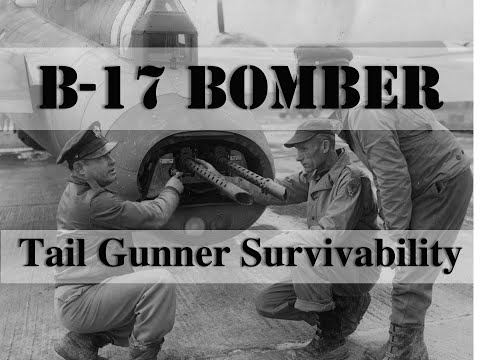
Kneeling rearward, the gunner’s world was a blur of adrenaline and precision. His station, with its thin aluminum skin—as thin as a credit card—and plexiglas windows, offered little protection from cannon shells. Only the rear viewing pane, a 2.5-inch thick slab of ballistic glass, and the frontal armor promised to stop a standard 30-caliber bullet. Everything else was a calculated risk. The guns, mechanically linked and harmonized to a ring sight, were hand-cranked, not powered like other turrets. The gunner’s arc of travel was limited to 30 degrees in each direction, but within that cone, his aim was deadly accurate.
The tail station’s design evolved from the early “stinger” to the later Cheyenne tail, which improved visibility and added a gun sight. But most B-17s—about 65 percent—retained the stinger type, with its simpler windows and exposed mechanics. In the stinger, the gunner had to contend with the tail wheel articulating into the fuselage, a cumbersome obstruction when moving to the waist section. And in an emergency, he could jettison his entry door with a pull of a lever, a feature that might mean the difference between life and death.
Flow deflectors on the barrel muzzles helped manage the back pressure gases that could throw off adjacent bullets, a small but crucial detail in the chaos of combat. Below the guns, formation bombing signal lights flashed white when the bomb bay doors opened, red for five seconds with each bomb dropped—a silent communication in the roar of engines and gunfire. The tail gunner’s survival depended on more than armor and guns; it relied on his ability to track, range, and deflect, all while kneeling in a glass box that was both shield and vulnerability.
As the war raged on, the data and the design evolved, but the tail gunner’s experience remained a unique blend of isolation and intensity. His story is one of countless untold acts of courage in the skies over Europe—a story that begins, like all missions, with the roar of engines and the cold, thin air of the stratosphere.
The gunner’s entry and bailout door, positioned just to his right, was his lifeline. In a bailout, he could jettison it with a single pull of the emergency release lever—no small advantage when seconds mattered. But before that moment ever came, he had to fight. And to fight, he had to see.
His right-side window could be opened, letting in the frigid slipstream and the smell of cordite. The other windows were plexiglas, easily scratched, easily fogged—except for that rear pane, the thick ballistic glass that framed his entire world. Through it, he watched the sky for the telltale glint of a Focke-Wulf or the dark specks of a fighter swarm forming up.
“Bandits, six o’clock low!” The call would crackle over the intercom, and the gunner’s hands would find the spade grips of his twin Brownings. Each gun was belt-fed from a 500-round ammo box, capable of chewing through fourteen rounds per second. He didn’t need to compensate much for deflection—the tail station’s geometry made tracking a fighter almost intuitive. That accuracy made him deadly.
But the same geometry that made him accurate also made him a target. Attacking fighters often aimed for the tail first, hoping to knock out the bomber’s rear-facing sting before pressing their attack. The gunner’s frontal torso armor could stop a 30-caliber round, but the Luftwaffe’s cannon shells were another matter entirely. The thin aluminum skin around him—24ST clad, equivalent to modern 2024-T3—was riveted in single rows, lap-spliced, and offered little more than a psychological comfort.
He used a 35mm ring sight, maintaining a 20-inch sight base from his eye to the ring. A removable etched deflection window overlay could be clipped in place, helping him relay drift corrections to the navigator. Fix on a ground object, read the drift, pass it along—a small act of navigation in the middle of a firefight.
The guns themselves were hand-manipulated, not powered. No hydraulic assist, no electric turret drive. Just the gunner’s own strength against the slipstream and the recoil. His arc of travel: 30 degrees right, left, up, down. Within that narrow cone, he was the bomber’s last line of defense.
And below the barrels, the formation bombing signal lights blinked their silent code—white when the bomb bay doors opened, red for five seconds with each bomb away. The gunner watched them, counted them, and then turned his eyes back to the rear, where the sky was always waiting.
The cold was a constant companion in the stinger tail. At 25,000 feet, the slipstream pouring through the open right-side window could freeze exposed skin in seconds, and the gunner’s electrically heated suit was his only defense against frostbite. He wore silk gloves beneath leather gauntlets, a heated vest, and a leather flying helmet with the intercom cord snaking down to the radio jack. Still, the cold seeped in—through the rivets, through the plexiglas, through the thin aluminum that was all that separated him from the void.
Every mission followed the same rhythm. The long climb to altitude, the tightening of the chest as the oxygen mask bit into his face, the first sight of flak blooming like black flowers ahead of the formation. Then the fighters—always the fighters. They came in from twelve o’clock high, from six o’clock low, from the flanks in slashing dives that ended in a blur of tracers. The tail gunner saw them first, every time. He was the formation’s early warning system, the eyes in the back of the bomber’s head.
When the fighters came, the intercom erupted. “Fighters, six o’clock! Two, three—no, four of them!” The gunner’s voice, calm and clipped, cut through the static. Pilots banked, waist gunners swiveled, and the tail gunner opened fire. The twin Brownings hammered, their recoil shuddering through the airframe, the spent casings clattering onto the floor and rolling with the bomber’s motion. The smell of burnt cordite filled the tiny compartment, mixing with the metallic tang of his own sweat.
There was a particular horror to watching a fighter line up on your tail and knowing you were the only thing standing between it and the bomber’s vitals. The gunner saw the pilot’s face sometimes—a pale blur behind the canopy, helmeted and goggled, closing at four hundred miles an hour. He had seconds to fire before the fighter’s cannons opened up. If his burst found its mark, the fighter would smoke and veer away. If it didn’t, the bomber would shudder under the impact of 20mm shells, and the gunner would feel the concussion in his teeth.
Some gunners painted kill marks on the aluminum beside their station—small swastikas or silhouettes, a private tally of survival. Others didn’t bother. The war was tally enough. They flew, they fired, they prayed, and they counted the missions left before they could go home. Twenty-five was the magic number. Twenty-five missions and you were done. But the tail gunners knew the odds better than anyone: the middle of the casualty pack meant the middle of the graveyard, too.
The bailout door was always on the gunner’s mind. If the bomber was hit, if the order came to abandon ship, he had to jettison that door, clip on his parachute pack, and throw himself into the slipstream. He’d practiced it a hundred times on the ground. But in the air, wounded and disoriented, with the bomber spinning and the altimeter unwinding, it was a different thing entirely. Some gunners made it out. Some didn’t.
And yet, they kept climbing into that glass box. They kept kneeling, facing backward, watching the sky. Because the bomber needed them—the formation needed them—and because there was no other place for a man who had volunteered to fight.
The men who flew the tail did not talk much about the statistics. They talked about the cold, the noise, the way the ring sight framed a fighter at eight hundred yards, and the particular loneliness of being the last man in the formation. “You’re the eyes back there,” one gunner wrote home. “If you blink, the whole crew pays for it.”
Kevin Michaels’s database on the 95th Bomb Group put the tail gunner in the middle of the casualty pack—not the worst, not the safest. But numbers never captured the ritual: the pre-mission check of the ammo boxes, the test of the door lever, the tap on the ballistic glass that had saved more than one life. The waist gunners took the heaviest losses, but the tail gunner fought alone, thirty degrees in every direction, with nothing but credit-card aluminum at his back.
When the war ended, the stinger tails were scrapped or melted down. The Cheyenne conversions, with their defrosters and optical sights, became museum pieces. But the men who knelt in that glass box remembered the view: the formation stretching ahead like a flock of silver geese, the fighters rising from the haze, the signal lights blinking white and red below the barrels.
“You did your job,” a pilot once told his tail gunner after a mission that nearly ended them both. “You kept them off us.” The gunner just nodded and lit a cigarette. There was nothing else to say. The sky had been watched, the door had stayed shut, and the bomber had come home.
Today, the few surviving B-17s still carry the scars—patchwork rivets, scratched plexiglas, the faint ghost of kill marks sanded away. Walk around the tail and you can feel the thinness of the skin, the narrowness of the arc, the sheer exposure of the station. It is a monument to a particular kind of courage: the courage to face backward, to watch the danger coming, and to hold the line anyway.
What would you have done, kneeling in that glass box with the sky closing in?
Report this article
Select a reason for reporting:






