In the crisp October air of 1897 Atlanta, inside the prestigious J. Morrison and Sons studio, a prosperous black family posed for a portrait that would become a silent enigma for over a century. Thomas Washington, a tailor on Auburn Avenue, stood with quiet authority; his wife Ruth sat poised, their three older children arranged around them. But in Ruth’s lap sat a small girl, six or seven, whose skin was impossibly pale, whose hair gleamed blonde—a child who seemed to belong to another world entirely.
For 128 years, that photograph sat in archives, its secret locked away. Archivists cataloged it, historians studied it, genealogists referenced it—but no one could answer the question: Who was this child, and why was she there? The image held evidence of a medical condition misunderstood in its time, a family’s fierce love, and a life that should never have been possible in Jim Crow America.
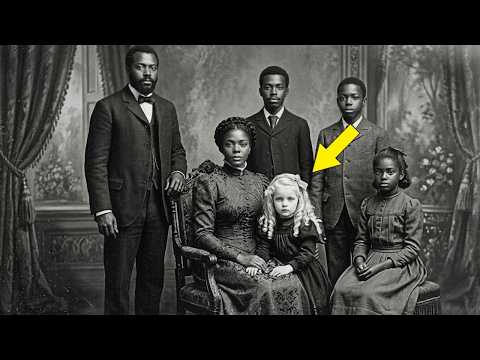
Dr. Rebecca Torres, a photography historian at Duke University, was six months into digitizing 19th-century Southern photography when she opened catalog file 3847. It was late February 2025, nearly midnight, and she was working through the final boxes of a recently acquired Atlanta collection. The photograph appeared routine at first—a prosperous black family, formal studio setting, Victorian era. She began filling out the standard documentation form, estimated date, photographic process, probable location. Then she adjusted the screen brightness to examine details more carefully.
Her fingers stopped moving across the keyboard. She stared at the monitor for several long seconds, then leaned closer, squinting. She zoomed the image to 200%, then 400%.
“That can’t be right,” she whispered.
The family was unmistakably African-American—the parents, the three older children, all clearly black. Their clothing was expensive, their posture dignified. But the youngest child, seated centrally in the mother’s lap, appeared to be white. Not light-skinned black, not biracial—white. Even in the sepia tones of 1890s photography, the contrast was impossible to miss.
Rebecca had studied historical photography for 15 years. She understood the technical limitations of 19th-century cameras, the ways aging and chemical processes could alter images. This wasn’t any of those things. The image quality was excellent. There was no evidence of retouching, composite work, or multiple exposures. The lighting was consistent across all subjects. This was a genuine, unaltered photograph of six people posed together. Five black, one apparently white.
Rebecca’s mind raced through possibilities. Adoption? But interracial adoption by black families in 1897 Georgia would have been virtually impossible and certainly dangerous. A neighbor’s child? Why would a formal, expensive studio portrait include someone else’s child, positioned so intimately in the mother’s arms? A photographic error? No, the positioning, lighting, and focus were too perfect.
She saved the file and marked it for priority research. Whatever this photograph was, it wasn’t routine. It was a puzzle that had apparently stumped everyone who’d seen it for over a century. And Rebecca Torres intended to solve it.
The photograph had almost no identifying information. The studio mark in the bottom corner read J. Morrison and Sons Photographers, Atlanta, Georgia, a well-known establishment that operated between 1885 and 1903. The clothing styles and photographic paper suggested a date between 1895 and 1899. But there were no names, no written notations, nothing to identify who these people were.
Rebecca contacted the estate executor who donated the collection. The photographs had belonged to Ernest Whitfield, a retired pharmacist who’d spent four decades collecting African-American historical materials before his death at age 93.
“Uncle Ernest never cataloged most of it properly,” his niece explained during their phone conversation. “He just collected whatever he could find. Always said too much black history was being destroyed or thrown away. So he saved everything he could get his hands on.”
Rebecca asked whether any documents, correspondence, or records might identify the families in the photographs. The niece promised to search through remaining boxes before the estate auction.
Three weeks later, a package arrived at Duke. Inside were a handwritten receipt, a studio appointment book, and a fragile envelope of customer correspondence. The receipt, dated October 12th, 1897, listed Washington family, six persons, formal sitting, four prints ordered, $8.50, paid in full. Washington—a surname, but no first names. The appointment book was more revealing. On October 12th, 1897, 2 p.m., Washington, proprietor, Auburn Avenue Tailoring Establishment, family portrait commission.
Rebecca’s pulse quickened. Auburn Avenue. In 1897 Atlanta, that was the heart of black economic success—the street where black-owned businesses thrived despite the increasing brutality of Jim Crow laws. If the Washingtons owned a tailoring business on Auburn Avenue, there would be city records.
She spent the next week immersed in Atlanta archives—business directories, tax records, property deeds, commercial licenses. Finally, she found it. Thomas Washington, proprietor, Washington and Sons Fine Tailoring, 127 Auburn Avenue, established 1889. Cross-referencing with census records, she assembled the family structure. Thomas Washington, born 1855. Wife Ruth, born 1858. Four children listed in the 1900 Federal Census: David, age 16; Samuel, age 13; Grace, age 11; Clara, age 9. Clara, born approximately 1891, which would make her about six or seven in an 1897 photograph. The youngest child—the position matched.
But it still didn’t explain the central mystery. Why did Clara Washington, daughter of two black parents, sister to three black siblings, appear white in this photograph? Rebecca knew she needed to find out who Clara was, and more importantly, what had happened to her.
Rebecca began building Clara Washington’s life story from fragmentary records, searching for any clue that might explain the photograph’s mystery. Atlanta city directories showed the Washington family’s stability and success. Thomas Washington’s tailoring business appeared in every directory from 1889 through 1904, with advertisements describing fine custom garments for distinguished gentlemen, and later ladies and children’s specialty tailoring. Church records from Big Bethel AME Church, one of Atlanta’s oldest and most prominent black congregations, listed the entire Washington family as members. Clara’s baptism record, dated April 1892, confirmed her birth: Clara Marie Washington, daughter of Thomas and Ruth Washington, born February 14th, 1891.
The 1900 census showed the family living in a purchased home on Bell Street, just off Auburn Avenue—a substantial two-story residence valued at $2,800, an impressive sum for a black family in that era. But nowhere in these routine records was there any explanation for Clara’s appearance.
Rebecca expanded her search into medical and institutional records, looking for any mention of unusual children, genetic conditions, or families dealing with medical anomalies. What she found chilled her. In the Georgia State Archives, she discovered reports from the state sanitarium and various county poorhouses from the 1890s. Several entries referenced abnormal negro children who’d been surrendered by families or removed by authorities—children with physical differences, disabilities, or appearances that deviated from expectations. One entry from 1896 made Rebecca’s stomach turn: Female child, approximately 4 years, negro parents, unusual pigmentation, surrendered to institution by family, county unknown.
The language was clinical and cruel. These children were treated as curiosities, defects, shameful secrets to be hidden away. Yet Clara Washington hadn’t been hidden. Rebecca found her name in the 1899 Sunday School enrollment at Big Bethel: Clara Washington, age 8, intermediate class. She was attending church openly, participating in children’s programs. In 1902, Gate City Colored School records listed Clara as a student, though with an unusual notation: modified attendance schedule, supplementary home instruction approved by administration. The school had made accommodations for her, but she was enrolled. She was being educated. She was part of the community.
Whatever Clara’s condition was, her family wasn’t hiding her. They were raising her openly in a society that typically punished difference with violence or institutionalization. But Rebecca still didn’t know what that condition was. The photograph showed the visual evidence, but without medical expertise, she couldn’t interpret what she was seeing. She needed a specialist—someone who could look at a 128-year-old photograph and diagnose a mystery that had remained unsolved for over a century.
Rebecca contacted Dr. James Mitchell, a geneticist at Emory University whose research focused on hereditary conditions and their historical documentation. She sent him the digitally enhanced photograph without explanation, asking simply, “What do you see when you look at this child?”
His response came within two hours. “Where did you find this? I need to know everything about this image.”
They met the following afternoon in his office. Dr. Mitchell had already printed the photograph in high resolution and pinned it beside modern clinical images on his bulletin board.
“This isn’t a white child,” he said immediately, pointing to Clara’s figure. “This is a black child with complete oculocutaneous albinism.”
Rebecca felt her breath catch. “Albinism?”
“Look at the characteristics,” Dr. Mitchell explained, his finger tracing Clara’s features. “The dramatically reduced pigmentation—not just lighter skin but near-total absence of melanin. The very light hair, probably white blonde or platinum. And if we could see her eyes in color, they’d almost certainly be blue or gray with visible red reflex from light hitting the retina.” He pulled up clinical photographs on his computer. “Oculocutaneous albinism is a genetic condition affecting melanin production. It occurs in all populations, including people of African descent. In black individuals, the contrast is particularly dramatic—exactly what we’re seeing in this 1897 photograph.”
Rebecca stared at the image with new understanding. So she wasn’t a white child in a black family. She was their biological daughter with a genetic condition.
“Exactly, and that makes this photograph historically extraordinary.” Dr. Mitchell’s voice carried intensity now. “Do you understand what it meant for a black family in 1897 Georgia to have a child with albinism and raise her openly?” He pulled up research files. “People with albinism, especially black children with albinism in the Jim Crow South, faced horrific discrimination. They were called ghost children, cursed, unnatural. Many communities believed they were supernatural beings or evidence of sin. Families typically hid these children completely—or worse.”
“Worse?” Rebecca asked quietly.
“Abandonment, institutionalization, in some cases infanticide.” Dr. Mitchell’s expression was grim. “There are documented cases of black children with albinism being killed by their own communities out of superstition and fear.” He turned back to the photograph. “But here’s Clara Washington, posed formally with her family in an expensive studio portrait, dressed beautifully, held lovingly by her mother, included as an equal with her siblings.”
“Her family was protecting her,” Rebecca said.
“Her family was saving her life,” Dr. Mitchell corrected, “and documenting it for history.”
With the medical mystery solved, Rebecca needed to understand the world Clara lived in—the specific danger she faced beyond the general brutality of Jim Crow segregation. Dr. Mitchell explained the medical challenges first. Albinism causes severe photosensitivity. Clara’s skin would have burned within minutes of direct sun exposure. In Georgia’s climate, without modern sunscreen or UV-protective clothing, she would have needed to stay indoors most of the time or cover completely when outside. “Her vision would have been significantly impaired,” he continued. “Nystagmus—involuntary eye movement—severe nearsightedness, extreme light sensitivity. In bright conditions, she might have been functionally blind. There were no treatments available in the 1890s, no corrective lenses that could help, no low-vision aids. But the social dangers were even more severe.”
Rebecca found newspaper archives from 1890s Atlanta filled with pseudo-scientific racism, eugenics propaganda, and articles treating any physical difference in black people as evidence of inferiority. The Atlanta Constitution regularly published pieces promoting white supremacy and describing black Americans in dehumanizing terms. In this environment, a black child who appeared white would have been dangerous on multiple levels. White supremacists might have seen Clara as evidence of racial contamination or degeneracy, potentially targeting her family with violence. Black communities, influenced by African spiritual beliefs carried through slavery, sometimes viewed albinism as supernatural or cursed, leading to ostracism or worse.
Rebecca found a chilling article from the Savannah Tribune, a black newspaper, dated 1893: “Tragic Death of Unusual Child.” The brief report described a 6-year-old with white appearance born to colored parents who died under suspicious circumstances in rural Georgia. The article implied the death wasn’t accidental but didn’t elaborate.
This was the reality the Washingtons navigated. Yet they’d not only kept Clara alive, they’d brought her to a public photography studio, posed her prominently in their family portrait, and ordered multiple prints to display. Rebecca found the studio’s advertising from 1897. Morrison and Sons was one of Atlanta’s premier photography establishments, serving both white and black clients in separate sessions. A sitting cost $8.50—nearly a week’s wages for most workers. The Washingtons had spent significant money to create a formal document declaring Clara’s place in their family. In an era when most families with children like Clara hid them completely, this was an act of defiance.
But how had they protected her? How had Clara survived childhood when so many others didn’t? Rebecca needed to find evidence of the family’s protective strategies. She began searching for clues about how the Washingtons kept Clara safe while raising her openly. She found evidence in unexpected places.
A classified advertisement in the Atlanta Independent, a black-owned newspaper, from March 1898: Washington & Sons Tailoring, now offering ladies and children’s garments, specializing in lightweight fabrics with superior coverage and comfort for summer wear. Rebecca understood immediately. Thomas Washington had expanded his business to create protective clothing for Clara—long sleeves, high collars, tightly woven fabrics that would block ultraviolet light. And he’d made it a general service, so it wouldn’t draw attention specifically to his daughter’s needs.
The 1900 census revealed another layer of protection. The Washington household included Ruth’s unmarried younger sister Anna, aged 34, listed as residing with family, occupation domestic duties. But cross-referencing with church records showed Anna taught Sunday school and coordinated children’s programs. Anna wasn’t just living with them—she was Clara’s full-time caretaker and guardian.
Property records from 1895 showed the Washingtons had carefully chosen their home: a two-story house on Bell Street with covered front and rear porches, mature shade trees on the property, northern exposure. They’d selected a house where Clara could be outside safely, protected from direct sunlight by shade and covered spaces.
The modified school arrangement Rebecca had found earlier now made more sense. Gate City Colored School’s 1902 records showed Clara attending classes early morning and late afternoon sessions only, with approved home instruction supplement. The school administrators had worked with the family to create a schedule that allowed Clara to attend when the sun was less intense, while providing additional education at home during peak daylight hours.
Rebecca found one more crucial detail in Big Bethel AME Church records. A notation from 1899 stated that special provisions made for Washington family seating, north side, shaded location, accommodation approved by council. Even the church had adapted its space to protect Clara, giving the family a permanent seat where she could attend services without sun exposure through the windows.
The pattern was unmistakable. The Washingtons had built an entire infrastructure around Clara’s needs, using their business success and community standing not to hide their daughter, but to create a life where she could participate safely. And their community—their church, their school, their neighbors on Auburn Avenue—had helped them do it. This wasn’t just one family’s love story. It was evidence of a broader network of black Atlantans who chose protection and inclusion over the prejudice that dominated the society around them.
Rebecca knew that finding Clara’s own words would be nearly impossible. Most black women from this era left few written records. And someone with Clara’s medical challenges would be even less likely to appear in historical documents. But she searched anyway. She contacted the Atlanta University Center Archives, explaining what she was looking for: anything related to Clara Washington, born 1891, who would have been a young woman in the 1910s.
The archivist called back four days later, excitement clear in her voice. “I found something. Not much, but it’s definitely her.”
Rebecca drove to Atlanta that afternoon. The archivist led her to a temperature-controlled reading room and carefully placed a worn ledger on the table. “This is from the Phyllis Wheatley YWCA, which served black women and girls in Atlanta from 1910 through the 1960s. They offered classes, cultural programs, and social activities.” She opened the ledger to a marked page. In the attendance records for a 1913 poetry reading series: Clara M. Washington, age 22. “She participated in their programs,” the archivist continued, flipping through pages. “1914, music appreciation course. Here, 1915, member of the literary discussion group. She was active in their social and cultural activities.”
Rebecca felt tears forming. Clara had lived a social life as a young woman. She hadn’t been isolated or hidden. Then the archivist pulled out a slim folder. “This is what I really wanted to show you.” Inside was a single sheet of paper—a handwritten contribution to the YWCA’s 1916 newsletter titled On Being Seen. The author: C. M. Washington.
Rebecca read carefully, her hands trembling slightly:
There are days when the sun feels like an enemy, when the brightness of the world forces me to retreat inside. When I must experience life through windows instead of directly. But I have learned this truth: Being seen is not the same as being visible. My family sees me—not my difference, but my soul. My community sees me—not as strange, but as their daughter, their sister, their neighbor. I see myself not through others’ fear or curiosity, but through the love that has surrounded me since my first breath. That love taught me I belong in this world, even when the world was not built for people like me.
Rebecca sat motionless, reading Clara’s words again and again, understanding that she’d found something precious: direct testimony from a woman who shouldn’t have survived, speaking across 109 years.
Armed with Clara’s own voice from 1916, Rebecca intensified her search for records of Clara’s adult life. If she’d been active in the YWCA and writing for their newsletter in her mid-20s, there had to be more. She found it in the Atlanta City Directory. 1918: Washington, Clara M. Music instructor, residence 127 Auburn Ave. Music instructor. Clara had become a teacher.
Rebecca requested employment records from the Atlanta Public Schools archives. What arrived astonished her. Clara Marie Washington had been employed from 1917 to 1949—32 continuous years—as a music teacher in schools serving black children throughout Atlanta. The records showed she taught piano, music theory, vocal training, and directed student choirs. Rebecca understood the brilliance of this choice. Music instruction happened indoors, often in interior rooms or basements where light was minimal. Piano teaching was conducted one-on-one or in small groups, not requiring a teacher to see clearly across large spaces. Clara had found a profession perfectly suited to her medical limitations while allowing her to contribute meaningfully to her community.
Then Rebecca discovered a photograph in a 1924 issue of the Atlanta Daily World, the city’s black newspaper. The image showed the faculty of Gate City Colored School—the same institution Clara had attended as a child with special accommodations. There, in the second row, stood a woman wearing a wide-brimmed hat and long sleeves despite the apparent summer heat. Clara Washington, age 33, now teaching at the very school that had welcomed her as a student.
More evidence emerged. A 1932 church program from Big Bethel AME listing Clara Washington as director of the children’s choir. A 1938 photograph of a student piano recital showing Clara seated at the instrument, her face turned slightly away from the camera to avoid the bright flash. The 1940 census listed Clara living with her widowed mother, Ruth, now age 82. Clara’s occupation: teacher, public school system.
So Clara had never married or had children—likely a deliberate choice, understanding the genetic nature of albinism and the challenges of her own experience. But she’d built a life of purpose, service, and community contribution. She’d done more than survive in a world that told her she shouldn’t exist. She’d thrived, touched hundreds of lives through her teaching, and carved out a space of dignity and respect in a society built to deny her both. The girl in the 1897 photograph had grown into a woman of quiet, powerful resilience.
Clara’s death certificate from 1970 listed metastatic melanoma—a cruel fate for a woman whose life had been defined by avoiding the sun. But the document also revealed something remarkable: she had outlived her parents, her siblings, and 78 years in the same house on Bell Street. Her will left a scholarship fund for music students facing unusual challenges, a legacy that supported 23 young people before being absorbed into the church’s larger program.
Among her possessions was the 1897 photograph, kept framed for 73 years. It had hung in her home as a silent testament to the family who chose love over fear. After her death, the photograph passed through dealers and collectors until it reached Duke’s archives—where Rebecca finally unlocked its secret.
Rebecca’s research, published in 2025, won the Medical Humanities Award and became required reading in genetic counseling and disability studies programs. Clara’s essay, “On Being Seen,” was reprinted in anthologies, and her story inspired a permanent scholarship at Big Bethel AME Church.
At the memorial service, Rebecca stood before the enlarged photograph. “For 128 years, people saw this image and couldn’t understand what they were looking at,” she said. “Now we know: we were looking at courage. At a family that built a community of protection around their daughter, and gave Clara Washington a life she never should have been able to live in Jim Crow Georgia.”
Diane, Clara’s great-great-niece, flew to Atlanta and stood before the portrait. “I wish I’d known her,” she whispered. “But now I know our family chose love when the world chose hate.”
The mystery is solved—but it leaves us with a question: How many other silent photographs hold stories of extraordinary love and resilience, waiting for someone to finally see?
Report this article
Select a reason for reporting:






