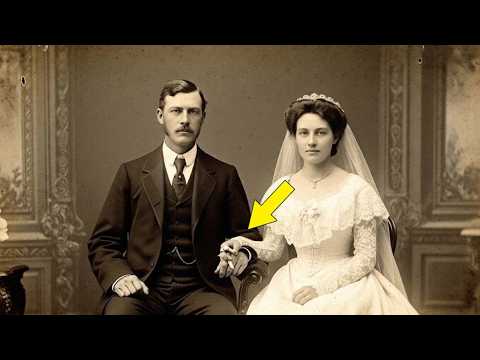
Dr. Sarah Mitchell had cataloged thousands of Victorian portraits, but the moment she lifted the ornate wooden frame from a dusty corner of the Hartford Historical Society, something felt different. The sepia-toned image from 1903 showed a stern groom and his bride in an elaborate white gown—typical for the era, when long exposures made smiling impractical. Yet as late afternoon sunlight hit the glass at just the right angle, Sarah’s breath caught. There, barely visible but unmistakable, was a subtle upturn of the bride’s lips—a genuine smile that defied every rule of 1903 portrait etiquette.
Her pulse quickened. In an era when formal wedding photos demanded stoic dignity, this bride was sharing a secret with the camera. Sarah adjusted her magnifying glass, her heart hammering. “That can’t be right,” she whispered to the empty archive room. But the evidence was undeniable: Elizabeth, the bride, was smiling—and something about that smile spoke not of joy, but of barely contained terror.
Sarah barely slept that night. By morning, she was buried in Hartford’s main library, cross-referencing wedding announcements from June 1903. Nothing matched a Thomas and Elizabeth married on the 15th. She expanded her search to church records, where Reverend Williams at Trinity Episcopal paused at her question about unusual circumstances. “There were occasionally marriages that weren’t, shall we say, conventional,” he murmured. “Such ceremonies might have been conducted quietly with minimal documentation.”
Back at the Historical Society, Sarah carefully removed the photograph from its frame. Tucked between the image and the backing was a small, yellowed note. Her hands shook as she unfolded it. “My dearest Thomas, by the time you read this, I will be far from Hartford. The photographs must tell the story I cannot. Look for what others cannot see. Remember our signal. Forever yours, A.”
“Our signal.” The words echoed in Sarah’s mind. She examined Elizabeth’s left hand, partially hidden by lace. The fingers were positioned oddly—not the formal placement expected in wedding portraits. Sarah photographed the hand and began researching Victorian sign language. In a 1902 etiquette book, she found it: a finger telegraph, a discreet hand signal used by women to convey messages. Elizabeth’s finger position matched a warning: help or not what it appears to be.
Sarah leaned back, the implications washing over her. This wasn’t a celebration. It was a desperate woman’s attempt to leave evidence of something terrible. Elizabeth’s smile wasn’t joy—it was a brave mask covering fear, and her hidden hand signal was a cry for help that had gone unnoticed for over 120 years.
Armed with the note, Sarah expanded her search to missing person reports. At the Hartford Police Department’s historical files, Officer Martinez pulled out a thick folder from 1903. There it was: Elizabeth Hayes, age 23, reported missing by her sister Margaret on July 20th. Last seen July 15th. Family reports unusual behavior in weeks prior to disappearance.
The address led Sarah to a Victorian house on Asylum Street, now converted into apartments. The owner, Robert, allowed her to search the attic, where she found a small wooden trunk. Inside was Margaret Hayes’s diary. Sarah’s hands trembled as she read the entries from summer 1903.
June 16th: “Elizabeth returned from her wedding ceremony changed. She smiles when she thinks no one is watching, but her eyes hold fear. She begs me not to ask questions about Thomas.”
July 14th: “Elizabeth came to me tonight in great distress. She said Thomas was not who he claimed to be and that she had discovered something that put her in danger. She asked me to keep a photograph—she said it would explain everything if something happened to her.”
Sarah’s heart raced. Elizabeth’s smile in the portrait wasn’t capturing joy—it was the brave face of a woman documenting evidence of danger, knowing it might be the last record of her existence. But who was Thomas? And what had Elizabeth discovered?
The answer came from an unexpected source: a 1903 Hartford City Directory listing for Thomas Miller, private detective, with an office just three blocks from where Elizabeth had been secretly living. A museum curator explained that private detectives of that era often operated in a gray area—sometimes helping families, sometimes working for whoever paid. “There were also cases involving blackmail,” he said. “Investigators might be hired either to prevent it or to facilitate it.”
Sarah’s stomach tightened. Could Elizabeth have been a target rather than a willing bride? Her research revealed that Thomas Miller had died in September 1903—a suspicious fall from a moving freight car while investigating a case involving missing documents. The timing was chilling: just two months after Elizabeth’s disappearance.
Then Sarah found it: a series of articles about a major embezzlement scandal at Hartford National Bank. In May 1903, $50,000 had vanished—over $1.5 million today. The bank’s president had hired private investigators, and one of them was Thomas Miller. Sarah’s pulse quickened as she pieced together the timeline. Elizabeth worked as a secretary at that very bank.
She returned to Margaret’s diary and found the entry she’d missed: “Elizabeth has secured a position as a secretary at Hartford National Bank. She is quite excited—the work is respectable for a young woman.”
Sarah’s heart raced. Elizabeth had access to records, transactions—information that could identify the real thief. If she had discovered something that contradicted Thomas’s investigation, or worse, if she had evidence that Thomas himself was involved, her life would have been in serious danger.
The wedding portrait began to make perfect sense. Thomas had used a fake marriage ceremony to gain Elizabeth’s trust. Elizabeth, realizing she was in danger, had used the portrait session to document evidence—her forced smile hiding fear, her hand signal calling for help, her note pointing toward the truth.
But Sarah needed confirmation. She delved deeper into the bank scandal coverage and found a breakthrough article from August 1903. The missing money had been traced to forged documents—and the evidence pointed not to a bank employee, but to someone with intimate knowledge of the bank’s procedures. The bank president was quoted: “The individual we trusted to find the thief appears to have been the perpetrator himself.”
Sarah’s theory was correct. Thomas Miller hadn’t been investigating the embezzlement—he had been committing it, using his role as a private detective to forge documents and steal the money. But Elizabeth had figured it out. As a bank secretary, she could have spotted the discrepancies.
The final piece came from a September 1903 police report. After Thomas’s death, police searched his office and found $30,000 hidden in a false drawer, along with forged bank documents bearing Elizabeth’s signature. The report noted: “Evidence suggests Miller forced Miss Hayes to sign documents authenticating his fraudulent transactions. Her disappearance likely occurred when she threatened to expose his scheme. Miller’s death appears to be suicide.”
Sarah leaned back, overwhelmed. Elizabeth hadn’t been Thomas’s willing bride—she had been his victim, coerced into helping with his scheme, then eliminated when she became a threat. The wedding portrait wasn’t a celebration. It was Elizabeth’s desperate attempt to leave evidence, knowing Thomas intended to silence her permanently.
But Sarah’s work wasn’t finished. She felt a deep responsibility to ensure Elizabeth’s story was told. She prepared a comprehensive report and contacted the Hartford Courant. The editor, Maria Rodriguez, was fascinated. “This is exactly the kind of historical mystery our readers love,” she said. “But more importantly, it’s a story about a woman who showed incredible courage in impossible circumstances.”
Sarah also reached out to genealogy websites, hoping to find living descendants. Her search led to Patricia Hayes, a great-great niece in Boston who had always wondered about the family stories of an ancestor who disappeared mysteriously. “We always heard whispers about Aunt Elizabeth,” Patricia said. “My great-grandmother used to say that Elizabeth had tried to help catch a bad man but got in trouble for it. I never knew if it was true.”
Patricia traveled to Hartford to see the portrait. Standing in the historical society, looking at Elizabeth’s photograph with new understanding, she wiped away tears. “She was so young,” Patricia whispered, “but she was trying to do the right thing, even when it put her in danger.”
Sarah arranged for the portrait to be properly preserved and displayed at the Hartford History Museum with a plaque telling Elizabeth’s complete story. As she looked at Elizabeth’s portrait one final time before it was moved, she marveled at how one woman’s desperate message, hidden in plain sight for over a century, had finally revealed the truth. Elizabeth’s smile, once a mystery, now stood as a testament to her bravery—a reminder that sometimes the most ordinary photographs hold the most extraordinary stories, waiting for someone willing to look closely enough to see what others had missed.
On the day the exhibit opened, Sarah stood beside Patricia Hayes in front of the portrait. The plaque beneath Elizabeth’s image read: “She spoke through a smile when silence was demanded.” Visitors paused, leaning in to study the faint curve of the bride’s lips and the hidden hand signal. “People keep asking if the smile is really there,” Patricia said, wiping her eyes. “I tell them: it always was. We just weren’t looking.”
Maria Rodriguez’s feature ran the following Sunday, and within a week the museum had received dozens of letters—from historians, from women’s groups, from strangers who felt they knew Elizabeth. One envelope contained a single pressed violet and a note: “Thank you for not letting her disappear twice.”
Sarah returned to her archive room that evening, the lamp humming softly over a fresh stack of uncatalogued photographs. Somewhere in those dusty boxes were more faces frozen in careful stillness, more secrets folded into cardboard backing. She picked up the next portrait, tilted it toward the light, and began to look.
Because that was the lesson Elizabeth Hayes had left behind for anyone patient enough to receive it: history doesn’t whisper its truths to those who merely glance—it waits for those who look.
What hidden story do you think is waiting in the oldest photograph your family has ever kept?
Report this article
Select a reason for reporting:






