April 1941, Tobruk, Libya. Major General Leslie Morshead stood on the dusty ramparts of the ancient fortress, counting the enemy positions surrounding his men. 14,000 Australian soldiers were trapped inside this crumbling coastal town, and the desert horizon was filled with German and Italian forces. Intelligence reports said 25,000 enemy troops had them encircled. The numbers were clear and terrifying: for every Australian defender, there were nearly two enemy soldiers waiting to attack.
The morning sun beat down on the sand-colored walls as Morshead watched German tanks rolling into position just three miles away. These were not ordinary German forces. This was the Afrika Korps led by General Erwin Rommel himself—the man the newspapers were calling the Desert Fox. Rommel had swept through North Africa like a sandstorm, crushing every Allied force in his path. Now his troops had cut off all land routes to Tobruk. The only way in or out was by sea, and German planes bombed the harbor every single day.
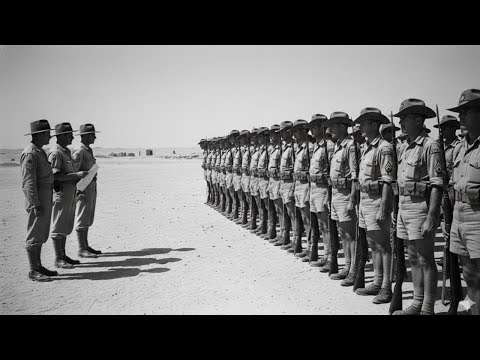
The situation was worse than just being surrounded. Tobruk held the only deep-water port between Egypt and Tunisia—a distance of over 1,000 miles. Without this port, the British could not supply their armies fighting in the desert. If Tobruk fell, Rommel could push straight into Egypt, capture the Suez Canal, and cut off Britain’s connection to India and the Pacific. The stakes were enormous. Everything depended on this dusty fortress town holding out.
British high command in Cairo had already sent their orders. The message was simple and direct: Defend Tobruk. Hold at all costs. Wait for relief forces to arrive and break the siege. The standard military textbook said that surrounded troops should dig in, conserve their supplies, and minimize casualties while waiting for rescue. This was how sieges had been handled for hundreds of years. Build strong defensive positions, ration your food and ammunition, and pray that help arrives before you run out.
The problem was that this conventional wisdom was already failing. Just three weeks earlier, Rommel had surrounded a British garrison at a place called Mechili. Those troops followed the textbook perfectly. They dug trenches, built strong defenses, and waited for relief. Rommel attacked them for exactly one day before they surrendered. 3,000 British soldiers became prisoners without firing more than a few shots. The defense collapsed not because the walls were weak, but because the men’s spirits broke first.
Now Rommel expected the same thing to happen at Tobruk—except faster. German intelligence officers had studied the Australian troops and wrote confident reports. These soldiers were volunteers from a country that had never fought a major war on its own. They had no experience with sieges. They were far from home, cut off from supplies, and faced an enemy with superior numbers and equipment. The German high command predicted Tobruk would fall within two weeks. Some officers bet it would take less than ten days.
Morshead read these intelligence reports that British spies had intercepted. He was 51 years old with gray hair and a weathered face that showed years of hard military service. Most people did not know much about him. He was not a famous general with medals covering his chest. He had been a school teacher before World War I, and during that war he fought in the bloody trenches of France. He survived four years of the worst fighting the world had ever seen. The experience taught him something that West Point and Sandhurst never put in their textbooks.
The other Allied commanders meeting in Cairo spoke with confidence about conventional siege defense. A British colonel with a crisp uniform explained the plan as if he were teaching a class. The Australians would build three defensive lines around Tobruk. They would place machine guns at regular intervals. They would dig deep trenches and string barbed wire across every approach. When the Germans attacked, the Australians would fire from these fixed positions and hold the line. Simple, proven, effective.
Morshead had listened to this plan and said nothing at first. He watched the other officers nodding in agreement. These were smart men with expensive educations from the best military academies in the world. They had studied famous sieges throughout history. They knew all about how the defenders of Constantinople held out for 53 days and how the French defended Verdun for nine months. But Morshead had actually lived through Verdun. He remembered what it felt like to sit in a trench for weeks waiting for the enemy to decide when and where to attack. He remembered the helplessness, the fear, the slow erosion of hope.
Back at Tobruk, Morshead called his senior officers together for a meeting. These were tough men who had sailed 12,000 miles from Australia to fight in a desert war. They expected him to repeat the orders from Cairo. Dig in, hold positions, wait for relief. Instead, Morshead spread a map across a wooden table and pointed at the German positions circling the town. His finger traced the enemy lines like he was planning an attack, not preparing a defense. Then Morshead said something that made every officer in that room go quiet. His words were simple, but they changed everything that would happen next.
He looked at his men and told them straight. “The Germans think we are going to sit here like scared rabbits waiting for them to pick us off one by one. They think we will hide in our holes and pray for rescue. They expect us to act like every other besieged force in history.” Morshead paused and let that sink in. Then he said the words that would define the next eight months. “We are not going to give them what they expect. We are not going to wait for them to attack us. We are going to make them regret ever surrounding us in the first place.”
Morshead’s plan was radical and simple at the same time. Instead of waiting behind their walls for the Germans to attack, the Australians would go out into the desert every single night and attack the Germans first. Not big attacks with thousands of men. Small raids with eight to twelve soldiers each. These tiny groups would sneak out after dark, move one to two miles into enemy territory, hit German positions hard and fast, then disappear back into the darkness before the enemy could respond.
The officers listening to this plan had serious doubts. A captain named Jack Edmondson raised his hand and asked the obvious question. “Sir, we have 14,000 men and they have 25,000. We are already outnumbered. How does sending our men out to attack them every night help us survive?” Another officer pointed out that night raids would use up ammunition and supplies they needed to save for the real battle. A third officer worried that losing men on these raids would weaken their actual defenses when Rommel launched his main assault.
Morshead listened to every concern. Then he explained the real mathematics of his plan. The Germans have us surrounded, which means their forces are spread out in a huge circle around Tobruk. That circle is 30 miles across. To cover all that ground, they have to split their men into dozens of small positions, each one isolated from the others. At night, each German position might have only 20 or 30 soldiers. Our raids will hit them when they are most vulnerable and most alone. We make them fear the darkness. We make them afraid to sleep.
The technical details of the raids were carefully planned. Each patrol would consist of exactly eight to twelve men—no more and no less. Fewer than eight, and the group would not have enough firepower. More than twelve, and they would make too much noise moving through the desert. The patrols would leave Tobruk between ten and eleven at night, when the desert was completely black. They would move on foot, covering the one to two miles to German lines in total silence. No talking, no smoking, no metal equipment that could clank or rattle.
Every patrol carried specific weapons for close combat. Each man had a rifle with a fixed bayonet. They also carried grenades, usually four per person. Some patrols brought small wire cutters to slip through German barbed wire without making noise. The goal was not to hold territory or capture prisoners. The goal was to kill or wound as many Germans as possible in five to ten minutes, then vanish before enemy reinforcements arrived.
The first test of this strategy happened on the night of April 13th. Morshead selected 24 men from the most experienced infantry companies. He split them into three patrols of eight men each. Their target was a German observation post about a mile and a half north of the main Australian defensive line. Intelligence reports said this post had 15 to 20 German soldiers watching the approaches to Tobruk during the day and sleeping in shifts at night.
Lieutenant William Sanderson led the first patrol. They left Tobruk at exactly 10:15 that night. The desert was pitch black with no moon. The men moved in single file, each soldier staying close enough to touch the man in front of him. The only sounds were boots crunching softly on sand and the distant rumble of German trucks moving supplies. It took them 45 minutes to crawl the last 300 yards to the German position. The Germans never saw them coming.
Sanderson and his men hit the observation post at exactly 11:30. Grenades flew through the darkness and exploded inside German tents. Australian soldiers rushed in with bayonets as confused Germans stumbled out of their sleeping bags. The fight lasted less than eight minutes. When it was over, six Germans were dead and four were wounded. The Australians captured maps, binoculars, and a radio before melting back into the darkness. They were back inside Tobruk by one in the morning. Not a single Australian soldier was killed.
The results from that first night shocked everyone, including Morshead. The three patrols had killed or wounded 23 German soldiers total. They destroyed two observation posts and one machine gun position. They captured valuable intelligence documents that showed exactly where German supply dumps were located. And they did all this while losing only two men wounded, neither seriously.
German commanders were furious and confused. A German captain sent an angry report to Rommel the next morning. The report said the Australians were not defending like normal besieged troops. Instead, they were attacking German positions every night like they owned the desert. The captain demanded more troops and better defenses because his men were terrified to leave their foxholes after sunset.
British high command in Cairo heard about the night raids and sent a message telling Morshead to stop immediately. A brigadier general wrote that these raids were wasting precious ammunition and risking lives for no strategic gain. The proper way to defend Tobruk was to conserve resources and wait for relief forces. Morshead read the message, filed it away, and ordered even more raids for the next night.
The one person who supported Morshead’s plan was General Thomas Blamey, the overall commander of Australian forces in the Middle East. Blamey had fought alongside Morshead in World War I and trusted his judgment. When other British officers complained about the night raids, Blamey defended them. He also arranged for British artillery units to provide covering fire when Australian patrols were returning to Tobruk. This support saved lives and made the raids more effective.
By the end of April, Morshead had 30 to 40 patrols going out every single night. That meant between 240 and 480 Australian soldiers were attacking German positions in the darkness. The patrols spread out across the entire 30-mile perimeter, hitting different targets each night, so the Germans could never predict where the next attack would come from. Some nights the Australians raided supply dumps. Other nights they attacked artillery positions or communication posts. Every morning, German commanders woke up to reports of more casualties and more damage.
The no man’s land between the Australian defenses and German lines became Australian territory after sunset. German soldiers stopped patrolling at night. They stopped setting up forward observation posts. They stayed huddled in their main defensive positions, afraid to venture out where Australian raiders might be waiting in the darkness. Rommel had surrounded Tobruk with his army, but somehow the Australians had turned the siege inside out. Now the Germans were the ones who felt trapped and afraid.
The numbers told a story military historians had never seen. In the first month, German forces around Tobruk suffered over 600 casualties from night raids alone. Before the raids, German commanders expected to lose maybe 50 men during the entire siege. They were wrong on every count.
Rommel tried to counter. On May 2nd, 120 German soldiers went hunting an Australian patrol. Three Australian patrols found them first. Twenty-eight Germans died in fifteen minutes of chaos. Rommel never ordered another large night patrol again.
By June, the Afrika Korps had lost over 2,000 casualties around Tobruk and achieved nothing. His officers called it the poisoned fortress. German soldiers fired at shadows, faked injuries, and begged for evacuation. The desert night belonged to the Australians.
After 241 days, relief finally broke through. The Rats of Tobruk marched out as heroes—and changed siege warfare forever. Active defense became doctrine from Korea to Vietnam.
Morshead died in 1959, largely forgotten outside Australia. But his lesson endures: you don’t survive by waiting to be defeated.
So here’s my question for you—when life has you surrounded, do you dig in and wait, or do you strike first?
Report this article
Select a reason for reporting:






